


Making Connections while Missing Connections


| Traveling as much as I do, I have learned that airports don’t have to be the worst, most stressful place to be during a delayed flight. Sure, I could wax poetic about my top five favorite airports and of course the least favorite airports, but I think anyone who flies has those lists ready for conversation. I am writing this post to highlight one particular occasion that occurred a few weeks ago and how it impacted not only my day and night, but most importantly my personal relationships at home. Those of you in the U.S., have probably heard about the Delta Airlines delays that affected the whole country in April of this year. If you didn’t hear about it, it might be due to the other airline controversies that took over the news. I fly pretty regularly and was headed home on a Thursday evening traveling from Atlanta to Boston. As soon as the weather turned for the worse earlier that day, the delays started piling up. When I arrived at the airport, my flight was already delayed and scheduled to leave 5 hours later so I figured I may as well make myself comfortable and get a bite to eat. As I walked into the Terminal, I saw more people and longer lines than I have ever seen in Atlanta (and that’s saying a lot for such a very busy airport), so I knew it was going to be a long night. I got through security and located my gate and the closest restaurant. As I sat down to order, I listened to all the chatter from everyone around me. Eventually, I ended up getting into a great conversation with the person sitting next to me. Within a few minutes, we found that we both had the same job title but at different companies in the Northeast. Immediately we shared business stories, some strategies about how we handle varying situations, and overall the conversation was going great. When we were out of business topics, we started talking about family and how we were both excited to get home to see them (whenever that may be due to the delays). It turned out that he and I had daughters of similar age (9 and 10). After going through some of our fun anecdotal stories, sharing pictures of our kids and so on, the conversation turned to a computer game called Minecraft - a virtual world where the player either joins in an existing location or builds their own version. Since I have an older son who played this years ago I was familiar with it, but had never understood the draw to it. I found the graphics weren’t nearly as nice as other games, the directions were sometimes difficult to understand, and overall I was unable to understand why my son was wasting so much time playing it. But my newly found friend had a whole different outlook. He saw tremendous benefits from this game and was more than happy to explain them to me. I was fascinated that there was so much more to it than I ever knew, such as how a young person can develop insights into their physical worlds as well as even some basic Project Management techniques. As the dinner ended and we parted ways, I knew I had to learn more about this game and see if my daughter knew anything about what he was talking about. Eighteen hours later as I arrived home, right about the same time my daughter did from school (yes, the flight delays were indeed brutal enough to push my arrival home by a day), I started asking questions about the game. I was mesmerized by how much she knew and how to play it. She has a whole virtual world she created and plays in with a good friend. Since that day, she has even creatively built a house out of blocks to my specifications in her virtual world. If you have gotten this far into my article, you may be wondering, “Why is he writing this story?” Here’s why: it made me realize missed or delayed airline connections provide an opportunity to make many other valuable connections. Since that adventure, I now regularly listen to my daughter explain her virtual world, its latest “crisis” and how she plans to address it. Just this morning she was trying to save one of her virtual animals from falling off of a cliff! It saddens me that I can’t take back all the time years ago when I naïvely dismissed my son’s interests in Minecraft rather than using it to become closer to him and learn more about his character. It has certainly opened a whole new connection between my daughter and me. Those of you with young, inquisitive children the age of mine know it is sometimes difficult to get beyond one-word answers when trying to connect or engage in discussion. . My daughter and I now discuss the challenges and happiness she experiences in her virtual world, giving me insights I would never have gained otherwise. I have the feeling the same is true for her. So, the next time you miss an airline connection and are trying to pass the time, I hope you too are able to make a new connection, learn from that temporary travelling colleague and then apply the lesson with someone much closer to you at home. You never know how it may change your life - it changed mine! |
Project Failure or Organizational Failure?
|
We asked the audience, "Please stand if you can say all of your projects delivered full scope, on time and within budget?" How many do you think stood up in a room of about 80 people, almost all of whom were project managers? Would you guess 50%? 20%? 10%? 5%? 1%? 0% is the correct answer. Was it because everyone was too shy to stand to receive a round of applause for such an unusual accomplishment? Or was it really because 80 projects managers had never had a successful project as measured by iron triangle factors? We then asked those who did not stand (everyone) to discuss with the person next to them what might be common reasons for such failure and to share with us. Responses included weak sponsorship, inadequate executive support, unskilled teams, and so on. You can probably add a few yourself. Or, maybe you can say that all of your projects were roaring successes. If so, please tell us what made them so. We had a great time presenting. The crux of our presentation was that project failure is often a misnomer. That is, project failures can often be attributed to organizational failure, and that failures can be reduced and even avoided by using portfolio, program, project management methods within a projectized organization. Project selection based on business goals and available budget has a much greater chance of producing successful projects. It makes decisions more transparent and more business goal-based. We were fortunate to be interviewed by Kristin Jones a few hours after our session. You can probably tell that we had a lot of fun. Have you found that external factors negatively impact your projects, sometimes more often than factors internal to your projects? Do you feel that sometimes projects are blamed for what might be a failure in leadership on the part of the organization? We'd love to hear your opinions.
|
 I was privileged to present with my friend and colleague Majeed Hosseiney on May 2nd at the PMI EMEA Congress in Rome on the topic of leadership in organizations as it applies to the project environment. The gist of our presentation was that we have a tendency when a project fails to shine a light on the indicators we watch as project managers - the famous iron triangle. That is, we look within the project to find reasons for failure, and not so often outside the project.
 Fear or Love? / ¿Miedo o Amor?
| Fear or Love? Organizational Culture and Servant Leadership While reading Catalin Teodor’s post “Now, we are free”, I asked myself how many organizations promote a servant culture within the ranks of their leaders. I believe, as Catalin mentioned, that most leaders feel they lose their power being servant leaders, taking care and being worried about the welfare of their collaborators. As an example, I recall the CEO of Enel Italian Group, Francesco Starace's response to a student at the Luiss Business School who asked him how to encourage people to adopt changes made in his organization. I understand there is not a servant leadership culture in Enel; on the contrary, their organizational culture is based on fear. Starace's answer to the student was "To achieve change you must inspire fear." He added: "First, you have to locate the ganglia - centers of power – that are contrary to the change, and hit on them to create fear and discomfort." While these comments were repudiated by the international press, there are many organizations that work that way. On the other hand, and fortunately, there are also stories of great leaders, who have generated extraordinary results in their organizations through leadership centered on the well-being of the people, using a style that has much in common with servant leadership: humility, care and concern for the well-being of others. Examples of these leaders are Herb Kelleher and Colleen Barrett, who have created low-cost Southwest Airlines in Texas, having had to overcome the attacks of the big airlines who were threatened by them, and that today has more passengers being carried on domestic flights in the United States than any other. Herb Kelleher and Colleen Barrett's leadership approach is "Employees come first," where leaders take care of employees, make sure they feel good, have what they need to do their jobs, and are supportive of their personal lives. Just to imagine how strong the organizational culture of Southwest Airlines is, consider that the company's stock is called "LUV". In addition, we can cite the case of Richard Branson, founder of Virgin Group, with more than 360 companies, who also imposes a culture in its companies that focus on employees. In an interview, Branson stated, "If the person who works in your company is 100% proud of the brand, and you give them the tools to do a good job and treat them well, they will be happy." Branson says that to make sure his employees are treated well, he collects feedback by walking through the cabin and talking directly to staff during Virgin flights. Another similar and very interesting example is Vineet Nayar, an Indian executive, former CEO of HCL Technologies and author of the best-selling book "Employees First, Customers Second: Turning Conventional Management Upside Down", who managed to converse every year with each one of the 89,000 employees, asking them about their problems and giving them answers. And it is not uncommon for these people-centered companies to have such good results, as studies show that the culture of the organization, and especially how people feel caring the climate of the company, can improve business performance by up to 30%. Renowned leadership expert and famous TEDx's speaker, Simon Sinek, whom we were lucky enough to hear as a keynote speaker at the PMI North America Leadership Institute Meeting in San Diego in September 2016, expressed that leaders must create an environment of care, protection, and trust so that the employees feel safe. Otherwise, people spend their energy on covering their backs, rather than investing in teamwork and production. I believe that, if organizations had this in mind, we would have more servant leaders and few"based on fear" leaders. Who would you rather work for? Caring leaders who increase company profits by keeping their workforce content, happily focusing on customer satisfaction? Or leaders who feel a need to instill fear and crush opposition to their views? En Español: ¿Miedo o Amor? La Cultura Organizacional y el Liderazgo Servicial Mientras leía el post “Now –we are free” de Catalin Teodor, me preguntaba cuántas organizaciones promueven la cultura de servicio en sus líderes. Creo, tal como menciona Catalin, que la mayoría de los líderes siente que pierde poder siendo el servidor, sirviendo y cuidando a sus colaboradores. Por ejemplo, recuerdo la respuesta del CEO del Grupo Italiano Enel, Francesco Starace, a un estudiante de la Luiss Business School, que le preguntó cómo lograr que las personas de su organización adopten los cambios. Entiendo que en Enel no hay una cultura de liderazgo servicial, por el contrario, la cultura organizacional está basada en el miedo. La respuesta de Starace al estudiante fue “Para lograr el cambio tienes que inspirar miedo”. Y agregó el directivo que “Primero hay que localizar los ganglios –centros de poder- que se opongan al cambio y pegarles para crear miedo y disconfort”. Si bien estos comentarios tuvieron repudio por parte de la prensa internacional, hay muchas organizaciones que funcionan de esa forma. Por otro lado, y por fortuna, también hay historias de grandes líderes, que han generado resultados extraordinarios en sus organizaciones a través un liderazgo centrado en el bienestar de las personas, donde se aprecia un estilo que tiene mucho en común con el liderazgo servicial: humildad, cuidado y preocupación por el bienestar de los demás. Ejemplos de estos líderes son Herb Kelleger y Colleen Barrett, quienes han creado la compañía aérea low cost de Texas, Southwest Airlines, la cual tuvo que vencer los ataques de las grandes líneas aéreas que veían una competencia amenazante en ellos, y que hoy en día es la compañía aérea que más cantidad de pasajeros transporta en vuelos domésticos en los Estados Unidos. El enfoque de liderazgo de Herb Kelleger y Colleen Barrett es el de “Los empleados son lo primero”, donde los líderes cuidan a los empleados y se aseguran que se sientan bien y tengan lo que necesitan para poder desarrollar sus trabajos, y también se preocupan de sus vidas personales. Cómo será de fuerte la cultura organizacional de Southest Airlines, que la acción de la compañía se llama “LUV”, (cuya pronunciación en inglés es similar a la palabra “love”, que significa “amor”). Adicionalmente, podemos citar el caso de Richard Branson, fundador del Virgin Group que posee más de 360 compañías, quién también impone una cultura en sus empresas que se centran en los empleados. En una entrevista, Branson dice que “Si la persona que trabaja en tu compañía está 100% orgullosa de la marca, y tú le brindas las herramientas para hacer un buen trabajo y los tratas bien, ellos serán felices”. Branson dice que para asegurarse que sus empleados son tratados bien, él mismo va a recoger feedback caminando por la cabina y conversando directamente con el staff durante los vuelos de Virgin. Otro ejemplo similar y muy interesante es el Vineet Nayar, ejecutivo indio, ex CEO de HCL Technologies, autor del libro best-seller “Empleados Primero, Clientes Segundo: Dando vuelta la Gestión convencional”, quién se las ingeniaba para conversar todos los años con sus 89.000 empleados, preguntándoles sobre sus problemas y dándoles respuestas. Y no es raro que estas compañías que se centran en las personas tengan tan buenos resultados, ya que los estudios muestran que la cultura de la organización, y en especial como la gente siente el clima, puede afectar hasta el 30% el desempeño del negocio. El experto en Liderazgo y reconocido orador de TEDx, Simon Sinek, al que tuvimos la suerte de escuchar en la Leadership Institute Meeting de PMI de Norteamérica que se desarrolló en San Diego en Setiembre de 2016, expresó, en aquella ocasión, que los líderes deben generar un ambiente de cuidado, protección y confianza para que sus colaboradores se sientan seguros. De lo contrario, las personas gastan su energía en cubrirse las espaldas, en vez de invertirla en trabajar en equipo y producir. Creo que, si las organizaciones tuvieran esto en cuenta, tendríamos más líderes serviciales y menos líderes que inspiren miedo. ¿Para quién preferirías trabajar? ¿Para líderes protectores, que aumentan los beneficios de la empresa manteniendo a los empleados contentos, felices, centrándose en la satisfacción del cliente? ¿O para líderes que sienten la necesidad de inculcar miedo y aplastar la oposición a sus puntos de vista?
|
What does Servant Leadership mean to you?
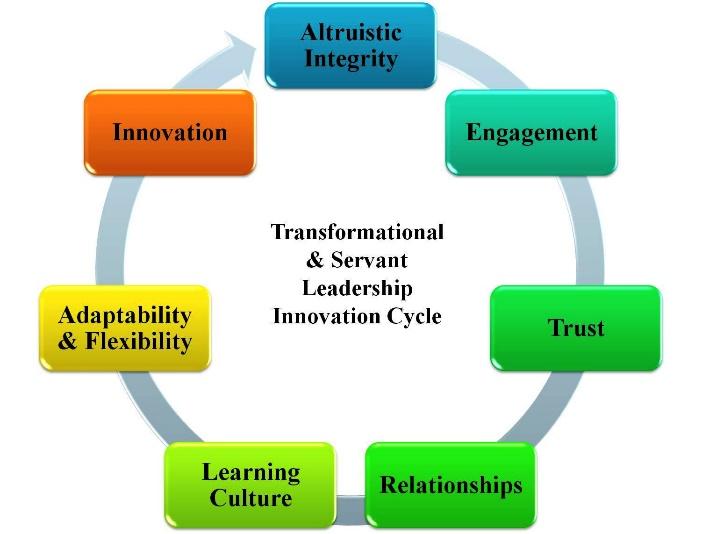
| What does Servant Leadership mean to you? Today, I am very thankful to Jon R Wallace in my leadership journey. I would like to share with you his Transformational Servant Leadership Innovation (TSI) model and hope you find it as helpful as I do!
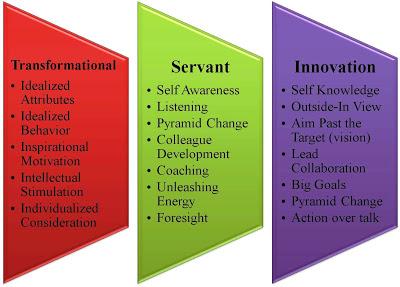
Transformational Servant Leadership Innovation Cycle (Wallace) Jon pointed out that “Transformational Leadership and Servant Leadership are closely intertwined with similar meanings. I agree with him that Servant Leadership is “transformational in scope and outcomes”. It is principle-based and it all started from the heart with the Trust that came from Altruistic Integrity which, when nurtured, will lead to Ingenuity that connects with the purpose. Servant Leadership has the potential to improve the organizational outcome and transform lives. Transformational Servant Leadership Innovation Cycle (Wallace) On a micro scale, we can say that trust relationships with people are the foundation of leadership. When thinking of servant leadership, think stewardship and commitment to help others succeed. Experience is our best teacher and so is the love of learning. Applying what we learn will prepare us for success. I picture servant leaders to be quiet leaders because they are thinkers (have vision) and they are also doers. Servant Leaders focus on providing the service, with others in mind (selflessness) and listen well. The intent itself demonstrates respect, awareness, and empathy to achieve a greater good. They plan ahead and anticipate change (have foresight); therefore, they are quick to respond to the unexpected. As Jon said, “At the end of the day it becomes a matter of what we choose to do to improve ourselves and then how we transfer that knowledge to encourage others to do the same.” It is the choice we make to achieve sustainable impact. I believe that is quite powerful. Do you? |
Now, we are free
|
The word “servant” triggers (in many situations) goose-bumps on individuals aspiring to be leaders. We are wired to perceive it as a “status-reducing” label, as a way to mark the limits for a second-class role (or, even worse, an individual). Associating it with strong, powerful noun - like leadership or leader - doesn’t make it better. In fact, in this case - servant leadership or servant leader - the term “servant” (officially, a noun) is perceived more like an adjective, diminishing the force of its more famous associate. I always look at people’s faces when this topic is brought to the table. I actually started a little experiment. When asked about what I am most passionate about and what my favourite speaking topic is, I answer first with “I am really into [or] I really like to speak about leadership…”. My conversational partner’s face lights up (“Oh, another one…” - he might be thinking) and he asks - ready to share and engage in a small debate - “What kind of leadership?”. As soon as the “infamous” association - servant leadership - leaves my mouth, the just-created magic disappears. I can see disorientation and confusion in my interlocutor’s eyes. The comfortable smile is replaced by a suspicious scowl and, most probably, questions start popping into his or her mind - “What the hell is this? You are either a servant, or a leader. Are you mocking me?” The reduction-effect of “servant” upon “leadership” - which I described earlier - is almost instantaneously present. Everybody loves Leadership and are willing to talk about this “amazing, sensible and always up-to date” topic. We need leaders and leadership. They are vital for our success, for our well-being, for our society. But...Servant Leadership? Servant Leaders? It seems to degrade the powerful noun.... leadership - as we were wired to perceive it. We put our leaders on a really high pedestal. Even if they don’t want to be there, we elevate them. In many situations, this is the only way we can see (as in “perceive”) them as leaders. We need to see them at any moment, to have them in front, (literally) leading the way. Our leaders have to pull us and help us achieve a strong pace to the target. Otherwise, they are not the leaders we expected, the leaders who can take us there no matter what. How can we trust a leader who is actually behind us, gently pushing, not pulling and, most of all, serving us? The way I see it, this sorry situation is triggered by two main factors:
As I recall, coming back to my little experiment, no conversation about Servant Leadership ends up in a dull, boring way. The majority of my interlocutors smile politely and either change the subject or excuse themselves, leave or engage in another conversation. I get it - we might not be ready for this. Re-wiring our brains can be hard and takes a long time. However, I have seen individuals (it’s true, just a small percent) who were stirred and intrigued by the whole idea. Something sparked behind their eyes - maybe just enough to kick-off an internal revolution. This kind of “inception” is the one I am counting on. This is the one bringing more selflessness and less selfishness, more trust, more community and less individuality, more authority and so on and so forth.
|



