
Viewing Posts by Fernanda Quinteros
Role Models for Women: Why are they important


| Leadership positions does not turn people who hold them into leaders. Becoming a leader is a construction process where your own identity as a leader is construct through time and validated by others that recognize you as a leader. Like a virtuous cycle, others recognition and reaffirmation of your own leadership capacity reinforce your self-confidence and encourage you to further seek leadership and growth opportunities. Leaders identity is also founded by a strong sense of purpose. This sense of purpose motivates people to push their limits in the road of pursuing their objectives and dreams. When leaders are connected with larger purposes, people around them, sharing similar values, trust them and also get connected to larger purposes. This help people find a meaning to their work, hence motivation.
Spanish version
Women and the labyrinth of leadership. Alice H. Eagly & Linda L. Carli. Harvard business review. Harvard business review 85(9):62-71, 146. October 2007. DOI: 10.1037/e664062007-001 Taking Gender Into Account: Theory and Design for Women’s Leadership Development Programs. Robin J. Ely, Herminia Ibarra, Deborah M. Kolb. Academy of Management Learning & Education, 2011, Vol. 10, No. 3, 474–493. http://dx.doi.org/10.5465/amle.2010.0046. A bed of thorns: Female leaders and the self-reinforcing cycle of illegitimacy. Andrea C. Vial, Jaime L. Napier, Victoria L. Brescoll. The Leadership Quarterly. Volume 27, Issue 3, June 2016, Pages 400-414. The Role of Female Role Models. https://thesocietypages.org/trot/2017/02/22/the-role-of-female-role-models/ The Role Model Effect: Women Leaders Key To Inspiring The Next Generation. https://www.forbes.com/sites/worldviews/2012/01/19/the-role-model-effect-women-leaders-key-to-inspiring-the-next-generation/ |
Leadership styles: opportunities for women
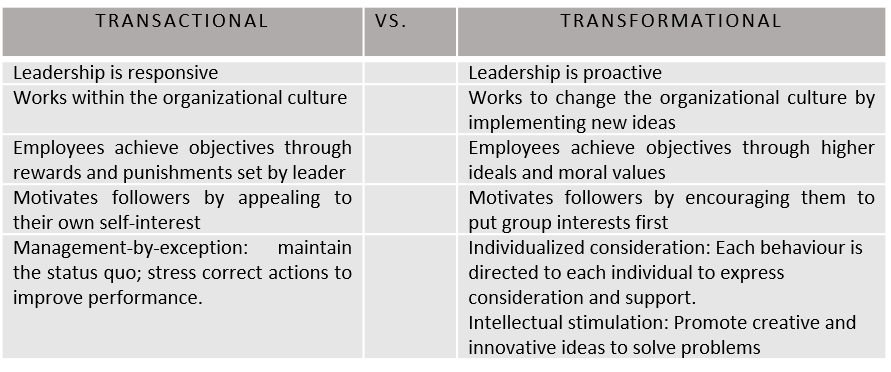
| Much has been studied about leadership styles and about the characteristics a leader should have. However, not as many studies include gender as a variable in their evaluations. Additionally, the studies that have done it differ in design, methodology and evaluations performed so though it is tempting to make an assertion about the case, it is difficult to conclude that there is a feminine leadership style in contraposition with a masculine one. Nonetheless, women have been associated more than men to exert a transformational leadership. Transformational leadership style is often compared with the transactional style and is a model that takes into account different variables addressed separately by other leadership theories like traits, behavior, context and organizational culture that are combined in this model. Below is a brief summary and comparison of both models.
The transformational model of leadership focus on team-building, motivation and collaboration with employees to accomplish a desired change. Transformational leaders motivate and inspires employees through incentives and by providing opportunities for growth while setting goals that are aligned with the strategic vision of the organization as well as with the team and the employee’s own interests, values and needs. This style of leadership is proactive and best for turbulent or changing environments. Women are more identified with this style of leadership where cooperation, collaboration, equity and empathy are characteristics traits. Transactional leaders, on the other hand, use disciplinary power and incentives as rewards or punishments to motivate employees to perform at their best. They are more concerned with maintaining the normal conditions and operations of the organization rather than with achieving change. This style of leadership is reactive and more suited for settled environments. The transactional style is the traditional leadership style used extensively across different organizations for many years and it is identified with masculine traits like self- interest and competitivity, authority, control, effectiveness, etc. Today many companies are immersed in changing and dynamic environments where the ability to response fast is highly valuable and needed to stay competitive. The traditional leadership model, based almost exclusively in increasing productivity and efficiency is being challenged. Strong hierarchized and bureaucratized organizations with specialized functional areas may not have the adequate structure for this new globalized environment. Opportunities arise here for women who generally exert a transformational leadership style that is more suited in this scenario. Inspirational motivation, the ability to create a sense of purpose and commitment, intellectual stimulation and the creation of shared spaces for discussion and joint resolution of problems are all traits and abilities associated with feminine characteristics related to cooperation, collaboration and empathy. These characteristics are needed in organizations that required flexibility and rapid adaptation to change, where innovation and changes are not only needed but welcomed. In summary, though is it difficult to differentiate and define a feminine leadership style it seems that women are more identified with the transformational one in which more feminine characteristics are represented. Certainly, also men could have them and exert a transformational style. Though transactional style has been the model widely accepted and used in traditional organizations, a fact that may have contributed to the under-representation of women in managerial positions, there seems to be now good perspectives for women with the values and attitudes needed to be a transformational leader. Lastly but not less, many studies reveal that men outperform women when testing self-confidence perception. We should pay attention to this, it is time to start working on it so as to be able to fully seize every opportunity that arise.
Spanish version
Estilos de liderazgo: oportunidades para las mujeres.
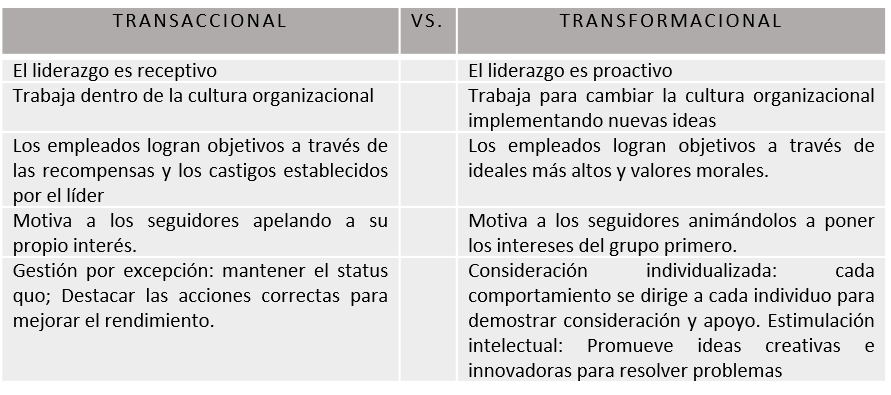
Mucho se ha estudiado sobre los estilos de liderazgo y sobre las características que debe tener un líder, sin embargo, no se han realizado muchos estudios que incluyan al género como una de las variables de sus evaluaciones. Los estudios que sí lo han hecho, además, difieren en el diseño, la metodología utilizada y las evaluaciones realizadas, por lo que, si bien es tentador hacer una afirmación sobre el tema, es difícil concluir que existe un estilo de liderazgo femenino en contraposición con uno masculino. A pesar de esto, las mujeres se han asociado más que los hombres a ejercer un estilo de liderazgo del tipo transformacional. El estilo de liderazgo transformacional normalmente se compara con el estilo transaccional y es un modelo que toma en cuenta y combina diferentes variables que han sido abordadas por separado por otras teorías de liderazgo tales como rasgos, comportamiento, contexto y cultura organizacional. A continuación, se muestra un breve resumen y comparación de ambos modelos:
El modelo de liderazgo transformacional se centra en la formación de equipos, la motivación y la colaboración con los empleados con el objetivo de lograr un cambio deseado. Los líderes transformacionales motivan e inspiran a sus seguidores a través de incentivos y brindan oportunidades de crecimiento al tiempo que establecen objetivos que están alineados con la visión estratégica de la organización, así como con el equipo y los intereses propios, valores y necesidades del colaborador. Este estilo de liderazgo es proactivo y es mejor para ambientes turbulentos o cambiantes. Las mujeres están más identificadas con este estilo de liderazgo donde la cooperación, la colaboración, la equidad y la empatía son características. Los líderes transaccionales, por otro lado, utilizan el poder disciplinario y los incentivos como recompensas o castigos para motivar a los empleados a rendir al máximo. Están más enfocados en mantener las condiciones y operaciones normales de la organización en lugar de lograr un cambio. Este estilo de liderazgo es reactivo y más adecuado para entornos establecidos. El estilo transaccional es el estilo de liderazgo tradicional que ha sido utilizado ampliamente en diferentes organizaciones durante muchos años y que se identifica con rasgos masculinos como el propio interés y la competitividad, la autoridad, el control, la efectividad, etc. En la actualidad, muchas empresas se encuentran inmersas en entornos cambiantes y dinámicos donde la capacidad para dar respuestas rápidas es muy valiosa y, aún más, necesaria para mantener la competitividad. El modelo de liderazgo tradicional, basado casi exclusivamente en el aumento de la productividad y de la eficiencia, está siendo desafiado. Las organizaciones fuertemente jerarquizadas y burocratizadas, con áreas funcionales especializadas pueden no tener la estructura adecuada para este nuevo entorno globalizado. Es aquí donde surgen oportunidades para las mujeres que generalmente ejercen un estilo de liderazgo transformacional, más adecuado a este nuevo escenario. La motivación inspiradora, la capacidad de crear un sentido de propósito y compromiso, la estimulación intelectual y la creación de espacios compartidos para el debate y la resolución conjunta de problemas son rasgos y habilidades que están asociados con características femeninas relacionadas con la cooperación, la colaboración y la empatía, características que se necesitan en organizaciones que requieren flexibilidad y rápida adaptación al cambio, donde la innovación y los cambios no solo son necesarios sino también bienvenidos. En resumen, aunque es difícil diferenciar y definir un estilo de liderazgo femenino, pareciera ser que las mujeres se identifican más que los hombres con el estilo transformacional en el que están más representadas características femeninas. Ciertamente, también los hombres podrían tener estas habilidades y características y ejercer un estilo de liderazgo transformacional. Si bien el estilo transaccional ha sido el modelo ampliamente aceptado y utilizado en las organizaciones tradicionales, hecho que puede haber contribuido a la subrepresentación de las mujeres en puestos directivos, pareciera ser que hay ahora buenas perspectivas para las mujeres que poseen los valores y las actitudes necesarias para ser una líder transformacional. Por último pero no menos importante, cabe notar que existen varios estudios que revelan que los hombres superan a las mujeres en su percepción de confianza en sí mismos. Deberíamos prestar atención a esto, pareciera ser hora de empezar a trabajar en esto de manera de poder aprovechar de lleno las oportunidades que se nos presentan.
Bibliography/Bibliografía -Liderazgo femenino: un modelo transformacional frente al paradigma de la organización tradicional. Thesis · September 2013. Maria Medina-Vincent. Universitat Jaume I. España -Mujer y liderazgo en el siglo XXI: una aproximación psicosocial a los factores que dificultan el acceso de la mujer a los puestos de alta responsabilidad. Memoria Final (Abril 2009). Proyecto nº: 22/05. Investigador principal Fernando Molero Alonso. Instituto de la mujer. Secretaría General de políticas de igualdad. Ministerio de igualdad. España. |
Women in Project Management: Future Perspectives
| In 2017 the World Economic Forum published the results of the 2017 Global Gender Gap Report (1). The report evaluates gender parity across four key areas: health, education, economy and politics in 144 different countries. The economic category evaluates participation in labor force, remuneration and advancement to leadership roles. Notably, after the political gap which is the widest but the one that narrows faster (77% gap that according to the report could be closed within 99 years) the economic gap is second in place (42%) but it would take 217 years to be closed at the pace of today. This means that, globally, women participation in labor force is poor, get paid less than their male counterparts and struggled to get into leadership positions. As a consequence there is a wide talent pool that is being underutilized. Considering this situation, what can be said about women's role in project management and the future of the profession? Though scarce information is found about women participation in project management, data presented in the PMI Project Management Salary Survey—10th Edition indicate that women representation in the field could be estimated to be mainly between 20-30% and that their average salary is lower than that of men (2). This is not surprising taking into account that many of the industries with a long story in project management have been male-dominated like engineering, and construction (3). From the report, it would be interesting to know which roles or positions women hold in the area. PMI Salary survey includes this feature in its evaluation though no analysis by gender is performed with it. Different studies analyze the future of jobs in a context of technological advancement and globalization. Technological drivers (mobile internet, cloud technology, big data, robotics, artificial intelligence, 3D printing, etc) together with demographic and socio economic drivers (changing nature of work, the emergence of the green revolution, ageing society, urbanization, etc) will disrupt business models and shift the employment landscape to a future where new skills, abilities and knowledge will be needed. Given this scenario, some sectors will face talent shortages and recruitment challenges (1, 4-6). Related to project management, we found that rapid change and fierce market competition are pushing organizations to rapidly adapt to changes and to maximize value delivery of their businesses and organizational practices. Organizations are thus increasingly recognizing the benefits of successful management of projects and so project management practices are growing and expanding to different industries, even to those that were traditionally less project-oriented like health care, professional services, education and public administration (7-10). This increase in projects and in project based organizations, named by the term projectification by different authors, is expected to generate a project related job growth of 33% collectively by 2027 (7-12) As a result, it is expected that organizations may experience shortages in qualified talent in the future (7). Given that the proportion of women in project management is low, opportunities arise here to fulfill that need and to grow in the area. In fact, some authors agree that one of the different trends of project management in the future is increase women participation (8, 13). It would be interesting to know whether women participation in project management is actually increasing nowadays since it seems to have increased in countries like Germany and UK (8). On the other hand, looking at the big picture to the whole labor market and analyzing the perspectives for women we found that future jobs will grow mainly in the area of computer, technology, engineering and mathematics. This is worth noting since these jobs belong to highly projectized industries where women are under-represented. This is not only due to low women enrolment in STEM (science, technology, engineering, mathematics) careers but also to a low proportion of women entering those fields once graduated and a high proportion leaving them once they have entered ( 1,4,14-16). According to the Global Gender Gap Report (1), if gender gap ratios informed persist over the 2015–2020 period there will be nearly one new STEM job per four jobs lost for men, but only one new STEM job per 20 jobs lost for women. In summary, future growth and emerging roles in areas with poor participation of women could generate an increase in women economic inequity. Concerns regarding a restricted talent pool have increase among these growing industries who are already experiencing difficulties in their hiring process and that will see them aggravated (1, 10). Opportunities as well as challenges arise. Women and project management professionals with the technical and leadership skills but also with a strategic vision, knowledge and understanding of the evolving technologies and their impact in business models and societies will find opportunities and be in advantage. Industries and organizations may need to put their efforts in hiring, retaining and promoting talented individuals that may not yet be considered or that are under-represented. Governments and society should recognize the importance of education and its impact on gender equity and take actions. Growing evidence indicate that promoting gender parity has its impact in the growth, competitiveness and future readiness of economies and businesses (1). Projects are the way organizations increasingly use to deliver their results and create value. In view of this, it would be wise for professionals in the project management area to encourage diversity and work towards equal opportunities for women in the field.
REFERENCES
|


