How Will Citizen Development Impact Leadership, Decision-Making and How Projects are Run? Part 1


| Welcome to my 3-part series on how citizen development is impacting projects and project management. Through the lens of citizen development, I’ll be looking at the areas of:
How Citizen Development Relates to Leadership People see leadership differently. To some, it means listening to your followers and make everyone happy, and to others, you have to take that strategic decision which in turn could mean saying ‘NO’ to certain quarters and ensure alignment to the strategic objectives of the organization. No doubt, becoming a good project manager does not end with just project management skills.
Leadership theories work, but sometimes situations in the organization are different. This leaves a leader to his fate to swim through the twists and turns of the rapidly changing environment.
A leader must set the path right for the organization and must do all that is required of him to grow the organization. Now, let us examine who is a good leader or the must-have leadership qualities of project managers. Every Project Manager should wear a leadership face and drive the project team to achieve the expected deliverables. Listed below are qualities that make a project manager a leader.
I look forward to sharing my next blog with you where I look more at the impact of citizen development on the project manager.
|

Understanding the Success of the Agile Manifesto (Part 1)
| I have lately been thinking about how a Manifesto could benefit the Citizen Development community in a similar manner to how it benefitted the Agile community at the start of this Century. To better my knowledge of how to translate the successful factors of the Agile mindset to Citizen Development I will release a series of blog posts and polls where I ask you for your opinion. This is the first post in that series. What made the Agile Alliance’s meeting a success? The story behind the Agile Manifesto is well known. A group of seventeen people (“ The Agile Alliance”) met in a lodge in Utah and worked for two days on the principles, values and beliefs that would become the Agile Manifesto. The group included representatives from Extreme Programming, SCRUM, DSDM, Adaptive Software Development, Crystal, Feature-Driven Development and Pragmatic Programming. Given the legacy of Agile and everything that has been borne out of the mindset that was made formal with that meeting I think it is fair to say that the meeting was a success but how can this success be explained and what do you think were the key ingredients to the Agile Alliance’s success in designing a Manifesto that is still relevant today? Please share your opinion in this discussion thread. Lessons from the 2001 Agile Manifesto On December 7, 2020, I issued a poll where I asked you if you still believed that the principles of the 2001 Agile Manifesto still are relevant. 61% of you still believed that it was. With that said, some of you pointed out that certain principles were showing their age. The most clear example of an aged principle being: “The most efficient and effective method of conveying information to and within a development team is face-to-face conversation”.
Several respondents also called out the importance not to confuse the Agile mindset with the methodologies and procedures born out of that very mindset and that the principles as a statement of intent and purpose still provided a strong foundation for all forms of Agile. Finally, it was highlighted that nothing in the twelve principles was radical and new at the time the Manifesto was designed back in 2001 but that it was beneficial to have good ways of working formalized. While most of you still believe that the principles of the Agile Manifesto stands the test of time – would they still have benefitted from being able to be amended? Please provide your opinion in the poll that can be found here.
|

My Citizen Development Journey
IntroductionAs a consultant, upskilling and advancing my knowledge on new technological advances, is key. The concept of citizen development fascinates me. I am going to use this forum to document my citizen development learning journey. How I heard about Citizen DevelopmentAt the start of last year, I attended a highly esteemed webinar. During the session, an executive discussed citizen development. I had never heard of this capability before. Being curiously minded, I made it my business to learn more about this topic. ResearchI have devoted a lot of my time into researching Citizen Development in recent months. As stated in an article I previously wrote (ProjectManagement.com - How Citizen Development Can Deliver Transient Competitive Advantage), citizen development, enables anyone who wants to create an application to do so. You no longer have to be a software developer or an IT specialist to create an app. Any person who has the ambition to create an app can do so by leveraging citizen development. There are multiple LCNC software vendors competing in this space (Kianda, WEM, Betty Blocks, OutSystems to name a few). Such vendors provide you with the tools required to create applications. All you need to do is select the vendor that can meet your needs. RealizationOne gap I found while conducting research on citizen development was that, to date, there are no agnostic resources available for people to develop their knowledge or practical skills in terms of citizen development. Up until recently, there were a lack of educational resources available. Enters the Citizen Development SpaceWhen I heard that the Project Management Institute announced that they are creating a suite of citizen development products, I was happy. I am hoping that PMI will provide leaners with resources that will enable or enhance their knowledge or practical skills in this area. By doing this, I (along with others who have never created an app before), will be able to create applications in a secure and controlled manner. PMI Launched the Citizen Developer Foundation CoursePMI launched the Citizen Developer Foundation course earlier this month. I had been keeping a close eye on the PMI Citizen Developer page for updates as to when this would be launched (on https://www.pmi.org/citizen-developer). When I saw the course become available, I jumped at the opportunity to take it. Signing up for the course was next on my “to-do” list. EnrolmentI found the enrolment process very straightforward. There were very few steps involved. Here are the steps I followed:
ConclusionI hope this blog gave you some insight into my citizen development journey so far. In my next blog, I will be documenting my experience of the Citizen Developer Foundation Course… Stay tuned :)
|
Low-Code or No-Code....What's the difference?
| Have you been wondering what the difference is between Low-Code and No-Code is? Read our quick primer to learn about these key terms in citizen development. In a recent interview between Sunil Prashara, President and CEO of PMI, and Praveen Seshadri, founder of AppSheet, Praveen drew a comparison between building software and driving a car. In the early days, driving a car was a very involved affair. Features we take for granted today simply didn’t exist; the automatic starter was not standard equipment in cars for many years. You had to physically crank the engine. You didn’t have a gear box or stick shift. There was no speedometer, water pressure or fuel gauge. Driving a car was clumsy and hard. In a similar way, early software engineering was tedious, painstaking and required a great deal of knowledge. The software pioneers had to be competent in many domains – being able to write instructions the computer could understand, how to write programmes to memory, how and where to store the data. All of this required the flicking of switches and the loading of punch cards or magnetic film in precise orders, making even small mistakes very costly. Most people will agree that driving a modern car today no longer requires experience akin to having a doctorate in mechanical engineering. Similarly, software engineering has evolved such that it is no longer the exclusive domain of the dedicated IT professional. In both these cases, over time, the relentless drive to make things easier, faster and more user friendly has meant that today pretty much anyone can drive a car, or build an application. Chances are you are already familiar with the terms low-code and no-code application development platforms. Essentially, they are what they say on the tin; low-code platforms started to make an appearance around three decades ago. Many of them born out of software houses’ desire to minimise repetitive, tedious very error prone tasks that are common when coding. No-code platforms are a natural evolution of low-code, with the ambition being total obfuscation of the complexities of code.
Low-Code Low-code platforms can be defined as tools that let you build software applications with a minimal amount of coding. Software developers can leverage pre-fabricated “blocks of code” to rapidly create applications. Rather than focusing their efforts on hand-coding the application end-to-end, they these pre-fab code blocks to construct the application, and then use code for fine-tuning where and when desired. In the strictest sense, low-code platforms require some level of coding knowledge, and this makes sense given that the target market, by and large, has been the existing IT department and software houses – these tools were designed to speed up what they were already doing, rather than trying to make software development more accessible to non-IT folk. That said, some low-code platforms do also appeal to the non-coder and indeed are being used by them to great effect, for example in building MVPs which could then be handed over to the IT team to finish off and publish. Low-code is markedly faster than hand-coding, and as a result projects are cheaper. Many prominent platform vendors feature use cases demonstrating 10x faster project delivery times compared to hand-coding approaches. This is one reason that Gartner estimates that the low-code market will be responsible for more than 65% of applications by 2024. No-Code While conceptually similar, no-code platforms go a step further and attempt to completely eliminate the need to write even a line a of code when creating an application. Boasting clean, intuitive graphical interfaces with point-and-click and drag-and-drop mechanics, no-code platforms are designed to be approachable to those outside the IT department. This is one of the fundamental drivers behind the growing global interest in the Citizen Development movement. Users of no-code platforms have demonstrated orders-of-magnitude faster delivery times when compared to hand-coding and even low-code. Application development projects that would ordinarily take months to simply mobilise, can now be delivered in a few days by a trained user of a no-code platform. It is important to note that no-code platforms are not inherently better than low-code platforms. For the increase in speed, there is a reduction in control. Indeed, many organizations prefer their existing low-code platforms, given they are likely less locked-down and offer a greater level of flexibility and control. There are numerous instances of core systems and highly complex applications that have been built using low-code platforms, but notably fewer examples on no-code platforms. It is also worth stating that low-code and no-code are sometimes used interchangeably and some platforms can justifiably be viewed as having both low-code and no-code characteristics (and catering to both the IT department and the non-IT business user at the same time). There are numerous no-code vendors out there that allow users to code, for example.
Conclusion Low-code and no-code platforms have demonstrated incredible return on investment for those organizations that have taken the plunge.
|
An Introduction to Hyper-Agile SDLC
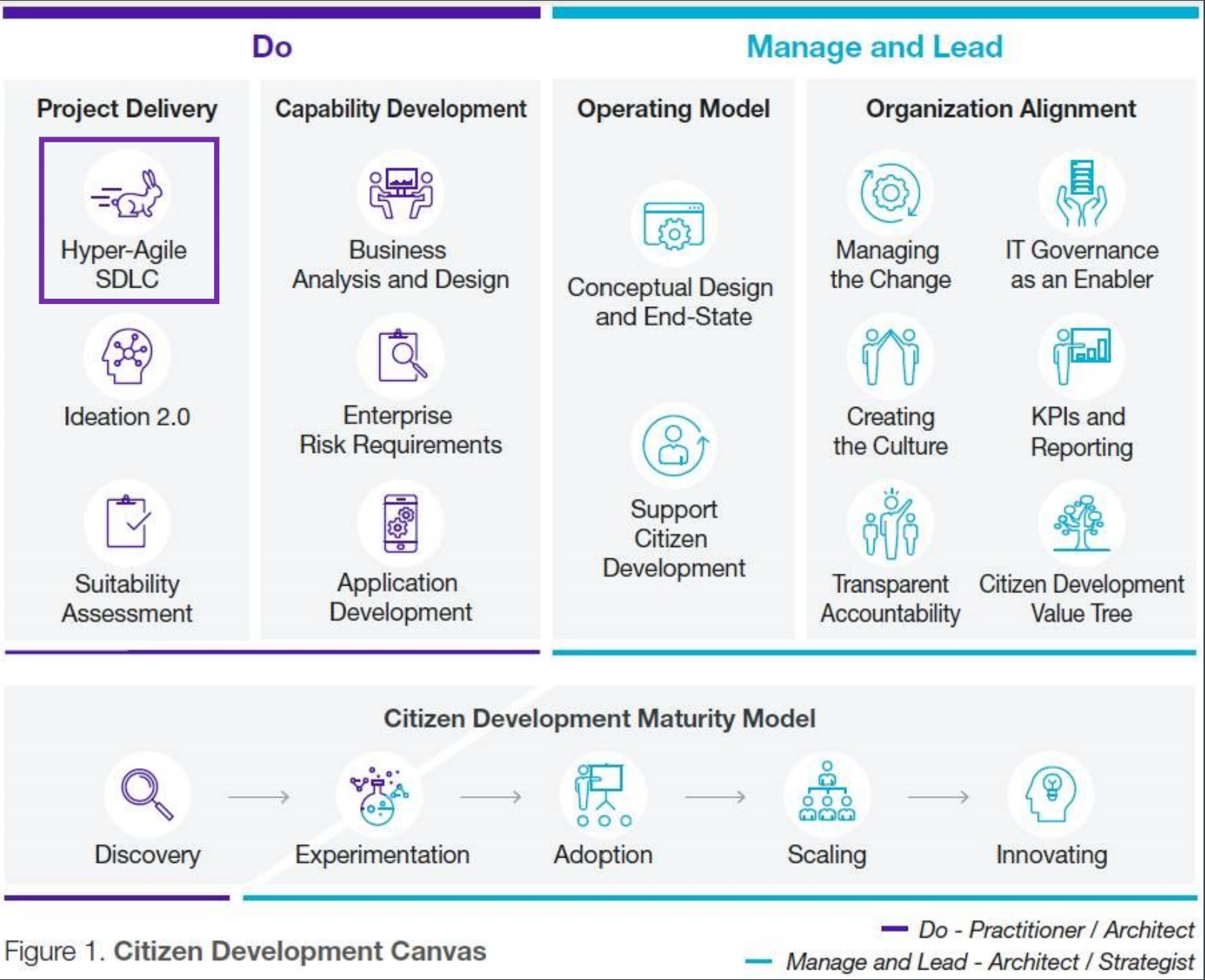
| Welcome to the world of citizen development. Amazing things happen here in the world of citizen development. If you’ve been in it a while, you already know how incredible it is to watch an idea go from spark to screen in days or even hours. If you’re new to citizen development, get ready for a fascinating new reality. This post is part of a series that will introduce you to elements on the PMI CD Canvas (see graphic below). These posts are designed to inspire you, share tips and insight, and further your knowledge and experience. I welcome your questions and encourage you to share your own stories. I am glad you’re here. Let’s begin.
An Introduction to Hyper-Agile SDLC As citizen developers, we inevitably interact with IT. In my early days of low-code app creation (before I even knew the term “citizen developer”) I encountered resistance from our IT department. They were leery of the process, tools, and security. The resistance eased when I took the time to learn the basic framework of their process so I could do a better job of explaining the one I was proposing. With your success in mind, I offer you two terms to learn and one case story to consider. Term #1: SDLC Its full name is Software Development Life Cycle. SDLC is a familiar term in the IT world and represents the six-stage process they use to plan, create, test, and deploy an information system. Each stage can take considerable time to complete. The SDLC process is as follows: 1. Requirement analysis 2. Design 3. Development and testing 4. Implementation 5. Documentation 6. Evaluation IT professionals pretty much live by this process. It’s proven, reliable, and connects all the dots in a way they have come to trust. Term #2: Hyper-agile SDLC This is the hyper-agile version of the Software Development Life Cycle. Same processes and same stages, but faster, leaner, and more agile. It is “an end-to-end process for developing and delivering applications by citizen developers using no-code/low-code tools,” per CDBOK. Case Story: Hyper-Agile SDLC In Action Situation: A marketing company was planning an in-person VIP event to launch a new product and needed a tool to enable teams to schedule and host private meetings. The existing process was cumbersome, and they wanted to replace it with a no-code app to automate scheduling, improve team communication, and capture critical data in real-time. Key stakeholders included the meeting concierge, room hosts, meeting hosts, and event meeting planners. Before: In prior events, the planners used an Excel spreadsheet to track and organize all of the meetings. Outlook was used for meeting invites. Confirmation emails containing specific meeting details along with the full spreadsheet showing the next day’s schedule was shared with stakeholders once a day. This caused extra work for stakeholders who had to sort through all of the data to find which events pertained to them. Cutting and pasting sections of the spreadsheet became the norm in an effort to make the information accessible and viewable. The process was not mobile-friendly, and valuable event metrics were difficult to track and gather. After: With the help of an in-house citizen developer using hyper-agile SDLC, a no-code app was built and deployed in four days. This included gathering requirements, design, basic IT testing, workflow creation, and user training. The hyper-agile SDLC build was possible due to (1) a highly engaged team who communicated clear requirements and workflows, and (2) a no-code platform that enabled the citizen developer to organize, design, and create a live app for the team to use. This platform was intuitive and user-friendly making training much quicker. The team built the app that efficiently managed all facets of the VIP customer meetings, plus these features: ● A mobile responsive design ● Overall view of room availability and configuration ● Quick search and simplified meeting request form ● Automated booking email confirmations and notifications ● Current and accessible master meeting calendar ● Automatic update notifications to specific team members ● A notes, comments, and completion confirmation section for room hosts ● Real-time meeting metrics for the meeting planners to track how many meetings were occurring, for how long, and who was hosting Customized dashboards were also created so each user type could view data that was relevant to them and their roles. This eliminated the need for any cutting and pasting of data and the meeting planners no longer had to wait until the end of the event to gather the event metrics. The app was a huge win for the entire team and demonstrates how hyper-agile SDLC can be used to create a solution for a process that was full of manual input, wasted time and money, and prone to human error. Applying Hyper-Agile SDLC In Your Organisation If you are looking to implement hyper-agile SDLC for the first time in your company, I recommend you select a workflow that is relatively simple but provides a good win for the team. Here are a few other tips: ● Look for a workflow that involves multiple manual steps that get repeated over and over again ● Get a good understanding of the actual workflow, the challenges, and the stakeholders ● Identify three basic requirements to fulfill with the new app and begin the design using the selected no-code/low-code platform. Begin with a simple and minimally-disruptive workflow so the stakeholders can see the positive impact and engage with the process. This will go a long way in setting the stage for quicker adoption of future, more complex apps. What did this post spark in you? Are you new to Hyper-Agile SDLC? Have you used it in your company? Please post your questions, comments, and stories below. |