


The recent redefinition of project success has shifted the focus from execution to delivered value. Success is no longer defined solely by schedule and budget compliance, but by value creation that justifies the effort and investment involved (Project Management Institute [PMI], 2024). This shift has direct implications for the role of the PMO.
At the same time, the profession faces a structural talent deficit. Projections indicate that by 2035, demand for project professionals could reach 65 million, with a potential gap of nearly 30 million (PMI, 2025a). Complexity is growing faster than available human capacity.
In this context, decisions become the true organizational asset.
However, evidence indicates that only 18% of professionals demonstrate a high level of business acumen, the ability to interpret strategic context, integrate variables, and understand broader organizational impacts (PMI, 2025b). This suggests that many decisions may be made under bounded rationality, even when supported by data.
The arrival of artificial intelligence amplifies this tension.
Recent studies on GenAI usage indicate that advanced users achieve higher output quality, but also report increased collaboration challenges and risks of misuse (PMI, 2025c). AI does not correct structural weaknesses. It amplifies them.
If the PMO’s decision architecture is immature, AI simply accelerates poorly structured decisions.
This is where the concept of Decision Intelligence emerges within the AI-PMO context.
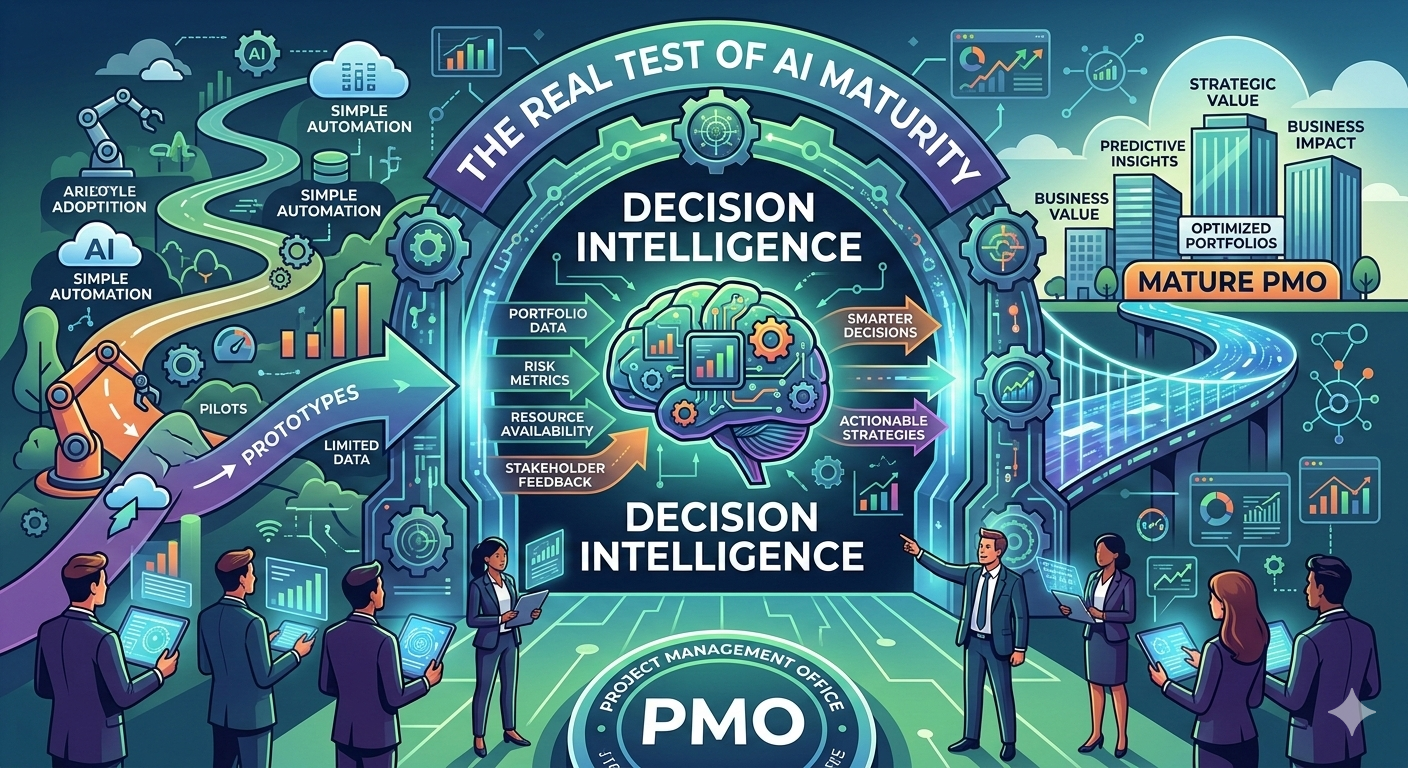
Decision intelligence goes beyond data analysis. It represents the capability to make explicit the criteria, patterns, and biases that structure organizational decisions. The AI-PMO model positions AI as strategic infrastructure and as a cognitive mirror, revealing inconsistencies, recurring patterns, and systemic impacts (AIPMO & Joslin, 2025).
Yet this transformation is sustained by clear principles.
First, final human accountability. AI-assisted decisions require explicit human validation and justification. Accountability is not transferred to the algorithm.
Second, transparency and explainability. If a PMO cannot explain the criteria behind an algorithmic recommendation, maturity does not exist. Governance requires traceability.
Third, active governance. AI must operate under structured supervision, with defined roles, continuous monitoring, and risk evaluation. Technology without governance accelerates uncertainty.
Fourth, ethics over efficiency. The fastest decision is not necessarily the right one. In the AI-PMO model, operational efficiency never overrides ethical responsibility.
Fifth, human AI integration. Maturity does not lie in pure automation, but in combining algorithmic analysis with contextual judgment. AI augments cognition; it does not replace reflection.
Sixth, reflexive learning. An intelligent PMO does not merely decide. It learns from its decisions. AI can surface invisible patterns but only if formal review and learning processes exist.
These principles fundamentally redefine maturity.
AI maturity is not measured by the number of automated dashboards or algorithm-generated reports. It is measured by the PMO’s ability to:
- Make decision criteria explicit
- Ensure transparency and justifiability
- Operate under structured governance
- Integrate ethics into decision processes
- Combine algorithmic analysis with human judgment
- Learn from patterns and consequences
The central question, therefore, is not whether the PMO uses AI.
The question is:
- Does the PMO know how to explain why it decides the way it does?
- Is AI being used to accelerate decisions or to improve them?
- Is there formal oversight over AI-assisted decisions?
- Are decision criteria transparent or implicit?
- Is the organization measuring automation or strategic impact?
The Intelligent PMO is not the one that uses AI as an operational tool.
It is the one that governs AI, understands its own decision architecture, and elevates the strategic quality of organizational choices.
And perhaps the most important question is not technological.
Perhaps it is structural.
If AI were removed tomorrow, would your PMO’s decision process remain solid, transparent, and justifiable?
Or does it depend on outputs that no one truly questions?
References
- AIPMO, & Joslin, R. (2025). AI-PMO™ Foundations: The Intelligent Companion. Association of International Project Management Officers (AIPMO). AI-PMO Foundations
- Project Management Institute. (2024). Maximizing project success. Project Management Institute.
- Project Management Institute. (2025a). Global project management talent gap. Project Management Institute.
- Project Management Institute. (2025b). Pulse of the Profession® 2025. Project Management Institute.
- Project Management Institute. (2025c). Reclaiming Agile’s Promise: How GenAI enhances agility’s business value through human-centered collaboration. Project Management Institute.
Posted on: February 27, 2026 04:20 PM |
Permalink


