


There is a pattern that is rarely discussed openly.
The more a PMO evolves internally, the less influence it tends to have over the organization’s critical decisions.
This is not a competence issue. It is a positioning issue.
The PMO becomes more structured, more consistent, and more reliable. But the decision-making center follows a different flow.
Executives do not operate based on organization.
They operate based on consequence.
They respond to movements that change results, reduce material risk, or shift direction. And this type of input rarely comes from the PMO.
In practice, what happens is straightforward.
The PMO gains more in-depth visibility into projects. But it does not gain greater influence over what gets decided.
It sees better.
However, it remains outside the moment when decisions are made.
This misalignment creates a silent effect.
The PMO becomes informative but ceases to be determinative.
At that point, executive perception shifts: the PMO is not changing anything that truly matters.
The problem is not in reports, rituals, or governance.
It lies in the absence of connection between what the PMO produces and the points where the organization defines priorities, risks, and investments.
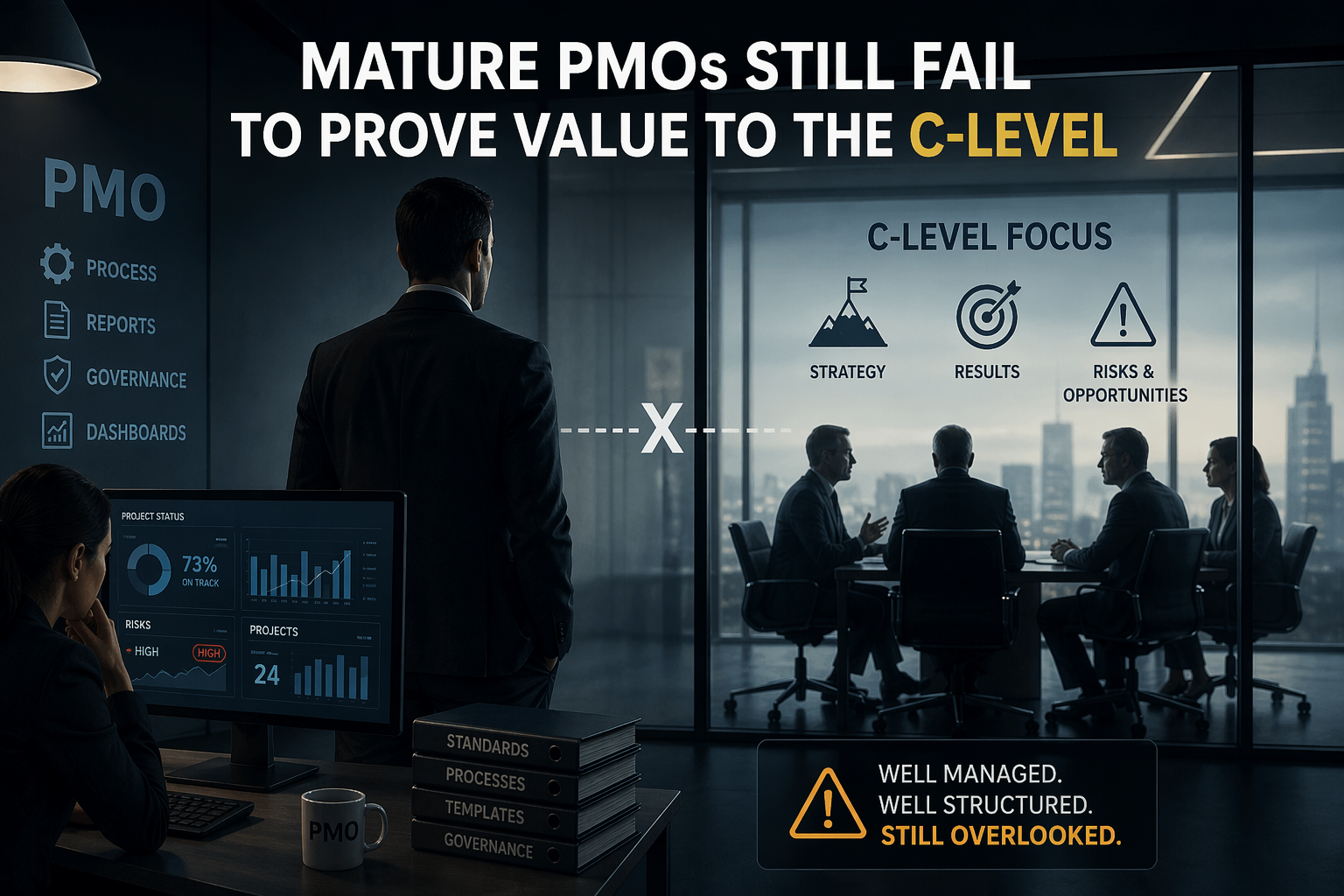
Without that connection:
- Risks continue to be absorbed too late
- Priorities continue to be redefined outside the PMO
- Decisions continue to happen without structured input
None of this shows up in internal assessments.
Because they measure consistency, not influence.
This is the breaking point.
A PMO can continuously evolve while simultaneously losing strategic relevance. When that happens, the nature of the discussion changes.
It is no longer about quality.
It becomes about necessity.
The PMO is not questioned for what it does. It is questioned for not making a difference.
From that point onward, any additional evolution tends to generate diminishing returns.
More process.
More control.
The same irrelevance.
The required shift is not technical.
It is structural.
As long as the PMO continues to operate as a mechanism for organizing execution, it will remain outside the decision core.
And outside the decision core, there is no perceived value.
In the next pieces, I will explore three points that are usually left out of this discussion:
- How to reposition the PMO to generate real influence,
- How to measure impact practically, and
- How to connect PMO services to executive decision-making.

 Community Champion


