



Project Management

Operational Excellence in Project Management

by
Leadership, PMO and Project Management

About this Blog

RSS

Recent Posts

PMOs Navigating Complexity: From Coordination to Sensemaking

How to Measure PMO Impact Practically, Based on Evidence Rather Than Perception

How to Reposition the PMO for Real Influence

Mature PMOs Still Fail to Prove Value to the C-Level – Part 1

Cybersecurity in Project Management: From Risk Awareness to Structured Execution

Categories

Agile, best practice, business agility, competence, Consulting, customer, customer succcess, Decision Making, Education, excellence, Governance, Government, Healthcare, Information Technology, Innovation, kamishibai, Leadership, leadership, lean, Organizational Project Management, PM in Academia, PMO, pmo, pmo, project leader, project manager, risk, risk management, scope, storytelling, team

Date

PMOs Navigating Complexity: From Coordination to Sensemaking

linkedin twitter facebook Request to reuse this  
PMOs typically operate through a familiar set of mechanisms:

  • governance;
  • planning;
  • monitoring;
  • dependency management;
  • performance tracking;
  • decision support.
These mechanisms remain relevant.

But there is a type of environment that challenges this operating model.

Even with:
  • more meetings;
  • more controls;
  • more indicators;
  • more rituals;
  • organizations may still experience:
  • rework;
  • misalignment;
  • constant change;
  • conflicting interpretations;
  • difficulty sustaining decisions.
In these situations, increasing coordination does not necessarily increase understanding.
The challenge becomes less about controlling execution and more about interpreting context.

Not every problem requires the same response


A common trap in PMO environments is assuming that problems that look similar require the same treatment.
When something is not working, typical responses often emerge:
  • increase reporting;
  • expand governance;
  • create additional rituals;
  • tighten accountability.
Sometimes this works. Sometimes it only increases administrative effort.
A more useful question may be:

Are we dealing with an execution problem or an interpretation problem?

Some signals can help.
  • When teams struggle to converge, the issue may not be execution alone. Different groups are often operating with different interpretations of context, priorities, or the meaning of the situation.
  • When small changes create large effects, it is worth investigating dependencies that have not yet been identified or understood.
  • When priorities shift continuously, the context itself may still be evolving and generating new information that changes direction.
  • When decisions produce conflicting interpretations, there is usually some level of organizational ambiguity that has not yet been surfaced or addressed.
The PMO’s role then starts to expand beyond coordination and include contextual interpretation.

Decisions do not always arrive complete


Projects frequently receive decisions accompanied by:
  • open assumptions;
  • partially understood impacts;
  • constraints still being validated;
  • dependencies still emerging.
  • The natural reaction is often to fill the gaps quickly.
But there is a risk:

Turning interpretation into certainty.

One practical alternative for PMOs is to structure conversations across three levels.

What is defined

Available facts, decisions already made, and current direction.


What remains under analysis

Impacts, dependencies, validations, and assumptions.


What happens next

Immediate actions, follow-up activities, and review points.

This separation reduces noise without requiring absolute predictability.

Data does not replace understanding


Many PMOs already have enough information.
The challenge has changed.
  • Now the task is to turn information into useful interpretation.
  • One simple practice is to review the questions being asked in meetings.
Replace questions such as:
Are we on schedule?
With questions such as:
  • What has changed since the last decision?
  • What assumptions are no longer valid?
  • Where have different interpretations emerged?
  • What are we assuming without evidence?
  • What still needs to be understood before accelerating?
The goal is not to abandon indicators.
The goal is to complement indicators with interpretation.

Alignment becomes a process rather than an event


In more dynamic environments, alignment does not happen only at formal milestones.
It needs to be rebuilt continuously.
Some practices that PMOs can apply:
  • review assumptions regularly;
  • document critical hypotheses;
  • make open decisions visible;
  • create short interpretation checkpoints;
  • validate understanding with stakeholders.
The objective is not to increase bureaucracy.
It is to prevent different areas from operating with different versions of reality.

Communication also changes


Another recurring issue is waiting for complete certainty before communicating.
In practice, this often creates:
  • rumors;
  • parallel interpretations;
  • misalignment.
A simple structure can help:

What we know

What is still evolving

What we will do now


This approach improves alignment without creating false predictability.


Five questions for PMOs to bring into the next meeting


  1. Do we have a shared understanding of the context?
  2. Are we treating assumptions as facts?
  3. Is the system continuing to change while we execute?
  4. Are we adding control or increasing understanding?
  5. What still needs to be interpreted before accelerating?

Closing


Governance remains necessary.
But some environments require an additional capability.

For PMOs, this means complementing discipline with interpretation, expanding contextual awareness, and maintaining direction while understanding continues to evolve.
Posted on: May 23, 2026 11:30 AM | Permalink | Comments (2)

How to Measure PMO Impact Practically, Based on Evidence Rather Than Perception

Categories: pmo

linkedin twitter facebook Request to reuse this  
Most PMOs do not measure impact. They measure activity.

And they often treat both as if they were the same thing.

The problem is not conceptual. It is structural.

Impact is not something a PMO “declares.”

It must be derived from organized evidence, and that evidence does not emerge from isolated indicators.
It emerges from a system.

The PMO-Mi Model framework addresses this explicitly:

Measurement does not start with impact. It starts with the structure that allows impact to be observed.

This implies three distinct layers that most PMOs tend to mix.


  • Progress is not impact

The first mistake is using progress as evidence.

Common examples include:

  • percentage of projects delivered
  • schedule and cost adherence
  • number of completed initiatives

These indicators demonstrate execution, not effect.

They answer:

“What was done?”

But they do not answer:

“What changed because of it?”

This distinction is fundamental.

Impact only exists when there is an observable change in the organizational system.


  • Maturity is not impact

The second mistake is using maturity as a proxy for impact.

More structured PMOs often assume:

“We have capability, therefore we generate impact.”

The data suggests otherwise.

Organizations continue investing in delivery capability while still showing significant gaps in converting those investments into business outcomes.

Capability measures potential.

Impact measures realization.

Without evidence of realization, maturity is merely infrastructure.


  • Impact requires direct linkage to services

The PMO-MI model is explicit:

Impact is not attributed to the PMO as an entity.

It is attributed to the services the PMO performs.

This entirely changes how measurement should be approached.

The question is not:

“PMO impact”

The question becomes:

“What is the impact of service X within domain Y?”

Without this linkage, there is no traceability.

And without traceability, there is no evidence.


  • Evidence comes from integration, not isolated indicators

Another recurring mistake is treating indicators as proof.

Isolated indicators do not demonstrate impact.

They must be integrated into a coherent interpretation logic.

Within the AIPMO perspective, measurement maturity requires moving from data to decisions. This implies:

  • integration between records (risks, decisions, changes)
  • connection with executed services
  • longitudinal interpretation over time

Without this, the PMO accumulates data but does not generate evidence.


  • Impact is inferred, not declared

Impact does not appear directly.

It must be inferred through observable patterns.

For example:

Not:

“The PMO improved decision-making.”

But rather:

  • reduction in decision-making time
  • fewer rework cycles
  • greater prioritization stability

And most importantly:

A clear connection with the service that generated the effect.

Without this structured inference, the PMO remains trapped in perception.


The central point


If impact cannot be traced, connected to services, and observed in organizational behavior, then it is not being measured.

It is being assumed.

Posted on: May 15, 2026 10:01 AM | Permalink | Comments (1)

How to Reposition the PMO for Real Influence

Categories: pmo, pmo

linkedin twitter facebook Request to reuse this  
Repositioning the PMO is not an organizational decision. It is a consequence of the operating model in which the PMO exists.
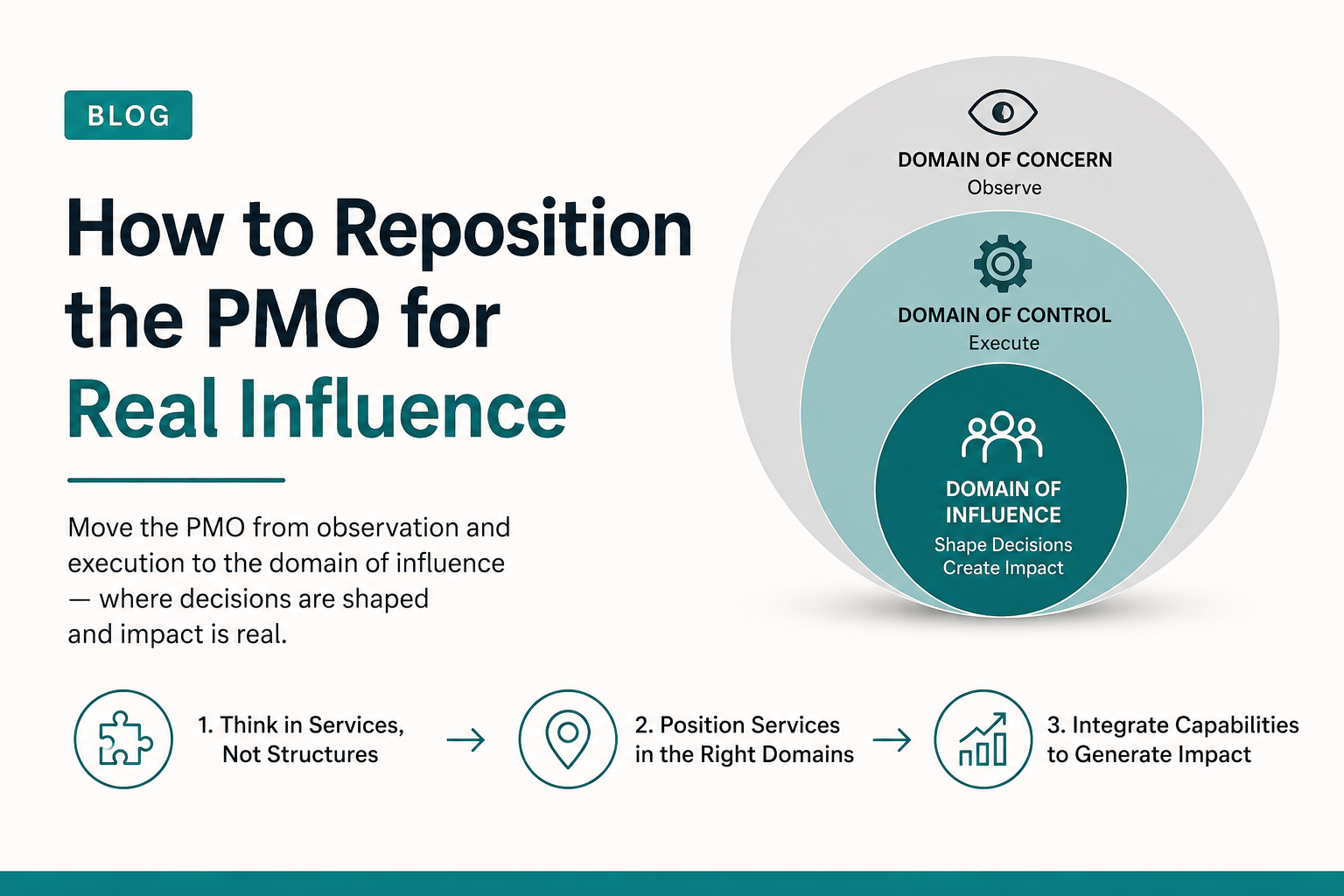


As long as the PMO remains restricted to the domain of concern, it observes. When it operates within the domain of control, it executes. Influence only emerges when the PMO consistently operates within the domain of influence.

Most PMOs are not at this level, and it is not because of a lack of technical capability.
It is because the operating model prevents it.

The mistake begins with how the PMO is defined. It is still treated as a structure.
But structures do not generate impact.

What generates impact are capabilities organized into services, operating within specific domains, and connected to the real decision-making process. Without this, any attempt to reposition the PMO becomes narrative.

It does not change behavior. Repositioning the PMO requires three structural changes.

  • Replace structural thinking with service-oriented thinking

Influence is not a characteristic of the PMO. It is the result of the services the PMO delivers.

The PMO-MI Model model is direct:

Impact is not in the existence of the PMO, but in how its services operate and connect.

This changes the core question.


Instead of asking:

“What is the role of the PMO?”

The question becomes:

“Which services actually interfere with relevant decisions?”


Without this shift, the PMO continues trying to gain relevance through internal structure.

And that does not change outcomes.


  • Reposition services into the correct domains

Not every service needs to influence decisions. However, critical services must be positioned where decisions are made.

The model establishes that impact occurs in the domains of control and influence, not within observation.

This requires a clear distinction:

  • services that remain in the domain of concern continue to be informational
  • services positioned in the domain of influence begin shaping decisions

Without this distinction, the PMO increases operational activity without increasing organizational relevance.


  • Integrate capabilities to generate organizational effect

Isolated capability does not create influence.

Impact is not the result of adding practices together.

It emerges from the integration between services and domains.

This is the most neglected point.

PMOs improve processes, tools, and controls.

But they fail to integrate capabilities in ways that alter how the organizational system operates.

The result is predictable:

  • Consistent execution with no meaningful organizational change.
  • Influence requires something different.

The capability to connect information, anticipate implications, and act before decisions become fixed.

Without this, the PMO reacts instead of directing.

Repositioning the PMO is not about evolving practices. It is about changing how the organization makes decisions.
When this happens, the evaluation criteria change.
The PMO stops being measured by what it controls and starts being recognized by what it changes.

Without this movement, any evolution tends to reinforce the current pattern:

  • more internal capability with the same absence of influence.
In the next edition, the focus will move to a critical aspect of this transition:
How to measure impact practically, based on evidence rather than perception.
Posted on: May 08, 2026 07:07 AM | Permalink | Comments (2)

Mature PMOs Still Fail to Prove Value to the C-Level – Part 1

linkedin twitter facebook Request to reuse this  
There is a pattern that is rarely discussed openly.

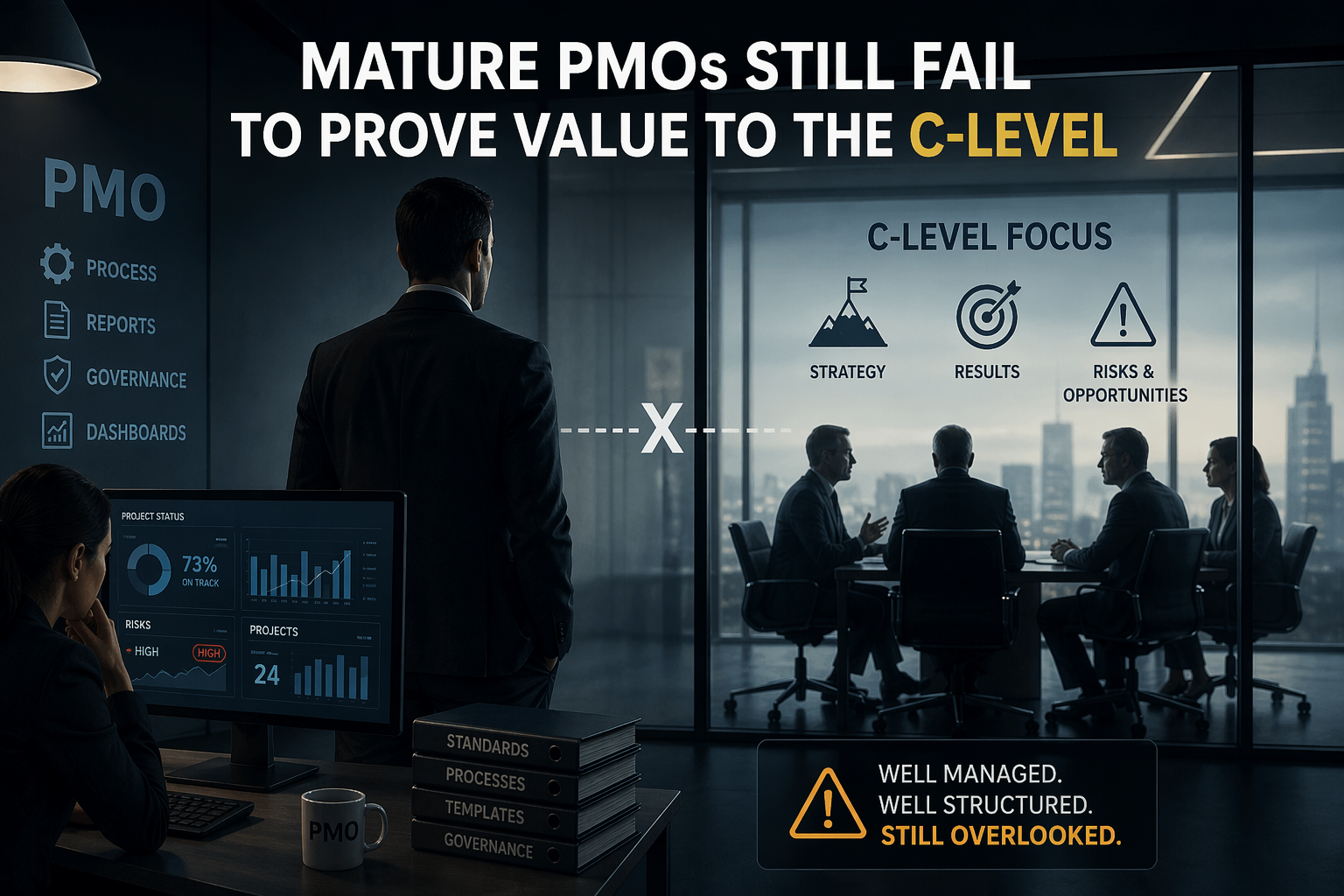
The more a PMO evolves internally, the less influence it tends to have over the organization’s critical decisions.

This is not a competence issue. It is a positioning issue.

The PMO becomes more structured, more consistent, and more reliable. But the decision-making center follows a different flow.

Executives do not operate based on organization.
They operate based on consequence.
They respond to movements that change results, reduce material risk, or shift direction. And this type of input rarely comes from the PMO.

In practice, what happens is straightforward.


The PMO gains more in-depth visibility into projects. But it does not gain greater influence over what gets decided.
It sees better.

However, it remains outside the moment when decisions are made.
This misalignment creates a silent effect.

The PMO becomes informative but ceases to be determinative.

At that point, executive perception shifts: the PMO is not changing anything that truly matters.
The problem is not in reports, rituals, or governance.
It lies in the absence of connection between what the PMO produces and the points where the organization defines priorities, risks, and investments.


Without that connection:
  • Risks continue to be absorbed too late
  • Priorities continue to be redefined outside the PMO
  • Decisions continue to happen without structured input
And most critically:

None of this shows up in internal assessments.

Because they measure consistency, not influence.

This is the breaking point.

A PMO can continuously evolve while simultaneously losing strategic relevance. When that happens, the nature of the discussion changes.
It is no longer about quality.
It becomes about necessity.

The PMO is not questioned for what it does. It is questioned for not making a difference.
From that point onward, any additional evolution tends to generate diminishing returns.
More process.
More control.
The same irrelevance.
The required shift is not technical.
It is structural.

As long as the PMO continues to operate as a mechanism for organizing execution, it will remain outside the decision core.
And outside the decision core, there is no perceived value.
In the next pieces, I will explore three points that are usually left out of this discussion:

  • How to reposition the PMO to generate real influence,
  • How to measure impact practically, and
  • How to connect PMO services to executive decision-making.
Posted on: April 24, 2026 07:49 AM | Permalink | Comments (2)

Cybersecurity in Project Management: From Risk Awareness to Structured Execution

linkedin twitter facebook Request to reuse this  


Introduction


The increasing convergence between Information Technology (IT) and Operational Technology (OT) has elevated cybersecurity from a technical concern to a strategic project management discipline. As organizations expand their digital footprint through Industry 4.0 and IIoT initiatives, project environments are exposed to a broader and more complex threat landscape.
In this context, cybersecurity must be treated as an integral dimension of project management, embedded across planning, execution, and governance activities rather than addressed as a parallel or reactive function.

The Nature of Cyber Risk in Projects

Cyber risks in project environments are characterized by three structural properties:
  • Interdependence: vulnerabilities in one system may propagate across integrated platforms
  • Latency: risks often remain undetected until late phases of execution
  • Impact asymmetry: relatively small vulnerabilities can generate disproportionate operational or financial consequences
Unlike traditional project risks, cybersecurity risks may simultaneously affect:
  • operational continuity
  • regulatory compliance
  • organizational reputation
  • physical safety (particularly in OT environments)
This multidimensional impact requires a structured and proactive management approach.

Integrating Cybersecurity into Project Management

From a project management perspective, cybersecurity should be incorporated as a transversal control layer across all knowledge areas. This implies:
1. Planning Phase
  • Definition of security requirements aligned with business and regulatory expectations
  • Identification of critical assets and threat vectors
  • Integration of security criteria into scope and acceptance definitions
2. Execution Phase
  • Continuous validation of security controls
  • Coordination between technical teams, vendors, and governance structures
  • Monitoring of vulnerabilities introduced during implementation
3. Monitoring and Control
  • Use of specific cybersecurity KPIs, such as:
  • percentage of implemented security requirements
  • number of critical vulnerabilities resolved within SLA
  • incident response time during testing phases
  • Alignment with frameworks such as ISO/IEC 27001 and NIST CSF
4. Closing Phase
  • Validation of compliance and certification requirements
  • Documentation of lessons learned related to security incidents and controls
This integrated approach ensures that cybersecurity is not treated as an isolated checkpoint but as a continuous management discipline.

The Role of the Project Manager

The project manager assumes a coordination role that goes beyond traditional delivery responsibilities. In cybersecurity-intensive environments, this role includes:
  • facilitating alignment between business, technical, and regulatory stakeholders
  • ensuring traceability between security requirements and implementation outcomes
  • supporting decision-making under uncertainty, particularly in risk prioritization
This requires not only methodological knowledge but also a systemic understanding of how security influences value delivery.

Common Implementation Challenges

Organizations typically face recurring challenges when integrating cybersecurity into projects:
  • Fragmentation of responsibilities between IT, security, and business units
  • Late inclusion of security requirements, increasing rework and costs
  • Limited visibility of cyber risks at the portfolio level
  • Difficulty in measuring the real impact of security initiatives
These challenges are not isolated issues but indicators of structural misalignment between governance, execution, and strategic objectives.

Practical Application: What Should Change in Project Execution

To operationalize cybersecurity within projects, organizations should adopt a set of practical measures:
  • Embed security checkpoints in stage-gate or agile review cycles
  • Define minimum security baselines for all project types
  • Establish clear ownership of cybersecurity risks within the project structure
  • Integrate security metrics into project dashboards and reporting routines
  • Use risk-based prioritization to balance delivery speed and protection requirements
These practices allow organizations to transition from reactive risk mitigation to structured risk management.


Conclusion

Cybersecurity is no longer an optional or specialized concern within project environments. It is a fundamental component of project governance, directly influencing the organization’s ability to deliver sustainable and resilient outcomes.
For project professionals, the key shift is conceptual and operational: cybersecurity must be understood not only as a technical domain, but as a management discipline that shapes how projects are designed, executed, and evaluated.
This perspective enables a more consistent alignment between project delivery and organizational resilience in increasingly complex and interconnected environments.
Posted on: March 30, 2026 10:32 AM | Permalink | Comments (3)
ADVERTISEMENTS

"Wise men talk because they have something to say; fools, because they have to say something."

- Plato

ADVERTISEMENT

Sponsors