Project Management

Drunken PM

by
Drunken Boxing for Project Managers “The main feature of the drunkard boxing is to hide combative hits in drunkard-like, unsteady movements and actions so as to confuse the opponent. The secret of this style of boxing is maintaining a clear mind while giving a drunken appearance.” Yeah... just like that… but with network diagrams and burndown charts… and a wee bit less vodka.
Agile | Agile 2010 | agile 2015 | Agile Alliance | agile transformation | agile2015 | AgileThinking | AOW4PM | apple | art of war | Bas De Baar | body language | branding | Brian Bozzuto | capacity | certified scrum trainer | Chris Li | cloud | cloud worker | commitment | Corkulous | CSM for PMP | cst | Dave Prior | David Bland | digitalpm | Docs to Go | Don Kim | dpm | dpm2013 | EMEA | emotional intelligence | Essential Scrum | facebook | field guide | FIRM REPORT | Flipboard | Global Economics | Greg Balestrero | GTD | Howard Sublett | Idea Wallets | IOS4 | iPad | iPad 2 | iPad2 | iPhone | IT&T SIG | Jesse Fewell | jim benson | kanban | Kathy Compton | Ken Schwaber | Kuala Lumpur | lacey | Leadership Meeting | LeadingAgile | lean | LeanKit | Livescribe | Livescribe Pulse | Mac | MacWorld | Macworld 2011 | Malaysia | Marshall Rosenberg | mashup | MDEC | Merlin | Mike Cohn | Mike Sutton | Mike Vizdos | mitch lacey | MITPM | modus cooperandi | Non-violent communication | Notes Plus | NVC | off shore | Offshore | Olaf Lewitz | Oredev | Øredev | overcommitment | Panda Transport | Papershow | personal branding | personal kanban | personal productivity | PMI | PMI Portugal | Product Owner | productivity | Project | project management | project manaqement | project planning | Project Potion | Projects At Work | projectshrink | ProjectWizards | pulse | Ricardo Vargas | Robyn Meredith | Scrum | Scrum Alliance | scrum but | scrum field guide | Scrum Gathering | ScrumFest | Shane Hastie | SK Khor | social media | sprint planning | SXSW | Thierry Holoweck | Things | Thushara | Tobias Mayer | Tom Perry | troy magennis | twitter | value | VCP | video conferencing | Vivek Angiras | vocal technique | waste | What We Say Matters | Wijewardena | WIzewerks | show all posts

About this Blog

RSS

Recent Posts

Certified Agile Leadership Training with Olaf

Don Kim - I Think, Therefore I Plan

Agile Coach to Agile Gamer - Peter Saddington

Scrum in School - A Case Study of Grandview Prep's Transformation

Forecasting Tools Based on Team Performance with Troy Magennis

Categories

20 Hour, 211, 4-Hour Body, 4-Hour Chef, 4-Hour Work Week, Aakash Srinivasan, Aaron Smith, Adam Weisbart, Adrian Howard, Agile, agile digitalpm, Agile 2010, agile 2015, Agile Alliance, Agile Classroom, Agile Enterprise, Agile Mindset, agile reporting, agile transformation, Agile Tribes, agile2015, AgileClassroom, AgileCraft, AgileScout, AgileThinking, Ainsley Nies, Al Goernor, Al Shalloway, Alistair Cockburn, Angela Harms, Anna Beatrice Scott, Ansley Nies, AOW4PM, apocalypse now, apple, art of war, Bas De Baar, Bas Vodde, Beyond Legacy Code, Big Visible, BigVIsible, bimodal, Blackie, Bob Sarni, body language, book review, braintrust, branding, breaking gantt, Brent Beer, Brett Pohlman, Brian Bozzuto, brian flatow, brian rabon, business agility, Business Model Canvas, CAL, Canvas, capacity, carson pierce, Catherine Louis, Center for Non-Violent Communication, Certification, Certified Agile Leadership, certified scrum trainer, Charter, Chet Hendrickson, Chris Li, Chris Spagnuolo, Christine Neidhardt, cloud, cloud worker, co-working, Coach's Clinic, Coaching, cochlear, commitment, conteneo, Corkulous, coworking, Craig Larman, Crystal, CSM for PMP, cst, DAD, Dan Brown, Dan Greening, dan markovitz, data, Dave Prior, David Anderson, David Bernstein, David Bland, David J Anderson, Dean Leffingwell, Dean Stevens, Declan Whelan, Denise Jacobs, Dennis Stevens, Designing Together Design, Dhaval Panchal, diana larsen, Digital Pm Summit, Digital Project Management, digitalpm, Disciplined Agile Delivery, Distributed Teams, Docs to Go, Don Kim, dpm, dpm2013, drunkenpm, drunkenpm radio, eduscrum, Eight Shapes, Elizabeth Harrin, Elizabeth Hendrickson, Elizabeth McClellan, EMEA, emotional intelligence, Enterprise Scrum, Essential Scrum, esther derby, EVEF, Evernote, Every Voice Engaged, Experience, Explore It!, facebook, field guide, FIRM REPORT, First 20 Hours, Flight Levels, Flipboard, FocusedObjective, forecast, Forecasting, Frank Illenberger, Fred George, fred kluth, funny garbage, Gil Broza, Github, Global Economics, Grandview Prep, Greg Balestrero, GTD, Happy Cog, Heartline, Howard Sublett, hybrid, I Think Therefore I Plan, Iain Frasier, ICAgile, Idea Wallets, improvisation, InfoQ, InspireMe!, International Consortium for Agi, IOS4, iPad, iPad 2, iPad2, iPhone, IT&T SIG, J.B. Rainsberger, James Tamm, Jason LIttle, Jean Tabaka, Jeff Patton, Jesse Fewell, Jessica Kerr, Jessie Shternshus, jim benson, Jim Tamm, johanna rothman, John D Cook, john miller, Judith Lasater, Jutta Eckstein, kamal manglani, kanban, kanbanfor1, kanbanpad, Kate Sullivan, Kathy Compton, Ken Rubin, Ken Schwaber, Kenny Rubin, Keynote, Kuala Lumpur, lacey, Large Scale Scrum, Larman, Larry Maccherone, Larsen, Lasater, Leadership Meeting, LeadingAgile, lean, Lean Kanban University, Lean Systems Engineering, LeanKit, Leffingwell, LESS, Liftoff, Linda Rising, Lithespeed, Livescribe, Livescribe Pulse, LSE, Luis Garcia, luke hohmann, lyssa adkins, Mac, MacWorld, Macworld 2011, Magennis, Malaysia, Malaysia Scrum User Group, Management, Managing the Unmanagable, Manny Gonzalez, Marc Johnson, Marshall Rosenberg, Martin Rosenqvist, mashup, matt barcomb, MDEC, Merlin, metrics, Michael Sahota, Michele Sliger, Mickey W. Mantle, Mike Cohn, Mike Cottmeyer, Mike Sutton, Mike Vizdos, mitch lacey, MITPM, Mode 1, Mode 2, modus cooperandi, Modus Institute, Nanette Brown, Natalie Warnert, Nic Sementa, NLP, Non Violent Communication, Non-violent communication, Notes Plus, NVC, off shore, Offshore, Olaf Lewitz, Open Space, Oredev, Øredev, oredev 2013, organizational agility, Organizational Change, overcommitment, pag, Panda Transport, Panel Picker, Papershow, Paul Hammond, personal agility canvas, personal branding, personal kanban, personal productivity, personal project management, personal projectmanagement, Peter Saddington First15, Petra Goltz, Philamade, pk, Planning, PM4Girls, PMI, PMI Portugal, PMP, podcast, Product Owner, Product Ownership, productivity, Project, project management, project manaqement, project planning, Project Potion, Projects At Work, projectshrink, ProjectWizards, Projet Chartering, pulse, rachel howard, Radical Collaboration, reach the peak, Rebecca Wirfs-Brock, review, riaan rottier, Ricardo Vargas, Robyn Meredith, Ron Jeffries, Ron Lichty, Rosenberg, SAFE, Safety, Sam Barnes, Sanjiv Augustine, Scaled Agile Framework, Schneider and Associates, School of Rock, Scott Ambler, Scrum, Scrum Alliance, scrum but, scrum field guide, Scrum Gathering, Scrum in Education, Scrum in Schools, scrum in waterfall, ScrumFest, Shane Hastie, Showing Up, SK Khor, social media, SolutionsIQ, sprint planning, Steffan Surdek, stephen denning, Steve Elliott, Stewart Copeland, Story Mapping, Sun Tzu, Swarming, SXSW, SXSW2012, Tabaka, Team Performance, Teams, Telecommunications, Telepresence, Temenos, Test Obsessed, the adstore, The Ron, theStrayMuse Louder than Ten, Thierry Holoweck, Things, Thushara, Tim Ferriss, Tim Ferriss Experiment, To Be Agile, Tobias Mayer, Tom Kealey, Tom Mellor, Tom Perry, Tom Smallwood, Tribes, Tricia Broderick, troy magennis, TrustTemenos, twitter, Unicat, User Stories, value, VCP, video conferencing, Virgin Digital, Vivek Angiras, VLC, vocal technique, waste, Weisbart, What We Say Matters, Wijewardena, WIzewerks, Woody Zuill, WWDC, yellowpencil, Zeldman

Date

Project Potion 9 - Dress for Success

linkedin twitter facebook Request to reuse this  

Project Potion 9 - Dress for Success

Posted on: April 06, 2010 06:24 PM | Permalink | Comments (3)

The Art of War Chapter 1 - Entry 6 - "The plan is useless..."

Categories: art of war, AOW4PM

linkedin twitter facebook Request to reuse this  

At the end of the first chapter of the Art of War, Sun Tzu gives direction that may make the strongest case for project management in the entire text.

"Those who triumph,
Compute at their headquarters
A great number of factors prior to a challenge"*

He goes on to explain that those who spend less time planning do not succeed. According to Sun Tzu, more planning = greater success, less = greater chance of failure and no planning at all pretty much guarantees you have no shot.

The first chapter of the Art of War ends with Sun Tzu claiming that by observing the time spent in "computation" he can determine whether or not one will succeed in their efforts.

From a PM's standpoint, this has relevance on a number of levels. The most obvious application would be to the idea of actually planning out a project, and if you follow the rest of the lessons of the Art of War, this is going to end up bringing in many of the elements included in a traditional project plan. Things like risk planning and developing a communication strategy are critical aspects of Sun Tzu’s formula for success.

One application that might not be so obvious is how this planning can play out on a smaller scale. Something as simple as a business meeting, offers a great opportunity to prove out some of Sun Tzu's claims. If you've ever been in a meeting where you arrived not knowing what was going to happen, or what you were going to say ahead of time, you are probably already all too familiar with the formula for defeat that is mentioned above. For my own part, this is a lesson that took a long time to learn, but over time I have learned that if I make the time for "computation" before a meeting, things go much better. In terms of preparation, working out things like how the Five Measures fit within the context of the meeting, thinking through what will take place based on who is likely to be present, what objectives or motivators they might have, who might say what, how the others in the room will respond, and especially, how to raise the issues I need addressed as well as how to respond to the questions I'm likely to be asked, seems simple but it is unfortunately something most people don’t take the time to do. It may sound like a lot of work, but my experience has been that once you get into a habit of doing it, this tends to come fairly easily. Whatever your goals in the meeting, even if it is just to get through it with your job intact, putting in the time to prepare before hand is just basic risk management. It will give you the freedom to devote the time and attention necessary to cover the things you were not able to think of before hand.

If success in the meeting equals getting your issues addressed without losing credibility, taking the time necessary to be prepared to participate with confidence and ease is just basic risk management, the same as you’d do on any project. And as for the others around the table, as Sun Tzu says, examining they prepare will give you a lot of insight into their ability to succeed or fail once things get underway.

While it can be fairly simple to see how this applies to Project Management, it has a lot of relevance to an Agile approach as well. If taking an Agile approach is intended to offer the freedom to handle constant change while incrementally working towards a desired goal, The Art of War in right in step. The basics of things like forming the team, having the team determine how they will best work together, what the vision statement is, etc. are all part of the “computation” Sun Tzu is talking about. These practices have even greater application later on in the Art of War. In a later section of the book Sun Tzu talks about the need to be fluid and adaptable, in order to do this successfully, someone leading an Agile project, or an Agile team, still needs to take the time to understand the basic concerns mentioned in this chapter.

The bottom line is, success is determined by your ability to make the time to learn about what you are facing and considering what will happen when things get underway.

Or, as President Eisenhower put it, "The plan is useless; it's the planning that's important."

* Quote taken from "The Art of Strategy" by R.L. Wing

Posted on: March 30, 2010 10:20 AM | Permalink | Comments (0)

Are you tired of filling out those boring old Red Amber Green reports? Introducing THE FIRM REPORT!

Categories: FIRM REPORT

linkedin twitter facebook Request to reuse this  

Last week I was talking with a co-worker about the status report we have to file each week. It’s called a RAG Report. He asks why it is called a RAG Report. I explained to him that RAG stands for Red-Amber-Green and we spent some time discussing the various merits (or not) of completing that type of report. The intent is clear – show red, amber or green to quickly convey a message about the state of the project, but in practice, the sad thing is that the simple color system easily lends itself to a situation in which an executive will simply look at the color and ignore the rest of the detail that has been painstakingly crafted and tuned by the highly developed creative spin tactics of the project manager (or lead).

So, that conversation got me to thinking that maybe a RAG format had outlived its useful(less)ness. Being the hard working, creative mastermind that I am, I started trying to work out a new alternative to the Red-Amber-Green… and now I am proud to give you… (drumroll please)

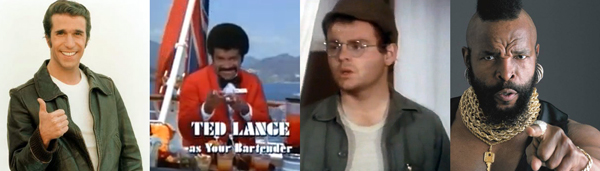
The FIRM Report

The FIRM report embraces a new model for rating project health:

  • F = Fonzi
  • I = Isaac (your bartender)
  • R = Radar O’Reilly
  • M = Mr. T


Here is how this works:

If you get a Fonzi, that means “AHHHHHHEEEY” - things are very, very coolamundo!

If you get an Isaac (portrayed here with his classic “Double Issac” hand gesture), this means things seem to be more or less okay, but it would probably be a good idea to head down to the Lido deck and start having at the Mai Tais (yes that is the plural… I looked it up) post haste.

If you get a Radar you should be remembering all those times in the TV classic M*A*S*H (ATTN Gen Y… TV Land is your friend) when Radar (IMHO, the greatest PM ever portrayed in film or TV) cocks his head ever so slightly, and says “CHOPPERS!” This usually happens about 20 seconds before anyone else hears them. In other words, there is some seriously bad stuff in the air, probably involving bodies that are no longer intact, and they are headed your way champ.

Finally, we get to Mr. T… as in “I PITY THE FOOL!” which means… Dude, you are simply screwed, and no amount of gold around your neck is going to save you from the fact that someone is going to be taking you sweet van away very soon.

More on this in the next episode of Project Potion… and I’ll be posting a status template for you to test your job stability with very soon.

Stay tuned!

Posted on: March 24, 2010 03:00 PM | Permalink | Comments (8)

Project Potion 8 - The Fonzi-Isaac-Radar-Mr. T Report

linkedin twitter facebook Request to reuse this  

We're modifying the format of Project Potion a bit, trying to keep the time down to 10 minutes or less. In this episode The Project Shrink and I talk about the Malaysian Scrum User Group, the article on Bas in PM Network and a new alternative to those tired old RAG reports... THE FIRM REPORT.

Posted on: March 24, 2010 10:32 AM | Permalink | Comments (1)

The Mike Sutton Sessions - Part 4 - Startup Diary

linkedin twitter facebook Request to reuse this  

Two weeks ago I had the pleasure of co-teaching a CSM class with Mike in Malaysia. In part 4 of the interview we shot he talks more about the work he is doing there and his startup diary, which can be found here.

Posted on: March 24, 2010 03:32 AM | Permalink | Comments (0)
ADVERTISEMENTS

"Put your hand on a hot stove for a minute, and it seems like an hour. Sit with a pretty girl for an hour, and it seems like a minute. THAT's relativity."

- Albert Einstein

ADVERTISEMENT

Sponsors