What Makes for a Good PMO Lead?


|
By Kevin Korterud
The definition of a successful PMO has changed over time. Today, a highly complex delivery ecosystem is the norm in most organizations. So PMOs that serve primarily as a “back office” function, providing only operational support services, are not seen as adding value. They are viewed as a means of reducing costs by assisting project, program and product managers with operational tasks.
The same can be said for the PMO lead in today’s modern organization. Organizations are turning to their PMO leads to share insights, impart predictability and strive towards the preservation of business value. Today, leads need capabilities that to a great degree mirror their project, program and product delivery leadership counterparts. A highly visible leader with a broad perspective across both delivery and business operations is rapidly becoming a key role in a delivery organization.
Based on the changing PMO landscape, here are what I see as the three essential characteristics of contemporary PMO leads:
The inherent complexity of projects and programs continues to increase as more of the business landscape is automated. In addition, there is growing opportunity for technology and process innovation. Projects and programs can morph into persistent and recurring product development, which in turn creates an environment where delivery is continuous. PMOs over time have also matured in lockstep with delivery complexity and persistency. PMO service groups have mechanized and industrialized PMO processes to support this growth. In concert, the charter of a PMO has shifted from being just a pure service function; it is now expected to serve as a predictor as well as an enabler of delivery. These factors put a PMO generalist at a distinct disadvantage. With higher expectations, it’s key that PMO leads have project, program and product delivery experience. These delivery skills provide insights and observations that are more organic in nature and go beyond what is found in status reports; their delivery experience allows them to get to the “so what” insights as well as to realistically predict delivery trajectory. In addition, prior delivery experience makes them more credible as a PMO lead with their project, program and product delivery peers. This also gives them the capability to become an adjunct delivery lead where required.
2. Ability to Conduct Delivery Assurance Reviews Organizations today can have hundreds of concurrent projects, programs and product delivery initiatives. In addition, the use of delivery performance metrics and other indicators can vary widely. While metrics have always been a useful starting point to determine the overall health of delivery, they don’t always reveal potential volatility in a timely manner.
Delivery assurance reviews go beyond the metrics to explore the factors behind the current trajectory of project, program and product delivery. These reviews are objective examinations conducted on behalf of an organization’s senior leadership to uncover potential delivery “surprises” not visible in status report metrics. The accumulation of delivery surprises over the entire portfolio can readily add up to a significant loss of value.
Leveraging their prior experience, today’s PMO leads are adept at conducting delivery assurance reviews. Enabled with a PMO charter that has been approved by senior leadership to mitigate delivery surprises, the combination of prior delivery knowledge as well as a value-driven mindset allows them to successfully execute delivery assurance reviews. Their organic ability to answer the questions “Where are we, where are we going and will we get there in time?” positions the PMO lead of today as a key team member within a delivery organization.
Today’s delivery ecosystem is a highly complex, fast-moving environment that demands a high level of people engagement. As a project, program or product delivery leader, the ability to seamlessly connect with organizational leadership, stakeholders and suppliers has proven a key factor in delivery success. The same can be said about today’s PMO leads. In the past, PMO leads and their respective teams were viewed more as an accessory to core delivery activities. Their services were employed directly to a project, program or product delivery lead; they rarely interacted with senior leadership, stakeholders or suppliers. However, today’s delivery ecosystem can tax the capacity and capability of delivery leadership. They need a peer partner who will help them achieve delivery success. To do so requires that the PMO lead understand both delivery and business operating models. This new PMO interaction model requires that a PMO lead possess a persona that can credibly engage with senior leadership, stakeholders and suppliers. They need to understand both delivery and business operations; the latter coming about from either professional study or exposure through prior delivery experience. While a PMO lead cannot understand every facet of business operations at a deep level of detail, having this exposure makes for more efficient and effective engagement with stakeholders as well as suppliers who are also key contributors to delivery success. The PMO Lead of Tomorrow Not long ago a colleague told me they were going to take on a PMO role in an organization. When asked about their motivation to do so, they shared that there were no current project, program or product delivery lead roles open, so they thought this would be a good place to start in this organization.
Much to my delight, this person had a strong background in delivery, professional training in relevant areas of business operations as well as plentiful experience engaging with leadership, stakeholders and suppliers. I smiled to myself that although they had no prior PMO experience, they had all of the right skills to succeed as a PMO lead.
PMO leads need all three of these skills in order to succeed in today’s modern delivery ecosystem. For the PMO lead of tomorrow, they’ll require even more skills to deal with ever-increasing demands for project, program and product delivery. This will position them to play an even greater role in the delivery success of an organization. I’d love to hear from you: What do you think makes for a good PMO lead?
|

Exploring the Philosophies and Principles of Planning Approaches
Categories:
Project Planning
Categories: Project Planning
| By Lynda Bourne
Any output from a planning process is an embodiment of the planners’ fundamental principles and philosophies. They apply these principles, or approaches, to develop their plans. And different people will develop different plans to achieve the same objectives. As early as the 1950s, James Kelley, one of the developers of the critical path method (CPM), reflected on this theme. He noted that in a class of 20-plus people learning the new CPM approach to scheduling, developing a 16-activity schedule from a set class exercise would result in nine to 10 different schedules. Clearly, different people use different approaches and assumptions. What Shapes Approaches The planner’s approaches may be explicitly stated, or they may be implicit and affected by:
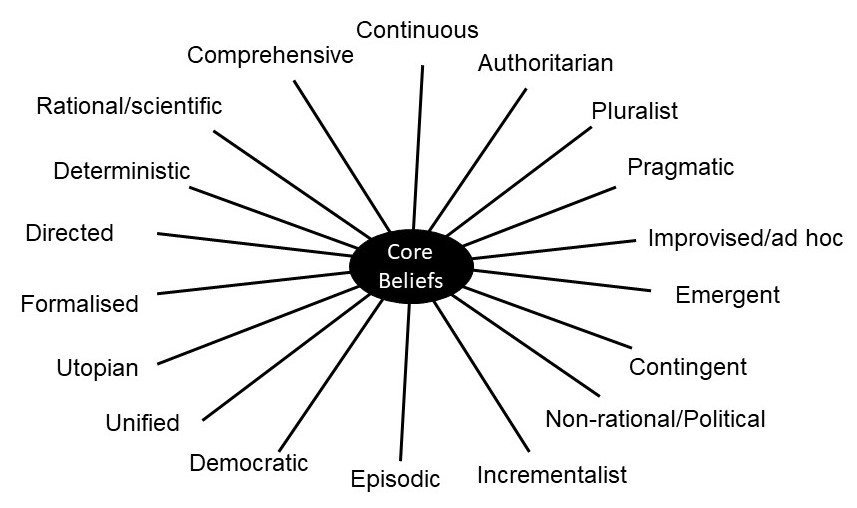
The conundrum facing organizations is deciding the best approach to develop a plan—one that’s accomplished in the most efficient way within a given set of circumstances, in a given cultural environment, that results in the best outcomes. There is no one right answer to this question, or one way of knowing if the chosen options have delivered the desired result. Each project is unique, making tests and comparisons impossible. Some of the approaches that can be used in combination, or isolation, include:
This diagram pairs opposite approaches; it’s up to you to determine where on the continuum is best for you in the current situation. Applying the Approaches The challenge is understanding the choices open to you and then making informed decisions about where on each of the dimensions is best for you in the current circumstances. Making overt choices rather than just doing the normal thing will generally lead to better planning outcomes. For example, an agile project will require a planning approach that leans toward using non-rationality, incrementalism, contingent, emergence, improvisation, utopian, pluralistic, democratic and continuous approaches to the planning activity. A traditional “hard dollar” engineering contract, on the other hand, tends to require the opposite. My recommendation is you think through these options. This offers you an opportunity to improve your planning practice, as one approach will not suit every project and simply doing the same as last time will inevitably lead to a suboptimal outcome. How do you think about your approach to planning? |

What I’ve Gained as a PMI Volunteer
| By Conrado Morlan
Did you know PMI is supported by volunteers from around the world? I had no idea when I first joined PMI in 2005. That changed in October 2007 when I joined the ranks of PMI volunteers, a community of practitioners who give their time to work on activities that make a difference around the world. I learned about the many services undertaken by volunteers, including writing PMI standards, preparing questions for certification exams, organizing global conferences and presenting at PMI events. And the list goes on and on. My first opportunity as a PMI volunteer came three or four months after I registered as a volunteer: participating in an item-writing session for the Project Management Professional (PMP®) exam in Philadelphia, Pennsylvania, USA. At first, I had too many questions and felt daunted. Would I be able to deliver? Am I experienced enough? Would I be called again after this session? When I arrived in Philadelphia, I put that feeling away and got ready to spend three days with a selected group of experienced project management practitioners from the United States and Canada. The session was quite productive; we shared our personal experiences and produced great material for the next version of the PMI certification exam. The experience was one of a kind; I could not believe everything I learned in three days, and for free. I went on to participate in sessions in São Paulo, Brazil; Mexico City, Mexico; Washington, D.C., USA; Macao, China; Amsterdam, the Netherlands; and more. I had the fortune to write items for the PMP, Program Management Professional (PgMP)® and Portfolio Management Professional (PfMP)® certification exams. But that was just the beginning. I kept looking for volunteering opportunities and, on several occasions, submitted papers for PMI congresses in North America and Latin America. Many of my papers were accepted and well received by audiences across the globe. Through the years, I also have supported local chapters as a keynote speaker or guest speaker in Dallas, Texas, USA; Mexico City, Mexico; Costa Rica; and Nuevo León, Mexico. This has enabled me to share my experiences working with multicultural project teams and meet practitioners from different latitudes. In 2009, at the congress in Orlando, Florida, USA, I tried something new: writing columns for a special edition of PMI Today. I then co-authored articles for PMI Community Post, have been quoted in several PM Network articles and, as you know, am a frequent contributor to Voices on Project Management. My proudest moments as a volunteer were when I was selected as a core team member to develop the Implementing Organizational Project Management: A Practice Guide and The Standard for Organizational Project Management in 2013 and 2016, respectively. The opportunity to interact with other project leaders from around the world and contribute to the profession was extraordinary. If you’re still wondering why I am grateful to be a PMI volunteer, try it for yourself. Take the opportunity to live your profession with passion. See what you can gain by sharing experiences with other colleagues while developing and mastering your skills in a friendly environment. What are you waiting for? Make your mark and join the local or global volunteer team to grow and advance the project management profession.
|

5 Career Tips for 2020
|
By Jen Skrabak, PMP, PfMP, MBA As we close out 2019 at work, wrap up projects, and plan to spend time with our families for the holidays, sometimes we forget this is the best time to prepare for the year to come. Here are my five tips to get you in the mindset: 1. 2020 starts now. The traditional thinking is that nothing happens from Thanksgiving to New Year’s since hiring managers and companies are preparing for the holidays. The real situation is that everything happens at the end of the year. Companies are busy preparing for next year, and, from personal experience, November/December has been the busiest time for recruiting senior-level portfolio/program executives. Hitting the ground running starting Jan. 1 means that 2020 starts now. Key questions for you to start your 2020 planning:
2. Ladder up your experiences and skills. The traditional thinking is that a career ladder is about getting a new title at the next level with a higher salary. The real situation is that building your career is about learning agility and building a repertoire of experiences and micro roles. If you’ve been in program or portfolio management for seven years or more, it may start to feel that you’ve “been there, done that.” To get to the next level of experiences, ask yourself: In 2020, how will you learn a new skill, gain a new experience or learn from someone? 3. Transformation must be visible. The traditional thinking is that transformation is about organizational change management, which is mainly instituted through a variety of communication methods and channels (memos, town halls, workshops, staff meetings, etc.). In a recent viral stationary bike ad, the woman depicted before and after the transformation looked the same—many people had issues with the cognitive dissonance where she said that her life changed so much, but the change was not visible. The real situation is that transformation is more than just communication. Instead of telling people what the change is, the approach should be to actively demonstrate the change so people can experience it. Transformation at the organizational level is about behavior change. When I implement a large-scale organizational change, I personally lead up interactive training sessions to teach people about the change, as well as follow-up sessions where I’m hands-on in mentoring and coaching people on the new skills. It’s a great way to get real-time feedback about the change, and most importantly, to be seen as the expert coach within the organization enabling the change. This has been very effective in building trust and credibility in the organization. 4. Create space. The traditional thinking is that when you see a good idea for a program, go implement it—quickly—to take advantage of speed to market. The real situation is, just like a cluttered drawer that you keep adding to, a portfolio can be cluttered if not systematically managed. From a personal standpoint, I had to move recently, and I was surprised at how many things I found in the back of the drawer that I forgot existed. When I emptied it out and scrutinized every item, I discovered that 30-40 percent of the items were not needed or were no longer useful since they were damaged, broken or just plain outdated. By getting rid of items, I created space for new items and technology, just like in an organization. The steps to portfolio management in an organization are:
5. Volunteer for your next role. The traditional thinking is that your manager assigns you the next program or role. The real situation is you are responsible for actively managing your next role. You should tell the right managers and other leaders what you would like your next program or role to be. Key steps:
Don’t wait: What is your plan for starting 2020 now? |

3 Things I'll Be Keeping An Eye On In 2020
Categories:
Best Practices
Categories: Best Practices
|
By Dave Wakeman I never like to miss a trend, so since 2020 is just around the corner, I thought I would put together a few of the ideas I’m going to be exploring in the coming year. My hope is that you all will reply in the comments section with some of your own ideas and areas of focus. We can call it a prediction post, without predictions. Here are the three things that I’ll be focusing on in 2020: Economic Uncertainties As I’m writing this, the United Kingdom is holding an election to try to clarify what they will or won’t do about Brexit. And I likely don’t have to tell you there’s an election in the United States in 2020. Alone, these two things mean little to most project managers, but underlying these elections is a sense of economic uncertainty due to some of the issues that are driving them. This is a big idea to pay attention to because the U.S. and the U.K. are two of the largest economies in the world. All of us have to pay attention because potential ripple effects could sideline our projects, cut our budgets, or just cause a general sense of uncertainty to seep into our work. I’ll be checking the economic pulse constantly in 2020 because uncertainty of any kind can have a big impact on business, the economy and our jobs. Climate Change I’m back from Australia, and while I was there New South Wales was dealing with severe brush fires. Some have attributed the fires to the impact of climate change. Whether climate change is an attributed factor in these fires or not, the trend of weather patterns being more severe is impacting population centers around the world. I’ll keep an eye on this because where there are challenges, there are opportunities. As project managers, the opportunity to mitigate the impact of severe weather is a huge chance to hone our skills, develop new solutions and work on things that really do have a significant, real-world impact. For me, I’m going to look at every major weather event and ask what were the lessons learned, what could we do to handle it better, and what is the trend line for this kind of event so that I can better understand where my skills and mindset can add the most value. Changes in Technology We take it for granted that technology is moving fast and changing the way we approach our lives and careers. I’ve been running out the flag that technology is a tool we should be using to improve our ability to do the things that only we, as humans, can accomplish. Maybe it will be a theme of the new year—I don’t know. But what I will say is that technology has been a crutch for a lot of us over the last few years, and as much as it improves our ability to do things, it also jams us up or sends us down a rabbit hole of needless activity. In 2020, I’m going to keep an eye on how we are using technology. Can we find ways to take mundane, repetitive tasks off our plates and give us the freedom to do the things that really add value? Or, are we continuing to allow technology to drive us and make us a tool of technology’s use? From my point of view, keeping an eye on technology likely means spending more time focusing on the outcomes I need to achieve and thinking through how technology supports them, instead of getting lost in all the cool features that a solution has to offer. But enough about me. Where are you going to focus your attention in 2020? |