




Guessing is not a strategy: How to build decision velocity with AI and real-time data
June 10, 2026 | Live Webinar

PMOs Navigating Complexity: From Coordination to Sensemaking
How to Measure PMO Impact Practically, Based on Evidence Rather Than Perception
How to Reposition the PMO for Real Influence
Mature PMOs Still Fail to Prove Value to the C-Level – Part 1
Cybersecurity in Project Management: From Risk Awareness to Structured Execution
Agile, best practice, business agility, competence, Consulting, customer, customer succcess, Decision Making, Education, excellence, Governance, Government, Healthcare, Information Technology, Innovation, kamishibai, Leadership, leadership, lean, Organizational Project Management, PM in Academia, PMO, pmo, pmo, project leader, project manager, risk, risk management, scope, storytelling, team


PMOs typically operate through a familiar set of mechanisms:
But there is a type of environment that challenges this operating model. Even with:
The challenge becomes less about controlling execution and more about interpreting context. Not every problem requires the same responseA common trap in PMO environments is assuming that problems that look similar require the same treatment. When something is not working, typical responses often emerge:
A more useful question may be: Are we dealing with an execution problem or an interpretation problem? Some signals can help.
Decisions do not always arrive completeProjects frequently receive decisions accompanied by:
Turning interpretation into certainty. One practical alternative for PMOs is to structure conversations across three levels. What is definedAvailable facts, decisions already made, and current direction.What remains under analysisImpacts, dependencies, validations, and assumptions.What happens nextImmediate actions, follow-up activities, and review points.This separation reduces noise without requiring absolute predictability. Data does not replace understandingMany PMOs already have enough information. The challenge has changed.
Are we on schedule? With questions such as:
The goal is to complement indicators with interpretation. Alignment becomes a process rather than an eventIn more dynamic environments, alignment does not happen only at formal milestones. It needs to be rebuilt continuously. Some practices that PMOs can apply:
It is to prevent different areas from operating with different versions of reality. Communication also changesAnother recurring issue is waiting for complete certainty before communicating. In practice, this often creates:
What we knowWhat is still evolvingWhat we will do nowThis approach improves alignment without creating false predictability. Five questions for PMOs to bring into the next meeting
ClosingGovernance remains necessary. But some environments require an additional capability. For PMOs, this means complementing discipline with interpretation, expanding contextual awareness, and maintaining direction while understanding continues to evolve. |
| Most PMOs do not measure impact. They measure activity. And they often treat both as if they were the same thing. The problem is not conceptual. It is structural. Impact is not something a PMO “declares.” It must be derived from organized evidence, and that evidence does not emerge from isolated indicators. It emerges from a system. The PMO-Mi Model framework addresses this explicitly: Measurement does not start with impact. It starts with the structure that allows impact to be observed. This implies three distinct layers that most PMOs tend to mix.
The first mistake is using progress as evidence. Common examples include:
These indicators demonstrate execution, not effect. They answer: “What was done?” But they do not answer: “What changed because of it?” This distinction is fundamental. Impact only exists when there is an observable change in the organizational system.
The second mistake is using maturity as a proxy for impact. More structured PMOs often assume: “We have capability, therefore we generate impact.” The data suggests otherwise. Organizations continue investing in delivery capability while still showing significant gaps in converting those investments into business outcomes. Capability measures potential. Impact measures realization. Without evidence of realization, maturity is merely infrastructure.
The PMO-MI model is explicit: Impact is not attributed to the PMO as an entity. It is attributed to the services the PMO performs. This entirely changes how measurement should be approached. The question is not: “PMO impact” The question becomes: “What is the impact of service X within domain Y?” Without this linkage, there is no traceability. And without traceability, there is no evidence.
Another recurring mistake is treating indicators as proof. Isolated indicators do not demonstrate impact. They must be integrated into a coherent interpretation logic. Within the AIPMO perspective, measurement maturity requires moving from data to decisions. This implies:
Without this, the PMO accumulates data but does not generate evidence.
Impact does not appear directly. It must be inferred through observable patterns. For example: Not: “The PMO improved decision-making.” But rather:
And most importantly: A clear connection with the service that generated the effect. Without this structured inference, the PMO remains trapped in perception. The central point If impact cannot be traced, connected to services, and observed in organizational behavior, then it is not being measured. It is being assumed. |
Repositioning the PMO is not an organizational decision. It is a consequence of the operating model in which the PMO exists.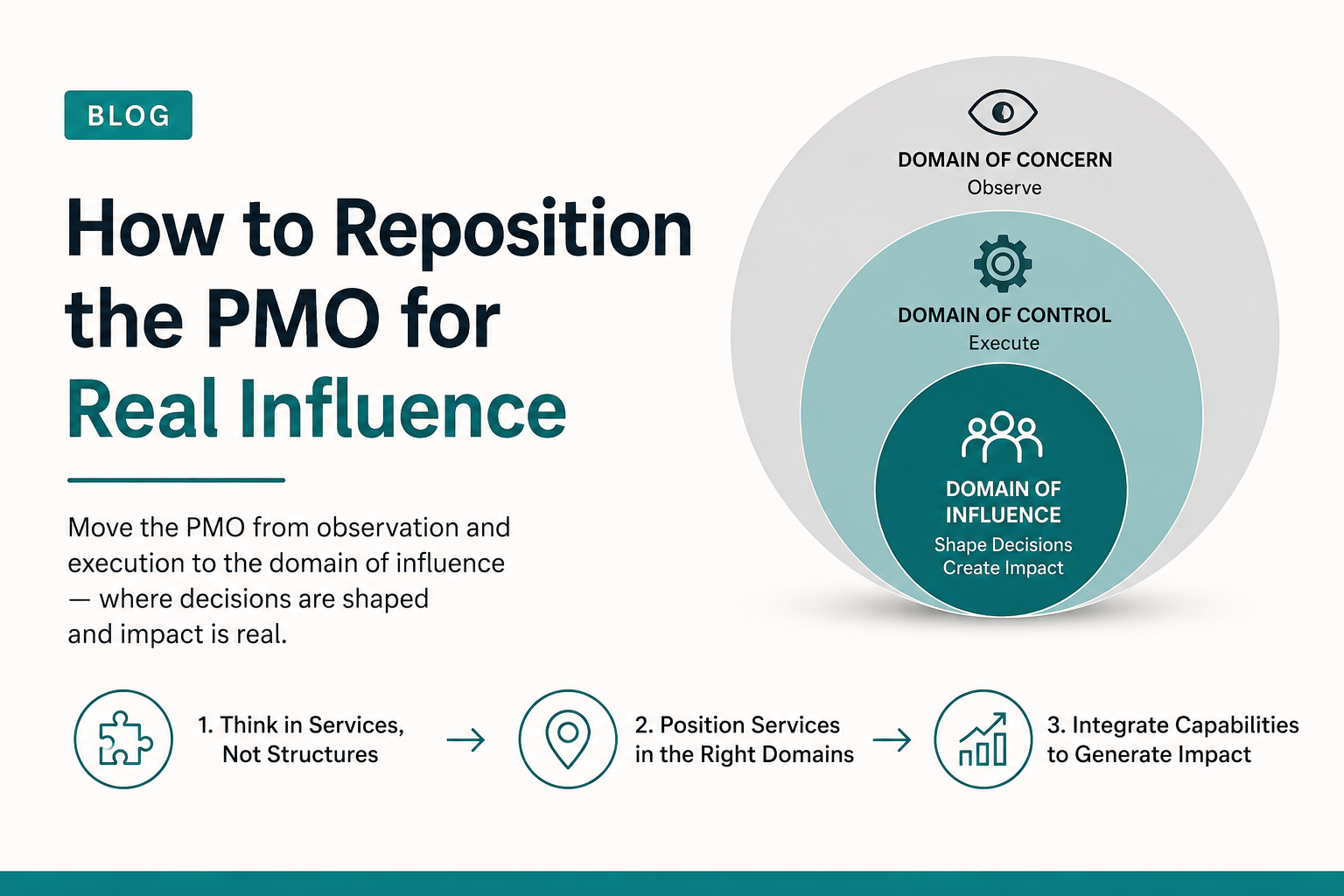 As long as the PMO remains restricted to the domain of concern, it observes. When it operates within the domain of control, it executes. Influence only emerges when the PMO consistently operates within the domain of influence. Most PMOs are not at this level, and it is not because of a lack of technical capability. It is because the operating model prevents it. The mistake begins with how the PMO is defined. It is still treated as a structure. But structures do not generate impact. What generates impact are capabilities organized into services, operating within specific domains, and connected to the real decision-making process. Without this, any attempt to reposition the PMO becomes narrative. It does not change behavior. Repositioning the PMO requires three structural changes.
Influence is not a characteristic of the PMO. It is the result of the services the PMO delivers. The PMO-MI Model model is direct: Impact is not in the existence of the PMO, but in how its services operate and connect. This changes the core question. Instead of asking: “What is the role of the PMO?” The question becomes: “Which services actually interfere with relevant decisions?” Without this shift, the PMO continues trying to gain relevance through internal structure. And that does not change outcomes.
Not every service needs to influence decisions. However, critical services must be positioned where decisions are made. The model establishes that impact occurs in the domains of control and influence, not within observation. This requires a clear distinction:
Without this distinction, the PMO increases operational activity without increasing organizational relevance.
Isolated capability does not create influence. Impact is not the result of adding practices together. It emerges from the integration between services and domains. This is the most neglected point. PMOs improve processes, tools, and controls. But they fail to integrate capabilities in ways that alter how the organizational system operates. The result is predictable:
The capability to connect information, anticipate implications, and act before decisions become fixed. Without this, the PMO reacts instead of directing.
How to measure impact practically, based on evidence rather than perception. |
| There is a pattern that is rarely discussed openly. The more a PMO evolves internally, the less influence it tends to have over the organization’s critical decisions. This is not a competence issue. It is a positioning issue. The PMO becomes more structured, more consistent, and more reliable. But the decision-making center follows a different flow. Executives do not operate based on organization. They operate based on consequence. They respond to movements that change results, reduce material risk, or shift direction. And this type of input rarely comes from the PMO. In practice, what happens is straightforward. The PMO gains more in-depth visibility into projects. But it does not gain greater influence over what gets decided. It sees better. However, it remains outside the moment when decisions are made. This misalignment creates a silent effect. The PMO becomes informative but ceases to be determinative. At that point, executive perception shifts: the PMO is not changing anything that truly matters. The problem is not in reports, rituals, or governance. It lies in the absence of connection between what the PMO produces and the points where the organization defines priorities, risks, and investments. 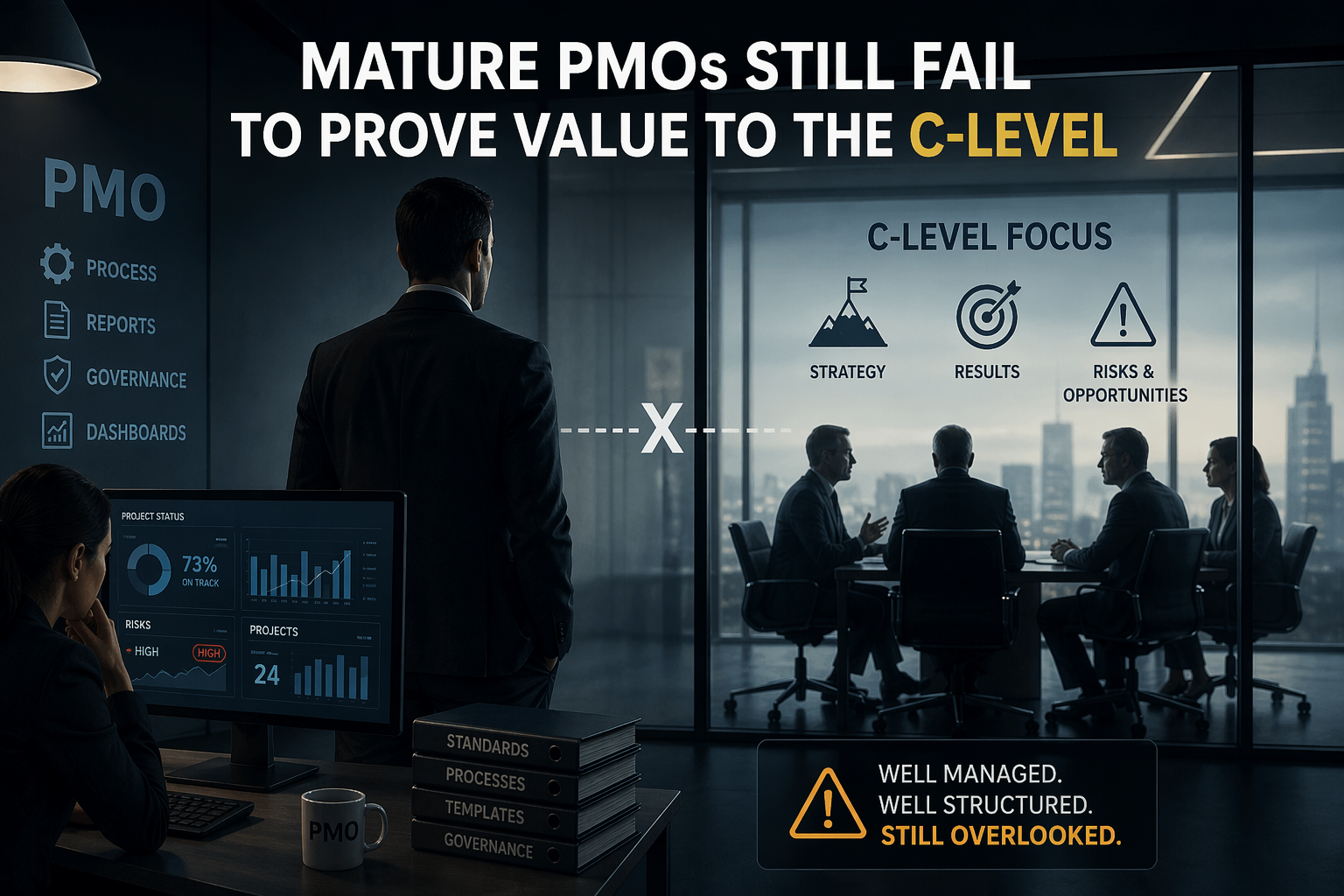 Without that connection:
None of this shows up in internal assessments. Because they measure consistency, not influence. This is the breaking point.
|
| |
|
"Nobody can be exactly like me. Even I have trouble doing it." - Tallulah Bankhead |