


The 4Ps of Citizen Development: Products, Promptness, People, and Process Framework


| Lots of people think Citizen Development is still a buzzword. However, it is interesting to know how the low-code/no-code platforms have grown over the years. I joined the Low-code & No-code (Rapid Application Development by low-code citizen developers) and the Toronto Citizen Developer User Group recently on LinkedIn and was amazed at how people have been doing great with the available low-code/no-code platforms. These platforms have made business users see an opportunity to optimize a process and take it upon themselves to create their apps.
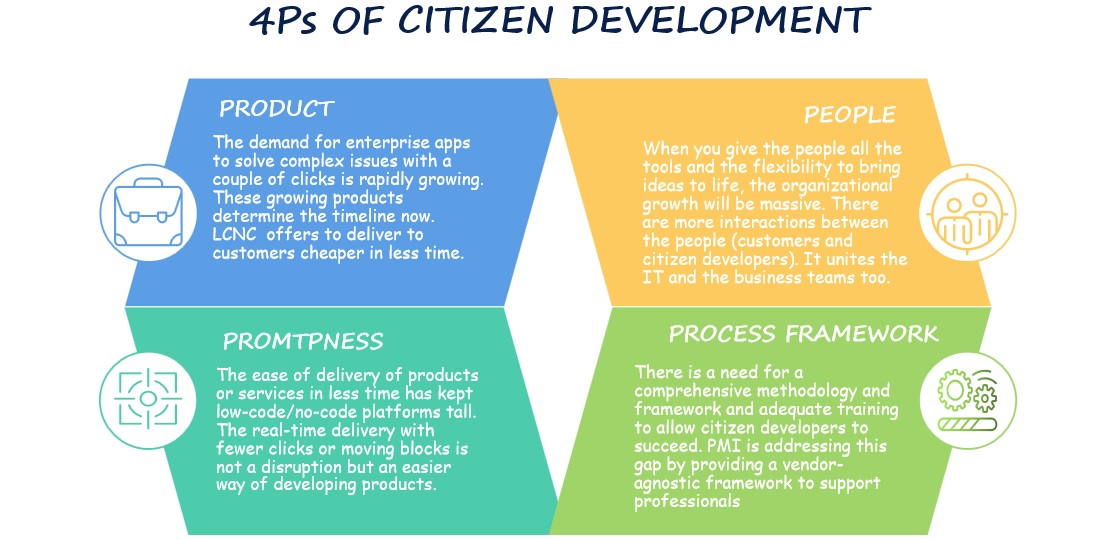
Some have argued, these disruptions in IT will not survive enterprise products, you need to train people to adapt, and those behind the blocks, doing the plug and play designs are IT savvy. Covid19 made the world know that the virus determines the timeline and we just have to regularize the situations to fit. The need for products and services, streamlining business processes determines the timeline now, it is growing by the day, low-code/no-code platforms have come to the rescue, and Project Management Institute (PMI) has developed the world’s first vendor-agnostic governance framework for citizen development (PMI Citizen DeveloperTM). One of the major factors affecting the prompt delivery of IT products is the miscommunications between the developers and the end-users. Sometimes, these developers waste months and years developing products that would become obsolete or useless for the users. At the core of these are the Four (4) Ps to citizen development struggling behind the scene to take charge. These are products, promptness, people, and process framework. However, all of these are as important as the other.
No doubt, there is a higher demand for IT products or services, the backlogs are growing more than ever, and the IT departments are under pressure to meet this growing demand. Low-code/No-code platforms are growing by the day. The links below are clear on this. Gartner estimates that low-code app platforms would account for over 65% of development by 2024 (https://www.salesforce.com/blog/gartner-lcap/). Forrester forecasts that the low-code market would top $21 billion spendings 2022 (https://go.forrester.com/blogs/why-you-need-to-know-about-low-code-even-if-youre-not-responsible-for-software-delivery/).
The demand for enterprise apps to solve complex issues with a couple of clicks is rapidly growing. These growing products determine the timeline now. The available options to get it done faster are the Low-code/No-code platforms. These platforms are equally getting better, products or services are delivered to customers cheaper in less time.
2. PROMPTNESS The ease of delivery of products or services in less time has kept low-code/no-code platforms tall. The real-time delivery with fewer clicks or moving blocks is not a disruption, but an easier way of developing products. Quick response to deliver value from Citizen Developers with a few clicks after understanding the requirements is key to making customers happy. Low-code/no-code platforms employ drag and drop tools instead of the usual long codes of programming. Platforms are easily comprehensible and they require less training. They have easy features, tools, and models. Citizen Developers can experiment, prototype, and deliver apps in hours to customers.
3. PEOPLE At the core of whole lots about low-code/no-code are the products to service the people. Ideas abound, the tools are now in the hands of the people (employees), and business processes are more flexible. The power to offer solutions is in the hands of those at the core of business processes to deliver results faster. "The simple act of paying positive attention to people has a great deal to do with productivity" - Tom Peters When you give the people all the tools and the flexibility to bring ideas to life, the organizational growth will be massive. End users can now build departmental, customized, and public applications using low-code/no-code platforms. The demand for products or services is growing. There are more interactions between the people (customers and citizen developers). It unites the IT and the business teams too.
4. PROCESS FRAMEWORK The Project Management Institute (PMI) has developed the world’s first vendor-agnostic governance framework for citizen development (PMI Citizen DeveloperTM). “PMI recognizes the critical role that citizen development plays in empowering individuals and organizations,” Mr. Prashara from PMI says. “As organizations look to leverage citizen development in their digital transformation programs, there are many pitfalls to avoid, including the lack of a comprehensive methodology and framework and adequate training to allow citizen developers to succeed. PMI is addressing this gap by providing a vendor-agnostic framework to support professionals’ need to learn the basics and best practices, but also organizations’ need to unlock the potential of citizen development in compliance with IT governance and security. This will give IT the confidence to scale citizen development across the enterprise to accelerate the organization’s transformation efforts.” This framework includes a set of umbrella activities that are applicable across the entire Citizen Development process.
Your opinions and insights will be quite appreciated, feel free to leave them here.
|


How Will Citizen Development Impact Leadership, Decision-Making and How Projects are Run? Part 3
| Welcome to part 3 of my 3-part series on how citizen development is impacting projects and project management. Through the lens of citizen development, I am looking at the areas of
If you missed parts 1 and 2 you can read them here and here.
How Citizen Development Can Impact Decision Making
At the core of Citizen Development lies decision-making about projects and programs that must align with organizational strategic objectives, the readiness of the decision-makers, the underlying factor of Return on Investment (ROI), and the uncertainties of citizen development, but one factor that keeps citizen development ahead is the speed of delivery of products or services in less time.
Lots of programs have failed even though time and a huge amount of funds were spent to deliver the benefits. Sometimes, products become obsolete at roll-out. The recent Covid-19 saga has shown the world that one has to respond faster to contain it. Real-time development and deployment of products or services is key to citizen development.
In my training as a Software Tester, one must not wait to find all the defects for a product to go live, some defects will pop up when the product goes live in different environments. Feedbacks will eventually help in fine-tuning the flexibilities required when the product is live and in use.
It is great to know citizen development is already launched on an existing low-code/no-code (LCNC) platform. The usage of LCNC is on the increase and the platform will get better as it progresses. The world is changing, the need for building applications will grow higher and the world will not find a better way to deliver products or services than to leverage on a low-code/no-code platform to deliver applications cheaper and in less time.
Applications will be launched faster with a higher Return on investment (ROI). This will not be negotiable for CEOs who always go for profit maximization. The low-code/no-code market will be huge in the nearest years.
This boom will reshape organizational development in my opinion. This is because it will create more opportunities for both the organization and the employees. Ideas can be brought to life in no time, and organizational growth will be rapid.
The strength of every organization is the people (employee), the fear of investing lots of resources on the employee ideas will be gone with a low code/no-code platform and ideas can be brought to life faster and cheaper.
The growth will be unstoppable with a low code/no-code platform.
|

How Will Citizen Development Impact Leadership, Decision-Making and How Projects are Run? Part 2
Categories:
citizen development,
software development,
PMI,
Strategy,
Leadership,
Citizen Development
Categories: citizen development, software development, PMI, Strategy, Leadership, Citizen Development
| Welcome to part 2 of my 3- part series on how citizen development is impacting projects and project management. Through the lens of citizen development, I am looking at the areas of
If you missed part 1 you can read that here ( http://www.projectmanagement.com/blog-post/67865/How-Will-Citizen-Development-Impact-Leadership--Decision-Making-and-How-Projects-are-Run--Part-1) How Citizen Development Relates to the PM Face
Citizen development is the new revolution for rapid organizational development, PMI has already developed a Governance Launchpad Framework and the low-code/no-code platform is readily available to explore. I am poised and glad to be part of this revolution in organizational development that will equally develop the people.
I look forward to sharing my next blog with you where I look more at the impact of citizen development on decision making.
|

My Experience of the Citizen Developer Foundation Course
My Experience of the Citizen Developer Foundation CourseMy ObjectiveAs a consultant, upskilling and advancing my knowledge on new technological advances is key. I have completed a lot of research on Low-Code/No-Code, i.e., Citizen Development, in recent months. My primary objective of completing this course was to further enhance my knowledge in this area. Module 1- Introduction to Citizen DevelopmentAt the start of this module, the learning objectives are clearly stated. You will learn:
By completing the module, I am happy to say that I achieved each of the learning objectives. The information included in this lesson was concise and interesting. The use of statistics was also very helpful. Instead of going into detail about how I found the module content or the elements in the module, I have created a table that summarizes my favourite aspects of the module and some ways in which I think the lesson could be improved.
Module 2- Overview of the Citizen Development CanvasThe learning objectives were also very clear at the beginning of this module. You will understand:
At the end of this module, I feel as though I met the learning objectives. I found the Citizen Development Canvas a little overwhelming, albeit, extremely useful. The canvas is depicted in an aesthetic graphic. It is clear that a lot of time and energy went into the creation of the Citizen Development Canvas - it is thorough. The table below summarizes my favourite aspects of the module and some ways in which I think the lesson could be improved.
Module 3- Ideation 2.0Again, the learning objectives were made clear at the outset of this module. You will learn:
I found the learning objectives easy to achieve during this lesson. The content contained in this module is in a logical flow which really enabled me to gather and understand the content quiet easily. This was an excellent module. The information was straight forward and to the point (there was no padding).
ConclusionOverall, I really enjoyed the Citizen Developer Foundation Course. I would rate the course very highly. My personal objective of taking the Citizen Developer Foundation Course was to enhance my knowledge in citizen development. I can proudly say, I have done just that. I am excited for the next course to be released. If you are interested in taking this course, be sure to go to: https://www.pmi.org/citizen-developer and enrol. Let’s hope the next PMI Citizen Developer course is as enjoyable.
|
A Quick Introduction to Ideation 2.0 (with a Case Story)
| Welcome to the world of citizen development. Amazing things happen here in the world of citizen development. If you’ve been in it a while, you already know how incredible it is to watch an idea go from spark to screen in days or even hours. If you’re new to citizen development, get ready for a fascinating new reality. This post is the second in a series that will introduce you to elements on the PMI CD Canvas (see graphic below). These posts are designed to inspire you, share tips and insight, and further your knowledge and experience. I welcome your questions and encourage you to share your own stories. I am glad you’re here. Last month I introduced you to Hyper-Agile SDLC. This month, I will introduce you to Ideation 2.0.
What is Ideation 2.0? Ideation is as old as humanity itself. You know how it goes: A group gathers to come up with ideas to solve a problem or invent something new. Ideators love it; implementers get restless. Ideation 2.0 lets the genius of both groups shine simultaneously. Ideators get to perpetually ideate and implementers get to perpetually implement. It’s a synergetic union, but how is it possible? It’s possible because of low-code / no-code / (LCNC) app creation. Your team spots an inefficiency and decides an app can fix it, then builds the app (often within a few days), launches the app, and continuously improves it with little or no delay, based on user feedback and more ideas. The key differentiator of Ideation 2.0 is the real-time development of LCNC apps (built by non-IT personnel) and rapid iterations based on user feedback and requests, allowing ideas to quickly take shape and launch throughout the entire development process.
Case Story: Ideation 2.0 in Action Situation: A security company needed to improve and secure data sharing between their dispatch and event security teams and determined a LCNC app could be the solution.
Before: The dispatcher team handled incoming requests, security issues, and scheduling security officers. The security team were stationed at various locations and provided security support at events, for VIPs, and small groups. The two teams had no efficient way of securely communicating the constantly changing incoming and outgoing information in real-time. They relied on unsecured texts, emails, and radio messages to relay updates, and each day the security team would download a PDF doc of the day’s info, which was quickly outdated.
Process: A core team of dispatchers and security officers was formed to design a secure app for data sharing between teams. Ideation 2.0 kicked off with a team idea gathering session to create a product vision board. Once that was completed, a prototype was built to specifications in 5 days using the hyper-agile SDLC process, then tested, and released to the core team for a beta test. Ideation 2.0 continued as the core team quickly returned with additional ideas, feature requests, modifications, and adjustments. The requests were implemented according to the change request process and the tool was deployed for a two-week trial for user testing in the field.
After: The teams were trained on how to navigate and use the tool and quickly began sharing additional ideas (continued ideation 2.0) based on their team’s needs. The core team remained in close contact with user teams and saw that some of the functionality originally requested by the core team wasn’t proving helpful after all. The citizen developer updated the tool and pushed it out to the end-users quickly and efficiently. Additional ideas and features outside of the original ones were added, such as the ability to upload photos, complete required incident forms, and time tracking. This further increased the value of the tool in the eyes of the whole team. Ideation 2.0 was part of every step starting with the core team’s initial ideas, beta-testing, two-week trial, and final survey questions. Ideators, implementers, and end-users were key to the creation and continual improvement of the app which exceeded the initial requirements and expectations.
Applying Ideation 2.0 in Your Organization In the world of citizen development, Ideation 2.0 is not a one-time thing, it is a continuous flow of idea generation and implementation throughout development. There are many ways to gather initial ideas for an LCNC app from your team. Some are detailed on this portal and others can be found in the Citizen Development Body of Knowledge. In the meantime, here are four suggestions as to how you would apply Ideation 2.0 to your next project:
What did this post spark in you? Are you new to no-code/low-code app creation? Have you used Ideation 2.0 in your company? Please post your questions, comments, and stories below. |



