How to Improve When You Can't Adopt New Technologies Easily
From the Disciplined Agile Applied Blog
by Scott Ambler

This blog explores pragmatic agile and lean strategies for enterprise-class contexts.
Recent Posts
Data Technical Debt: 2022 Data Quality Survey Results
Is Technical Debt A Management Problem? Survey Says...
You Think Your Staff Wants to Go Back to the Office? Think Again.
Contracts, Procurement, Vendors, and Agile
Disciplined Agile 5.4 Released
Categories
#AgileBeyondIT,
#ChoiceIsGood,
ACP,
agile,
Agile Alliance,
agile-manifesto,
book,
Business Agility,
Certification,
Choose your WoW,
Conference,
Context,
Continuous Improvement,
contracts,
COVID-19,
Data Management,
database,
DDJ,
Disciplined Agile,
Enterprise Agile,
estimation,
Fundamentals,
Governance,
GQM,
guesstimation,
http://disciplinedagiledelivery.com/principles/be-awesome/,
India,
information technology,
Introduction,
Kanban,
lean,
MANAGEIndia,
math,
MENA,
Metrics,
mindset,
News,
OKRs,
Organization,
People Management,
Planning,
PMO,
Portfolio Management,
Principle,
Project Management,
Quality,
Ranged Estimates,
Remote Work,
Scrum,
Security,
skill,
software,
Surveys,
Technical Debt,
Technical debt,
Terminology,
Transformation,
value stream,
vendor management,
VMO
Date

I was recently part of a business agility webinar for PMI's MENA (Middle East and North Africa) chapters. At the very end of the webinar we were asked a question that was along the lines of "How can you apply DA when you're unable to adopt new technologies?" which I answered quickly as we were out of time. My answer was a bit harsh at the time, which I share below, and in hindsight I wish I'd had time to answer more thoroughly. Hence this blog posting which presents a more thorough answer.
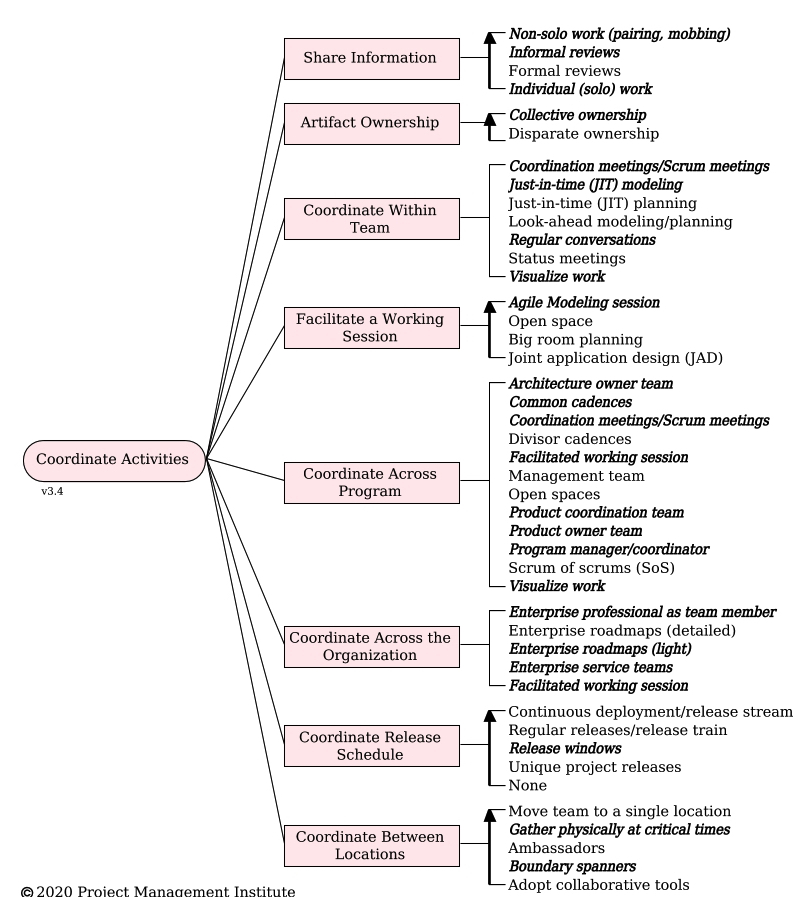
First, improvement doesn't always require new technology. Many of the techniques referenced by the Disciplined Agile (DA) toolkit are technology independent. For example, consider the Coordinate Activities process goal diagram of Figure 1. Many of the techniques are manual in nature, such as Agile Modeling sessions (OK, you require the "technologies" of whiteboards, markers, and sticky notes), architecture owner teams (a cross-team group of people), and release windows (scheduled times when it's possible to release/deploy something to your customers). On the other hand, some improvements may require new technologies. For example, the strategy of adopt collaborative tools to coordinate between locations explicitly requires the adoption of agile management tools such as Atlassian's Jira or Zoho's Sprints. The point is that your organization's potential inability to adopt new technologies doesn't completely prevent you from making improvements to your way of working (WoW). As always, it depends.
Figure 1. The Coordinate Activities process goal.
Second, it's not that you can't adopt new strategies, it's that organizationally you choose not to. Stop looking for excuses to not improve, to not do what needs to be done for your organization to survive in the new competitive landscape that you face. Really. You need to stop making excuses. Your competitors are finding ways to adopt new technologies and so can you. You need to start making some hard choices now. My recommendation is that choose to succeed, and then choose to do the hard work required to do so.
Third, if you can't respond and improve quickly in the age of COVID-19 you're not likely to survive. This was pretty much my answer in the webinar. If there are groups in your organization preventing you from making the improvements that you need to compete and better serve your customers then you need to remove those blockers now. This may mean that you educate those people as to why you need to improve, help them find budget to support the changes, or even ask them to get out of your way. Yes, that final strategy may require leadership within your organization to rethink whether those people should still be employed by your organization - even if that includes some of them.
Fourth, helping your organization improve sounds like a great opportunity for your project management office (PMO). Earlier in the webinar PMI's Srini Srinivasan had addressed the issue of what role PMOs have in an agile organization. He understandably indicated that PMOs must offer real value and be seen doing so. If your organization is struggling to make the changes it needs to improve, that sounds like a pretty good opportunity for a PMO to add tangible value.
I can't tell you exactly what the "new normal," or perhaps more accurately the "new abnormal," will be in the COVID-19 and post COVID-19 environments. But I know that it will be much more competitive than what you've been used to up until now. I also know that it will require you to be able to better sense and respond to the changes in your environment. The Disciplined Agile (DA) tool kit can help you to do exactly this.
Posted on: May 27, 2020 03:46 AM |
Permalink
Comments (10)
Please login or join to subscribe to this item

Mario Faddoul
Chapter Engagement Lead - MENA| Project Management Institute
Leb, Lebanon
I couldn't agree more. Your "harsh" answer was only reflecting reality. It is a good slap in the face that will make organizations stop making excuses and focus on what really matters to succeed!
Technology governance and standardization are needed to avoid chaos, but they like all else need to evolve to remain relevant and responsive to what the organization needs to grow. Thanks for the insights, Scott!

Scott Ambler
Consulting Methodologist| Ambysoft Inc.
Toronto, Ontario, Canada
Kiron, the original question was clear what the problem actually was, but onerous governance is certainly a common challenge in many organizations.
I have seen far too many procurement groups within organizations that were unknowingly doing more harm than good in their quests to ensure the "right" purchases were being made. And far too many vendor management strategies that resulted in services companies abusing their customers.
The good news is that such groups can be helped to become more effective, if they're willing.
Very interesting., thanks for sharing

Jonathan Lee
Business Development Manager| Symphony Communication Services LLC
Singapore, Singapore, Singapore
This is very real talk, and done really concisely. Appreciate it very much.

Pierre E. Neis
Organizational Transformation Architect · Agile Coach · Creator of the
AO Method| Menschgeist GmbH
Pfäffikon Zh, Switzerland
Agree. In Agile, we are looking for moment of exaptation (https://en.wikipedia.org/wiki/Exaptation).
Improving is the way you change or shift a trait of a function. Technology and the other hand, I how you automatise an improvement.
Technology is a hammer. Risk with a hammer is that all problems look like nails.

Aiman Atef
General Manager| Builder Travel
New Cairo, C, Egypt
Agree. In Agile, we have to adapt with changes very quickly in order to compete with the market and to maximise our market share.

Nishant Bhalla
Sr. Project Manager| Adventure India Journey Private Limited.
New Delhi, Delhi, India
Agree, in today' agile world, early adopters have edge over their competitors.
Please Login/Register to leave a comment.
|
I only know two pieces of music. One of them is 'Claire de Lune.' The other one isn't.
- Victor Borge
|







