


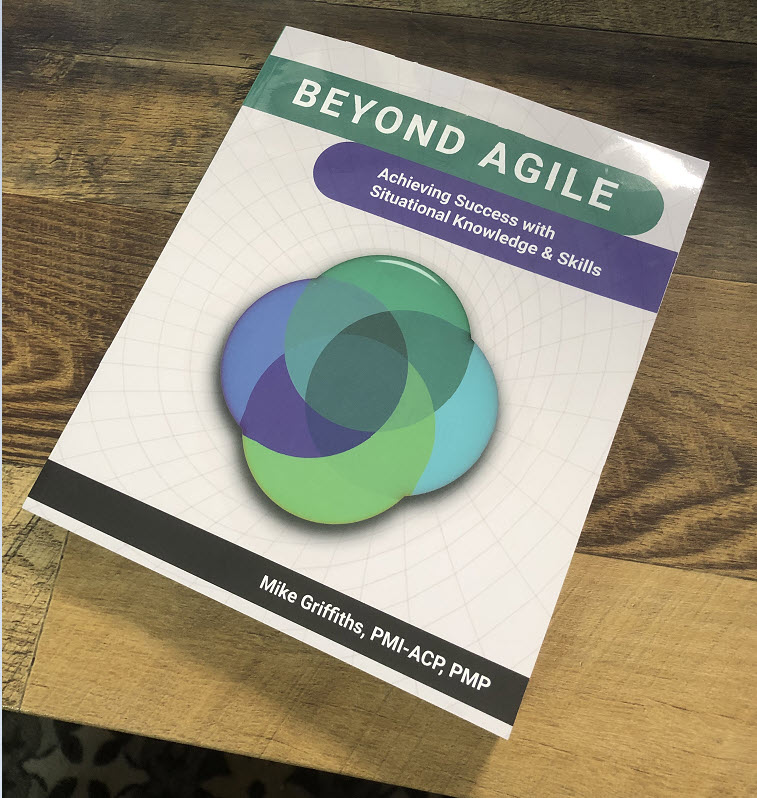
In case you haven't heard, PMI's Mike Griffiths has a new book out, Beyond Agile: Achieving Success with Situation Knowledge and Skills. Mike is a well known and respected thought leader within the agile community. To be transparent, Mike is currently an employee of PMI, working on the Disciplined Agile IP team with me, and he is a long-time volunteer with PMI and contributor to PMI publications.
So why is one of the Disciplined Agile (DA) guys recommending a book titled "Beyond Agile"? Simple: The material in this book is incredibly complementary and confirmatory to what we recommend in DA. Here's what I like about Beyond Agile:
- It promotes a hybrid strategy. Just like DA, the Beyond Agile approach recommends mixing a combination of lean, agile, and traditional strategies. And it recommends doing so for both project teams as well as long-standing teams (such as product and service teams).
- Context counts. A common theme throughout the book is to do what is right for the situation that you face. So there are no best practices, rather there are practices that work well for you given the context of your situation. Furthermore, having industry-specific knowledge and experience is a part of that - what works well for the automotive industry may prove to be a mess for the financial industry, and vice versa.
- It addresses people issues. The book offers a lot of great advice around people-oriented topics. This includes emotional intelligence (EI) and emotional quotient (EQ), both intrapersonal and interpersonal skills, leadership, servant leadership, and working with stakeholders. Just this material alone is worth the price of the book (and the rest of the book is great too).
- It addresses process issues, particularly those critical for project professionals. One of the greatest frustrations that project professionals have with many agile writings is how they avoid, gloss over, or provide naive advice around issues that are critical to your success. Luckily this book doesn't make that mistake. It provides proven strategies for when (and when not) to take a plan-driven approach, how to work effectively with project management offices (PMOs), performance analysis and reporting, estimating time and cost, and risk management to name a few key topics.
- It covers organizational change. Adopting more agile ways of working is a change for many teams and their organizations. The book covers several key topics in this space, including Frederic Laloux's organizational model and several organization change models (Kubler-Ross, Satir, ADKAR, Kotter, and SCARF). While the book won't make you a change expert, it does cover critical models that you may want to explore in greater detail. You may also find the offerings of PMI's BrightLine to be of value.
- It's consumable. This book is well-written and an easy read. There are a lot of pictures including great cartoons.
There are several compelling reasons to read Beyond Agile: Achieving Success with Situation Knowledge and Skills. In summary, Mike says it best on his page describing the book:
Beyond Agile is for project practitioners, PMOs, and business representatives who want relevant, high-value delivery guidance. The book presents a model that provides a context-specific approach from a full spectrum of project disciplines including: lean/agile, leadership/EI, plan-driven, and industry-specific approaches. Unlike scaling models such as SAFe, LeSS, and Nexus, the Beyond Agile Model avoids agile-myopia (believing everything can be solved best by agile approaches) and buffet-syndrome (taking on too much process) by being simultaneously broader but ruthlessly selective in its recommendations.


 Community Champion





