


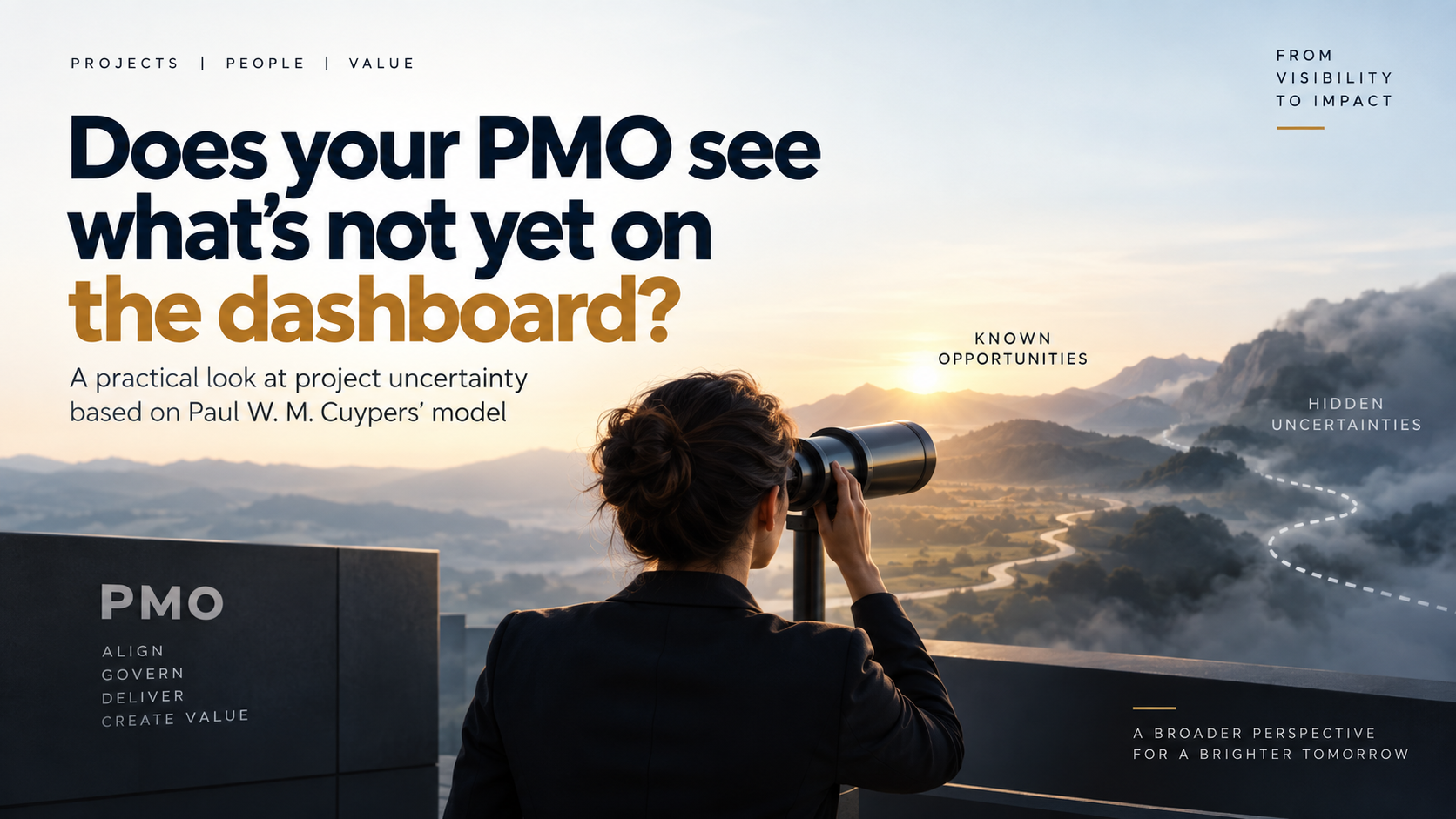
One of the strategic projects is green. Schedule performance is within tolerance. Costs are under control. The main risks have been identified. Expected benefits remain valid, and there is no material change in the value case.
Two weeks later, a dependency with another initiative becomes visible. That dependency requires an executive decision. The decision takes longer than expected because ownership was unclear. A key deliverable slips. The next portfolio review shows the project in yellow.
The dependency did not appear two weeks earlier.
It was already there.
What changed was the organization’s ability to see it.
That distinction is central to Paul W. M. Cuypers’ book Mastering Project Uncertainty: A Systems Thinking Approach. Cuypers treats project uncertainty as something broader than risk. In his model, uncertainty is also related to information awareness and information availability.
A project team may know something, know that information is missing, fail to notice information that already exists, or be completely unaware that relevant information should be sought at all.
For a PMO or VMO, that is a useful perspective because it adds another layer to governance.
A mature office already looks at delivery, benefits, value, strategic alignment, capacity, dependencies, risk, performance, and portfolio balance. Cuypers’ model does not replace any of those disciplines. It helps examine the quality and completeness of the information behind them.
Five places where uncertainty can sit
Cuypers structures project uncertainty around five dimensions:
Assignment, Context, Decisions, Method, and Scenarios.
The model is systemic. A weakness in one dimension can propagate into another. An overlooked stakeholder may create a new requirement. That requirement may require another deliverable. The deliverable adds work. More work consumes resources, affects the schedule, and may reduce the expected value of the initiative.
The visible delay is only the final symptom.
Assignment: Are we still working on the right definition of the project?
The assignment dimension covers stakeholders, benefits, deliverables, activities, and resources.
That gives a PMO a broader review lens than simple plan compliance.
A project may be delivering on time while an important stakeholder has not been properly engaged. Benefits may still appear in the business case even though the causal link between the deliverables and those benefits has weakened. Resource estimates may remain formally approved even though the underlying assumptions are no longer valid.
A useful governance discussion can therefore include questions such as:
- Are all relevant stakeholders still represented?
- Are the expected benefits still credible?
- Do the current deliverables still support those benefits?
- Has any required deliverable emerged since approval?
- Do we still have the resources and capabilities needed to complete the work?
Context: What is happening outside the project?
Projects do not operate in isolation.
Cuypers includes prerequisites, constraints, interdependencies, threats, and opportunities in the context dimension.
This is where an enterprise PMO has an advantage over an individual project team.
A project manager sees one initiative in depth. The PMO can see the system.
Two projects may depend on the same specialist. A regulatory approval may affect several initiatives. One programme may be consuming capacity needed by a more valuable investment. A supplier delay in one project may create an indirect dependency elsewhere.
Each project can look healthy on its own while the portfolio accumulates exposure.
The governance conversation then becomes less about isolated status and more about relationships across the system.
- Which new interdependencies have appeared?
- Which prerequisites remain unresolved?
- Have any constraints changed?
- Is another project now affecting this initiative?
- Has a new opportunity emerged that changes the investment case?
Decisions: What needs to be decided, including what we have not yet noticed?
Cuypers gives decision uncertainty much more attention than most project reporting systems do.
He separates decision-making into qualifiers, alternatives, rationale, effects, and confirmation.
The uncertainty is not limited to choosing between option A and option B.
There may be an option C that nobody has identified.
The decision criteria may be wrong.
The information supporting the decision may be incomplete.
The consequences may not be fully understood.
And sometimes the most dangerous situation is that an important decision has not yet been recognized as a decision.
For a PMO, this suggests treating critical decisions as governed information, not just as meeting minutes.
A decision register could include the decision owner, deadline, alternatives, missing information, expected effects, and the future evidence needed to confirm whether the choice was sound.
That creates a useful distinction between a risk and an overdue decision.
They may affect the same project, but they are not the same management problem.
Method: Are we executing the right approach well?
Cuypers also treats the project method itself as a source of uncertainty.
The method dimension includes approach, techniques, tools, communication, and coordination.
That has a direct implication for PMOs that manage corporate methodologies.
A project can comply perfectly with the approved methodology and still be using the wrong approach for the work.
A highly exploratory initiative may need more adaptation than the corporate standard allows. A project that started in discovery mode may later need stronger control, documentation, and decision gates. A team may be using an agile framework competently while the broader governance mechanism remains inappropriate for the assignment.
The governance question is no longer only:
Is the project compliant with the method?
It also becomes:
Is the method still appropriate for the project?
That is a more useful question.
Scenarios: risk, problem, and crisis require different responses
Cuypers also separates plan, risk, problem, crisis, and measures.A risk is a possible future event.
A problem already exists.
A crisis is a state in which solving the original problem may no longer be realistic and attention shifts toward limiting damage.
The book associates different responses with each condition: preemptive measures for risks, countermeasures for problems, and contingency measures for crises.
That distinction can improve PMO reporting immediately.
Many organizations still use risk registers as repositories for almost every type of adverse information. The result is a mixture of possible events, existing issues, decisions, constraints, dependencies, and assumptions.
The label may be convenient.
The response is often weaker because of it.
How I would apply the model in a PMO
I would not create another heavy governance process.
I would add an uncertainty review to the existing portfolio or project governance cycle.
The review would use Cuypers’ five dimensions as a structured lens:
- Assignment - What has changed, or remains unclear, about stakeholders, benefits, deliverables, activities, and resources?
- Context - Which prerequisites, constraints, interdependencies, threats, or opportunities have emerged?
- Decisions - Which critical decisions are open, late, poorly supported, or perhaps still unrecognized?
- Method - Does the current approach remain appropriate for the nature and stage of the project?
- Scenarios - Are we dealing with a risk, an existing problem, or a crisis, and is the response appropriate?
They can feed the PMO’s existing governance system.
Cuypers goes further in Chapter 9 with the Project Meta-Data Technique (PMDT). The technique structures information such as decisions, prerequisites, constraints, dependencies, risks, problems, crises, assumptions, and open questions instead of leaving them scattered across emails, meeting minutes, and personal notes. The model also supports a shared working log and dashboards by information type.
That makes the idea particularly useful at the PMO level.
A dashboard could track not only cost, schedule, benefits, and value, but also indicators such as:
- critical decisions approaching their deadline;
- unresolved interdependencies;
- unmet prerequisites;
- assumptions awaiting validation;
- problems without an agreed countermeasure;
- open questions with material impact on benefits or value.
They help explain what may affect them next.
A green project can still carry significant uncertainty
Dashboards are good at displaying what has already been identified, classified, and measured.
They are much less effective at showing a stakeholder nobody has identified, a dependency nobody has noticed, a decision nobody realizes is required, or an assumption everyone has quietly accepted as fact.
That is where Cuypers’ model adds something useful to PMO and VMO thinking.
The office can continue to manage delivery, benefits, value, risk, capacity, and strategic alignment while deliberately building another capability: systematically looking for relevant information that has not yet entered the governance system.
Risk management asks what uncertain events we have identified.
Uncertainty management adds another question:
What do we still need to discover before we can make a better decision?
Cuypers’ model is primarily project-centred. For a PMO or VMO, I would extend it by connecting uncertainty directly to value, interdependencies and decision-making.
A simple Uncertainty and Value Review can be added to existing governance meetings. For each relevant uncertainty, capture:
| My contribution | |
| Dimension | Assignment, Context, Decision, Method or Scenario? |
| Uncertainty | What do we still not know or have not confirmed? |
| Missing information | What needs to be discovered? |
| Interdependency | Which other projects, functions, or stakeholders are affected? |
| Value at risk | Which benefit or expected value could be affected? |
| Owner | Who must investigate or act? |
| Decision required | What needs to be decided? |
| Decision deadline | How long can the organization wait? |
| Confirmation evidence | How will we know the uncertainty has been resolved? |
This adds an organizational layer to Cuypers’ model. The PMO does not merely consolidate uncertainty across projects; it can identify where uncertainty propagates across the portfolio, where value is exposed, and where delayed decisions require executive attention.
A useful governance question then becomes:
What do we still have to discover? How much value could it affect? Who needs to act or decide, and how long can we wait for the answer?
Reference
CUYPERS, Paul W. M. Mastering Project Uncertainty: A Systems Thinking Approach. Routledge, 2024.
Posted on: September 12, 2026 11:28 AM |
Permalink


