





Guessing is not a strategy: How to build decision velocity with AI and real-time data
June 10, 2026 | Live Webinar

Thoughts on The Project Economy
Integrate Design into Your Organization
Insights from the 2019 CEO Outlook
9 Tips for Managing Creative Teams
Agile, Applications Delivery, Benefits Realization, business agility, Career Development, Collaboration, Communications Management, Design, Design Thinking, DevOps, Education, Innovation, Leadership, Lean, Lessons Learned, Networking, PMI EMEA Congress, PMI Global Conference, Project Delivery, Project Management, Responsibility, Soft Skills, Stakeholder Management, Volunteering


| I have been thinking about cross-team collaboration lately as it is one of the key success factors in programs. I collected some of my thoughts into what I am calling a "Collaboration Manifesto". Feedback and suggestions are welcome.
Collaboration Manifesto
|
| We are hearing a lot about "The Project Economy" and how the radical and disruptive changes are evolving the future of work. While I am not an expert on this topic, nor am I as forward-thinking enough to fully comprehend how the way we work is changing, here are my thoughts around the concept of "The Project Economy" How do you define the concept of "The Project Economy"? Advancements in technology and the need for businesses to evolve to meet market and customer demands have propelled organizations to change how we work. The Project Economy is about evolving from routine work of operating the business to one of changing or transforming the business. The primary vehicle for "changing the business" and delivering value to our employees and customers is through projects. How will "The Project Economy" impact individuals? Individuals will increasingly work within a project-driven workflow, rather than operational workflows. Initially, these initiatives will be contained within organizations, but the value will scale when projects are applied to cross-organizational efforts in society. Individuals will join and exit cross-discipline project teams as needed. As contributors, individuals will be given increasingly more opportunities to apply their expertise toward initiatives that generate value and benefits. How will work present itself within organizations? Work will be a blend of operational and project-based initiatives. Business organizations will retain some structure and governance around standing up projects. How widespread do you believe this phenomenon to be? We are just at the beginning of the Project Economy, thus it is not wide-spread. Some industries, such as construction, IT, finance, government, and pharma, are heavily invested in project-based workflows. Other industries (i.e. healthcare, education) are lagging in this evolution. What has led to organizational shifts within the project management profession? The migration of work from operational departments into project-driven parts of organizations have led to the rise in importance of project management. This has driven the need for not only more project managers, but better-skilled project leaders. Some organizations are elevating project execution and delivery to an executive level. Where will the major working changes need to be made for organizations to remain effective and efficient? Financial and budgeting practices within most organizations are still 19th Century and need to evolve to support more fast-paced and iterative business models that are required of the Project Economy. In terms of the skill sets focus, what should organizations be working to develop? Organizations should develop adaptive and growth mindsets within their employees and managers. Leaders will need to be well-versed in change management and project managers will need improved business skills. What are the risks and the opportunities that could arise in trying to re-educate the workforce about a new set of project management skills? There are several risks relating to re-training the workforce, here are two:
One opportunity: a combination of MBA and PMP skills and expertise will open many doors to success in the Project Economy. What does this new way of working mean for project managers and how is this going to change the way they work on an everyday basis? Project managers will need improved business acumen and skills, and will need to be comfortable with managing change. In addition to delivering stakeholder value, project managers will also become responsible for "changing the business".
Connect with on Linkedin, at www.brucegay.com, or follow me on Twitter @brucegay |
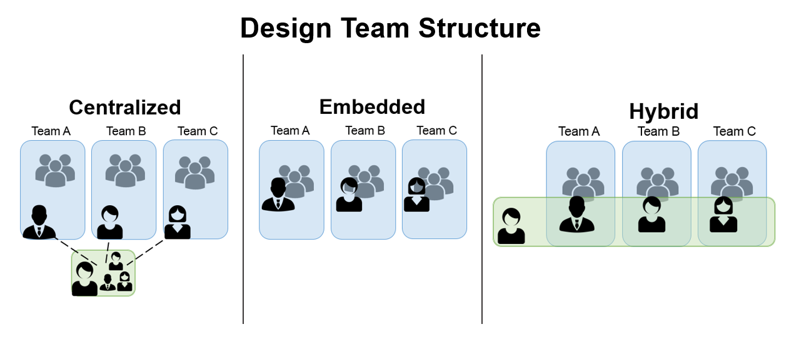
| In May 2016, I presented a webinar to the PMI Community on the topic "Design Thinking & Project Management". In this article I address options and recommendations on how to structure User Experience (UX) Design teams within your organization.
Each company or organization is different. How you decide to organize your teams will depend on what works best for your company's goals and culture. The key organizational models for UX Design are: centralized, de-centralized (aka embedded), or hybrid of the two. There are advantages and disadvantages for each model. 1. Centralized Model In a centralized team model, designers belong to a single unit and are "farmed out" to work on individual projects around the organization. When a particular designer's work is complete they return to the central group and are re-assigned to new work and new projects. Advantages:
Disadvantages:
2. Embedded Model In this model, designers are embedded into multidisciplinary teams and report up through local management. Designers are dedicated to a team and each team is devoted to a distinct aspect of the product or software development. Advantages:
Disadvantages:
3. Hybrid Model From recent experiences, we overcame the disadvantages of the two previous models by evolving a hybrid model with both embedded and centralized attributes. We found that having UX designers embedded in the development teams, but also members of a design group within the organization, worked best. The result had the combined advantages from both models. In the hybrid model, there is a degree of commitment and engagement desired from the embedded designers assigned to specific projects. In this case, the designer understands the full life cycle and is deeply wedded to the business or domain. Having a centralized reporting structure lets designers to be managed by other designers. This allows for peer design, knowledge sharing across projects and quickly ramping up on a project.
I am passionate about evangelizing Design within the Project Management community. I welcome any feedback or comments on this article. Connect with me on Linkedin or follow me on Twitter @brucegay |
|
KPMG released their U.S. CEO Outlook 2019 report with survey results from 400 U.S. CEOs. Key Findings from the survey provided some very relevant insights for Project Leaders who want to grow in their careers and remain on the forefront of technical, cultural, and economic change. I decided to turn the insights into an infographic which can be downloaded here: --> CEO Outlook and Insights for PMs You can read the full KPMG CEO Outlook report here: https://home.kpmg/content/dam/kpmg/us/pdf/2019/06/2019-ceo-outlook.pdf Summary of the Key Findings: https://home.kpmg/us/en/home/campaigns/2019/05/key-findings.html
Key Finding: CEOs reported a positive outlook and tempered optimism. A majority of U.S. CEOs (81 percent) plan to pursue inorganic growth, favoring strategic alliances and M&A. Actions you can take based on this finding:
Key Finding: CEOs have more realistic expectations of AI implementation and are becoming more enthused about AI-driven decisions. Actions you can take:
Key Finding: Agility is a critical capability and requires innovation maturity. Sixty-three percent (63%) expressed the need to improve innovation processes and execution in the next three years. Actions you can take:
Key Finding: Investment in tech is prioritized over people. When asked to make a point-blank choice between investing in technology or people, more than two-thirds of CEOs chose technology. Actions you can take:
Key Finding: Companies are actively disrupting their sectors. Seventy-six percent (76%) noted that their growth relies on their ability to challenge and disrupt any business norm. Actions you can take:
Key Finding: Cyber security risk is slowly being seen as a top organizational risk. CEOs no longer look at cyber risk as a separate IT topic and are embedding cyber in all technology-fueled growth decisions. Only a minority (16 percent) point to cyber security risk itself as their organization’s top threat. Actions you can take:
Key Finding: Organization want to align policies to reflect the values of their customers. Seventy-seven percent (77%) of U.S. CEOs believe that they could significantly improve their understanding of their customers. Eight-one percent (81%) feel it is their personal responsibility to ensure that their organization’s Environmental, Social and Governance (ESG) policies reflect the values of their customers. Actions you can take:
Again, a copy of the infographic can be downloaded here: CEO Outlook and Insights for PMs |
|
Project Managers need to balance process rigor and process with allowing teams the time and space to do their best work. Here are nine (9) tips and lessons learned for managing creative teams. 1) Shield your team from as much administrative work as possible. Keep your team focused on the most valuable tasks and where they can be most productive. 2) Train your team in creative problem-solving techniques. 3) Allocate time for new ideas to emerge. Try not to hold your team to unreasonable and arbitrary schedules and deadlines. 4) Let your team do their job without the constant check-ins and oversight. Avoid micro-management! 5) Stress the importance of open communication. 6) Encourage your team to utilize you as an escalation point. 7) Allow exploration to happen and encourage the team to share ‘learnings’ across all disciplines. Promote interdisciplinary collaboration. 8) Keep challenging the way your team approaches their work. Encourage team members to keep looking anew at the way they approach their work. 9) And most importantly — tolerate risk-taking. It is inevitable with design thinking and agile models now being used on projects. Foster a team environment where failure is a learning opportunity, not something that would limit one’s career.
In summary, make space for creativity, investigation, and failure on your team. |
|
"Enjoy yourself. It's later than you think." - Chinese Proverb |