

Integrate Design into Your Organization
Categories:
Applications Delivery,
Design Thinking,
Project Delivery,
Design,
Innovation,
Lessons Learned
Categories: Applications Delivery, Design Thinking, Project Delivery, Design, Innovation, Lessons Learned


| In May 2016, I presented a webinar to the PMI Community on the topic "Design Thinking & Project Management". In this article I address options and recommendations on how to structure User Experience (UX) Design teams within your organization.
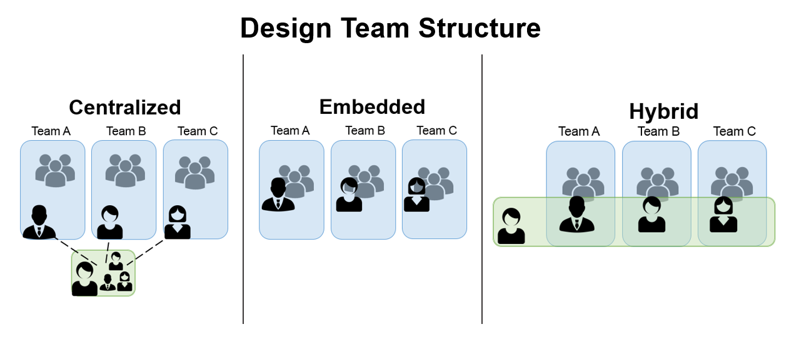
Each company or organization is different. How you decide to organize your teams will depend on what works best for your company's goals and culture. The key organizational models for UX Design are: centralized, de-centralized (aka embedded), or hybrid of the two. There are advantages and disadvantages for each model. 1. Centralized Model In a centralized team model, designers belong to a single unit and are "farmed out" to work on individual projects around the organization. When a particular designer's work is complete they return to the central group and are re-assigned to new work and new projects. Advantages:
Disadvantages:
2. Embedded Model In this model, designers are embedded into multidisciplinary teams and report up through local management. Designers are dedicated to a team and each team is devoted to a distinct aspect of the product or software development. Advantages:
Disadvantages:
3. Hybrid Model From recent experiences, we overcame the disadvantages of the two previous models by evolving a hybrid model with both embedded and centralized attributes. We found that having UX designers embedded in the development teams, but also members of a design group within the organization, worked best. The result had the combined advantages from both models. In the hybrid model, there is a degree of commitment and engagement desired from the embedded designers assigned to specific projects. In this case, the designer understands the full life cycle and is deeply wedded to the business or domain. Having a centralized reporting structure lets designers to be managed by other designers. This allows for peer design, knowledge sharing across projects and quickly ramping up on a project.
I am passionate about evangelizing Design within the Project Management community. I welcome any feedback or comments on this article. Connect with me on Linkedin or follow me on Twitter @brucegay |
What Goes on in the Mind of a Project Manager?
|
The persona I generated is based off of interviews Aurora Melchor, a UX Designer, conducted with her team as well as additional data points that I added from my circle of colleagues. GOALS: Keep everyone happy; Deliver value and project success; Predictability MOTIVATIONS: Wants interesting, fun, and challenging work; Recognition and promotion MINDSET: Likes problem-solving; Feels the urgency to “get stuff done”; Driven by accomplishment; Often does well “riding the wave” of change PAIN POINTS: “My day is a fractured experience!”; Inadequate planning and poor estimates; Manual repetitive work across multiple applications; Having to do more with less; Risk, complexity, and uncertainty has increased (VUCA)
Let me know your feedback on this representation of a Project Manager. - What insights do you draw from the persona? - What can non-Project Managers learn from this persona? - Is there additional information that you recommend to include in the persona? Connect with me here on Linkedin, at www.brucegay.com, or follow me on Twitter @brucegay < Right click and open image in new tab to read the text more clearly. > |
 Have you ever stopped to think about the common characteristics you have with other Project Managers? In order to explain these to an audience of non-project managers, I generated a user persona to explain the goals, motivations, mindsets, and pain points of Project Managers.
Design Thinking Resources for Project Managers
| |

#PMChat - Twitter Chat for Project Managers
|
I will be hosting #PMChat ... Friday February 2nd at 12 pm EST / 5 pm GMT. Come join the discussion on how human-centered design can improve customer satisfaction and overall benefits realization for your projects. Looking forward to the dialog.
Twitter: @brucegay |

Making a Difference
|
I am really looking forward to this year's PMI Global Conference in Chicago. This will be my first PMI Conference that I have attended outside of my regional chapter's professional development symposiums. This year's conference theme "Making a Difference" asks us as professionals: Are you a Difference Maker? Who do you want to be? I ask myself "Am I a Difference Maker"? -- "Miracle Worker"? -- "Bar Raiser"? -- "Game Changer" or even a "Deadline Crusher"? I probably could best describe myself as both a "Chaos Tamer" as well as a "Collaboration Wizard". Throughout my career, I endeavored to build working environments and team cultures that promote collaboration, innovation and fun. I am also looking forward to the keynote speakers (Tim Berners-Lee, Nicholas Epley and Mercedes Ramirez-Johnson) at the Global Conference. They each have interesting background and experiences.
Where you will likely find me at the conference... Saturday, October 28th
Sunday, October 29th
Monday, October 30th
See you in Chicago! |



