


Categories: Applications Delivery, Design, Design Thinking, Innovation, Lessons Learned, Project Delivery
In May 2016, I presented a webinar to the PMI Community on the topic "Design Thinking & Project Management".
In this article I address options and recommendations on how to structure User Experience (UX) Design teams within your organization.
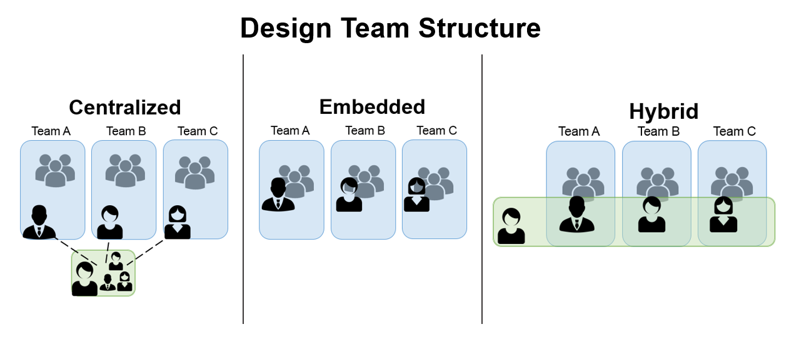
Each company or organization is different. How you decide to organize your teams will depend on what works best for your company's goals and culture. The key organizational models for UX Design are: centralized, de-centralized (aka embedded), or hybrid of the two. There are advantages and disadvantages for each model.
1. Centralized Model
In a centralized team model, designers belong to a single unit and are "farmed out" to work on individual projects around the organization. When a particular designer's work is complete they return to the central group and are re-assigned to new work and new projects.
Advantages:
- Promotes uniform career growth of the design team.
- Provides emotional benefits of belonging to a group.
- Advances a coherent design experience across the organization.
Disadvantages:
- Reduces design to a purely execution function, not fully integrated into the project life cycle.
- Designers are inserted into a project that was already underway.
- Designers would not have participated in problem definition, a key activity that designers are well-suited to lead the team through.
- Perception of designers as outsiders - "not one of us".
2. Embedded Model
In this model, designers are embedded into multidisciplinary teams and report up through local management. Designers are dedicated to a team and each team is devoted to a distinct aspect of the product or software development.
Advantages:
- Over time, the team forms a cohesive unit and team members respect the contributions of the designer.
- The designer builds up specific business or domain knowledge and
- The designer establishes stronger bonds with key stakeholder (and decision makers) involved in the project.
Disadvantages:
- Designers have no sense of design community for support, they could become lonely.
- Designers work on their own, likely not collaborating with other designers within the organization.
- Team members are non-designers who do not speak the same professional language.
3. Hybrid Model
From recent experiences, we overcame the disadvantages of the two previous models by evolving a hybrid model with both embedded and centralized attributes. We found that having UX designers embedded in the development teams, but also members of a design group within the organization, worked best. The result had the combined advantages from both models.
In the hybrid model, there is a degree of commitment and engagement desired from the embedded designers assigned to specific projects. In this case, the designer understands the full life cycle and is deeply wedded to the business or domain. Having a centralized reporting structure lets designers to be managed by other designers. This allows for peer design, knowledge sharing across projects and quickly ramping up on a project.
I am passionate about evangelizing Design within the Project Management community. I welcome any feedback or comments on this article.
Connect with me on Linkedin or follow me on Twitter @brucegay




