

Integrate Design into Your Organization
Categories:
Applications Delivery,
Design Thinking,
Project Delivery,
Design,
Innovation,
Lessons Learned
Categories: Applications Delivery, Design Thinking, Project Delivery, Design, Innovation, Lessons Learned


| In May 2016, I presented a webinar to the PMI Community on the topic "Design Thinking & Project Management". In this article I address options and recommendations on how to structure User Experience (UX) Design teams within your organization.
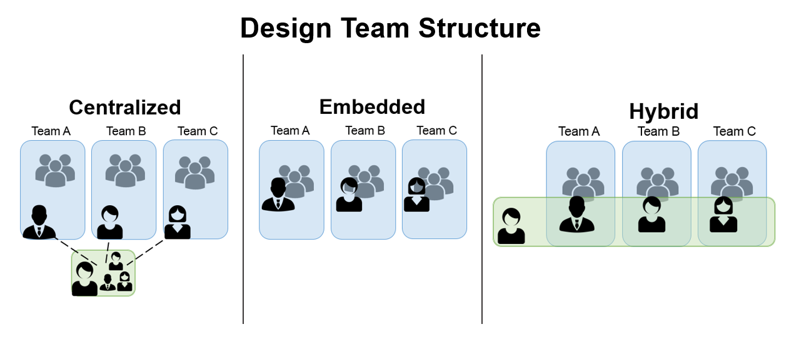
Each company or organization is different. How you decide to organize your teams will depend on what works best for your company's goals and culture. The key organizational models for UX Design are: centralized, de-centralized (aka embedded), or hybrid of the two. There are advantages and disadvantages for each model. 1. Centralized Model In a centralized team model, designers belong to a single unit and are "farmed out" to work on individual projects around the organization. When a particular designer's work is complete they return to the central group and are re-assigned to new work and new projects. Advantages:
Disadvantages:
2. Embedded Model In this model, designers are embedded into multidisciplinary teams and report up through local management. Designers are dedicated to a team and each team is devoted to a distinct aspect of the product or software development. Advantages:
Disadvantages:
3. Hybrid Model From recent experiences, we overcame the disadvantages of the two previous models by evolving a hybrid model with both embedded and centralized attributes. We found that having UX designers embedded in the development teams, but also members of a design group within the organization, worked best. The result had the combined advantages from both models. In the hybrid model, there is a degree of commitment and engagement desired from the embedded designers assigned to specific projects. In this case, the designer understands the full life cycle and is deeply wedded to the business or domain. Having a centralized reporting structure lets designers to be managed by other designers. This allows for peer design, knowledge sharing across projects and quickly ramping up on a project.
I am passionate about evangelizing Design within the Project Management community. I welcome any feedback or comments on this article. Connect with me on Linkedin or follow me on Twitter @brucegay |
9 Tips for Managing Creative Teams
|
Project Managers need to balance process rigor and process with allowing teams the time and space to do their best work. Here are nine (9) tips and lessons learned for managing creative teams. 1) Shield your team from as much administrative work as possible. Keep your team focused on the most valuable tasks and where they can be most productive. 2) Train your team in creative problem-solving techniques. 3) Allocate time for new ideas to emerge. Try not to hold your team to unreasonable and arbitrary schedules and deadlines. 4) Let your team do their job without the constant check-ins and oversight. Avoid micro-management! 5) Stress the importance of open communication. 6) Encourage your team to utilize you as an escalation point. 7) Allow exploration to happen and encourage the team to share ‘learnings’ across all disciplines. Promote interdisciplinary collaboration. 8) Keep challenging the way your team approaches their work. Encourage team members to keep looking anew at the way they approach their work. 9) And most importantly — tolerate risk-taking. It is inevitable with design thinking and agile models now being used on projects. Foster a team environment where failure is a learning opportunity, not something that would limit one’s career.
In summary, make space for creativity, investigation, and failure on your team. |

Design Thinking Introduction for Project Leaders
|
The pace of change and disruption in the business environment demands that we, as Project Leaders, grow and acquire new skills. To be successful, we need to look past the rigor and discipline of managing projects and embrace agility and collaboration, thinking about customers first, with innovation and adaptive leadership. Design Thinking has emerged as a successful methodology that organizations use to approach problem-solving and delivery of innovative solutions that delight their customers. Design Thinking provides models for project leaders to be more successful in this every-changing profession. My webinar from May 2016 outlines the benefits of incorporating design on projects while providing a high-level overview of methods and tools:
https://www.projectmanagement.com/videos/330087/Design-Thinking---Project-Management
Connect with me on Linkedin or follow me on Twitter @brucegay |

Design Thinking & Project Management (repost)
|
Design and design thinking is "old news." As Project Managers, we are late to this party. If you have not yet seen my webinar on Design Thinking & Project Management, here is a link: https://www.projectmanagement.com/videos/330087/Design-Thinking---Project-Management Design thinking has emerged as a major trend for how innovative organizations are approaching problem-solving. Design thinking encourages innovative solutions by drawing on approaches from engineering and design, and combining them with ideas from the arts, social sciences, and the business world. Design Thinking is ... 1) People-centered. Empathy is at the core. Empathy gained through user research is at the center of design. The PM and project team should strive to include all project stakeholders and customers in the process, starting from project initiation. The goal is to get immediate and timely feedback from the customer and make changes and revisions along the way. 2) Extensive interdisciplinary collaboration. A common challenge across projects is communication. Words, and the meaning behind them are often misunderstood. Different people with different backgrounds and experiences use language differently. Design Thinking tools and methods, like sketching, mind maps or physical models, can be extremely useful. They force people to remove imprecise words and organize around a “synthesized” picture to describe the concept. Additionally, people are terrible at recall, but we’re awesome at recognition. Project Managers should utilize these tools and methods to bring people together and work more effectively. 3) Highly creative. Strives for diverse viewpoints. As a PM, you should staff your project team with people that possess different perspectives for the best results. You absolutely need people who think differently, but to be efficient, you need to find ways to communicate, prioritize, share in decision making. Seek out staff that can “think laterally” and are willing to try connecting ideas that might not seem to intuitively go together. 4) All about doing and being hands-on. Design Thinking is about taking ideas and concepts and quickly giving them form. Whether a napkin sketch, a prototype carved from foam rubber, or a digital mock-up, the quick-and-rough models that designers constantly create are a critical component of innovation. When you give form to an idea, you begin to make it real and can elicit emotional responses from end users and customers. You have to make in order to learn. 5) Iterative. Lastly, Design Thinking is iterative. You and your team will never get it right the first time. As part of your project management process, you need to embed the cyclical process of prototyping, analyzing, and refining a product or service. Your team needs to secure timely feedback from the customer in order to make iterative/incremental improvements along the way. My advice -- the iterative nature of design is not as costly as not doing it at all. A few closing thoughts on this topic:
I am passionate about evangelizing Design Thinking within the Project Management community. I welcome any feedback or comments below. |

Guidance for Project Managers
|
Recently I have been working on a turnaround project that needed some additional project management discipline and rigor. I have been providing come guidance to some of the junior PMs, that I wanted to share with the community here.
Guidance for Project Managers:
Connect with me on Linkedin or follow me on Twitter @brucegay |


