

Collaboration Manifesto


| I have been thinking about cross-team collaboration lately as it is one of the key success factors in programs. I collected some of my thoughts into what I am calling a "Collaboration Manifesto". Feedback and suggestions are welcome.
Collaboration Manifesto
|
Integrate Design into Your Organization
Categories:
Applications Delivery,
Design Thinking,
Project Delivery,
Design,
Innovation,
Lessons Learned
Categories: Applications Delivery, Design Thinking, Project Delivery, Design, Innovation, Lessons Learned
| In May 2016, I presented a webinar to the PMI Community on the topic "Design Thinking & Project Management". In this article I address options and recommendations on how to structure User Experience (UX) Design teams within your organization.
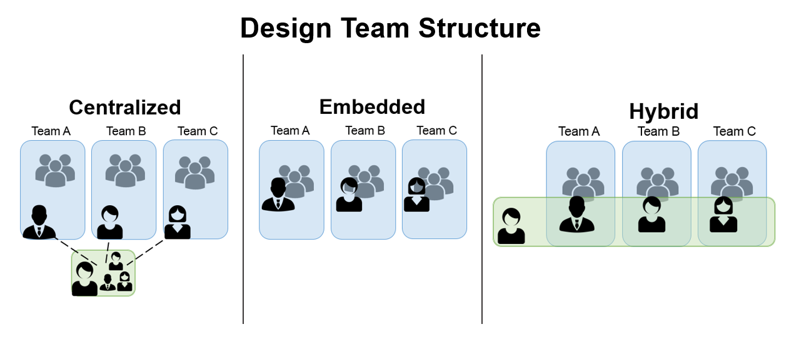
Each company or organization is different. How you decide to organize your teams will depend on what works best for your company's goals and culture. The key organizational models for UX Design are: centralized, de-centralized (aka embedded), or hybrid of the two. There are advantages and disadvantages for each model. 1. Centralized Model In a centralized team model, designers belong to a single unit and are "farmed out" to work on individual projects around the organization. When a particular designer's work is complete they return to the central group and are re-assigned to new work and new projects. Advantages:
Disadvantages:
2. Embedded Model In this model, designers are embedded into multidisciplinary teams and report up through local management. Designers are dedicated to a team and each team is devoted to a distinct aspect of the product or software development. Advantages:
Disadvantages:
3. Hybrid Model From recent experiences, we overcame the disadvantages of the two previous models by evolving a hybrid model with both embedded and centralized attributes. We found that having UX designers embedded in the development teams, but also members of a design group within the organization, worked best. The result had the combined advantages from both models. In the hybrid model, there is a degree of commitment and engagement desired from the embedded designers assigned to specific projects. In this case, the designer understands the full life cycle and is deeply wedded to the business or domain. Having a centralized reporting structure lets designers to be managed by other designers. This allows for peer design, knowledge sharing across projects and quickly ramping up on a project.
I am passionate about evangelizing Design within the Project Management community. I welcome any feedback or comments on this article. Connect with me on Linkedin or follow me on Twitter @brucegay |
9 Tips for Managing Creative Teams
|
Project Managers need to balance process rigor and process with allowing teams the time and space to do their best work. Here are nine (9) tips and lessons learned for managing creative teams. 1) Shield your team from as much administrative work as possible. Keep your team focused on the most valuable tasks and where they can be most productive. 2) Train your team in creative problem-solving techniques. 3) Allocate time for new ideas to emerge. Try not to hold your team to unreasonable and arbitrary schedules and deadlines. 4) Let your team do their job without the constant check-ins and oversight. Avoid micro-management! 5) Stress the importance of open communication. 6) Encourage your team to utilize you as an escalation point. 7) Allow exploration to happen and encourage the team to share ‘learnings’ across all disciplines. Promote interdisciplinary collaboration. 8) Keep challenging the way your team approaches their work. Encourage team members to keep looking anew at the way they approach their work. 9) And most importantly — tolerate risk-taking. It is inevitable with design thinking and agile models now being used on projects. Foster a team environment where failure is a learning opportunity, not something that would limit one’s career.
In summary, make space for creativity, investigation, and failure on your team. |

Big Bang Delivery is Dead
|
ASSERTION: The era of the big bang transformation and delivery is dead. Rapid, hybrid solution delivery is ascendant and necessary. - Do you agree or disagree?
Given the rapid pace of technology and business disruption, most organizations are investing heavily just to keep up with the changes. What differentiates the leaders from the laggards in addressing this disruption is how they organize their business to execute against strategy. We can no longer use the model of monolithic programs that go on for 2-3 years. Organizations find that what they set out to do or solve at the beginning is not what they will finish doing. In the current business environment, traditional delivery models are now looking too rigid and organizations are locked into investments that often miss the mark. Leading organizations are using rapid delivery cycles that mobilize a project very quickly, aiming to release the product into market or to customers with minimum investment.
- How does role of the Project Manager change with this trend? - How does the role of the PMO change? - Does the approach to portfolio management need to adjust?
|

Professional Development Day Volunteering
|
The PDD is our chapter's largest event of the year and after staging it in the city's suburbs for the past 5 years, the event returned to downtown Pittsburgh. We found the central location boosted attendance and we actually had to cut off registration in advance of the event. I played the role of both volunteer organizer and session speaker, so I had the unique vantage of what was going on behind the scenes as well as on stage at the PDD. Here are some observations that I made leading up to and during the day of the PDD:
Looking forward to an event bigger Professional Development Day (PDD) in November 2019! |
 Last week, the PMI Pittsburgh Chapter held its annual

