



Guessing is not a strategy: How to build decision velocity with AI and real-time data
June 10, 2026 | Live Webinar

The Emerging Tensions of Adaptive Governance
From Statistical Patterns to Operational Judgment
ORGANIZATIONAL MEMORY & DECISION CONTINUITY
RESPONSIBLE DECISION ARCHITECTURE™
Decision Architecture Under Pressure
Agile, Career Development, Career Development, Career Development, Career Development, Career Development, Career Development, Career Development, Career Development, Career Development, Career Development, Career Development, Career Development, Career Development, Career Development, Career Development, Career Development, Career Development, Career Development, Career Development, Career Development, Career Development, Career Development, Career Development, Career Development, Career Development, Career Development, Career Development, Career Development, Career Development, Career Development, Career Development, Career Development, Career Development, Career Development, Career Development, Career Development, Career Development, Career Development, Career Development, Career Development, Career Development, Career Development, Career Development, Career Development, Career Development, Career Development, Career Development, Career Development, Career Development, Career Development, Career Development, Career Development, Career Development, Career Development, Career Development, Career Development, Career Development, Career Development, Career Development, Career Development, Career Development, Career Development, Career Development, Career Development, Career Development, Career Development, Career Development, Career Development, Career Development, Career Development, Career Development, Career Development, Career Development, Career Development, Career Development, Career Development, Interpersonal Skills, Interpersonal Skills, Interpersonal Skills, Interpersonal Skills, Interpersonal Skills, Interpersonal Skills, Interpersonal Skills, Interpersonal Skills, Interpersonal Skills, Interpersonal Skills, Interpersonal Skills, Interpersonal Skills, Interpersonal Skills, Interpersonal Skills, Interpersonal Skills, Interpersonal Skills, Interpersonal Skills, Interpersonal Skills, Interpersonal Skills, Interpersonal Skills, Interpersonal Skills, Interpersonal Skills, Interpersonal Skills, Interpersonal Skills, Interpersonal Skills, Interpersonal Skills, Interpersonal Skills, Interpersonal Skills, Interpersonal Skills, Interpersonal Skills, Interpersonal Skills, Interpersonal Skills, Interpersonal Skills, Interpersonal Skills, Interpersonal Skills, Interpersonal Skills, Interpersonal Skills, Interpersonal Skills, Interpersonal Skills, Interpersonal Skills, Interpersonal Skills, Interpersonal Skills, Interpersonal Skills, Interpersonal Skills, Interpersonal Skills, Interpersonal Skills, Interpersonal Skills, Interpersonal Skills, Interpersonal Skills, Interpersonal Skills, Interpersonal Skills, Interpersonal Skills, Interpersonal Skills, Interpersonal Skills, Interpersonal Skills, Interpersonal Skills, Interpersonal Skills, Interpersonal Skills, Interpersonal Skills, Interpersonal Skills, Interpersonal Skills, Interpersonal Skills, Interpersonal Skills, Interpersonal Skills, Interpersonal Skills, Interpersonal Skills, Interpersonal Skills, Interpersonal Skills, Interpersonal Skills, Interpersonal Skills, Interpersonal Skills, Interpersonal Skills, Interpersonal Skills, Interpersonal Skills, Interpersonal Skills, Interpersonal Skills, Leadership, Leadership, Leadership, Leadership, Leadership, Leadership, Leadership, Leadership, Leadership, Leadership, Leadership, Leadership, Leadership, Leadership, Leadership, Leadership, Leadership, Leadership, Leadership, Leadership, Leadership, Leadership, Leadership, Leadership, Leadership, Leadership, Leadership, Leadership, Leadership, Leadership, Leadership, Leadership, Leadership, Leadership, Leadership, Leadership, Leadership, Leadership, Leadership, Leadership, Leadership, Leadership, Leadership, Leadership, Leadership, Leadership, Leadership, Leadership, Leadership, Leadership, Leadership, Leadership, Leadership, Leadership, Leadership, Leadership, Leadership, Leadership, Leadership, Leadership, Leadership, Leadership, Leadership, Leadership, Leadership, Leadership, Leadership, Leadership, Leadership, Leadership, Leadership, Leadership, Leadership, Leadership, Leadership, Leadership, Leadership, Strategy, Strategy, Strategy, Strategy, Strategy, Strategy, Strategy, Strategy, Strategy, Strategy, Strategy, Strategy, Strategy, Strategy, Strategy, Strategy, Strategy, Strategy, Strategy, Strategy, Strategy, Strategy, Strategy, Strategy, Strategy, Strategy, Strategy, Strategy, Strategy, Strategy, Strategy, Strategy, Strategy, Strategy, Strategy, Strategy, Strategy, Strategy, Strategy, Strategy, Strategy, Strategy, Strategy, Strategy, Strategy, Strategy, Strategy, Strategy, Strategy, Strategy, Strategy, Strategy, Strategy, Strategy, Strategy, Strategy, Strategy, Strategy, Strategy, Strategy, Strategy, Strategy, Strategy, Strategy, Strategy, Strategy, Strategy, Strategy, Strategy, Strategy, Strategy, Strategy, Strategy, Strategy, Strategy, Strategy, Sustainability, Talent Management, Talent Management, Talent Management, Talent Management, Talent Management, Talent Management, Talent Management, Talent Management, Talent Management, Talent Management, Talent Management, Talent Management, Talent Management, Talent Management, Talent Management, Talent Management, Talent Management, Talent Management, Talent Management, Talent Management, Talent Management, Talent Management, Talent Management, Talent Management, Talent Management, Talent Management, Talent Management, Talent Management, Talent Management, Talent Management, Talent Management, Talent Management, Talent Management, Talent Management, Talent Management, Talent Management, Talent Management, Talent Management, Talent Management, Talent Management, Talent Management, Talent Management, Talent Management, Talent Management, Talent Management, Talent Management, Talent Management, Talent Management, Talent Management, Talent Management, Talent Management, Talent Management, Talent Management, Talent Management, Talent Management, Talent Management, Talent Management, Talent Management, Talent Management, Talent Management, Talent Management, Talent Management, Talent Management, Talent Management, Talent Management, Talent Management, Talent Management, Talent Management, Talent Management, Talent Management, Talent Management, Talent Management, Talent Management, Talent Management, Talent Management, Talent Management


 Modern governance is changing. Projects, PMOs, agile operating models, AI-enabled systems, and adaptive organizations are all moving toward greater flexibility, continuous feedback, distributed coordination, and dynamic value reassessment. At first glance, this seems like progress. And in many ways, it is. But new tensions are beginning to emerge beneath the surface. As organizations become more adaptive: • Governance becomes more behavioral, • Coordination becomes more algorithmic, • Legitimacy becomes more fluid, • Control becomes less visible. The challenge is no longer simply how to deliver projects efficiently. The deeper challenge is this: How do organizations continuously adapt without dissolving: • Accountability, • Strategic coherence, • Responsible judgment, • Human autonomy? This series explores those tensions. Not as criticism of frameworks, governance, agility, or AI. But as an attempt to understand what modern governance is becoming under conditions of: • Continuous adaptation, • Systemic complexity, • Distributed decision-making, • AI-native coordination. Across the next articles, I will explore themes such as: • Adaptive legitimacy, • Coherence erosion, • Invisible command-and-control, • Behavioral governance, • Cybernetic organizations, • PMOs as coherence architectures, • The irreducible role of human judgment under uncertainty. Because the future of governance may not be determined by how much organizations automate or adapt. But by whether they can preserve coherent human judgment while doing so. |
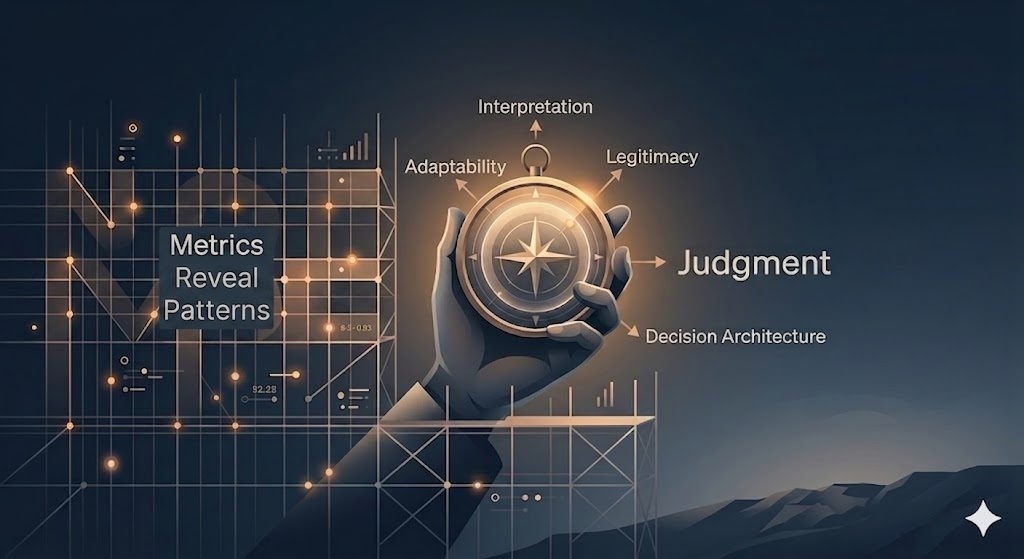 Why Frameworks Improve Probability – But Cannot Eliminate Judgment Modern project management is becoming increasingly evidence-informed. Frameworks such as NPSS and PMI’s M.O.R.E. model reflect an important shift in how project success is understood. Success is no longer interpreted solely through scope, schedule, and budget. It is increasingly associated with legitimacy, adaptability, stakeholder alignment, contextual awareness, and the quality of decisions made under uncertainty. That shift matters. For decades, many organizations treated project management primarily as a discipline of control:
Projects succeed or fail not only because of execution discipline, but because:
But probability is not certainty. And that distinction is where the real operational challenge begins. The moment frameworks meet operational reality One of the most revealing aspects of the M.O.R.E. framework is that it repeatedly places practitioners inside situations where:
Even highly structured decision environments still depend on human interpretation. The framework structures reflection. It does not eliminate ambiguity. It guides attention. It does not decide. That distinction is critical. Because many organizations unconsciously attempt to operationalize frameworks as if structured process could fully absorb uncertainty itself. It cannot. Correlation is not decision architecture The research behind NPSS and M.O.R.E. is valuable because it identifies meaningful correlations between certain practices and higher levels of perceived project success. That evidence matters. Patterns matter. Behavioral tendencies matter. But correlations are not operational decisions. Frameworks are built from aggregated patterns. Decisions are made inside singular operational realities. A statistical pattern may suggest that:
They are judgment questions. And judgment only becomes visible when consequence enters the system. Metrics reveal patterns. Leadership interprets context. This is where many organizations unintentionally create confusion. Metrics are often treated as if they contain the decision itself. They do not. Metrics:
The difficult part is interpretation under consequence. This is precisely why leadership remains irreducible. Not because frameworks lack value, but because operational reality exceeds what frameworks can fully formalize. The hidden risk of over-structuring judgment Ironically, the more sophisticated frameworks become, the easier it becomes for organizations to confuse structured reflection with operational certainty. But frameworks are not substitutes for judgment. They are scaffolding for judgment. Used well, frameworks:
Following the approved process can reduce personal exposure, support auditability, and create operational consistency. But it does not eliminate responsibility for the interpretation, prioritization, and trade-offs embedded in operational decisions. Procedural compliance may explain how a decision was made. It does not automatically justify whether the decision was contextually correct. At some point, somebody still has to decide. And that decision still carries:
This becomes especially important in environments that increasingly emphasize agility, reassessment, and continuous adaptation. The challenge is not whether organizations should adapt. They must. The challenge is whether adaptation remains coherently anchored to the intended value the project exists to protect. Without that anchor, adaptation itself can slowly become strategic drift:
Not every new signal deserves strategic redirection. Not every stakeholder concern justifies structural change. Not every emerging opportunity strengthens the original purpose of the initiative. The difficult work is preserving coherence while remaining genuinely adaptive. That balance cannot be fully proceduralized. Risk, uncertainty, and the limits of formalization Another important distinction often becomes blurred in framework-driven environments: The difference between risk and true uncertainty. Most frameworks are highly effective at structuring attention around identifiable risks:
Because the organization is no longer navigating calculable variation inside known boundaries. It is navigating ambiguity itself. The irreducible layer of project leadership This is why the future of project leadership is unlikely to belong to organizations that simply accumulate:
It is a recognition of their proper role. Frameworks improve the probability of better outcomes because they:
But under real operational pressure, judgment is still what navigates uncertainty, legitimacy, and consequence. |
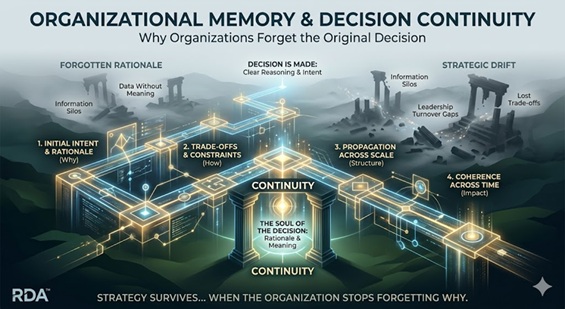 Why Organizations Forget the Original Decision Organizations rarely fail because they lack information. They rarely fail because they cannot generate ideas. Most organizations fail because decisions lose continuity over time. A decision is made. The reasoning is clear. Trade-offs are understood. Direction is aligned. And then the organization moves on. Teams change. Leadership rotates. Priorities evolve. Pressure increases. Contexts shift. Months later, the same execution problems begin to reappear. The same tensions return. The same coordination failures emerge. The same strategic drift repeats itself. Not because the organization forgot the decision. But because it forgot why the decision was originally made. 1. Decisions Do Not Only Travel Across Organizations They also travel across time. Most organizations understand that decisions must survive: • Scaling • Interpretation • Adaptation • Operational pressure Far fewer understand that decisions must also survive organizational memory loss. A decision may remain formally active while its original rationale gradually disappears. Execution continues. Processes remain operational. Metrics still move. But the meaning behind the decision enters system drift, where intent gradually erodes. Over time, organizations continue operating while disconnecting from the reasoning that originally created coherence. 2. Information Retention Is Not Organizational Memory Most organizations attempt to preserve memory through: • Documentation • Repositories • Dashboards • Knowledge bases • Lessons learned archives But storing information is not the same as preserving decision continuity. Organizational memory is not data retention. It is continuity of meaning. The critical issue is not whether organizations preserve records. It is whether they preserve: • Rationale • Intent • Context • Assumptions • Constraints • Accepted trade-offs Behind important decisions. Without this continuity, future teams inherit actions without understanding why those actions originally made sense. This is where many organizations become operationally active but strategically disconnected. 3. Strategic Drift Often Begins with Forgotten Rationale Strategic drift rarely begins as deliberate rejection. It usually begins when organizations continue executing decisions whose original context is no longer visible. As rationale fades: • Adaptations become disconnected • Local optimization increases • Priorities are reinterpreted • Incentives reshape behavior • Exceptions accumulate Each adjustment appears rational within local context. But collectively, the organization gradually redefines direction without consciously deciding to do so. This creates one of the most dangerous organizational conditions: Activity without continuity of meaning. 4. Why Organizations Repeat the Same Problems Many execution problems are not new problems. They are unresolved organizational memory failures. Organizations repeatedly revisit: • Governance conflicts • Coordination breakdowns • Prioritization tensions • Resource allocation disputes • Alignment failures Because the reasoning behind earlier decisions was never preserved coherently across time. The organization remembers: • The process • The structure • The decision itself But forgets: • The conditions • The constraints • The trade-offs • The original intent As a result, the same systemic tensions continuously re-emerge under new operational forms. 5. Decision Continuity Requires Stewardship Important decisions cannot depend only on initial approval. They require continuity stewardship. This means preserving not only: • What was decided But also: • Why it was decided • What conditions shaped it • What trade-offs were accepted • What risks were consciously tolerated Without stewardship, organizations gradually inherit decisions stripped of context. Over time: • Interpretation diverges • Adaptation accelerates • Coherence weakens • Strategic meaning erodes Governance as stewardship does not exist to control adaptation. It exists to preserve the guardrails of the original intent so that local adaptation does not destroy systemic direction. This is why strong organizations do not only preserve execution capability. They preserve decision continuity. 6. The Invisible Cost of Leadership Turnover Leadership transitions often create hidden discontinuities. New leaders inherit: • Structures • Initiatives • Commitments • Operating models But frequently without continuity of rationale. As pressure increases, inherited decisions are reinterpreted through current priorities instead of original systemic context. This creates gradual strategic fragmentation. Not because leaders are ineffective. But because organizational memory was never structurally preserved. The organization continues operating. But its decisions no longer belong to the same strategic narrative. 7. Organizational Memory Is a Governance Capability Most organizations treat memory as an administrative function. In reality, it is a strategic governance capability. Because governance is not only about: • Defining decisions • Assigning accountability • Enforcing control It is also about preserving continuity of direction across time. Without organizational memory: • Feedback loops weaken • Learning fragments • Rationale disappears • Coherence degrades • Adaptation becomes reactive instead of intentional Strong governance therefore requires mechanisms that preserve continuity between: • Original intent • Operational adaptation • Evolving reality This is the role of stewardship: Not policing execution, but preserving coherence as the organization evolves under pressure and change. 8. Technology Cannot Preserve Meaning Automatically Modern organizations increasingly rely on digital systems to preserve institutional memory. Platforms can retain: • Information • Workflows • Documents • Historical records But technology alone cannot preserve meaning. Most systems preserve the output of decisions. Very few preserve the reasoning behind them. Modern AI systems, copilots, and enterprise knowledge platforms can retrieve artifacts, summarize documents, and accelerate access to information. But they still struggle to preserve: • Contextual judgment • Human trade-offs • Pressure conditions • Rejected alternatives • Implicit assumptions • Strategic rationale Meaning depends on: • Interpretation • Context • Judgment • Assumptions • Trade-Offs • Organizational understanding Without deliberate stewardship, organizations risk creating systems that preserve artifacts while losing rationale. This creates a dangerous illusion: The organization appears informed. But no longer remembers why it decided what it did. 9. Coherence Across Time Organizations often focus on maintaining coherence across scale. But long-term resilience also depends on coherence across time. Strong organizations preserve: • Direction during growth • Intent during adaptation • Rationale during transition • Meaning during pressure This is what allows systems to evolve without losing strategic identity. Without continuity, adaptation eventually becomes drift. 10. The Real Function of Organizational Memory Organizational memory is not nostalgia. It is not archival preservation. Its purpose is not to freeze the organization in the past. Its function is to preserve enough continuity of meaning for future adaptation to remain coherent. Strong organizations do not preserve memory to avoid change. They preserve memory so change does not destroy direction. 11. Final Insight Organizations do not lose decisions only across complexity. They also lose them across time. The most dangerous drift is often invisible because execution continues long after the original meaning has disappeared. Closing Statement A strong organization is not only the one that makes decisions and executes them effectively. It is the one that preserves the rationale, intent, and strategic meaning behind those decisions as the organization evolves. Because in the end: Strategy survives not when decisions are remembered. But when the organization still remembers why they were made. |
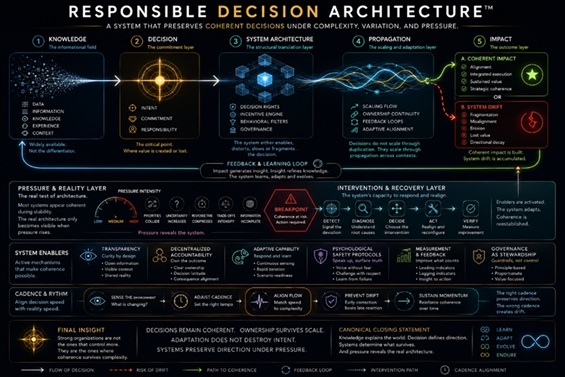 Pressure-Adaptive Version A system that preserves coherent decisions under complexity, variation, and pressure. For decades, organizations optimized for information. Then they optimized for analysis. Today, the real constraint is no longer knowledge. It is the system’s ability to preserve coherent decisions under pressure. Most organizations do not fail because they lack intelligence. They fail because: • Decisions lose coherence • Ownership fragments • Incentives distort intent • Systems cannot preserve direction under pressure Responsible Decision Architecture™ explains how: Knowledge becomes decision. Decisions propagate through systems. Coherent impact is either sustained… or lost to drift. The framework shifts the focus: From: • Isolated decision quality To: • System capability to sustain decisions across complexity THE FIVE STRUCTURAL LAYERS KNOWLEDGE The informational field. Inputs: • Data • Information • Knowledge Knowledge is now widely available. It is no longer the primary differentiator. Organizations do not transform because they know more. They transform because they decide and sustain decisions coherently. DECISION The commitment layer. A decision is not analysis. A decision is commitment under uncertainty. Core components: • Intent • Commitment • Responsibility This is the critical point where value is either created or lost. Without commitment: • Knowledge remains passive • Alignment remains theoretical • Execution fragments SYSTEM ARCHITECTURE The structural translation layer. This layer determines whether decisions remain coherent as they enter the organization. Core mechanisms: • Decision Rights • Incentive Engine • Behavioral and Interpretive Filters • Governance The system can: • Enable the decision • Distort the decision • Slow the decision • Fragment the decision Organizations rarely execute the stated decision. They execute the decision reshaped by the real system. The system influences not only behavior, but also how decisions are interpreted across contexts, incentives, and operational pressures. PROPAGATION The scaling and adaptation layer. Decisions do not scale through duplication. They scale through propagation across multiple contexts. Core mechanisms: • Scaling Flow • Ownership Continuity • Feedback Loops • Adaptive Alignment Risk factors: • Fragmentation • Signal Erosion • Incentive Divergence • Contextual Drift • Communication Distortion Organizations do not scale decisions directly. They scale interpretations shaped by context, incentives, and system pressures. Strategic drift rarely begins as open resistance. It emerges gradually as local adaptations reshape the meaning of the original decision. IMPACT The outcome layer. Two outcomes become possible. A. COHERENT IMPACT • Alignment • Integrated Execution • Sustained Value • Strategic Coherence B. SYSTEM DRIFT • Fragmentation • Misalignment • Erosion • Lost Value • Directional Decay System drift rarely appears as sudden collapse. It usually emerges gradually through accumulated adaptation, propagation distortion, and erosion of strategic meaning. PRESSURE-ADAPTIVE LAYER The real test of architecture. Most systems appear coherent during stability. The real architecture only becomes visible when: • Priorities collide • Uncertainty increases • Response time compresses • Trade-offs intensify • Information becomes incomplete Pressure does not create the system. Pressure reveals the system. Under pressure: • Hidden incentives emerge • Unclear authority becomes visible • Communication weakens • Propagation fragments • Coherence is tested Resilient systems do not only detect pressure. They develop the capability to: • Respond • Realign • Recover coherently A resilient organization is not one that eliminates variation. It is one that preserves direction while adaptation happens. SYSTEM ENABLERS • Transparency → See clearly • Accountability → Own the outcome • Adaptability → Respond and learn • Culture → Reinforce what matters • Measurement → Improve what counts FINAL INSIGHT Strong organizations are not the ones that control more. They are the ones where: • Decisions remain coherent • Ownership survives scale • Adaptation does not destroy intent • Systems preserve direction under pressure Because in the end: Scaling is not about size. It is about preserving coherence across complexity. CANONICAL CLOSING STATEMENT Knowledge explains the world. Decision defines direction. Systems determine what survives. Pressure reveals the real architecture. |
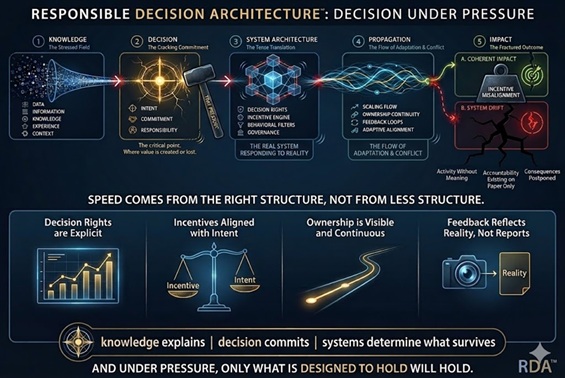 What Breaks, What Holds, What Must Be True Every decision model looks strong in theory. The real question is different: What happens under pressure? When time compresses, When incentives conflict, When accountability becomes visible, When the system resists. That is where most models fail. Not because they are wrong. Because they were never designed for reality. 1. The Risk of Architectural Overload A decision architecture can become a new layer of friction. More structure. More coordination. More time before action. If that happens, the system slows down instead of accelerating. This is a real risk. But it comes from a misunderstanding. Decision architecture is not about adding control. It is about removing invisible friction. When done correctly:
It comes from the right structure. 2. The “Real System” Is Not the Enemy Organizations often describe misalignment as a failure. But what is called misalignment is often something else. The system responding to reality Incentives. Constraints. Local pressures. Survival logic. This is not noise. It is signal. The “Real System” is not a distortion to eliminate. It is the environment decisions must survive. Trying to impose perfect alignment is not only unrealistic. It is dangerous. It removes the very tension that prevents bad decisions from scaling. The objective is not uniformity. It is coherence under variation 3. Commitment Does Not Survive Misaligned Incentives Many models assume that once a decision is made, people will follow it. This is rarely true. People do not follow decisions. They follow incentives If incentives contradict direction:
It is denial. Without aligned incentives: Commitment is not a capability It is an exception Any decision system that ignores this will fail. 4. The Cost of Stewardship Maintaining decision integrity requires continuity. But stewardship can be misunderstood. If it becomes:
Nothing moves without approval. The system freezes. This is not stewardship. It is dependency. Real stewardship is different. It is continuity embedded in the system It operates through:
The system carries the decision. 5. The Condition Most Organizations Avoid There is a deeper tension. Most organizations do not fail because they lack intelligence. They fail because they avoid exposure. Shared ambiguity feels safer than individual commitment. Drift feels safer than direction. Distributed interpretation feels safer than ownership. This is why many systems remain in motion without ever truly moving. Not because people cannot decide. Because the system makes not deciding rational. 6. What Must Be True This kind of decision architecture does not work by default. It works under conditions. Four, in particular: Decision rights are explicit Incentives are aligned with intent Ownership is visible and continuous Feedback reflects reality, not reports Without these, the system will revert. Not slowly. Immediately. 7. What This Model Really Does This model does not eliminate tension. It makes it visible. It does not reduce exposure. It makes it explicit. It does not guarantee better decisions. It makes decisions real. And that changes behavior. Because once decisions are real:
The real risk is not that decision architecture creates pressure. The real risk is operating without it. Where:
Strong organizations are not the ones that avoid tension. They are the ones that can sustain it without losing direction. Because in the end: Knowledge explains Decision commits Systems determine what survives And under pressure, only what is designed to hold will hold. |
|
Don't ever take a fence down until you know why it was put up. - Robert Frost |