Support to Develop
by Luis Branco

This blog addresses management-related topics and has three areas of focus: 1. Technical skills; 2. Competencies in the field of interpersonal relations and communication (including personal organization and delegation, leadership, teamwork, conflict resolution, conducting meetings, and negotiation); and 3. Strategy (including diagnosis, strategic guidelines, and implementation).4.Technology
Recent Posts
RCPCV™: A Method for Decision-Making and Continuous Improvement
The Same Change Can Succeed and Fail at the Same Time
What Must Exist Even When No Single Role Owns the Whole?
PHASE 4 – THE EMERGENCE
When Structural Drift Becomes Consequential
Categories
Agile,
Career Development,
Career Development,
Career Development,
Career Development,
Career Development,
Career Development,
Career Development,
Career Development,
Career Development,
Career Development,
Career Development,
Career Development,
Career Development,
Career Development,
Career Development,
Career Development,
Career Development,
Career Development,
Career Development,
Career Development,
Career Development,
Career Development,
Career Development,
Career Development,
Career Development,
Career Development,
Career Development,
Career Development,
Career Development,
Career Development,
Career Development,
Career Development,
Career Development,
Career Development,
Career Development,
Career Development,
Career Development,
Career Development,
Career Development,
Career Development,
Career Development,
Career Development,
Career Development,
Career Development,
Career Development,
Career Development,
Career Development,
Career Development,
Career Development,
Career Development,
Career Development,
Career Development,
Career Development,
Career Development,
Career Development,
Career Development,
Career Development,
Career Development,
Career Development,
Career Development,
Career Development,
Career Development,
Career Development,
Career Development,
Career Development,
Career Development,
Career Development,
Career Development,
Career Development,
Career Development,
Career Development,
Career Development,
Career Development,
Career Development,
Career Development,
Career Development,
Career Development,
Career Development,
Career Development,
Career Development,
Career Development,
Career Development,
Career Development,
Career Development,
Career Development,
Career Development,
Career Development,
Career Development,
Career Development,
Career Development,
Career Development,
Career Development,
Career Development,
Career Development,
Career Development,
Career Development,
Career Development,
Career Development,
Career Development,
Career Development,
Career Development,
Career Development,
Career Development,
Career Development,
Career Development,
Career Development,
Career Development,
Career Development,
Career Development,
Career Development,
Career Development,
Career Development,
Career Development,
Career Development,
Career Development,
Career Development,
Career Development,
Career Development,
Career Development,
Career Development,
Career Development,
Career Development,
Education,
Governance,
Governance,
Governance,
Governance,
Governance,
Governance,
Governance,
Governance,
Governance,
Governance,
Governance,
Governance,
Governance,
Governance,
Governance,
Governance,
Governance,
Governance,
Governance,
Governance,
Governance,
In,
Integration Management,
Interpersonal Skills,
Interpersonal Skills,
Interpersonal Skills,
Interpersonal Skills,
Interpersonal Skills,
Interpersonal Skills,
Interpersonal Skills,
Interpersonal Skills,
Interpersonal Skills,
Interpersonal Skills,
Interpersonal Skills,
Interpersonal Skills,
Interpersonal Skills,
Interpersonal Skills,
Interpersonal Skills,
Interpersonal Skills,
Interpersonal Skills,
Interpersonal Skills,
Interpersonal Skills,
Interpersonal Skills,
Interpersonal Skills,
Interpersonal Skills,
Interpersonal Skills,
Interpersonal Skills,
Interpersonal Skills,
Interpersonal Skills,
Interpersonal Skills,
Interpersonal Skills,
Interpersonal Skills,
Interpersonal Skills,
Interpersonal Skills,
Interpersonal Skills,
Interpersonal Skills,
Interpersonal Skills,
Interpersonal Skills,
Interpersonal Skills,
Interpersonal Skills,
Interpersonal Skills,
Interpersonal Skills,
Interpersonal Skills,
Interpersonal Skills,
Interpersonal Skills,
Interpersonal Skills,
Interpersonal Skills,
Interpersonal Skills,
Interpersonal Skills,
Interpersonal Skills,
Interpersonal Skills,
Interpersonal Skills,
Interpersonal Skills,
Interpersonal Skills,
Interpersonal Skills,
Interpersonal Skills,
Interpersonal Skills,
Interpersonal Skills,
Interpersonal Skills,
Interpersonal Skills,
Interpersonal Skills,
Interpersonal Skills,
Interpersonal Skills,
Interpersonal Skills,
Interpersonal Skills,
Interpersonal Skills,
Interpersonal Skills,
Interpersonal Skills,
Interpersonal Skills,
Interpersonal Skills,
Interpersonal Skills,
Interpersonal Skills,
Interpersonal Skills,
Interpersonal Skills,
Interpersonal Skills,
Interpersonal Skills,
Interpersonal Skills,
Interpersonal Skills,
Interpersonal Skills,
Interpersonal Skills,
Interpersonal Skills,
Interpersonal Skills,
Interpersonal Skills,
Interpersonal Skills,
Interpersonal Skills,
Interpersonal Skills,
Interpersonal Skills,
Interpersonal Skills,
Interpersonal Skills,
Interpersonal Skills,
Interpersonal Skills,
Interpersonal Skills,
Interpersonal Skills,
Interpersonal Skills,
Interpersonal Skills,
Interpersonal Skills,
Interpersonal Skills,
Interpersonal Skills,
Interpersonal Skills,
Interpersonal Skills,
Interpersonal Skills,
Interpersonal Skills,
Interpersonal Skills,
Interpersonal Skills,
Interpersonal Skills,
Interpersonal Skills,
Interpersonal Skills,
Interpersonal Skills,
Interpersonal Skills,
Interpersonal Skills,
Interpersonal Skills,
Interpersonal Skills,
Interpersonal Skills,
Interpersonal Skills,
Interpersonal Skills,
Interpersonal Skills,
Interpersonal Skills,
Interpersonal Skills,
Interpersonal Skills,
Interpersonal Skills,
Interpersonal Skills,
Interpersonal Skills,
Interpersonal Skills,
Interpersonal Skills,
Interpersonal Skills,
Knowledge Management,
le,
lea,
Leadership,
Leadership,
Leadership,
Leadership,
Leadership,
Leadership,
Leadership,
Leadership,
Leadership,
Leadership,
Leadership,
Leadership,
Leadership,
Leadership,
Leadership,
Leadership,
Leadership,
Leadership,
Leadership,
Leadership,
Leadership,
Leadership,
Leadership,
Leadership,
Leadership,
Leadership,
Leadership,
Leadership,
Leadership,
Leadership,
Leadership,
Leadership,
Leadership,
Leadership,
Leadership,
Leadership,
Leadership,
Leadership,
Leadership,
Leadership,
Leadership,
Leadership,
Leadership,
Leadership,
Leadership,
Leadership,
Leadership,
Leadership,
Leadership,
Leadership,
Leadership,
Leadership,
Leadership,
Leadership,
Leadership,
Leadership,
Leadership,
Leadership,
Leadership,
Leadership,
Leadership,
Leadership,
Leadership,
Leadership,
Leadership,
Leadership,
Leadership,
Leadership,
Leadership,
Leadership,
Leadership,
Leadership,
Leadership,
Leadership,
Leadership,
Leadership,
Leadership,
Leadership,
Leadership,
Leadership,
Leadership,
Leadership,
Leadership,
Leadership,
Leadership,
Leadership,
Leadership,
Leadership,
Leadership,
Leadership,
Leadership,
Leadership,
Leadership,
Leadership,
Leadership,
Leadership,
Leadership,
Leadership,
Leadership,
Leadership,
Leadership,
Leadership,
Leadership,
Leadership,
Leadership,
Leadership,
Leadership,
Leadership,
Leadership,
Leadership,
Leadership,
Leadership,
Leadership,
Leadership,
Leadership,
Leadership,
Leadership,
Leadership,
Leadership,
Leadership,
Leadership,
Leadership,
Leadership,
or,
Organizational Project Management,
Portfolio Management,
Program,
Program Management,
Strategy,
Strategy,
Strategy,
Strategy,
Strategy,
Strategy,
Strategy,
Strategy,
Strategy,
Strategy,
Strategy,
Strategy,
Strategy,
Strategy,
Strategy,
Strategy,
Strategy,
Strategy,
Strategy,
Strategy,
Strategy,
Strategy,
Strategy,
Strategy,
Strategy,
Strategy,
Strategy,
Strategy,
Strategy,
Strategy,
Strategy,
Strategy,
Strategy,
Strategy,
Strategy,
Strategy,
Strategy,
Strategy,
Strategy,
Strategy,
Strategy,
Strategy,
Strategy,
Strategy,
Strategy,
Strategy,
Strategy,
Strategy,
Strategy,
Strategy,
Strategy,
Strategy,
Strategy,
Strategy,
Strategy,
Strategy,
Strategy,
Strategy,
Strategy,
Strategy,
Strategy,
Strategy,
Strategy,
Strategy,
Strategy,
Strategy,
Strategy,
Strategy,
Strategy,
Strategy,
Strategy,
Strategy,
Strategy,
Strategy,
Strategy,
Strategy,
Strategy,
Strategy,
Strategy,
Strategy,
Strategy,
Strategy,
Strategy,
Strategy,
Strategy,
Strategy,
Strategy,
Strategy,
Strategy,
Strategy,
Strategy,
Strategy,
Strategy,
Strategy,
Strategy,
Strategy,
Strategy,
Strategy,
Strategy,
Strategy,
Strategy,
Strategy,
Strategy,
Strategy,
Strategy,
Strategy,
Strategy,
Strategy,
Strategy,
Strategy,
Strategy,
Strategy,
Strategy,
Strategy,
Strategy,
Strategy,
Strategy,
Strategy,
Strategy,
Strategy,
Strategy,
Strategy,
Strategy,
Sustainability,
Talent Management,
Talent Management,
Talent Management,
Talent Management,
Talent Management,
Talent Management,
Talent Management,
Talent Management,
Talent Management,
Talent Management,
Talent Management,
Talent Management,
Talent Management,
Talent Management,
Talent Management,
Talent Management,
Talent Management,
Talent Management,
Talent Management,
Talent Management,
Talent Management,
Talent Management,
Talent Management,
Talent Management,
Talent Management,
Talent Management,
Talent Management,
Talent Management,
Talent Management,
Talent Management,
Talent Management,
Talent Management,
Talent Management,
Talent Management,
Talent Management,
Talent Management,
Talent Management,
Talent Management,
Talent Management,
Talent Management,
Talent Management,
Talent Management,
Talent Management,
Talent Management,
Talent Management,
Talent Management,
Talent Management,
Talent Management,
Talent Management,
Talent Management,
Talent Management,
Talent Management,
Talent Management,
Talent Management,
Talent Management,
Talent Management,
Talent Management,
Talent Management,
Talent Management,
Talent Management,
Talent Management,
Talent Management,
Talent Management,
Talent Management,
Talent Management,
Talent Management,
Talent Management,
Talent Management,
Talent Management,
Talent Management,
Talent Management,
Talent Management,
Talent Management,
Talent Management,
Talent Management,
Talent Management,
Talent Management,
Talent Management,
Talent Management,
Talent Management,
Talent Management,
Talent Management,
Talent Management,
Talent Management,
Talent Management,
Talent Management,
Talent Management,
Talent Management,
Talent Management,
Talent Management,
Talent Management,
Talent Management,
Talent Management,
Talent Management,
Talent Management,
Talent Management,
Talent Management,
Talent Management,
Talent Management,
Talent Management,
Talent Management,
Talent Management,
Talent Management,
Talent Management,
Talent Management,
Talent Management,
Talent Management,
Talent Management,
Talent Management,
Talent Management,
Talent Management,
Talent Management,
Talent Management,
Talent Management,
Talent Management,
Talent Management,
Talent Management,
Talent Management,
Talent Management,
Talent Management,
Talent Management,
Talent Management,
Talent Management
Date
The Silent Driver of Rework, Conflict and Strategic Drift
The most expensive waste in a project is rarely found in the schedule or the budget.
It lives in assumptions that were never examined.
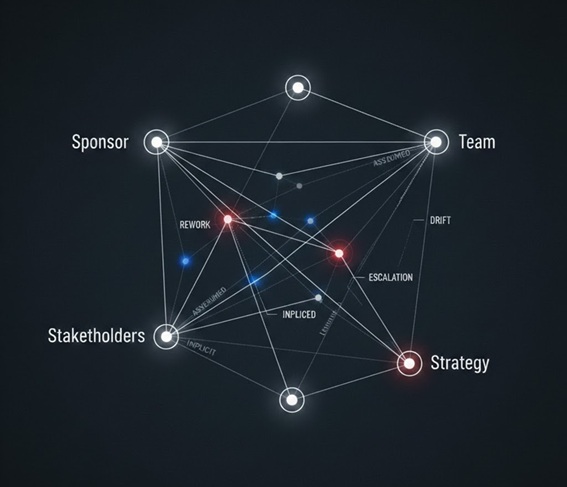
When projects struggle, we tend to diagnose visible symptoms. Scope creep. Stakeholder resistance. Misalignment. Delays. Escalations. Rework.
But many of these are not primary causes. They are consequences of beliefs treated as facts without being consciously validated.
Unexamined assumptions are latent risk.
They silently shape decisions before execution even begins.
The Invisible Origin of Inefficiency
Most project inefficiencies do not start with poor planning. They start with implicit thinking.
Consider how often we hear statements such as:
- The sponsor is aligned.
- The team understands the objective.
- Stakeholders will adapt.
- The data is sufficient.
- Everyone agrees with the priorities.
These are not confirmed realities. They are assumptions presented as certainty.
Now consider the cost when one of them fails.
If “the sponsor is aligned” proves false, late scope correction can trigger budget overruns, credibility loss and executive tension.
If “the team understands the objective” is inaccurate, execution may be technically correct but strategically misdirected, leading to expensive rework.
If “stakeholders will adapt” is optimistic, resistance may surface only after implementation, when change becomes harder and trust more fragile.
By the time misalignment becomes visible, the cognitive error is already structural.
Rework, conflict and delay are often the downstream cost of upstream assumptions.
Assumptions Are Not Risks
A risk is acknowledged uncertainty.
An assumption is unacknowledged certainty.
This distinction matters.
Risks are documented, discussed and monitored. Assumptions often remain invisible because they feel obvious.
Here is the difference clearly:
Risk
- Explicitly identified
- Recognized as uncertain
- Assigned ownership
- Monitored and reviewed
Assumption
- Implicit or taken for granted
- Treated as fact
- Rarely challenged
- Often undocumented
Risks are governed.
Assumptions, when hidden, govern us.
Yet assumptions shape:
- What problem we believe we are solving.
- What success looks like.
- What constraints we consider real.
- Whose perspective we prioritize.
When left unexamined, they create cognitive debt. And like financial debt, it compounds.
The longer assumptions remain untested, the more expensive their correction becomes.
Transactional Noise as a Symptom
In pressured environments, communication often becomes transactional. Updates replace understanding. Reporting replaces reflection.
Noise increases.
But noise is rarely the root problem. It is a symptom of misaligned mental models.
When assumptions differ and remain implicit:
- Conversations feel tense but undefined.
- Decisions appear logical but generate resistance.
- Teams comply without committing.
- Stakeholders agree publicly and disengage privately.
The system becomes operationally active but strategically incoherent.
Transactional communication often signals cognitive divergence beneath the surface.
Listening as Invisible Risk Mitigation
This is where listening becomes strategic.
Listening is not courtesy. It is governance.
When leaders listen deeply, they are not simply gathering opinions. They are surfacing hidden premises. They are mapping how people interpret reality. They are stress-testing intention before committing to direction.
Listening reveals:
- What people believe is true.
- What they fear but do not articulate.
- What they assume others already know.
- Where interpretations quietly diverge.
This is not soft skill territory. It is risk mitigation in real time.
Every assumption made explicit reduces future rework.
Every divergence clarified early protects alignment.
Every perspective genuinely heard strengthens systemic coherence.
Listening reduces entropy before entropy becomes cost.
The Brain Economy Perspective
In an era shaped by artificial intelligence and rapid automation, access to information is no longer the differentiator.
The scarce resource is discernment.
We are moving from a knowledge economy to a brain economy, where value is created not by accumulating data but by exercising judgment, interpretation and ethical clarity under complexity.
AI can process information.
It can generate scenarios.
It can optimize parameters.
But it does not naturally detect the implicit assumptions embedded in human intention unless those assumptions are made explicit.
If assumptions remain hidden, even advanced systems will amplify flawed premises.
Conscious decision-making begins with assumption awareness.
Leadership in the brain economy requires the discipline to question what feels obvious.
From Assumption Awareness to Regenerative Leadership
Regenerative leadership does not eliminate uncertainty. It creates cognitive transparency.
It asks:
- What are we assuming to be true?
- What evidence supports that belief?
- Whose perspective is missing?
- What interpretation are we treating as fact?
By making the invisible visible, leaders reduce the probability of strategic drift and strengthen long-term trust.
Projects do not fail only because of volatility. They often falter because internal assumptions were never surfaced, challenged or aligned.
Rework is expensive.
Conflict is disruptive.
Strategic drift is dangerous.
But unexamined assumptions are the silent architects of all three.
The greatest waste in a project is not always found in time or cost variance. It is found in the gap between what we think is true and what has never been consciously examined.
Leadership begins when we close that gap.
When we question before we commit.
When we listen before we decide.
When we make assumptions visible before they become structural liabilities.
In complex environments, clarity is not accidental.
It is designed. |
Posted on: February 24, 2026 03:09 PM
|
Permalink |
Comments (1)
|
"Maybe this world is another planet's hell."
- Aldous Huxley
|




