From Statistical Patterns to Operational Judgment
From the Support to Develop Blog
by Luis Branco

This blog addresses management-related topics and has three areas of focus: 1. Technical skills; 2. Competencies in the field of interpersonal relations and communication (including personal organization and delegation, leadership, teamwork, conflict resolution, conducting meetings, and negotiation); and 3. Strategy (including diagnosis, strategic guidelines, and implementation).4.Technology
Recent Posts
RCPCV™: A Method for Decision-Making and Continuous Improvement
The Same Change Can Succeed and Fail at the Same Time
What Must Exist Even When No Single Role Owns the Whole?
PHASE 4 – THE EMERGENCE
When Structural Drift Becomes Consequential
Categories
Agile,
Career Development,
Career Development,
Career Development,
Career Development,
Career Development,
Career Development,
Career Development,
Career Development,
Career Development,
Career Development,
Career Development,
Career Development,
Career Development,
Career Development,
Career Development,
Career Development,
Career Development,
Career Development,
Career Development,
Career Development,
Career Development,
Career Development,
Career Development,
Career Development,
Career Development,
Career Development,
Career Development,
Career Development,
Career Development,
Career Development,
Career Development,
Career Development,
Career Development,
Career Development,
Career Development,
Career Development,
Career Development,
Career Development,
Career Development,
Career Development,
Career Development,
Career Development,
Career Development,
Career Development,
Career Development,
Career Development,
Career Development,
Career Development,
Career Development,
Career Development,
Career Development,
Career Development,
Career Development,
Career Development,
Career Development,
Career Development,
Career Development,
Career Development,
Career Development,
Career Development,
Career Development,
Career Development,
Career Development,
Career Development,
Career Development,
Career Development,
Career Development,
Career Development,
Career Development,
Career Development,
Career Development,
Career Development,
Career Development,
Career Development,
Career Development,
Career Development,
Career Development,
Career Development,
Career Development,
Career Development,
Career Development,
Career Development,
Career Development,
Career Development,
Career Development,
Career Development,
Career Development,
Career Development,
Career Development,
Career Development,
Career Development,
Career Development,
Career Development,
Career Development,
Career Development,
Career Development,
Career Development,
Career Development,
Career Development,
Career Development,
Career Development,
Career Development,
Career Development,
Career Development,
Career Development,
Career Development,
Career Development,
Career Development,
Career Development,
Career Development,
Career Development,
Career Development,
Career Development,
Career Development,
Career Development,
Career Development,
Career Development,
Career Development,
Career Development,
Career Development,
Career Development,
Career Development,
Education,
Governance,
Governance,
Governance,
Governance,
Governance,
Governance,
Governance,
Governance,
Governance,
Governance,
Governance,
Governance,
Governance,
Governance,
Governance,
Governance,
Governance,
Governance,
Governance,
Governance,
Governance,
In,
Integration Management,
Interpersonal Skills,
Interpersonal Skills,
Interpersonal Skills,
Interpersonal Skills,
Interpersonal Skills,
Interpersonal Skills,
Interpersonal Skills,
Interpersonal Skills,
Interpersonal Skills,
Interpersonal Skills,
Interpersonal Skills,
Interpersonal Skills,
Interpersonal Skills,
Interpersonal Skills,
Interpersonal Skills,
Interpersonal Skills,
Interpersonal Skills,
Interpersonal Skills,
Interpersonal Skills,
Interpersonal Skills,
Interpersonal Skills,
Interpersonal Skills,
Interpersonal Skills,
Interpersonal Skills,
Interpersonal Skills,
Interpersonal Skills,
Interpersonal Skills,
Interpersonal Skills,
Interpersonal Skills,
Interpersonal Skills,
Interpersonal Skills,
Interpersonal Skills,
Interpersonal Skills,
Interpersonal Skills,
Interpersonal Skills,
Interpersonal Skills,
Interpersonal Skills,
Interpersonal Skills,
Interpersonal Skills,
Interpersonal Skills,
Interpersonal Skills,
Interpersonal Skills,
Interpersonal Skills,
Interpersonal Skills,
Interpersonal Skills,
Interpersonal Skills,
Interpersonal Skills,
Interpersonal Skills,
Interpersonal Skills,
Interpersonal Skills,
Interpersonal Skills,
Interpersonal Skills,
Interpersonal Skills,
Interpersonal Skills,
Interpersonal Skills,
Interpersonal Skills,
Interpersonal Skills,
Interpersonal Skills,
Interpersonal Skills,
Interpersonal Skills,
Interpersonal Skills,
Interpersonal Skills,
Interpersonal Skills,
Interpersonal Skills,
Interpersonal Skills,
Interpersonal Skills,
Interpersonal Skills,
Interpersonal Skills,
Interpersonal Skills,
Interpersonal Skills,
Interpersonal Skills,
Interpersonal Skills,
Interpersonal Skills,
Interpersonal Skills,
Interpersonal Skills,
Interpersonal Skills,
Interpersonal Skills,
Interpersonal Skills,
Interpersonal Skills,
Interpersonal Skills,
Interpersonal Skills,
Interpersonal Skills,
Interpersonal Skills,
Interpersonal Skills,
Interpersonal Skills,
Interpersonal Skills,
Interpersonal Skills,
Interpersonal Skills,
Interpersonal Skills,
Interpersonal Skills,
Interpersonal Skills,
Interpersonal Skills,
Interpersonal Skills,
Interpersonal Skills,
Interpersonal Skills,
Interpersonal Skills,
Interpersonal Skills,
Interpersonal Skills,
Interpersonal Skills,
Interpersonal Skills,
Interpersonal Skills,
Interpersonal Skills,
Interpersonal Skills,
Interpersonal Skills,
Interpersonal Skills,
Interpersonal Skills,
Interpersonal Skills,
Interpersonal Skills,
Interpersonal Skills,
Interpersonal Skills,
Interpersonal Skills,
Interpersonal Skills,
Interpersonal Skills,
Interpersonal Skills,
Interpersonal Skills,
Interpersonal Skills,
Interpersonal Skills,
Interpersonal Skills,
Interpersonal Skills,
Interpersonal Skills,
Interpersonal Skills,
Interpersonal Skills,
Knowledge Management,
le,
lea,
Leadership,
Leadership,
Leadership,
Leadership,
Leadership,
Leadership,
Leadership,
Leadership,
Leadership,
Leadership,
Leadership,
Leadership,
Leadership,
Leadership,
Leadership,
Leadership,
Leadership,
Leadership,
Leadership,
Leadership,
Leadership,
Leadership,
Leadership,
Leadership,
Leadership,
Leadership,
Leadership,
Leadership,
Leadership,
Leadership,
Leadership,
Leadership,
Leadership,
Leadership,
Leadership,
Leadership,
Leadership,
Leadership,
Leadership,
Leadership,
Leadership,
Leadership,
Leadership,
Leadership,
Leadership,
Leadership,
Leadership,
Leadership,
Leadership,
Leadership,
Leadership,
Leadership,
Leadership,
Leadership,
Leadership,
Leadership,
Leadership,
Leadership,
Leadership,
Leadership,
Leadership,
Leadership,
Leadership,
Leadership,
Leadership,
Leadership,
Leadership,
Leadership,
Leadership,
Leadership,
Leadership,
Leadership,
Leadership,
Leadership,
Leadership,
Leadership,
Leadership,
Leadership,
Leadership,
Leadership,
Leadership,
Leadership,
Leadership,
Leadership,
Leadership,
Leadership,
Leadership,
Leadership,
Leadership,
Leadership,
Leadership,
Leadership,
Leadership,
Leadership,
Leadership,
Leadership,
Leadership,
Leadership,
Leadership,
Leadership,
Leadership,
Leadership,
Leadership,
Leadership,
Leadership,
Leadership,
Leadership,
Leadership,
Leadership,
Leadership,
Leadership,
Leadership,
Leadership,
Leadership,
Leadership,
Leadership,
Leadership,
Leadership,
Leadership,
Leadership,
Leadership,
Leadership,
Leadership,
or,
Organizational Project Management,
Portfolio Management,
Program,
Program Management,
Strategy,
Strategy,
Strategy,
Strategy,
Strategy,
Strategy,
Strategy,
Strategy,
Strategy,
Strategy,
Strategy,
Strategy,
Strategy,
Strategy,
Strategy,
Strategy,
Strategy,
Strategy,
Strategy,
Strategy,
Strategy,
Strategy,
Strategy,
Strategy,
Strategy,
Strategy,
Strategy,
Strategy,
Strategy,
Strategy,
Strategy,
Strategy,
Strategy,
Strategy,
Strategy,
Strategy,
Strategy,
Strategy,
Strategy,
Strategy,
Strategy,
Strategy,
Strategy,
Strategy,
Strategy,
Strategy,
Strategy,
Strategy,
Strategy,
Strategy,
Strategy,
Strategy,
Strategy,
Strategy,
Strategy,
Strategy,
Strategy,
Strategy,
Strategy,
Strategy,
Strategy,
Strategy,
Strategy,
Strategy,
Strategy,
Strategy,
Strategy,
Strategy,
Strategy,
Strategy,
Strategy,
Strategy,
Strategy,
Strategy,
Strategy,
Strategy,
Strategy,
Strategy,
Strategy,
Strategy,
Strategy,
Strategy,
Strategy,
Strategy,
Strategy,
Strategy,
Strategy,
Strategy,
Strategy,
Strategy,
Strategy,
Strategy,
Strategy,
Strategy,
Strategy,
Strategy,
Strategy,
Strategy,
Strategy,
Strategy,
Strategy,
Strategy,
Strategy,
Strategy,
Strategy,
Strategy,
Strategy,
Strategy,
Strategy,
Strategy,
Strategy,
Strategy,
Strategy,
Strategy,
Strategy,
Strategy,
Strategy,
Strategy,
Strategy,
Strategy,
Strategy,
Strategy,
Strategy,
Sustainability,
Talent Management,
Talent Management,
Talent Management,
Talent Management,
Talent Management,
Talent Management,
Talent Management,
Talent Management,
Talent Management,
Talent Management,
Talent Management,
Talent Management,
Talent Management,
Talent Management,
Talent Management,
Talent Management,
Talent Management,
Talent Management,
Talent Management,
Talent Management,
Talent Management,
Talent Management,
Talent Management,
Talent Management,
Talent Management,
Talent Management,
Talent Management,
Talent Management,
Talent Management,
Talent Management,
Talent Management,
Talent Management,
Talent Management,
Talent Management,
Talent Management,
Talent Management,
Talent Management,
Talent Management,
Talent Management,
Talent Management,
Talent Management,
Talent Management,
Talent Management,
Talent Management,
Talent Management,
Talent Management,
Talent Management,
Talent Management,
Talent Management,
Talent Management,
Talent Management,
Talent Management,
Talent Management,
Talent Management,
Talent Management,
Talent Management,
Talent Management,
Talent Management,
Talent Management,
Talent Management,
Talent Management,
Talent Management,
Talent Management,
Talent Management,
Talent Management,
Talent Management,
Talent Management,
Talent Management,
Talent Management,
Talent Management,
Talent Management,
Talent Management,
Talent Management,
Talent Management,
Talent Management,
Talent Management,
Talent Management,
Talent Management,
Talent Management,
Talent Management,
Talent Management,
Talent Management,
Talent Management,
Talent Management,
Talent Management,
Talent Management,
Talent Management,
Talent Management,
Talent Management,
Talent Management,
Talent Management,
Talent Management,
Talent Management,
Talent Management,
Talent Management,
Talent Management,
Talent Management,
Talent Management,
Talent Management,
Talent Management,
Talent Management,
Talent Management,
Talent Management,
Talent Management,
Talent Management,
Talent Management,
Talent Management,
Talent Management,
Talent Management,
Talent Management,
Talent Management,
Talent Management,
Talent Management,
Talent Management,
Talent Management,
Talent Management,
Talent Management,
Talent Management,
Talent Management,
Talent Management,
Talent Management,
Talent Management,
Talent Management
Date
 Why Frameworks Improve Probability – But Cannot Eliminate Judgment
Modern project management is becoming increasingly evidence-informed.
Frameworks such as NPSS and PMI’s M.O.R.E. model reflect an important shift in how project success is understood. Success is no longer interpreted solely through scope, schedule, and budget.
It is increasingly associated with legitimacy, adaptability, stakeholder alignment, contextual awareness, and the quality of decisions made under uncertainty.
That shift matters.
For decades, many organizations treated project management primarily as a discipline of control:
- Define the plan,
- Protect the baseline,
- Monitor variance,
- Optimize execution.
But operational reality has always been more complex than procedural logic alone.
Projects succeed or fail not only because of execution discipline, but because:
- Stakeholder expectations evolve,
- Legitimacy shifts,
- External conditions change,
- Value is interpreted differently across groups,
- Decisions must still be made under ambiguity, incomplete information, and competing pressures.
Frameworks such as M.O.R.E. attempt to address that reality directly. They encourage:
- Broader systems awareness,
- Adaptive reassessment,
- Stakeholder-centered value definition,
- Contextual interpretation,
- Accountability beyond narrow role boundaries.
All of this improves the probability of better outcomes.
But probability is not certainty.
And that distinction is where the real operational challenge begins.
The moment frameworks meet operational realityOne of the most revealing aspects of the M.O.R.E. framework is that it repeatedly places practitioners inside situations where:
- Multiple interpretations are defensible,
- Stakeholder legitimacy conflicts,
- Trade-offs remain unresolved,
- Information is incomplete,
- Timing itself changes the meaning of the decision.
This is important because the framework unintentionally demonstrates something deeper than its own methodology:
Even highly structured decision environments still depend on human interpretation.
The framework structures reflection.
It does not eliminate ambiguity.
It guides attention.
It does not decide.
That distinction is critical.
Because many organizations unconsciously attempt to operationalize frameworks as if structured process could fully absorb uncertainty itself.
It cannot.
Correlation is not decision architectureThe research behind NPSS and M.O.R.E. is valuable because it identifies meaningful correlations between certain practices and higher levels of perceived project success.
That evidence matters.
Patterns matter.
Behavioral tendencies matter.
But correlations are not operational decisions.
Frameworks are built from aggregated patterns.
Decisions are made inside singular operational realities.
A statistical pattern may suggest that:
- Stakeholder engagement improves outcomes,
- Reassessment improves adaptability,
- Alignment improves perceived success.
But no framework can fully determine:
- Whom to engage first,
- How much reassessment is enough,
- When adaptation becomes drift,
- When alignment becomes paralysis,
- Which trade-offs deserve protection,
- When legitimacy outweighs procedural stability.
Those are not statistical questions anymore.
They are judgment questions.
And judgment only becomes visible when consequence enters the system.
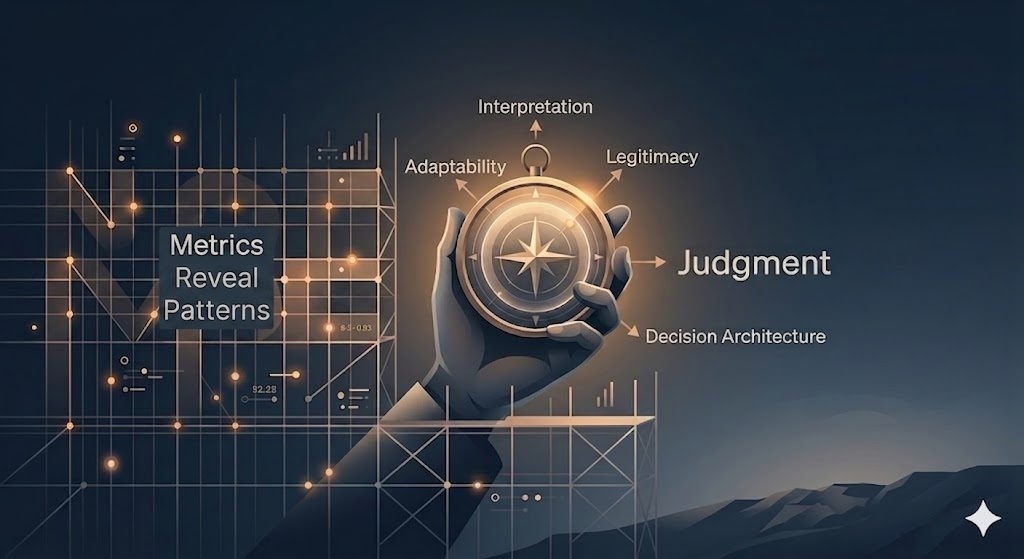
Metrics reveal patterns. Leadership interprets context.This is where many organizations unintentionally create confusion.
Metrics are often treated as if they contain the decision itself.
They do not.
Metrics:
- Surface signals,
- Reveal tendencies,
- Expose probabilities,
- Identify areas requiring attention.
But metrics cannot independently resolve:
- Conflicting stakeholder values,
- Legitimacy tensions,
- Contextual ambiguity,
- Political exposure,
- Ethical trade-offs,
- Strategic interpretation.
Two experienced leaders can look at the same evidence and still reach different conclusions because the difficult part is rarely the metric itself.
The difficult part is interpretation under consequence.
This is precisely why leadership remains irreducible.
Not because frameworks lack value, but because operational reality exceeds what frameworks can fully formalize.
The hidden risk of over-structuring judgmentIronically, the more sophisticated frameworks become, the easier it becomes for organizations to confuse structured reflection with operational certainty.
But frameworks are not substitutes for judgment.
They are scaffolding for judgment.
Used well, frameworks:
- Improve visibility,
- Surface blind spots,
- Expand perspective,
- Structure reflection,
- Clarify trade-offs,
- Improve the quality of organizational conversations.
Used poorly, they create:
- Procedural comfort,
- Artificial certainty,
- Governance inflation,
- Endless alignment cycles,
- Delayed accountability,
- The illusion that process maturity can eliminate ambiguity itself.
One of the hidden organizational risks of framework-heavy environments is the gradual substitution of accountable judgment by procedural defensibility.
Following the approved process can reduce personal exposure, support auditability, and create operational consistency.
But it does not eliminate responsibility for the interpretation, prioritization, and trade-offs embedded in operational decisions.
Procedural compliance may explain how a decision was made.
It does not automatically justify whether the decision was contextually correct.
At some point, somebody still has to decide.
And that decision still carries:
- Uncertainty,
- Trade-offs,
- Legitimacy consequences,
- Accountability,
- Incomplete information that no framework can fully absorb.
Adaptation versus adaptive driftThis becomes especially important in environments that increasingly emphasize agility, reassessment, and continuous adaptation.
The challenge is not whether organizations should adapt.
They must.
The challenge is whether adaptation remains coherently anchored to the intended value the project exists to protect.
Without that anchor, adaptation itself can slowly become strategic drift:
- Continuous reinterpretation,
- Unstable priorities,
- Governance fatigue,
- Stakeholder inflation,
- The gradual erosion of strategic coherence disguised as responsiveness.
This is why reassessment itself requires judgment.
Not every new signal deserves strategic redirection.
Not every stakeholder concern justifies structural change.
Not every emerging opportunity strengthens the original purpose of the initiative.
The difficult work is preserving coherence while remaining genuinely adaptive.
That balance cannot be fully proceduralized.
Risk, uncertainty, and the limits of formalizationAnother important distinction often becomes blurred in framework-driven environments:
The difference between risk and true uncertainty.Most frameworks are highly effective at structuring attention around identifiable risks:
- Known constraints,
- Measurable variances,
- Predictable dependencies,
- Scenarios where probabilities can at least be estimated.
But leadership becomes most critical when organizations encounter uncertainty that cannot yet be:
- Probabilistically modeled,
- Politically stabilized,
- Operationally standardized,
- Historically benchmarked.
In those moments:
- Historical metrics weaken,
- Precedent becomes unreliable,
- Governance structures alone become insufficient.
This is where operational judgment becomes irreducible.
Because the organization is no longer navigating calculable variation inside known boundaries.
It is navigating ambiguity itself.
The irreducible layer of project leadershipThis is why the future of project leadership is unlikely to belong to organizations that simply accumulate:
- More frameworks,
- More dashboards,
- More governance layers,
- More success metrics.
The differentiator will increasingly become the organizational capacity to:
- Interpret context coherently,
- Navigate competing legitimacy systems,
- Balance adaptation with stability,
- Recognize when reassessment is necessary,
- Preserve decision quality under uncertainty,
- Maintain strategic coherence while conditions continue shifting.
This is not a rejection of frameworks.
It is a recognition of their proper role.
Frameworks improve the probability of better outcomes because they:
- Shape attention,
- Structure reflection,
- Expose blind spots,
- Improve the quality of organizational judgment.
But operational reality still requires human beings to:
- Interpret context,
- Navigate ambiguity,
- Balance competing value systems,
- Assume responsibility for decisions that remain inherently incomplete.
Frameworks can illuminate the terrain.
But under real operational pressure, judgment is still what navigates uncertainty, legitimacy, and consequence.
Posted on: June 01, 2026 12:25 PM |
Permalink
Comments (1)
Please login or join to subscribe to this item

Kwiyuh Michael Wepngong
 Community Champion
Financial Management Specialist | US Peace Corps
Yaounde, Centre, Cameroon
Please Login/Register to leave a comment.
|
"Next week there can't be any crisis. My schedule is already full."
- Henry Kissinger
|




