Support to Develop
by Luis Branco

This blog addresses management-related topics and has three areas of focus: 1. Technical skills; 2. Competencies in the field of interpersonal relations and communication (including personal organization and delegation, leadership, teamwork, conflict resolution, conducting meetings, and negotiation); and 3. Strategy (including diagnosis, strategic guidelines, and implementation).4.Technology
Recent Posts
RCPCV™: A Method for Decision-Making and Continuous Improvement
The Same Change Can Succeed and Fail at the Same Time
What Must Exist Even When No Single Role Owns the Whole?
PHASE 4 – THE EMERGENCE
When Structural Drift Becomes Consequential
Categories
Agile,
Career Development,
Career Development,
Career Development,
Career Development,
Career Development,
Career Development,
Career Development,
Career Development,
Career Development,
Career Development,
Career Development,
Career Development,
Career Development,
Career Development,
Career Development,
Career Development,
Career Development,
Career Development,
Career Development,
Career Development,
Career Development,
Career Development,
Career Development,
Career Development,
Career Development,
Career Development,
Career Development,
Career Development,
Career Development,
Career Development,
Career Development,
Career Development,
Career Development,
Career Development,
Career Development,
Career Development,
Career Development,
Career Development,
Career Development,
Career Development,
Career Development,
Career Development,
Career Development,
Career Development,
Career Development,
Career Development,
Career Development,
Career Development,
Career Development,
Career Development,
Career Development,
Career Development,
Career Development,
Career Development,
Career Development,
Career Development,
Career Development,
Career Development,
Career Development,
Career Development,
Career Development,
Career Development,
Career Development,
Career Development,
Career Development,
Career Development,
Career Development,
Career Development,
Career Development,
Career Development,
Career Development,
Career Development,
Career Development,
Career Development,
Career Development,
Career Development,
Career Development,
Career Development,
Career Development,
Career Development,
Career Development,
Career Development,
Career Development,
Career Development,
Career Development,
Career Development,
Career Development,
Career Development,
Career Development,
Career Development,
Career Development,
Career Development,
Career Development,
Career Development,
Career Development,
Career Development,
Career Development,
Career Development,
Career Development,
Career Development,
Career Development,
Career Development,
Career Development,
Career Development,
Career Development,
Career Development,
Career Development,
Career Development,
Career Development,
Career Development,
Career Development,
Career Development,
Career Development,
Career Development,
Career Development,
Career Development,
Career Development,
Career Development,
Career Development,
Career Development,
Career Development,
Career Development,
Education,
Governance,
Governance,
Governance,
Governance,
Governance,
Governance,
Governance,
Governance,
Governance,
Governance,
Governance,
Governance,
Governance,
Governance,
Governance,
Governance,
Governance,
Governance,
Governance,
Governance,
Governance,
In,
Integration Management,
Interpersonal Skills,
Interpersonal Skills,
Interpersonal Skills,
Interpersonal Skills,
Interpersonal Skills,
Interpersonal Skills,
Interpersonal Skills,
Interpersonal Skills,
Interpersonal Skills,
Interpersonal Skills,
Interpersonal Skills,
Interpersonal Skills,
Interpersonal Skills,
Interpersonal Skills,
Interpersonal Skills,
Interpersonal Skills,
Interpersonal Skills,
Interpersonal Skills,
Interpersonal Skills,
Interpersonal Skills,
Interpersonal Skills,
Interpersonal Skills,
Interpersonal Skills,
Interpersonal Skills,
Interpersonal Skills,
Interpersonal Skills,
Interpersonal Skills,
Interpersonal Skills,
Interpersonal Skills,
Interpersonal Skills,
Interpersonal Skills,
Interpersonal Skills,
Interpersonal Skills,
Interpersonal Skills,
Interpersonal Skills,
Interpersonal Skills,
Interpersonal Skills,
Interpersonal Skills,
Interpersonal Skills,
Interpersonal Skills,
Interpersonal Skills,
Interpersonal Skills,
Interpersonal Skills,
Interpersonal Skills,
Interpersonal Skills,
Interpersonal Skills,
Interpersonal Skills,
Interpersonal Skills,
Interpersonal Skills,
Interpersonal Skills,
Interpersonal Skills,
Interpersonal Skills,
Interpersonal Skills,
Interpersonal Skills,
Interpersonal Skills,
Interpersonal Skills,
Interpersonal Skills,
Interpersonal Skills,
Interpersonal Skills,
Interpersonal Skills,
Interpersonal Skills,
Interpersonal Skills,
Interpersonal Skills,
Interpersonal Skills,
Interpersonal Skills,
Interpersonal Skills,
Interpersonal Skills,
Interpersonal Skills,
Interpersonal Skills,
Interpersonal Skills,
Interpersonal Skills,
Interpersonal Skills,
Interpersonal Skills,
Interpersonal Skills,
Interpersonal Skills,
Interpersonal Skills,
Interpersonal Skills,
Interpersonal Skills,
Interpersonal Skills,
Interpersonal Skills,
Interpersonal Skills,
Interpersonal Skills,
Interpersonal Skills,
Interpersonal Skills,
Interpersonal Skills,
Interpersonal Skills,
Interpersonal Skills,
Interpersonal Skills,
Interpersonal Skills,
Interpersonal Skills,
Interpersonal Skills,
Interpersonal Skills,
Interpersonal Skills,
Interpersonal Skills,
Interpersonal Skills,
Interpersonal Skills,
Interpersonal Skills,
Interpersonal Skills,
Interpersonal Skills,
Interpersonal Skills,
Interpersonal Skills,
Interpersonal Skills,
Interpersonal Skills,
Interpersonal Skills,
Interpersonal Skills,
Interpersonal Skills,
Interpersonal Skills,
Interpersonal Skills,
Interpersonal Skills,
Interpersonal Skills,
Interpersonal Skills,
Interpersonal Skills,
Interpersonal Skills,
Interpersonal Skills,
Interpersonal Skills,
Interpersonal Skills,
Interpersonal Skills,
Interpersonal Skills,
Interpersonal Skills,
Interpersonal Skills,
Interpersonal Skills,
Interpersonal Skills,
Knowledge Management,
le,
lea,
Leadership,
Leadership,
Leadership,
Leadership,
Leadership,
Leadership,
Leadership,
Leadership,
Leadership,
Leadership,
Leadership,
Leadership,
Leadership,
Leadership,
Leadership,
Leadership,
Leadership,
Leadership,
Leadership,
Leadership,
Leadership,
Leadership,
Leadership,
Leadership,
Leadership,
Leadership,
Leadership,
Leadership,
Leadership,
Leadership,
Leadership,
Leadership,
Leadership,
Leadership,
Leadership,
Leadership,
Leadership,
Leadership,
Leadership,
Leadership,
Leadership,
Leadership,
Leadership,
Leadership,
Leadership,
Leadership,
Leadership,
Leadership,
Leadership,
Leadership,
Leadership,
Leadership,
Leadership,
Leadership,
Leadership,
Leadership,
Leadership,
Leadership,
Leadership,
Leadership,
Leadership,
Leadership,
Leadership,
Leadership,
Leadership,
Leadership,
Leadership,
Leadership,
Leadership,
Leadership,
Leadership,
Leadership,
Leadership,
Leadership,
Leadership,
Leadership,
Leadership,
Leadership,
Leadership,
Leadership,
Leadership,
Leadership,
Leadership,
Leadership,
Leadership,
Leadership,
Leadership,
Leadership,
Leadership,
Leadership,
Leadership,
Leadership,
Leadership,
Leadership,
Leadership,
Leadership,
Leadership,
Leadership,
Leadership,
Leadership,
Leadership,
Leadership,
Leadership,
Leadership,
Leadership,
Leadership,
Leadership,
Leadership,
Leadership,
Leadership,
Leadership,
Leadership,
Leadership,
Leadership,
Leadership,
Leadership,
Leadership,
Leadership,
Leadership,
Leadership,
Leadership,
Leadership,
Leadership,
or,
Organizational Project Management,
Portfolio Management,
Program,
Program Management,
Strategy,
Strategy,
Strategy,
Strategy,
Strategy,
Strategy,
Strategy,
Strategy,
Strategy,
Strategy,
Strategy,
Strategy,
Strategy,
Strategy,
Strategy,
Strategy,
Strategy,
Strategy,
Strategy,
Strategy,
Strategy,
Strategy,
Strategy,
Strategy,
Strategy,
Strategy,
Strategy,
Strategy,
Strategy,
Strategy,
Strategy,
Strategy,
Strategy,
Strategy,
Strategy,
Strategy,
Strategy,
Strategy,
Strategy,
Strategy,
Strategy,
Strategy,
Strategy,
Strategy,
Strategy,
Strategy,
Strategy,
Strategy,
Strategy,
Strategy,
Strategy,
Strategy,
Strategy,
Strategy,
Strategy,
Strategy,
Strategy,
Strategy,
Strategy,
Strategy,
Strategy,
Strategy,
Strategy,
Strategy,
Strategy,
Strategy,
Strategy,
Strategy,
Strategy,
Strategy,
Strategy,
Strategy,
Strategy,
Strategy,
Strategy,
Strategy,
Strategy,
Strategy,
Strategy,
Strategy,
Strategy,
Strategy,
Strategy,
Strategy,
Strategy,
Strategy,
Strategy,
Strategy,
Strategy,
Strategy,
Strategy,
Strategy,
Strategy,
Strategy,
Strategy,
Strategy,
Strategy,
Strategy,
Strategy,
Strategy,
Strategy,
Strategy,
Strategy,
Strategy,
Strategy,
Strategy,
Strategy,
Strategy,
Strategy,
Strategy,
Strategy,
Strategy,
Strategy,
Strategy,
Strategy,
Strategy,
Strategy,
Strategy,
Strategy,
Strategy,
Strategy,
Strategy,
Strategy,
Sustainability,
Talent Management,
Talent Management,
Talent Management,
Talent Management,
Talent Management,
Talent Management,
Talent Management,
Talent Management,
Talent Management,
Talent Management,
Talent Management,
Talent Management,
Talent Management,
Talent Management,
Talent Management,
Talent Management,
Talent Management,
Talent Management,
Talent Management,
Talent Management,
Talent Management,
Talent Management,
Talent Management,
Talent Management,
Talent Management,
Talent Management,
Talent Management,
Talent Management,
Talent Management,
Talent Management,
Talent Management,
Talent Management,
Talent Management,
Talent Management,
Talent Management,
Talent Management,
Talent Management,
Talent Management,
Talent Management,
Talent Management,
Talent Management,
Talent Management,
Talent Management,
Talent Management,
Talent Management,
Talent Management,
Talent Management,
Talent Management,
Talent Management,
Talent Management,
Talent Management,
Talent Management,
Talent Management,
Talent Management,
Talent Management,
Talent Management,
Talent Management,
Talent Management,
Talent Management,
Talent Management,
Talent Management,
Talent Management,
Talent Management,
Talent Management,
Talent Management,
Talent Management,
Talent Management,
Talent Management,
Talent Management,
Talent Management,
Talent Management,
Talent Management,
Talent Management,
Talent Management,
Talent Management,
Talent Management,
Talent Management,
Talent Management,
Talent Management,
Talent Management,
Talent Management,
Talent Management,
Talent Management,
Talent Management,
Talent Management,
Talent Management,
Talent Management,
Talent Management,
Talent Management,
Talent Management,
Talent Management,
Talent Management,
Talent Management,
Talent Management,
Talent Management,
Talent Management,
Talent Management,
Talent Management,
Talent Management,
Talent Management,
Talent Management,
Talent Management,
Talent Management,
Talent Management,
Talent Management,
Talent Management,
Talent Management,
Talent Management,
Talent Management,
Talent Management,
Talent Management,
Talent Management,
Talent Management,
Talent Management,
Talent Management,
Talent Management,
Talent Management,
Talent Management,
Talent Management,
Talent Management,
Talent Management,
Talent Management,
Talent Management
Date
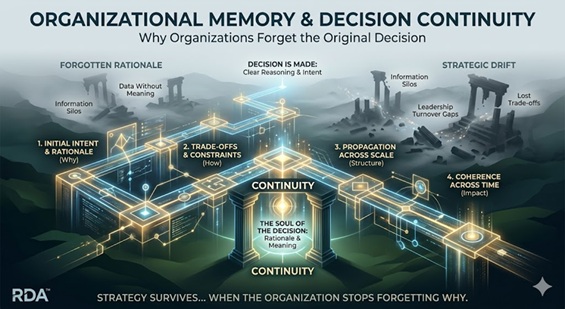
Why Organizations Forget the Original Decision
Organizations rarely fail because they lack information.
They rarely fail because they cannot generate ideas.
Most organizations fail because decisions lose continuity over time.
A decision is made.
The reasoning is clear.
Trade-offs are understood.
Direction is aligned.
And then the organization moves on.
Teams change.
Leadership rotates.
Priorities evolve.
Pressure increases.
Contexts shift.
Months later, the same execution problems begin to reappear.
The same tensions return.
The same coordination failures emerge.
The same strategic drift repeats itself.
Not because the organization forgot the decision.
But because it forgot why the decision was originally made.
1. Decisions Do Not Only Travel Across Organizations
They also travel across time.
Most organizations understand that decisions must survive:
• Scaling
• Interpretation
• Adaptation
• Operational pressure
Far fewer understand that decisions must also survive organizational memory loss.
A decision may remain formally active while its original rationale gradually disappears.
Execution continues.
Processes remain operational.
Metrics still move.
But the meaning behind the decision enters system drift, where intent gradually erodes.
Over time, organizations continue operating while disconnecting from the reasoning that originally created coherence.
2. Information Retention Is Not Organizational Memory
Most organizations attempt to preserve memory through:
• Documentation
• Repositories
• Dashboards
• Knowledge bases
• Lessons learned archives
But storing information is not the same as preserving decision continuity.
Organizational memory is not data retention.
It is continuity of meaning.
The critical issue is not whether organizations preserve records.
It is whether they preserve:
• Rationale
• Intent
• Context
• Assumptions
• Constraints
• Accepted trade-offs
Behind important decisions.
Without this continuity, future teams inherit actions without understanding why those actions originally made sense.
This is where many organizations become operationally active but strategically disconnected.
3. Strategic Drift Often Begins with Forgotten Rationale
Strategic drift rarely begins as deliberate rejection.
It usually begins when organizations continue executing decisions whose original context is no longer visible.
As rationale fades:
• Adaptations become disconnected
• Local optimization increases
• Priorities are reinterpreted
• Incentives reshape behavior
• Exceptions accumulate
Each adjustment appears rational within local context.
But collectively, the organization gradually redefines direction without consciously deciding to do so.
This creates one of the most dangerous organizational conditions:
Activity without continuity of meaning.
4. Why Organizations Repeat the Same Problems
Many execution problems are not new problems.
They are unresolved organizational memory failures.
Organizations repeatedly revisit:
• Governance conflicts
• Coordination breakdowns
• Prioritization tensions
• Resource allocation disputes
• Alignment failures
Because the reasoning behind earlier decisions was never preserved coherently across time.
The organization remembers:
• The process
• The structure
• The decision itself
But forgets:
• The conditions
• The constraints
• The trade-offs
• The original intent
As a result, the same systemic tensions continuously re-emerge under new operational forms.
5. Decision Continuity Requires Stewardship
Important decisions cannot depend only on initial approval.
They require continuity stewardship.
This means preserving not only:
• What was decided
But also:
• Why it was decided
• What conditions shaped it
• What trade-offs were accepted
• What risks were consciously tolerated
Without stewardship, organizations gradually inherit decisions stripped of context.
Over time:
• Interpretation diverges
• Adaptation accelerates
• Coherence weakens
• Strategic meaning erodes
Governance as stewardship does not exist to control adaptation.
It exists to preserve the guardrails of the original intent so that local adaptation does not destroy systemic direction.
This is why strong organizations do not only preserve execution capability.
They preserve decision continuity.
6. The Invisible Cost of Leadership Turnover
Leadership transitions often create hidden discontinuities.
New leaders inherit:
• Structures
• Initiatives
• Commitments
• Operating models
But frequently without continuity of rationale.
As pressure increases, inherited decisions are reinterpreted through current priorities instead of original systemic context.
This creates gradual strategic fragmentation.
Not because leaders are ineffective.
But because organizational memory was never structurally preserved.
The organization continues operating.
But its decisions no longer belong to the same strategic narrative.
7. Organizational Memory Is a Governance Capability
Most organizations treat memory as an administrative function.
In reality, it is a strategic governance capability.
Because governance is not only about:
• Defining decisions
• Assigning accountability
• Enforcing control
It is also about preserving continuity of direction across time.
Without organizational memory:
• Feedback loops weaken
• Learning fragments
• Rationale disappears
• Coherence degrades
• Adaptation becomes reactive instead of intentional
Strong governance therefore requires mechanisms that preserve continuity between:
• Original intent
• Operational adaptation
• Evolving reality
This is the role of stewardship:
Not policing execution, but preserving coherence as the organization evolves under pressure and change.
8. Technology Cannot Preserve Meaning Automatically
Modern organizations increasingly rely on digital systems to preserve institutional memory.
Platforms can retain:
• Information
• Workflows
• Documents
• Historical records
But technology alone cannot preserve meaning.
Most systems preserve the output of decisions.
Very few preserve the reasoning behind them.
Modern AI systems, copilots, and enterprise knowledge platforms can retrieve artifacts, summarize documents, and accelerate access to information.
But they still struggle to preserve:
• Contextual judgment
• Human trade-offs
• Pressure conditions
• Rejected alternatives
• Implicit assumptions
• Strategic rationale
Meaning depends on:
• Interpretation
• Context
• Judgment
• Assumptions
• Trade-Offs
• Organizational understanding
Without deliberate stewardship, organizations risk creating systems that preserve artifacts while losing rationale.
This creates a dangerous illusion:
The organization appears informed.
But no longer remembers why it decided what it did.
9. Coherence Across Time
Organizations often focus on maintaining coherence across scale.
But long-term resilience also depends on coherence across time.
Strong organizations preserve:
• Direction during growth
• Intent during adaptation
• Rationale during transition
• Meaning during pressure
This is what allows systems to evolve without losing strategic identity.
Without continuity, adaptation eventually becomes drift.
10. The Real Function of Organizational Memory
Organizational memory is not nostalgia.
It is not archival preservation.
Its purpose is not to freeze the organization in the past.
Its function is to preserve enough continuity of meaning for future adaptation to remain coherent.
Strong organizations do not preserve memory to avoid change.
They preserve memory so change does not destroy direction.
11. Final Insight
Organizations do not lose decisions only across complexity.
They also lose them across time.
The most dangerous drift is often invisible because execution continues long after the original meaning has disappeared.
Closing Statement
A strong organization is not only the one that makes decisions and executes them effectively.
It is the one that preserves the rationale, intent, and strategic meaning behind those decisions as the organization evolves.
Because in the end:
Strategy survives not when decisions are remembered.
But when the organization still remembers why they were made. |
Posted on: May 29, 2026 05:41 AM
|
Permalink |
Comments (4)
|
"From the moment I picked your book up until I laid it down I was convulsed with laughter. Some day I intend to read it."
- Groucho Marx
|




