Support to Develop
by Luis Branco

This blog addresses management-related topics and has three areas of focus: 1. Technical skills; 2. Competencies in the field of interpersonal relations and communication (including personal organization and delegation, leadership, teamwork, conflict resolution, conducting meetings, and negotiation); and 3. Strategy (including diagnosis, strategic guidelines, and implementation).4.Technology
Recent Posts
RCPCV™: A Method for Decision-Making and Continuous Improvement
The Same Change Can Succeed and Fail at the Same Time
What Must Exist Even When No Single Role Owns the Whole?
PHASE 4 – THE EMERGENCE
When Structural Drift Becomes Consequential
Categories
Agile,
Career Development,
Career Development,
Career Development,
Career Development,
Career Development,
Career Development,
Career Development,
Career Development,
Career Development,
Career Development,
Career Development,
Career Development,
Career Development,
Career Development,
Career Development,
Career Development,
Career Development,
Career Development,
Career Development,
Career Development,
Career Development,
Career Development,
Career Development,
Career Development,
Career Development,
Career Development,
Career Development,
Career Development,
Career Development,
Career Development,
Career Development,
Career Development,
Career Development,
Career Development,
Career Development,
Career Development,
Career Development,
Career Development,
Career Development,
Career Development,
Career Development,
Career Development,
Career Development,
Career Development,
Career Development,
Career Development,
Career Development,
Career Development,
Career Development,
Career Development,
Career Development,
Career Development,
Career Development,
Career Development,
Career Development,
Career Development,
Career Development,
Career Development,
Career Development,
Career Development,
Career Development,
Career Development,
Career Development,
Career Development,
Career Development,
Career Development,
Career Development,
Career Development,
Career Development,
Career Development,
Career Development,
Career Development,
Career Development,
Career Development,
Career Development,
Career Development,
Career Development,
Career Development,
Career Development,
Career Development,
Career Development,
Career Development,
Career Development,
Career Development,
Career Development,
Career Development,
Career Development,
Career Development,
Career Development,
Career Development,
Career Development,
Career Development,
Career Development,
Career Development,
Career Development,
Career Development,
Career Development,
Career Development,
Career Development,
Career Development,
Career Development,
Career Development,
Career Development,
Career Development,
Career Development,
Career Development,
Career Development,
Career Development,
Career Development,
Career Development,
Career Development,
Career Development,
Career Development,
Career Development,
Career Development,
Career Development,
Career Development,
Career Development,
Career Development,
Career Development,
Career Development,
Career Development,
Education,
Governance,
Governance,
Governance,
Governance,
Governance,
Governance,
Governance,
Governance,
Governance,
Governance,
Governance,
Governance,
Governance,
Governance,
Governance,
Governance,
Governance,
Governance,
Governance,
Governance,
Governance,
In,
Integration Management,
Interpersonal Skills,
Interpersonal Skills,
Interpersonal Skills,
Interpersonal Skills,
Interpersonal Skills,
Interpersonal Skills,
Interpersonal Skills,
Interpersonal Skills,
Interpersonal Skills,
Interpersonal Skills,
Interpersonal Skills,
Interpersonal Skills,
Interpersonal Skills,
Interpersonal Skills,
Interpersonal Skills,
Interpersonal Skills,
Interpersonal Skills,
Interpersonal Skills,
Interpersonal Skills,
Interpersonal Skills,
Interpersonal Skills,
Interpersonal Skills,
Interpersonal Skills,
Interpersonal Skills,
Interpersonal Skills,
Interpersonal Skills,
Interpersonal Skills,
Interpersonal Skills,
Interpersonal Skills,
Interpersonal Skills,
Interpersonal Skills,
Interpersonal Skills,
Interpersonal Skills,
Interpersonal Skills,
Interpersonal Skills,
Interpersonal Skills,
Interpersonal Skills,
Interpersonal Skills,
Interpersonal Skills,
Interpersonal Skills,
Interpersonal Skills,
Interpersonal Skills,
Interpersonal Skills,
Interpersonal Skills,
Interpersonal Skills,
Interpersonal Skills,
Interpersonal Skills,
Interpersonal Skills,
Interpersonal Skills,
Interpersonal Skills,
Interpersonal Skills,
Interpersonal Skills,
Interpersonal Skills,
Interpersonal Skills,
Interpersonal Skills,
Interpersonal Skills,
Interpersonal Skills,
Interpersonal Skills,
Interpersonal Skills,
Interpersonal Skills,
Interpersonal Skills,
Interpersonal Skills,
Interpersonal Skills,
Interpersonal Skills,
Interpersonal Skills,
Interpersonal Skills,
Interpersonal Skills,
Interpersonal Skills,
Interpersonal Skills,
Interpersonal Skills,
Interpersonal Skills,
Interpersonal Skills,
Interpersonal Skills,
Interpersonal Skills,
Interpersonal Skills,
Interpersonal Skills,
Interpersonal Skills,
Interpersonal Skills,
Interpersonal Skills,
Interpersonal Skills,
Interpersonal Skills,
Interpersonal Skills,
Interpersonal Skills,
Interpersonal Skills,
Interpersonal Skills,
Interpersonal Skills,
Interpersonal Skills,
Interpersonal Skills,
Interpersonal Skills,
Interpersonal Skills,
Interpersonal Skills,
Interpersonal Skills,
Interpersonal Skills,
Interpersonal Skills,
Interpersonal Skills,
Interpersonal Skills,
Interpersonal Skills,
Interpersonal Skills,
Interpersonal Skills,
Interpersonal Skills,
Interpersonal Skills,
Interpersonal Skills,
Interpersonal Skills,
Interpersonal Skills,
Interpersonal Skills,
Interpersonal Skills,
Interpersonal Skills,
Interpersonal Skills,
Interpersonal Skills,
Interpersonal Skills,
Interpersonal Skills,
Interpersonal Skills,
Interpersonal Skills,
Interpersonal Skills,
Interpersonal Skills,
Interpersonal Skills,
Interpersonal Skills,
Interpersonal Skills,
Interpersonal Skills,
Interpersonal Skills,
Interpersonal Skills,
Interpersonal Skills,
Knowledge Management,
le,
lea,
Leadership,
Leadership,
Leadership,
Leadership,
Leadership,
Leadership,
Leadership,
Leadership,
Leadership,
Leadership,
Leadership,
Leadership,
Leadership,
Leadership,
Leadership,
Leadership,
Leadership,
Leadership,
Leadership,
Leadership,
Leadership,
Leadership,
Leadership,
Leadership,
Leadership,
Leadership,
Leadership,
Leadership,
Leadership,
Leadership,
Leadership,
Leadership,
Leadership,
Leadership,
Leadership,
Leadership,
Leadership,
Leadership,
Leadership,
Leadership,
Leadership,
Leadership,
Leadership,
Leadership,
Leadership,
Leadership,
Leadership,
Leadership,
Leadership,
Leadership,
Leadership,
Leadership,
Leadership,
Leadership,
Leadership,
Leadership,
Leadership,
Leadership,
Leadership,
Leadership,
Leadership,
Leadership,
Leadership,
Leadership,
Leadership,
Leadership,
Leadership,
Leadership,
Leadership,
Leadership,
Leadership,
Leadership,
Leadership,
Leadership,
Leadership,
Leadership,
Leadership,
Leadership,
Leadership,
Leadership,
Leadership,
Leadership,
Leadership,
Leadership,
Leadership,
Leadership,
Leadership,
Leadership,
Leadership,
Leadership,
Leadership,
Leadership,
Leadership,
Leadership,
Leadership,
Leadership,
Leadership,
Leadership,
Leadership,
Leadership,
Leadership,
Leadership,
Leadership,
Leadership,
Leadership,
Leadership,
Leadership,
Leadership,
Leadership,
Leadership,
Leadership,
Leadership,
Leadership,
Leadership,
Leadership,
Leadership,
Leadership,
Leadership,
Leadership,
Leadership,
Leadership,
Leadership,
Leadership,
or,
Organizational Project Management,
Portfolio Management,
Program,
Program Management,
Strategy,
Strategy,
Strategy,
Strategy,
Strategy,
Strategy,
Strategy,
Strategy,
Strategy,
Strategy,
Strategy,
Strategy,
Strategy,
Strategy,
Strategy,
Strategy,
Strategy,
Strategy,
Strategy,
Strategy,
Strategy,
Strategy,
Strategy,
Strategy,
Strategy,
Strategy,
Strategy,
Strategy,
Strategy,
Strategy,
Strategy,
Strategy,
Strategy,
Strategy,
Strategy,
Strategy,
Strategy,
Strategy,
Strategy,
Strategy,
Strategy,
Strategy,
Strategy,
Strategy,
Strategy,
Strategy,
Strategy,
Strategy,
Strategy,
Strategy,
Strategy,
Strategy,
Strategy,
Strategy,
Strategy,
Strategy,
Strategy,
Strategy,
Strategy,
Strategy,
Strategy,
Strategy,
Strategy,
Strategy,
Strategy,
Strategy,
Strategy,
Strategy,
Strategy,
Strategy,
Strategy,
Strategy,
Strategy,
Strategy,
Strategy,
Strategy,
Strategy,
Strategy,
Strategy,
Strategy,
Strategy,
Strategy,
Strategy,
Strategy,
Strategy,
Strategy,
Strategy,
Strategy,
Strategy,
Strategy,
Strategy,
Strategy,
Strategy,
Strategy,
Strategy,
Strategy,
Strategy,
Strategy,
Strategy,
Strategy,
Strategy,
Strategy,
Strategy,
Strategy,
Strategy,
Strategy,
Strategy,
Strategy,
Strategy,
Strategy,
Strategy,
Strategy,
Strategy,
Strategy,
Strategy,
Strategy,
Strategy,
Strategy,
Strategy,
Strategy,
Strategy,
Strategy,
Strategy,
Sustainability,
Talent Management,
Talent Management,
Talent Management,
Talent Management,
Talent Management,
Talent Management,
Talent Management,
Talent Management,
Talent Management,
Talent Management,
Talent Management,
Talent Management,
Talent Management,
Talent Management,
Talent Management,
Talent Management,
Talent Management,
Talent Management,
Talent Management,
Talent Management,
Talent Management,
Talent Management,
Talent Management,
Talent Management,
Talent Management,
Talent Management,
Talent Management,
Talent Management,
Talent Management,
Talent Management,
Talent Management,
Talent Management,
Talent Management,
Talent Management,
Talent Management,
Talent Management,
Talent Management,
Talent Management,
Talent Management,
Talent Management,
Talent Management,
Talent Management,
Talent Management,
Talent Management,
Talent Management,
Talent Management,
Talent Management,
Talent Management,
Talent Management,
Talent Management,
Talent Management,
Talent Management,
Talent Management,
Talent Management,
Talent Management,
Talent Management,
Talent Management,
Talent Management,
Talent Management,
Talent Management,
Talent Management,
Talent Management,
Talent Management,
Talent Management,
Talent Management,
Talent Management,
Talent Management,
Talent Management,
Talent Management,
Talent Management,
Talent Management,
Talent Management,
Talent Management,
Talent Management,
Talent Management,
Talent Management,
Talent Management,
Talent Management,
Talent Management,
Talent Management,
Talent Management,
Talent Management,
Talent Management,
Talent Management,
Talent Management,
Talent Management,
Talent Management,
Talent Management,
Talent Management,
Talent Management,
Talent Management,
Talent Management,
Talent Management,
Talent Management,
Talent Management,
Talent Management,
Talent Management,
Talent Management,
Talent Management,
Talent Management,
Talent Management,
Talent Management,
Talent Management,
Talent Management,
Talent Management,
Talent Management,
Talent Management,
Talent Management,
Talent Management,
Talent Management,
Talent Management,
Talent Management,
Talent Management,
Talent Management,
Talent Management,
Talent Management,
Talent Management,
Talent Management,
Talent Management,
Talent Management,
Talent Management,
Talent Management,
Talent Management
Date
When Alignment Replaces Thinking in Project Environments
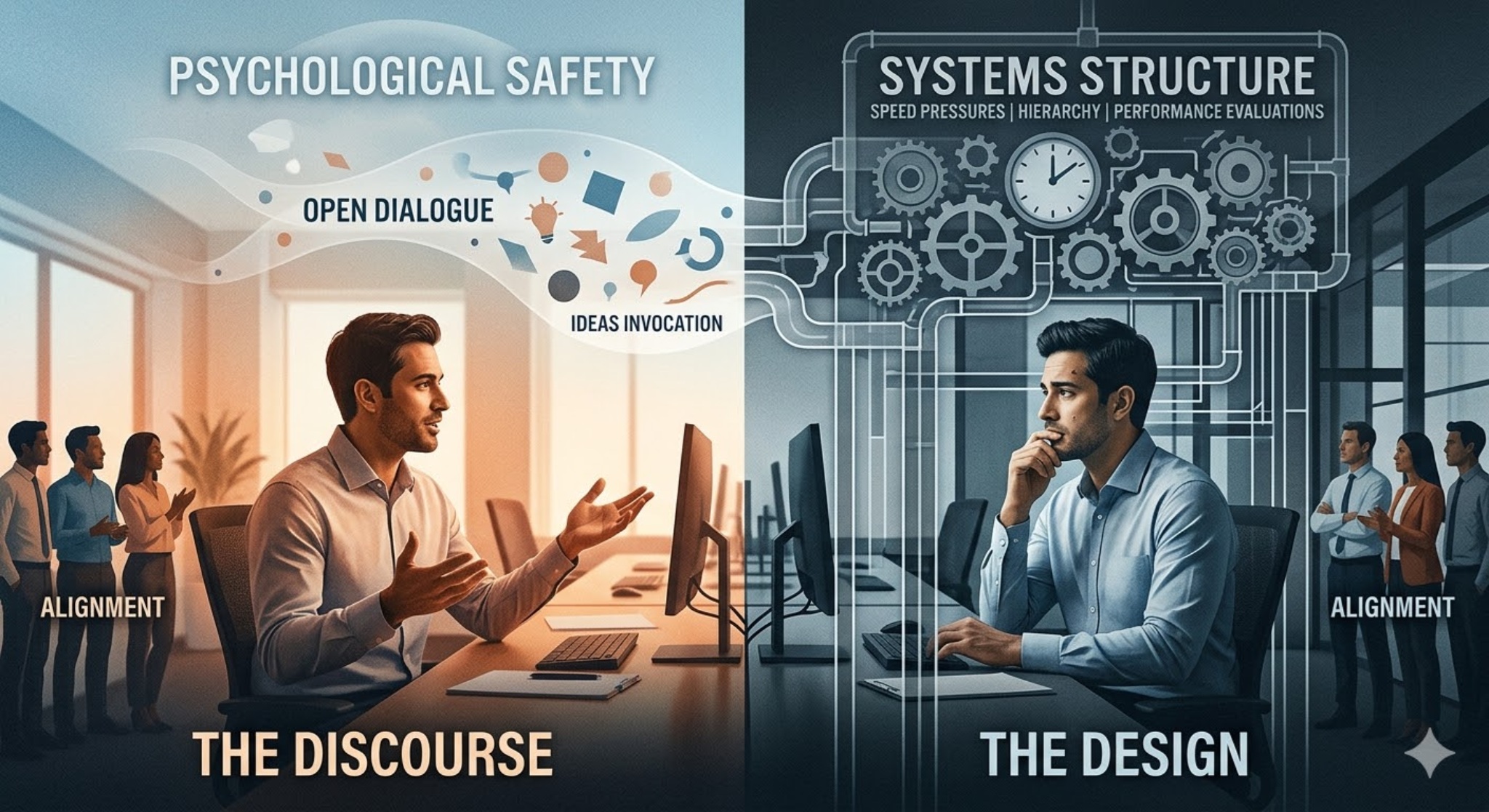
Most organizations claim to value open dialogue.
Leaders speak about psychological safety. Teams are encouraged to share ideas. Diversity of perspectives is described as a driver of innovation.
On the surface, the message is clear:
Disagreement is welcome.
Yet in many project environments, something different happens.
Ideas converge quickly.
Alternative perspectives disappear early in discussions.
Decisions are accepted with little exploration of underlying assumptions.
What appears to be alignment may actually be something else.
A system that quietly discourages disagreement.
The question is therefore not whether people value constructive debate.
It is whether the surrounding system truly allows it.
The Hidden Signals of Organizational Systems
Organizations rarely suppress disagreement intentionally.
Instead, they design systems that unintentionally make disagreement risky.
Performance evaluations reward reliability and speed.
Governance structures prioritize rapid convergence.
Escalation paths emphasize clarity rather than exploration.
Under these conditions, teams receive subtle signals about what is expected.
Alignment begins to be interpreted as professionalism.
Questioning assumptions may appear as friction.
Raising alternative interpretations can feel like slowing progress.
Over time, people adapt.
Disagreement becomes less frequent not because teams lack ideas, but because the system quietly teaches them that harmony is safer than inquiry.
The Speed Trap
Another force reinforcing this dynamic is pressure for speed.
Projects operate under tight deadlines, financial constraints and strong expectations for momentum.
Leaders often seek clarity and confidence from their teams.
In this context, early convergence can appear efficient.
Discussions shorten.
Meetings produce quick agreements.
Decisions move forward with apparent momentum.
Yet speed can hide a deeper cost.
When teams converge too early, assumptions remain untested.
Alternative perspectives are never explored.
The collective intelligence of the group remains partially unused.
Efficiency improves.
Understanding declines.
Power and the Cost of Dissent
Hierarchy also shapes how freely disagreement appears.
In organizations where authority is concentrated, questioning a decision can easily be interpreted as challenging the person behind it.
Even when leaders encourage open dialogue, the structural asymmetry of power remains visible.
People read the room.
They observe which perspectives are welcomed and which are quietly set aside.
Over time, a subtle form of self-censorship emerges.
Not because individuals lack courage.
But because they understand the informal rules of the environment.
Silence becomes a rational adaptation.
Alignment becomes the safest contribution.
Not necessarily the most insightful one.
The Difference Between Culture and Design
For this reason, constructive disagreement cannot be sustained by culture alone.
Organizations often attempt to solve the problem by encouraging new behaviours.
Speak up.
Challenge assumptions.
Share your perspective.
These messages matter.
But without supportive structures, they remain fragile.
Sustained intellectual diversity depends on design.
Governance forums must allow time for exploration before convergence.
Decision processes must reward insight, not only speed.
Leadership must distinguish critique of ideas from judgement of people.
When systems support inquiry, disagreement becomes a resource rather than a disruption.
Designing Systems That Allow Thinking
Organizations that benefit from collective intelligence rarely rely on courage alone.
They design structures that make questioning normal.
Examples include:
• Design reviews where assumptions are examined before commitments are made
• Cross-functional problem-solving sessions where multiple perspectives are invited
• Retrospectives that analyze reasoning rather than only results
• Decision forums that explicitly surface trade-offs instead of hiding them
Some organizations also institutionalize dissent through structured techniques such as the pre-mortem, introduced by Gary Klein.
In a pre-mortem, teams assume that a project has already failed and work backward to identify what might have caused the failure.
This simple shift changes the dynamics of conversation.
Instead of requiring individuals to challenge the dominant view, the process itself invites alternative interpretations.
Dissent becomes a responsibility of the system rather than a personal risk.
AI as a Cognitive Safeguard
A new element is beginning to influence how teams reason together.
Artificial intelligence is often introduced into organizations as a tool for efficiency.
It accelerates analysis, summarizes information and processes large volumes of data.
Yet its most interesting role may lie elsewhere.
When thoughtfully integrated into decision processes, AI can act as a cognitive safeguard.
Unlike human participants, it is not influenced by hierarchy, reputation or social pressure to converge quickly.
It can surface contradictory data, highlight inconsistencies in reasoning and introduce alternative interpretations.
In this role, artificial intelligence does not replace human judgement.
It protects the conditions under which judgement improves.
Automation accelerates tasks.
Augmentation expands thinking.
In environments where speed pressures suppress exploration, this distinction becomes increasingly important.
Structural Safety
Leaders play a critical role in shaping these dynamics.
Their responsibility goes beyond moderating conversations.
They shape the conditions under which people think together.
When leaders acknowledge uncertainty, invite alternative interpretations and protect dissenting views from premature dismissal, they send a powerful signal.
Inquiry is legitimate.
Over time, teams begin to experience what might be called structural safety.
An environment where questioning assumptions is not only tolerated, but expected.
This type of safety does not emerge from encouragement alone.
It emerges from systems designed to support it.
Reflection
Consider your next decision meeting.
Will disagreement appear naturally?
Or would someone need unusual courage to raise a different perspective?
More importantly, does the system surrounding that conversation reward exploration or rapid alignment?
Organizations often say they want people to challenge assumptions.
But systems ultimately determine whether doing so feels safe.
Because collective intelligence rarely depends only on individual courage.
More often, it depends on the design of the system in which that courage must appear - and whether the system quietly punishes it. |
Posted on: March 13, 2026 03:07 PM
|
Permalink |
Comments (1)
|
I have made good judgements in the past. I have made good judgements in the future.
- Dan
|




