


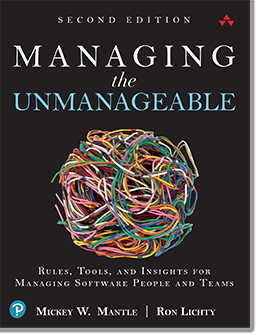
Podcast Interview with Ron Lichty, author of Managing the Unmanageable: Rules, Tools, and Insights for Managing Software People and Teams


|
Click here to go straight to the podcast. A few weeks ago I had the opportunity to interview Ron Lichty, Agile throught leader co-author and of Managing the Unmanageable: Rules, Tools, and Insights for Managing Software People and Teams. One of the great things about the books is that Ron and his co-author Mickey W. Mantle have culled their collective experience and offered up a set of tools they have found useful over the years in working on software projects. Ron and Mickey take the approach that software developers are a unique group within the knowledge workforce and that they require an adjustment in how we treat them, how they treat each other and what we can do to help them work with non-developers.
One of Ron’s current areas of focus is rooted in the question of “Why do we need managers if Agile teams are supposed to be self organizing?” Ron’s has found that only about 5% of software managers have had actual training in how to manage people. We basically just expect developers to be able to move into a managing role and just know how to do it based on their experience in not being a manager. Ron looks at the critical role that management can make in helping companies transform to Agile and the importance in making sure that they are trained both in management AND in how Agile works so that they can be better prepared to help, rather than impede the Agile teams as they are getting off the ground.
|

Review: The Apprentice and the Project Manager
|
(check out the interview here) The book includes a narrative based in the past and the present. Stories from earlier work experiences as an apprentice mechanic and current experiences working as a technology project manager are used as a metaphor to explain some key concepts that factor into Agile and Lean. Explaining an Agile process/framework as a call and response narrative is not a new approach, but what is unique and refreshing about Kamal's book is that in taking a practical approach to getting work done and coping with very specific situations, the author has made a choice to steer clear of promoting one method over another and just kept it to a very pragmatic, straight up approach. If you are new to Agile and/or Lean, this book would be a great starting place to introduce some of the key concepts without drowning you in jargon and trying to sell you on having found "THE WAY".
You can check out the Apprentice and the Project Manager at Amazon or HappyAbout. |
 A few weeks ago I had a chance to
  For me, as someone who has spent a lot of time working in both traditional project management and in Agile, my favorite section of this book was the chapter on Financial Health. It is great to see a book for people who lead projects include an easy to understand explanation of why it is so important to factor finance into our decision making process and how to go about doing that in a responsible manner.
 Catching up with Jim Benson on Personal Kanban
|
In this Projects At Work interview I got a chance to ask Jim some questions about putting items on the board just so you have a record of them and can move them over. At what point does that become a wasteful step. As always, Jim’s feedback led me to thinking about my practice of PK in a completely different way than I had in the past. You can find the interview here: Part 1(Listed as Part 3 on the ProjectsAtWork site) Part 2 (Listed as Part 4 on the ProjectsAtWork site) I still find that one of the most interesting aspects of using Personal Kanban (which I have not found with other productivity practices) is that there is the doing of thing and the learning about how you are doing things. The insight provided by the latter continues to prove to be the more valuable part of working this way. For me, putting everything on to the board does mean that I am putting up stuff just to move it over. This does create some waste. But it also helps me become more aware of the fact that I am overloading every day/week all the time and still trying to plan more in than could be done. Yes, I need more discipline in how I work. (Who doesn’t?) But the discipline is not needed as much in how I work, as it is in what work I assign myself in the first place. Reducing or limiting what I put in my backlog should make it easier to get more done, but only if I can maintain the discipline to actually stick to my board and not keep including items that are not up there and taking them as items to work on.
… and I guess admitting you have a problem is the first step to recovery. ;) * The interviews are listed on the Projects at Work site as Part 3 and Part 4 If you'd like to learn more about Personal Kanban, you can find the book here. You can find Jim on Twitter here.
|
 Back in December
  The more I work with PK, the more I discover that it isn’t so much about getting things into the done column, or clearing out a backlog as it is about raising my awareness of how I think about and approach my work. It is a more mindful way of planning and managing what I have to do.
PhilaPM March Meetup Recap
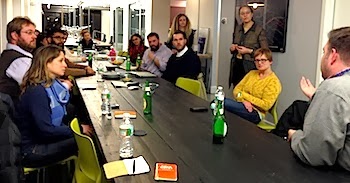
 Wednesday Night @HappyCog in Philadelphia…By traditional PM standards, this is an odd question.
Answering it requires admitting there are times when you don’t know what you are doing and are way out of your depth. This is not the way of the traditional PM. If you admit not knowing everything, you demonstrate WEAKNESS and might lose CONTROL. If you have no CONTROL, how can you MANAGE PEOPLE?
By Agile standards, it’s not an odd question. It’s an “it depends” question.
Once the question has been laid down for the room, however, the sharing begins. Several of the PMs around the table offer stories of impossible situations they’ve faced. These aren’t the kind of challenges that can be addressed with a change to a contract or a revised scoping doc. These are the “we had it sorted and then the bottom fell out of the world” problems. The ones you couldn’t have seen coming and which leave you with no good options. These are the problems you give talks about at conferences for the next five years.
RETROPOSTREMORTEMVIEWBLAMESPECTIVEIf you’ve been working in project management for any length of time, you’ve been involved with the meetings that take place at the end of projects. These project reviews or post mortems are generally a wee bit heavy on blame side and a bit light on the learning to improve side. That is, assuming you are actually doing them.If you are working with Agile, hopefully you are doing retrospectives so that your team can get together to explore how to improve how they work together. Retrospectives are one of the best parts of Agile and a great thing for the team… but this is a little different. This meeting, which is hosted by Happy Cog is none of the above. It is, however, one of the more interesting characteristics of this segment of the PM population. Digital PM has been around for a while, but only in the past few years has it begun to identify itself as a somewhat separate group. This meeting is full of PMs from different companies. What they have in common is that in one way or another, they all manage projects that are involved with digital media. Some of their projects are less than a month long. Some last more than a year. Some of their clients demand a traditional approach to managing the work. Some demand an Agile approach. The PMs working in these organizations are generally working with fairly small, design centric teams. Their hybrid model is evolving from needing to be able to work a variety of ways, but being able to fully lock into neither. Their agility is their flexibility and this sharing is part of their approach to continuous improvement. Ten years ago, the project management that existed in this space was simple, basic and practiced by people who were just beginning to cut their teeth. Now it is led by experienced professional project managers and leaders who are schooled up in Agile and waterfall and are collaborating on hybrid tools and techniques that allow them to leverage the best of both. Their pragmatic, collaborative, framework agnostic approach to finding the best way to work with the team and deliver for the client is an exciting and emerging thing. PhilaPM is organized by Brett Harned, Brenna Heaps, Sloan Miller, and Justin Handler. The group has evolved to the point where they are now working developing a new logo, name and website. Until that happens, you can find them here - http://philamade.com/ If you aren’t from Philly, but do work in digital media or if you are just a PM who could use a little inspiration, you may want to check out some of the following… ConferencesDPM2014 http://blog.dpm2013.com/2014/02/24/save-the-date-2014-digital-pm-summit/DPMUK http://www.dpmuk.com/ Groups in the US and CanadaAustin http://www.meetup.com/Digital-PM-Meetup-Austin/Boston http://www.meetup.com/Digital-Project-Management-Boston/ Boulder http://www.meetup.com/Boulder-Web-Project-Managers/ Minneapolis: http://www.meetup.com/Twin-Cities-Interactive-Project-Management-Meetup/ NYC http://dpmconnect.com and http://www.meetup.com/projectmgmt-72/ Philadelphia http://philamade.com Portland: http://pdxdigitalpm.com Vancouver http://www.meetup.com/Vancouver-Digital-Project-Managers/ Groups in EMEALondon, UK http://www.meetup.com/london-digital-project-managers/Manchester, UK http://www.meetup.com/Northern-Digital-PM/ Oslo http://www.meetup.com/Oslo-Digital-Project-Managers/ Groups in ASIAPACMelbourne Digital Project Managers http://www.meetup.com/Melbourne-Digital-Project-Management/Sydney Digital Project Managers http://www.meetup.com/Sydney-Digital-Project-Management/ |
Ultra-Violent Communication
|
When I see that__I am not making good on my commitment to practicing NVC_ I feel _bad/frustrated/anxious_ because my need for _trying to figure out if I can actually do it_ is/is not met. Would you (I) be willing to _man the hell up and give it a frigging chance__? To be fair, I do spend an inordinate amount of time pondering it each day – especially when I’m driving… and get cut off by someone who very clearly has a more urgent need to get someplace than I do. When I see that__ some &*%^%!! has cut me off_ I feel _like I wish my car came with a rocket launcher_ because my need for _deleting him/her from the road/universe_ is/is not met. Would you be willing to _oh nevermind__
Because I have decided to don my cloak of self imposed guilt for not automatically laying down the communication habits I’ve developed over the past 40+ years in favor of a non-violent approach to life, the universe and everything, I have become hyper-aware of how non non-violent my speech actually is. This has led me to wonder if perhaps I am not more suited for a new approach called UVC – Ultra Violent Communication.
I do believe that this awareness, is very important. I do not know yet if I will be able to adopt NVC. I do know that while I am able to understand that it is more than just a communication pattern, I have trouble internalizing that. (Much the same way some people respond to the idea of a team being self organizing by winking at me in class and whispering “Yeah, but really… who’s really in charge?”). I also have observed that letting myself freak out about someone cutting me off on I-35, or having the insane gall to try and get past TSA with a bottle of water in their backpack (Whiskey Tango Foxtrot) gives me a bit of an adrenaline rush. Yelling a string of obscenities from within the safety of my car at some motorist I do not know, helps no one, but the release of anger is a boost, and I have become aware that a) the outburst does nothing to change the situation in any way and b) the pull of the boost can be a wee bit habit forming. The more aware of this I become, the more I am finding that when I recognize an of an event and become aware of my emotional response, there is an increasing delay now before my reaction triggers. More and more, that delay is becoming large enough that I have the time to make a deliberate decision about what is going to come out of my mouth. So, in on the whole transparency front, I’m not really delivering on my intent with non-violent communication yet, but in my continuing efforts to get there, the awareness is helping me cultivate a slightly less-violent communication… at least most of the time. |
 In December I wrote about how I was going to start experimenting with adopting Non-Violent Communication. And I am, sort of. I’m finding that this is probably going to be an ongoing effort and one I will need to keeping coming back to. What I have been doing so far has helped me check in with myself and come to this:
 My intent in writing about this is, in part, to express that while I am working on it, I am honestly struggling with adopting NVC. A lot of how I have learned to communicate seems to be at odds with NVC practices. It is important to me, in writing about this, that I be as transparent and honest about how it is going as I can because if there are other people like me who are struggling with this (read: grew up in Philadelphia), I would like to make sure they know that they’re not alone. And to consider that maybe having trouble with this is not necessarily a bad thing, but is perhaps more about letting the dissonance from the conflict reach a level where change happens. My experiment is to see if I can adopt NVC as a practice of (initially) communicating and (ideally) of approaching other aspects of my life.
 My practice (or not) so far has basically involved me noticing how I react to things, like being cut off while I’m driving or some other social injustice, which has been done to me by someone. Typically, the social injustice has very little to do with the other person and is really just me spazzing out in my reaction to something I have decided is a great crime against all things good in the universe. But, if I did have a rocket launcher, I’m pretty sure that by this time, very few people would be willing to cut in front of me in line at Walmart.


