


Sometimes, Project Management Sucks
Categories:
Leadership
Categories: Leadership


|
Like when you are developing a product using technologies that are relatively new and totally new to your team and stakeholders. While it is fun to be learning new things, it's damn hard to estimate effectively and stick to a schedule. Especially when the culture around you isn't used to new technologies or R&D-style projects. I mean, really. Like when programming languages that went out of style 20 years ago are still the core of most new development. Sometimes it seems like every day brings yet another unforeseen problem you weren't expecting at all. And you work with smart people. You're smart. Why is this happening? BreatheThe first step is to breathe. You may have to pivot, educate stakeholders, negotiate extensions. There are worse things in the world. You are the project manager after all, and you can get your team through this. Plus when you keep your head up and continue to be a role model for your team during tough times, something amazing can happen. Team GrowthThis situation can be turned to your advantage. There have been times I've been struggling like described above, and I was pleasantly surprised when my team took the pressure of our situation and used it as a tool to come together and execute. It can accelerate the storming phase of team formation when a strong leader on the team demonstrates optimism in the fact of adversity. When people see that 'can do' attitude, it becomes contagious. So, I say to myself and anyone else in this situation right now. Stop crying, little baby. Be a leader and show 'em what you're made of. |
 Do you know what I mean?
Switching Domains As a Project Manager
Categories:
Career Development
Categories: Career Development
|
I have a burning question that may or may not only affect me and my job searching experience. I have a PMP, and a higher education that includes a degree with a focus in project management. However my work experience has not been in the IT area and I have not been able to break this mold. Do you have any suggests on how to highlight cross transferable skills? I have worked in construction but not in the commercial area. It is not that I would not feel comfortable managing an IT project only most lean towards someone with a degree in computer science or someone that is considered an expert in the field. Please advise. I think it's true that in order to successfully manage projects in a particular domain the PM must have at least a foundation of technical knowledge about that domain. Someone who had only experience in IT but none in construction would be hard pressed to land a construction PM job, for example. Depending on the area of expertise, you can focus your efforts to maximum benefit. If general IT infrastructure projects are what you are going for, look into ITIL and use the process of studying to become more knowledgeable about IT. You may have to do something like I did when I moved into the Aerospace field - take a step down in responsibility in a role that is more of an analyst or coordinator role first to get your feet wet in the new domain - then in a year or so you'll be much better placed to transition to an IT PM role if you've done a good job of networking internally and proving your value. |
 Abdul asks:
How To Get Into Project Management
Categories:
Career Development
Categories: Career Development
| How do you get into project management?
Especially when you have little to no experience, and the jobs require experience managing projects?
|
Why Risk Management Rocks
Categories:
Risk Management
Categories: Risk Management
|
The "It's All About Science Festival" was the first of it's kind in my city.
Since I love science and support the promotion of the public understanding of science, I volunteered to help out with the event.
I was just a grunt, volunteering my time and back to help get exibitors set up and carrying heavy equipment and tables for the displays.
Still, it's difficult to take my project management hat off.
In the process I was reminded of an important fact today.
Contingency Planning Is A Must
The venue was set.
Plans had been made.
Exhibitors had assigned tents to set up under, the food vendors were in a good spot, and when the public came to the event everything was set up for ease of access and flow of the crowd.
Had everything gone to plan, I probably wouldn't be writing this post.
But it didn't.
It rained.
We haven't had rain in a long time, we're in a drought. But it rained.
They Had A Contingency Plan
Sort of.
There was ample space inside to accommodate the majority of the exhibitions.
And that was good.
But that's where the contigency planning stopped *I think*.
This resulted in several key problems and lessons learned for the future.
I am not trying to blame the organizers, the event still went very well and they worked very hard.
But this is also an opportunity to reflect on lessons learned so the next event is even better.
Exhibitors Were Confused
There were no assigned spaces for inside the building. So exhibitors were confused and didn't know where to set up.
The resulting layout was not optimal in several ways.
First, exhibitors weren't clear on what the main entrance would be. There were several entry points possible.
Because they had moved from outside to the inside, we all hauled everything through a side door.
Many assumed this would also be the entry point for the public.
It wasn't.
Because of this miscommunication and lack of contingency planning, many exhibitors were set up in exactly the wrong direction.
When the public walked in, they saw the exhibition tables from the rear.
The user experience was 1) walk in 2) be confused about where to go
Food Vendors Were Isolated
Had this project gone to plan, the food vendors would have been set up in an optimal spot for the crowd.
Because we were now inside and food vendors had trucks they were selling from, they couldn't set up where the people were.
And now they were set up way on the other side of the building from the front entrance too, and where some of the larger exhibitors were still set up outside.
I pointed out that if we could get the food vendors to drive around to the front and set up, it would be a better situation for them and the hungry masses.
Alas, because this eventuality was not anticipated, other less mobile and huge exhibitions were blocking entry to the best contingency location for the food vendors.
So in the end this resulted in a hungry crowd. Many of them probably left prematurely to go get something to eat elsewhere because they never even saw the food vendors. And many were likely dissatisfied by the lack of available food and beverages.
And of course this had a major impact on the vendors' sales - making them dissatisfied and less likely to come back next year.
In The Moment
Although it could have been handled better with some planning, there were some bright spots.
Two of the exhibitors who hadn't moved inside were still set up outside.
Over on the side of the building away from the front entrance and flow of the crowd.
I saw them and also noticed two empty spots available right next to the front entrance where the foot traffic would be high.
One hadn't moved because he had a rather large solar panel display that had to stay on the parking lot, and I think the other was just too nice and didn't want to be a bother.
I tried to find the event coordinator to verify that it would be acceptable for them to move since the spaces were (apparently) open.
I was unable to find her, so I just made an executive decision.
I asked both of them if I could help them relocate to the two open spaces. They accepted, and we got everything hauled over to the new locations.
As a result, they had a massive amount of foot traffic and interest they wouldn't have otherwise gotten.
And we even got better southern exposure for the solar panels!
Lesson Learned: Risk Management Rocks!
I think many people don't do much contingency planning because they fear it's a waste of time.
After all if it hadn't rained that contingency plan would have been a waste, right?
Wrong.
That's like saying car insurance is a waste if you never get into an accident.
Being prepared for the most likely and most impactful risks is never a waste.
It's just good project management.
|
 Today I volunteered to help with an awesome event.
World Governments Call For Better Project Management
|
Like the UK example earlier, this is a call for better project management in government. Again we see recommendations for the establishment of a "Centre for Excellence" in Project Management for Governments.
Here are some highlights from the report with my summaries.
Major Finding 1 - "Government does not have a sound governance framework for the development of major capital projects"
Major Finding 2 - "Project management practices for the new high schools projects were deficient"
Major Finding 3 - "Government Administration Building employed good project management practices"
Some good news! This project had a competent and well-trained project manager and came in on time and within budget.
What can the rest of us learn from these examples from the Cayman Islands? Share your thoughts in the comments. |
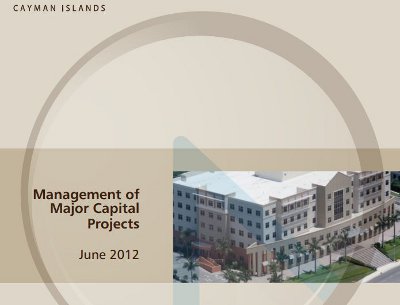 In another example of governments around the world realizing they need to focus on better project management, the Cayman Islands' Auditor General

