


MBA: Do You Have The Right Mindset?
Categories:
Education
Categories: Education


| I just responded to a great question about whether an online MBA would be worth it for someone. If I had the choice between an in-class degree versus an online degree, I might prefer the in-class option. I like to badger the professors too much, and you don't get to see their faces get red too often when you are doing it virtually. :-) Seriously though, many people find themselves in a situation where an in-class program just isn't going to be a possibility, or at least not something they would be willing to make happen by moving or re-arranging their lives. Personally, I wouldn’t shy away from an online degree if it were the best fit for my situation. The primary goal will be to study hard and learn tons of new information you can apply.
The better question is to ask if you have the right mindset in the first place, for any form of learning. As long as you have the right mindset (you are doing this to learn and make yourself more capable) then you can get as much if not more than other students who are doing an MBA program at an Ivy league school. I am fairly certain that over half of my classmates when I went to college didn't have the mindset I'm talking about. Having 'the mindset' can be inferred by behaviors like:
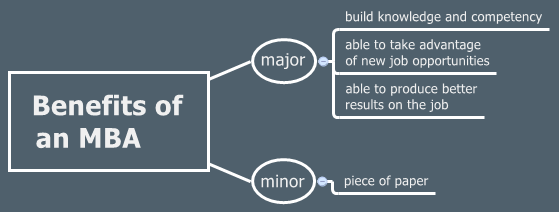
Just remember, the piece of paper is not what matters. Building your competency is what matters, so more opportunities will become available to you as you network professionally. Networking and getting referrals from people who know you do good work is a much more effective way of getting your foot in the door. If you’ve built your competency then you can knock their socks off after you’ve created the initial opportunity for yourself.
| |||||


Implementing User Stories in a Waterfall Paradigm
Categories:
Agile
Categories: Agile
|
| |||||

The Power of Focus
Categories:
Kanban
Categories: Kanban
|
Today I'd like to share a few a success story that I've had recently with using kanban as a method for managing projects. In May of 2010 I decided to use this thing called kanban with one of my smaller project teams. The team was really excited about the idea although a little wary as well. I had only been there for about a month and already had a reputation as someone lets to try crazy weird new things. Value Stream Mapping
Continuous Integration
Focus
Ahead of Schedule
Now, I'm happy to report that we are over a month ahead of schedule on our second release! The original baseline schedule was made at a time when we didn't have a lot of these practices in place that we now do. I have three other systems to experiment with, so the experiment will continue. But so far I'm really loving what kanban, user stories, daily tag ups, and continuous integration are doing for us.
| |||||


A Good Reason Not To Be A Project Manager
Categories:
Career Development
Categories: Career Development
|
The first question I ask of students when I do career coaching is whether or not this is even the right choice for you. Here is a primary consideration if you are considering a career switch into project management. Individual Contributor?In what role do you get the majority of your satisfaction? Contributing directly in an individual role or by leading others who are contributing directly?Make no mistake, the project management role is about facilitating the real work that is producing a new product or service. When I point to the result of something my project teams have produced, I say "this is what my team did", not "this is what I did." I guided my teams to create the product, I didn't create it myself.
The Goal: Love What You DoHave you ever had a manager (project or otherwise) who just didn't seem like they loved what they do? Of course, we all have! If you do not have a passion for working with people and deriving your satisfaction through them, you probably should not be a manager of any kind. You'll end up being on the extreme: a micromanager or an apathetic manager.
It becomes a problem when they want to write big chunks of applications themselves because "no one else can do it like I can." and so forth. Or in some cases, the job becomes a meaningless cycle of paperwork because they just don't get jazzed by developing people, enabling team communication, or removing obstacles to help their teams succeed. Do you have the DNA of a project manager, or an individual contributor? Neither is better or worse, they are just different.
| |||||


Experience and Competence
| Sometimes, we equate things that don't really mean the same thing. Competence requires experience, but experience does not equate to competence. I can infer experience from observing competence....but I can not accurately infer competence from a list of positions you've held. Experienced ≠ CompetentWe fall prey to common cognitive biases which lead us to believe that if someone is experienced, they are therefore competent. It can trip us up when hiring for our teams. Another aspect of this, and the more pernicious one, is that new professionals may lead themselves to believe that once they have some experience under their belt they will have 'made it'. Complacency can set in after you've landed a job for instance, because you've tricked yourself into believing that simply holding that position makes you more valuable. Certifications and Degrees ≠ CompetenceThe same goes for certifications and degrees. Many people believe that holding a particular credential implies a level of competence. Unless the credential is formulated specifically to assess competence, no such correlation is warranted however. Organizations fall prey by hiring people and screening them on the basis of particular certifications or degrees. Individuals fall prey by thinking they will have 'made it' once they get a slip of paper certifying them as 'master of the universe'. Strive for Competence
If you make experience, certification or degrees your primary goals, you run the risk of gaining those primary goals without acheiving a true level of competence for yourself. These window dressings and indications of possible competence should only come about as a result of your journey towards something substantive; real competence. It doesn't matter if you had the right answer or not; what matters is that you understand why it is wrong or right. Seek to understand why. Practical Ways to Target CompetenceHere are some ideas you can use immediately to strive for competence. Add your own ideas in the comments!
| |||||
 Do not go after experience or certification as your primary goal. They will come as a result of your journey towards competence.

