


10 Attributes I Look For in New Project Managers
Categories:
Career Development
Categories: Career Development


| I was recently interviewed and asked the question, "What should hiring managers be looking for in a new project manager?"
These are the top 10 qualities I look for:
What do you think of these attributes? Do you have more to add?
| |||||



Question for You: Operations and Project Management
Categories:
Operations
Categories: Operations
|
I can see the wisdom in this, especially when the new developments are very different than existing operations. But on the other side of the coin, when projects are very similar to existing operations, or in fact are themselves organizational changes, is this still a good idea? Or would a common source of authority and/or funding for these projects be a positive situation? This is a question for you. What do you think?
| |||||
2011 Predictions for Project Management
Categories:
Misc
Categories: Misc
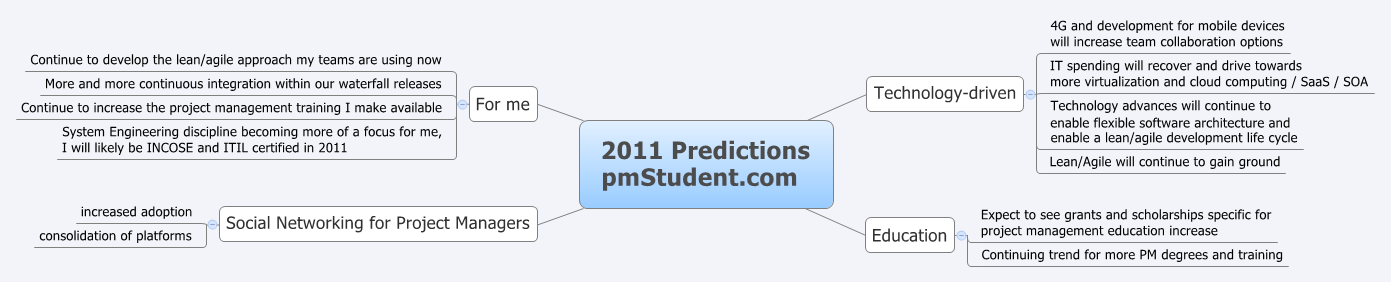
| This happens every year. We make predictions so we know we can look back and see how wrong we really are. No one really looks back though, so I'm just going to accept that this is a fun exercise and I'm going to be wrong. However, you can listen to episode 164 of the Project Management Podcast and hear my project management predictions for 2011 along with a handful from other people. Lean/AgileI think we will continue to see momentum in the direction of Lean and Agile. Technology will enable this in more ways than one, and Lean/Agile projects will enable technology implementations. It's a virtuous cycle that will continue in 2011 and probably pick up the pace. Distributed and virtualized systems and technologies in particular will increase in adoption as more and more knowledge workers become distributed. There will be a struggle between the benefits of co-location and distributed teams, a struggle I am going through now myself. EducationI'm a volunteer for the PMI Educational Foundation and have seen increases in both awards and candidates for scholarships and grants for project management education. I think that will continue in 2011. Also, the offerings of project management courses and training has grown. I plan to offer more courses myself through pmStudent e-Learning and other venues, so the choices available will be ever-expanding from me and other providers like here at Gantthead, which is great! Social NetworkingI expect to see increased adoption, and a consolidation of platforms. I'm spread so thin across so many platforms and groups within those platforms, I think it's time to simplify. And I think a lot of other project managers involved with social media will feel the same. For Me PersonallyI will continue to develop the lean/agile approach my teams and I have been working on. Eliminating waste in process has become a bit of an obsession for me, and I will continue to evolve my approach over the course of 2011. I'm also planning on focusing a bit more on Systems Engineering than I have in the past, and perhaps become INCOSE certified in the process.
What are your predictions for 2011? |
The 2 Faces of Scope; Are You Managing Them Well?
Categories:
Scope Management
Categories: Scope Management
| I answer a question from a member of my project management training program about project scope considerations, and highlight a dichotomy between project scope and product scope, their different sources and how they should be thought of as separate but related entities.
| |||||
3 Ways Project Documentation Can Run Amok
| We all know documentation can be useful and is an important part of project management. But all too often, we go too far. Here are just a few ways your own project documentation can run amok. Seek out and destroy them. Relying on Documentation for Communication
Really? My first question is why the hell we have a software design document with 734 or more pages? Second, exactly what mechanism do you think is at play that would allow all stakeholders and team members to be aware of every update to all the documentation on your project? Did I miss the memo about the new matrix-style jacks so we can all plug in and download information directly into our brains? When I talk about communication, face-to-face is always preferred, followed by phone, then email. Communicating via documentation is not even on my list because it's not a method for communicating. It's for documenting. Ask yourself...is this information best used as a book is used? Is it something that needs to be documented so it can be learned by someone new, years down the road? Are you trying to shove a bunch of stuff into it that could best be communicated in another way? Producing Documentation that Provides No Value
Every section of every document should have a purpose. It should have a user. If there is no user, there is no purpose. Who is going to read this thing? User stories can be wonderful for identifying the value for documentation, and specific sections within documents. If you're not familiar with user stories, they are simple. Use the following syntax.
"As a [user] I encourage you to create a set of user stories for every document you have. Go show them to the users and validate you actually know what the [bleep] this is being used for. It will be an enlightening experience. I have gone through this activity and cut 60-page management plans down to 8 pages in length, without losing any value. In reality, the organization actually gained value because someone might actually read an 8-page document. I have come into organizations and found documents that have taken on lives of their own. When I ask why a particular activity is being performed because I don't see what it's used for, I am told "it's for the TPS report". When I ask who reads the TPS report the answer is "I don't know." Hmm. Let's stop doing it, and see if we get any phone calls. Producing Documentation as an Alternative to TrustDo you ever get the feeling some things are documented just so someone can point a finger and say "I told you so!" or "You should have known better!" Documentation (and process) is no alternative to trusting people to do the right thing. A classic example is the case where a simple point-to-point communication step in a process is turned into a frankenstein monster. I once was on a project where an update to configuration-controlled artifacts was implemented by a specific individual. After changes to the project were formally approved, this person would update the baseline. The 'trigger' to have this person look for the completed change request and update the baseline could be as simple as "give Jasmine the CCR number and ask her to update the baseline." Instead, a whole new tool was set up so that timestamps could be saved and requests would be formally documented. Mind you, this is completely separate from the system used to actually run the change control process. In the end, this insanity resulted in pages upon pages of documentation about the new system and all of the scenarios that could possibly every happen. There was no trust in the people running the process in the first place; and no trust that people on the project had enough brain power and common sense to fiture out what to do in case things didn't go smoothly. Trying to document every 'what if' scenario is as futile and worthless as trying to manage every risk. Only a handful of scenarios are worth the time and effort to plan for. Like the one that mud people will emerge from the bay and raid our server rooms, frying server after server with their muddy slime and killing our project. Damn mud people.
images by A.K. Photography and ChernobylBob
| |||||
 It's always so strange to me when I hear someone justify a lack of communication by saying they assumed everyone knew about it, because it was on page 734 of the software design document.
 When it seems you are putting more time and effort into writing documentation than actually producing a product, it's time to ask yourself what value that documentation is providing.


