
How to Reposition the PMO for Real Influence


Repositioning the PMO is not an organizational decision. It is a consequence of the operating model in which the PMO exists.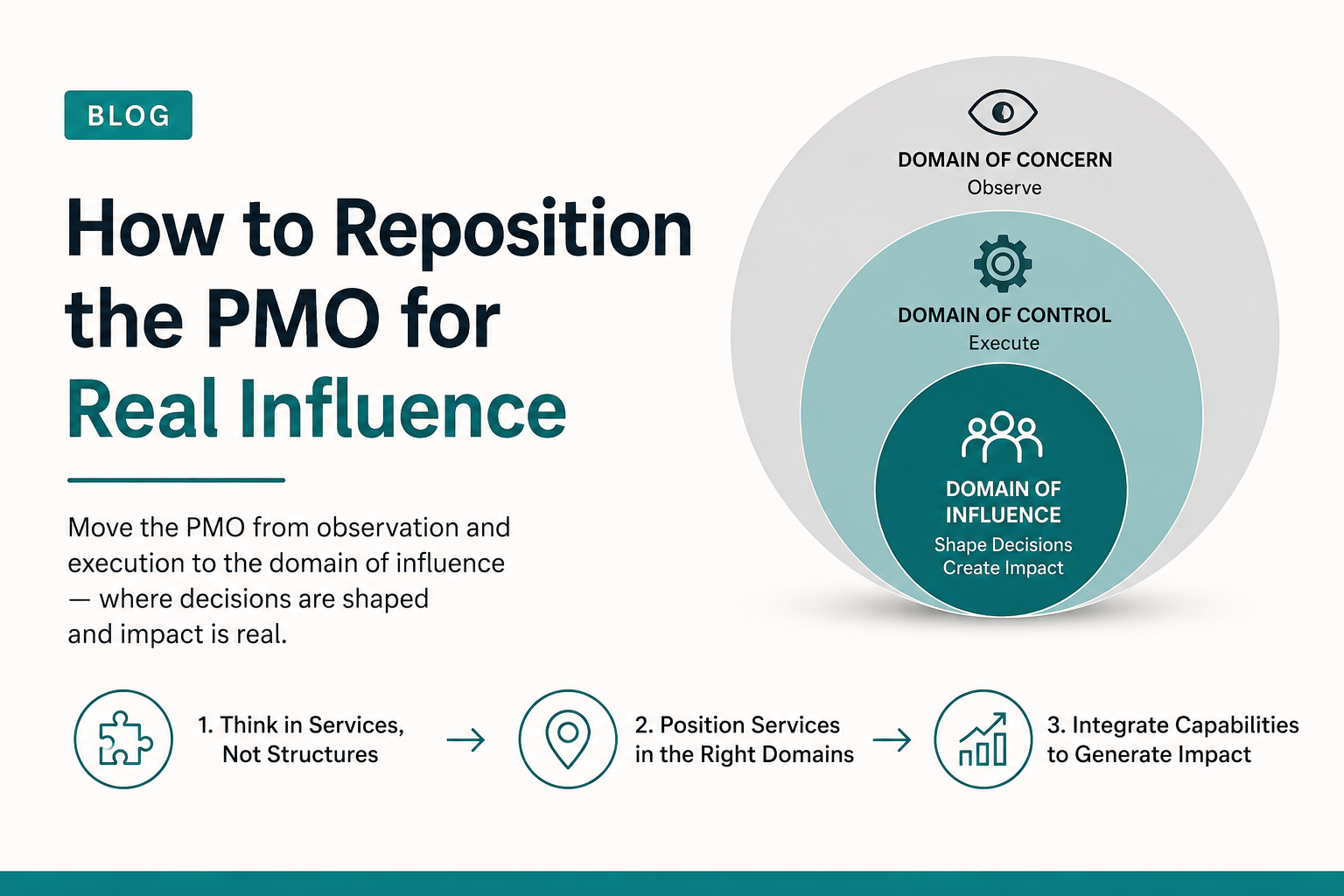 As long as the PMO remains restricted to the domain of concern, it observes. When it operates within the domain of control, it executes. Influence only emerges when the PMO consistently operates within the domain of influence. Most PMOs are not at this level, and it is not because of a lack of technical capability. It is because the operating model prevents it. The mistake begins with how the PMO is defined. It is still treated as a structure. But structures do not generate impact. What generates impact are capabilities organized into services, operating within specific domains, and connected to the real decision-making process. Without this, any attempt to reposition the PMO becomes narrative. It does not change behavior. Repositioning the PMO requires three structural changes.
Influence is not a characteristic of the PMO. It is the result of the services the PMO delivers. The PMO-MI Model model is direct: Impact is not in the existence of the PMO, but in how its services operate and connect. This changes the core question. Instead of asking: “What is the role of the PMO?” The question becomes: “Which services actually interfere with relevant decisions?” Without this shift, the PMO continues trying to gain relevance through internal structure. And that does not change outcomes.
Not every service needs to influence decisions. However, critical services must be positioned where decisions are made. The model establishes that impact occurs in the domains of control and influence, not within observation. This requires a clear distinction:
Without this distinction, the PMO increases operational activity without increasing organizational relevance.
Isolated capability does not create influence. Impact is not the result of adding practices together. It emerges from the integration between services and domains. This is the most neglected point. PMOs improve processes, tools, and controls. But they fail to integrate capabilities in ways that alter how the organizational system operates. The result is predictable:
The capability to connect information, anticipate implications, and act before decisions become fixed. Without this, the PMO reacts instead of directing.
How to measure impact practically, based on evidence rather than perception. |


