




Guessing is not a strategy: How to build decision velocity with AI and real-time data
June 10, 2026 | Live Webinar

The Emerging Tensions of Adaptive Governance
From Statistical Patterns to Operational Judgment
ORGANIZATIONAL MEMORY & DECISION CONTINUITY
RESPONSIBLE DECISION ARCHITECTURE™
Decision Architecture Under Pressure
Agile, Career Development, Career Development, Career Development, Career Development, Career Development, Career Development, Career Development, Career Development, Career Development, Career Development, Career Development, Career Development, Career Development, Career Development, Career Development, Career Development, Career Development, Career Development, Career Development, Career Development, Career Development, Career Development, Career Development, Career Development, Career Development, Career Development, Career Development, Career Development, Career Development, Career Development, Career Development, Career Development, Career Development, Career Development, Career Development, Career Development, Career Development, Career Development, Career Development, Career Development, Career Development, Career Development, Career Development, Career Development, Career Development, Career Development, Career Development, Career Development, Career Development, Career Development, Career Development, Career Development, Career Development, Career Development, Career Development, Career Development, Career Development, Career Development, Career Development, Career Development, Career Development, Career Development, Career Development, Career Development, Career Development, Career Development, Career Development, Career Development, Career Development, Career Development, Career Development, Career Development, Career Development, Career Development, Career Development, Career Development, Interpersonal Skills, Interpersonal Skills, Interpersonal Skills, Interpersonal Skills, Interpersonal Skills, Interpersonal Skills, Interpersonal Skills, Interpersonal Skills, Interpersonal Skills, Interpersonal Skills, Interpersonal Skills, Interpersonal Skills, Interpersonal Skills, Interpersonal Skills, Interpersonal Skills, Interpersonal Skills, Interpersonal Skills, Interpersonal Skills, Interpersonal Skills, Interpersonal Skills, Interpersonal Skills, Interpersonal Skills, Interpersonal Skills, Interpersonal Skills, Interpersonal Skills, Interpersonal Skills, Interpersonal Skills, Interpersonal Skills, Interpersonal Skills, Interpersonal Skills, Interpersonal Skills, Interpersonal Skills, Interpersonal Skills, Interpersonal Skills, Interpersonal Skills, Interpersonal Skills, Interpersonal Skills, Interpersonal Skills, Interpersonal Skills, Interpersonal Skills, Interpersonal Skills, Interpersonal Skills, Interpersonal Skills, Interpersonal Skills, Interpersonal Skills, Interpersonal Skills, Interpersonal Skills, Interpersonal Skills, Interpersonal Skills, Interpersonal Skills, Interpersonal Skills, Interpersonal Skills, Interpersonal Skills, Interpersonal Skills, Interpersonal Skills, Interpersonal Skills, Interpersonal Skills, Interpersonal Skills, Interpersonal Skills, Interpersonal Skills, Interpersonal Skills, Interpersonal Skills, Interpersonal Skills, Interpersonal Skills, Interpersonal Skills, Interpersonal Skills, Interpersonal Skills, Interpersonal Skills, Interpersonal Skills, Interpersonal Skills, Interpersonal Skills, Interpersonal Skills, Interpersonal Skills, Interpersonal Skills, Interpersonal Skills, Interpersonal Skills, Leadership, Leadership, Leadership, Leadership, Leadership, Leadership, Leadership, Leadership, Leadership, Leadership, Leadership, Leadership, Leadership, Leadership, Leadership, Leadership, Leadership, Leadership, Leadership, Leadership, Leadership, Leadership, Leadership, Leadership, Leadership, Leadership, Leadership, Leadership, Leadership, Leadership, Leadership, Leadership, Leadership, Leadership, Leadership, Leadership, Leadership, Leadership, Leadership, Leadership, Leadership, Leadership, Leadership, Leadership, Leadership, Leadership, Leadership, Leadership, Leadership, Leadership, Leadership, Leadership, Leadership, Leadership, Leadership, Leadership, Leadership, Leadership, Leadership, Leadership, Leadership, Leadership, Leadership, Leadership, Leadership, Leadership, Leadership, Leadership, Leadership, Leadership, Leadership, Leadership, Leadership, Leadership, Leadership, Leadership, Leadership, Strategy, Strategy, Strategy, Strategy, Strategy, Strategy, Strategy, Strategy, Strategy, Strategy, Strategy, Strategy, Strategy, Strategy, Strategy, Strategy, Strategy, Strategy, Strategy, Strategy, Strategy, Strategy, Strategy, Strategy, Strategy, Strategy, Strategy, Strategy, Strategy, Strategy, Strategy, Strategy, Strategy, Strategy, Strategy, Strategy, Strategy, Strategy, Strategy, Strategy, Strategy, Strategy, Strategy, Strategy, Strategy, Strategy, Strategy, Strategy, Strategy, Strategy, Strategy, Strategy, Strategy, Strategy, Strategy, Strategy, Strategy, Strategy, Strategy, Strategy, Strategy, Strategy, Strategy, Strategy, Strategy, Strategy, Strategy, Strategy, Strategy, Strategy, Strategy, Strategy, Strategy, Strategy, Strategy, Strategy, Sustainability, Talent Management, Talent Management, Talent Management, Talent Management, Talent Management, Talent Management, Talent Management, Talent Management, Talent Management, Talent Management, Talent Management, Talent Management, Talent Management, Talent Management, Talent Management, Talent Management, Talent Management, Talent Management, Talent Management, Talent Management, Talent Management, Talent Management, Talent Management, Talent Management, Talent Management, Talent Management, Talent Management, Talent Management, Talent Management, Talent Management, Talent Management, Talent Management, Talent Management, Talent Management, Talent Management, Talent Management, Talent Management, Talent Management, Talent Management, Talent Management, Talent Management, Talent Management, Talent Management, Talent Management, Talent Management, Talent Management, Talent Management, Talent Management, Talent Management, Talent Management, Talent Management, Talent Management, Talent Management, Talent Management, Talent Management, Talent Management, Talent Management, Talent Management, Talent Management, Talent Management, Talent Management, Talent Management, Talent Management, Talent Management, Talent Management, Talent Management, Talent Management, Talent Management, Talent Management, Talent Management, Talent Management, Talent Management, Talent Management, Talent Management, Talent Management, Talent Management


|
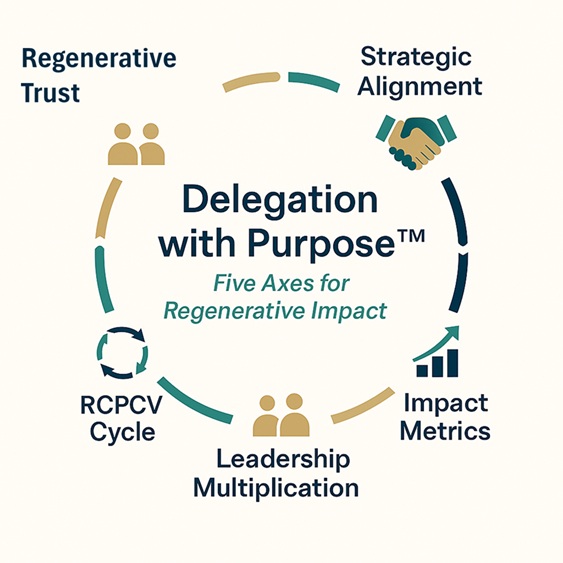
Third post in the series “The 11 Keys of Regenerative Leadership” Delegating is not just about assigning tasks. In regenerative leadership, delegation becomes a strategic act: It’s not about offloading work. Delegation with Purpose™ A model that links delegation to five regenerative dimensions:
See the image below for the visual representation of the model. Practical Example In a large-scale transformation project, a leader applied this model to identify and develop successors. The results?
How to apply it in practice To operationalize regenerative delegation:
Give the person room to choose how to reach the outcome. Practical tip: Set aside 15 minutes a week to validate, adjust, and celebrate. When we delegate with intention, we don’t just deliver results - we build legacy. What are you delegating today that is truly preparing for tomorrow? Missed the previous posts?
|
|
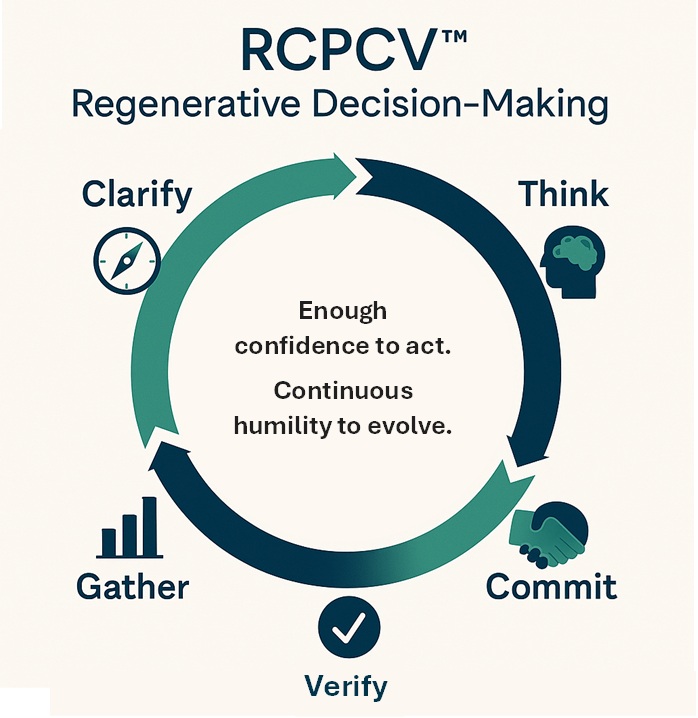
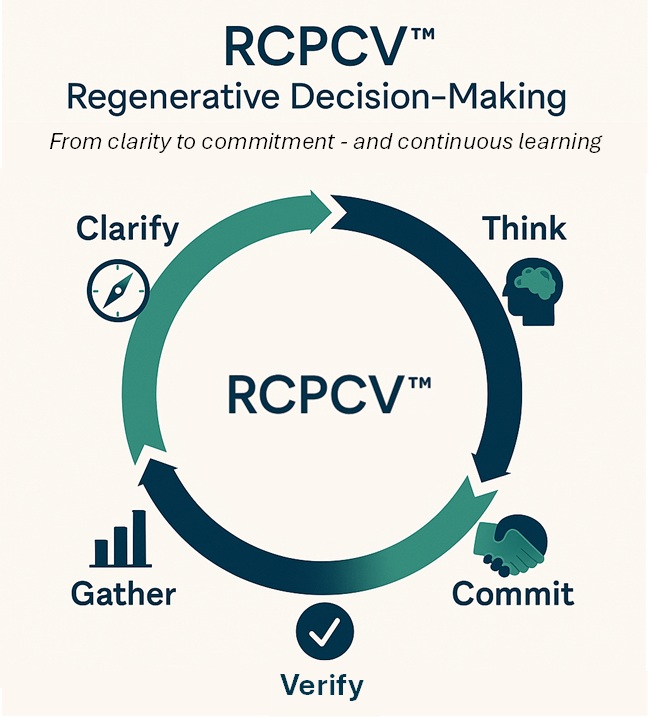
Not all clarity comes from logic. This post was inspired by a recent comment in this series - one that captured the essence of regenerative decision-making with powerful clarity: “Decisions are never neutral. They shape outcomes, legacies and lives.” The RCPCV™ model offers an effective decision cycle.
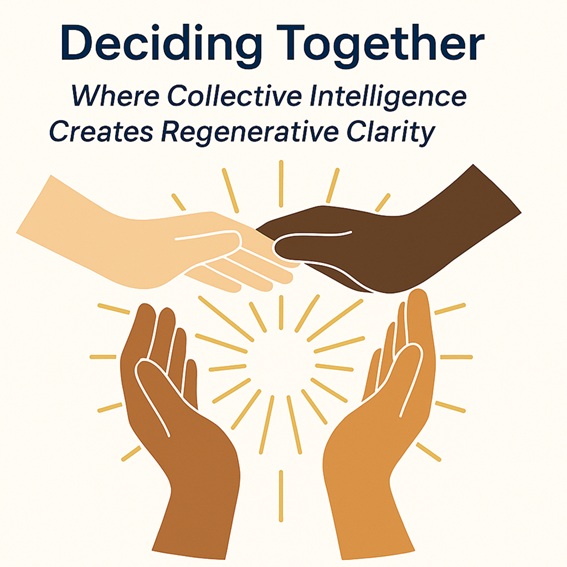
I’ve seen decisions shift direction simply because a previously silent voice was finally heard. Deciding together is more than deciding well. In your experience: how do you bring collective voice into critical decisions? Did you miss the previous posts in this series?
|
|
Companion Post to Pillar 2 | RCPCV™ in Real Action It’s not always possible to wait for certainty. That was precisely what struck me in a recent comment: “Certainty is often an illusion. This sentence captures the essence of RCPCV™: RCPCV™ as a living cycle: Decision-making is not a single act — it is an iterative, relational and learning process. Instead of chasing perfection, the RCPCV™ model helps leaders to:
Regenerative leadership means moving forward with imperfect confidence And having enough humility to learn from each decision. It means turning every choice into a cultural act, not just a technical one. It means understanding that progress doesn’t require certainty — it requires presence, purpose, and courage. And what about you? Where have you been hesitating — waiting for “total certainty”? Share in the comments. Missed the previous posts? • Post 1 — Introduction to the 11 Keys of Regenerative Leadership • Post 2 — Pillar 1 — Regenerative Trust • Post 3 — Pillar 2: Effective Decision-Making (RCPCV™) • Post 4 — Deciding with Emotional Clarity - When Listening Also Means Feeling |
|
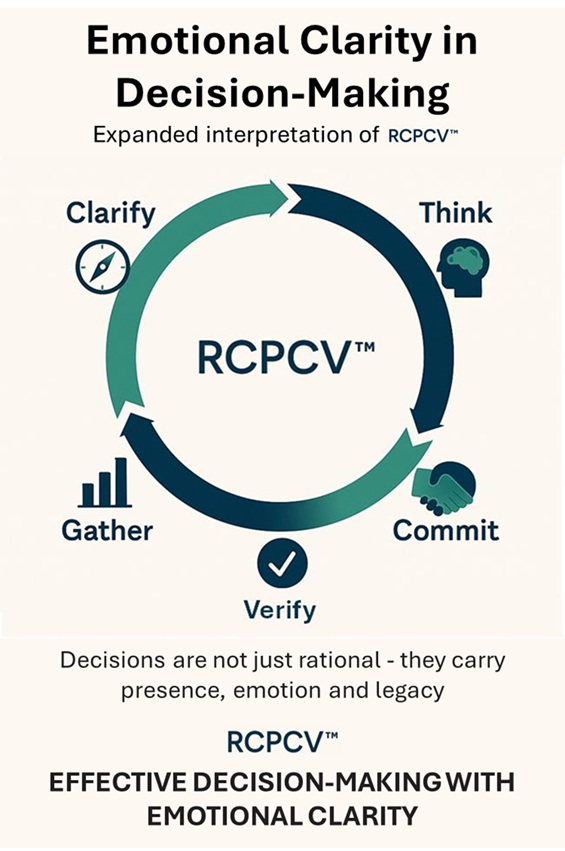
Subdimension of RCPCV™ | Expanded interpretation of Pillar 2 Not every decision is logical. When I shared Pillar 2 – RCPCV™: Effective Decision-Making, I received a comment that made me pause and reflect: “What is often overlooked is the emotional weight carried by decisions. This expanded reading reveals something essential: That’s why I’m sharing today a transversal subdimension of the RCPCV™ model: In each of the five RCPCV™ phases, there is an emotional layer that can influence, support — or block — clarity:
Emotional clarity does not replace critical thinking. Because decisions are not neutral. And for that reason, they deserve full presence — cognitive, ethical… and emotional.What about in your reality? When do you feel the emotional weight of decision-making most strongly? Share in the comments.
Missed the previous posts in the series? • Post 1 — Introduction to the 11 Keys of Regenerative Leadership • Post 2 — Pillar 1 — Regenerative Trust • Post 3 — Pillar 2: Effective Decision-Making (RCPCV™) |
|
This is the second post in the series “The 11 Keys to Regenerative Leadership” In regenerative leadership, decision-making is not a single act. Effective decision-making goes beyond speed or assertiveness. That’s why I developed the RCPCV™ model - a regenerative decision cycle built on five essential steps: 1. Gather the Facts — collect available data, signals, and context (acknowledging uncertainty) Practical example: To decide regeneratively is to choose with purpose - and to recognize that each decision also shapes our evolution. What does your decision-making process look like in times of uncertainty?
Missed the first post in this series? |
|
"The purpose of art: to make the unconscious conscious." - Richard Wagner |