




Guessing is not a strategy: How to build decision velocity with AI and real-time data
June 10, 2026 | Live Webinar

The Emerging Tensions of Adaptive Governance
From Statistical Patterns to Operational Judgment
ORGANIZATIONAL MEMORY & DECISION CONTINUITY
RESPONSIBLE DECISION ARCHITECTURE™
Decision Architecture Under Pressure
Agile, Career Development, Career Development, Career Development, Career Development, Career Development, Career Development, Career Development, Career Development, Career Development, Career Development, Career Development, Career Development, Career Development, Career Development, Career Development, Career Development, Career Development, Career Development, Career Development, Career Development, Career Development, Career Development, Career Development, Career Development, Career Development, Career Development, Career Development, Career Development, Career Development, Career Development, Career Development, Career Development, Career Development, Career Development, Career Development, Career Development, Career Development, Career Development, Career Development, Career Development, Career Development, Career Development, Career Development, Career Development, Career Development, Career Development, Career Development, Career Development, Career Development, Career Development, Career Development, Career Development, Career Development, Career Development, Career Development, Career Development, Career Development, Career Development, Career Development, Career Development, Career Development, Career Development, Career Development, Career Development, Career Development, Career Development, Career Development, Career Development, Career Development, Career Development, Career Development, Career Development, Career Development, Career Development, Career Development, Career Development, Interpersonal Skills, Interpersonal Skills, Interpersonal Skills, Interpersonal Skills, Interpersonal Skills, Interpersonal Skills, Interpersonal Skills, Interpersonal Skills, Interpersonal Skills, Interpersonal Skills, Interpersonal Skills, Interpersonal Skills, Interpersonal Skills, Interpersonal Skills, Interpersonal Skills, Interpersonal Skills, Interpersonal Skills, Interpersonal Skills, Interpersonal Skills, Interpersonal Skills, Interpersonal Skills, Interpersonal Skills, Interpersonal Skills, Interpersonal Skills, Interpersonal Skills, Interpersonal Skills, Interpersonal Skills, Interpersonal Skills, Interpersonal Skills, Interpersonal Skills, Interpersonal Skills, Interpersonal Skills, Interpersonal Skills, Interpersonal Skills, Interpersonal Skills, Interpersonal Skills, Interpersonal Skills, Interpersonal Skills, Interpersonal Skills, Interpersonal Skills, Interpersonal Skills, Interpersonal Skills, Interpersonal Skills, Interpersonal Skills, Interpersonal Skills, Interpersonal Skills, Interpersonal Skills, Interpersonal Skills, Interpersonal Skills, Interpersonal Skills, Interpersonal Skills, Interpersonal Skills, Interpersonal Skills, Interpersonal Skills, Interpersonal Skills, Interpersonal Skills, Interpersonal Skills, Interpersonal Skills, Interpersonal Skills, Interpersonal Skills, Interpersonal Skills, Interpersonal Skills, Interpersonal Skills, Interpersonal Skills, Interpersonal Skills, Interpersonal Skills, Interpersonal Skills, Interpersonal Skills, Interpersonal Skills, Interpersonal Skills, Interpersonal Skills, Interpersonal Skills, Interpersonal Skills, Interpersonal Skills, Interpersonal Skills, Interpersonal Skills, Leadership, Leadership, Leadership, Leadership, Leadership, Leadership, Leadership, Leadership, Leadership, Leadership, Leadership, Leadership, Leadership, Leadership, Leadership, Leadership, Leadership, Leadership, Leadership, Leadership, Leadership, Leadership, Leadership, Leadership, Leadership, Leadership, Leadership, Leadership, Leadership, Leadership, Leadership, Leadership, Leadership, Leadership, Leadership, Leadership, Leadership, Leadership, Leadership, Leadership, Leadership, Leadership, Leadership, Leadership, Leadership, Leadership, Leadership, Leadership, Leadership, Leadership, Leadership, Leadership, Leadership, Leadership, Leadership, Leadership, Leadership, Leadership, Leadership, Leadership, Leadership, Leadership, Leadership, Leadership, Leadership, Leadership, Leadership, Leadership, Leadership, Leadership, Leadership, Leadership, Leadership, Leadership, Leadership, Leadership, Leadership, Strategy, Strategy, Strategy, Strategy, Strategy, Strategy, Strategy, Strategy, Strategy, Strategy, Strategy, Strategy, Strategy, Strategy, Strategy, Strategy, Strategy, Strategy, Strategy, Strategy, Strategy, Strategy, Strategy, Strategy, Strategy, Strategy, Strategy, Strategy, Strategy, Strategy, Strategy, Strategy, Strategy, Strategy, Strategy, Strategy, Strategy, Strategy, Strategy, Strategy, Strategy, Strategy, Strategy, Strategy, Strategy, Strategy, Strategy, Strategy, Strategy, Strategy, Strategy, Strategy, Strategy, Strategy, Strategy, Strategy, Strategy, Strategy, Strategy, Strategy, Strategy, Strategy, Strategy, Strategy, Strategy, Strategy, Strategy, Strategy, Strategy, Strategy, Strategy, Strategy, Strategy, Strategy, Strategy, Strategy, Sustainability, Talent Management, Talent Management, Talent Management, Talent Management, Talent Management, Talent Management, Talent Management, Talent Management, Talent Management, Talent Management, Talent Management, Talent Management, Talent Management, Talent Management, Talent Management, Talent Management, Talent Management, Talent Management, Talent Management, Talent Management, Talent Management, Talent Management, Talent Management, Talent Management, Talent Management, Talent Management, Talent Management, Talent Management, Talent Management, Talent Management, Talent Management, Talent Management, Talent Management, Talent Management, Talent Management, Talent Management, Talent Management, Talent Management, Talent Management, Talent Management, Talent Management, Talent Management, Talent Management, Talent Management, Talent Management, Talent Management, Talent Management, Talent Management, Talent Management, Talent Management, Talent Management, Talent Management, Talent Management, Talent Management, Talent Management, Talent Management, Talent Management, Talent Management, Talent Management, Talent Management, Talent Management, Talent Management, Talent Management, Talent Management, Talent Management, Talent Management, Talent Management, Talent Management, Talent Management, Talent Management, Talent Management, Talent Management, Talent Management, Talent Management, Talent Management, Talent Management


 Who Holds the Decision as It Moves Organizations often focus on who makes the decision. But in complex systems, that is not enough. The deeper question is: Who holds the decision as it moves? Because a decision does not remain intact by itself. It must be carried. Translated. Protected. Reconfirmed. Without ownership across the flow, even the best decision becomes vulnerable to drift. 1. The Ownership Gap A decision may have an owner at the moment it is made. But once it moves into execution, ownership often becomes unclear. It passes through: • Teams • Functions • Timelines • Dependencies • Operational constraints And somewhere along the way, something happens. The decision is still referenced. But no one is actively holding it. This is the ownership gap. 2. Decision-Making Is Not the Same as Decision-Holding Making a decision is an act of commitment. Holding a decision is an act of continuity. The first defines direction. The second protects it. Organizations often assign responsibility for making decisions. But they rarely assign responsibility for maintaining the integrity of those decisions as they travel. That is where many decisions begin to lose force. 3. Why Ownership Dissolves Ownership dissolves for predictable reasons. A. Execution Is Distributed Many people contribute to implementation. But contribution is not the same as ownership. When execution spreads, accountability often spreads with it. And when accountability spreads too far, it disappears. B. Context Changes As decisions move, new constraints appear. Teams adapt. Priorities shift. Interpretations emerge. Without a clear owner, adaptation becomes drift. C. Handoffs Create Loss Every handoff creates risk. Meaning can weaken. Intent can be simplified. Trade-offs can be forgotten. What was decided becomes what is convenient to execute. D. Success Metrics Fragment Different teams measure success differently. One decision enters multiple performance systems. The result is predictable: The decision is optimized locally and weakened systemically. 4. The Role of the Decision Holder Every important decision needs a holder. Not only a decision-maker. A decision holder is responsible for ensuring that the decision: • Retains its intent • Remains visible • Is translated coherently • Is adapted without distortion • Is revisited when reality changes This is not micromanagement. It is stewardship. 5. Ownership Must Travel with the Decision If the decision moves, ownership must move with it. Not by transferring responsibility. But by preserving continuity. This requires clarity on three levels: A. Who Decided The person or body accountable for the original commitment. B. Who Carries The roles responsible for translating the decision into action. C. Who Reconfirms The point of authority that validates whether adaptations still preserve the original intent. Without these three levels, ownership becomes symbolic. 6. Reconfirmation Requires Feedback Reconfirmation is not a subjective act. It must be grounded in reality. As decisions move through the system, feedback becomes the primary signal of whether: • Intent is being preserved • Adaptation is coherent • Outcomes align with expectations Without structured feedback, reconfirmation becomes symbolic. The decision holder is left to rely on interpretation instead of evidence. Effective systems close this gap. They connect decision flow with feedback loops, ensuring that: • Data reflects real execution • Signals are visible across levels • Deviations are detected early In this context, reconfirmation is not a checkpoint. It is a decision informed by system feedback. This is what closes the loop between design and reality. 7. Adaptation Without Ownership Becomes Drift Adaptation is necessary. No decision survives reality unchanged. But adaptation without ownership is dangerous. It allows decisions to change without being consciously re-decided. That is how organizations end up executing something no one explicitly chose. The problem is not adaptation. The problem is adaptation without accountability. 8. Decision Flow as a Governance Capability Decision flow is the path a decision takes from commitment to impact. It includes: • Communication • Translation • Execution • Feedback • Reconfirmation If this flow is not designed, the decision depends on informal interpretation. And informal interpretation rarely preserves strategic intent at scale. Governance must therefore manage not only decision rights. It must manage decision flow. 9. From Accountability to Stewardship Traditional accountability asks: Who is responsible if this fails? Decision stewardship asks: Who ensures this remains coherent before it fails? This is a deeper form of responsibility. It is proactive, not reactive. It protects direction before consequences become visible. 10. The Link to the Previous Layers Decision flow connects the entire architecture. • Decision integrity protects intent • Culture filters what survives • Scaling tests coherence • Incentives shape behavior • Ownership sustains continuity Without ownership, the system may still move. But it may no longer be moving in the direction originally decided. 11. Final Insight Organizations do not lose decisions only because people resist them. They lose decisions because no one holds them long enough. Closing Statement A strong organization is not the one where decisions are simply made. It is the one where decisions are held, translated, adapted, and sustained with ownership. Because in the end, decisions do not create impact when they are approved. They create impact when someone keeps them alive as they move through the system. |
 Why Behavior Follows Structure, Not Intention Organizations do not behave according to what they say. They behave according to what they reward. This is the invisible layer behind every decision. After understanding how decisions degrade, are filtered by culture, and lose coherence at scale, one mechanism consistently explains why: Incentives. 1. The Illusion of Alignment Organizations often believe alignment comes from: • Communication • Shared goals • Leadership direction But alignment does not come from intention. It comes from structure. If incentives contradict decisions, behavior will follow incentives. Not the decision. 2. Decisions Do Not Compete with Ignorance Decisions rarely fail because people do not understand them. They fail because they conflict with what people are measured on. Every system creates a simple rule: What is rewarded gets repeated. What is not rewarded fades. 3. The Hidden Conflict Most organizations operate with two parallel systems: • The stated system → Strategy, Decisions, Values • The real system → Incentives, Metrics, Consequences When these systems diverge: • Decisions are reinterpreted • Priorities shift • Execution adapts Not as resistance. As rational behavior. 4. Why Incentives Distort Decisions Incentives shape behavior through predictable mechanisms. A. Local Optimization People optimize for their scope. Even when it harms the whole. B. Short-Term Bias What is measured frequently becomes dominant. Long-term decisions are sacrificed. C. Risk Avoidance If failure is penalized, experimentation disappears. Decisions become conservative. D. Metric Substitution When outcomes are complex, proxies take over. The proxy becomes the objective. The decision loses meaning. 5. Incentives as a Design Lever Incentives are not a cultural issue. They are a design choice. They define: • What matters in practice • What behavior is reinforced • What decisions can survive Incentives are not only extrinsic. In environments that require creativity, judgment, or complex problem-solving, intrinsic motivation plays a critical role. Purpose, autonomy, and mastery influence behavior in ways that metrics cannot fully capture. However, intrinsic motivation does not replace structural incentives. It operates within them. Without alignment at the structural level, even strong intrinsic motivation will eventually erode under pressure. 6. Designing Incentives for Coherence If behavior follows structure, incentives must be designed deliberately. Three principles become critical: A. Align Incentives with Intent What is rewarded must reflect the decision’s purpose. Not only its output. B. Balance Local and System Outcomes Reward contribution to the whole. Not only local performance. C. Enable Responsible Risk If decisions require judgment, incentives must tolerate learning. Otherwise, behavior collapses into safety. Designing incentives is not a one-time solution. Balancing short-term and long-term outcomes, or local and system performance, introduces inherent tension. Every incentive structure creates trade-offs. Simplification reduces friction but may ignore complexity. Over-engineering increases precision but creates bureaucracy. The objective is not perfection. It is continuous calibration. 7. The Role of Leadership Leadership is not only about setting direction. It is about aligning the system behind it. A decision without aligned incentives is not a decision. It is a suggestion. 8. From Culture to Structure Culture reflects repeated behavior. Behavior follows incentives. This creates a simple chain: Incentives → Behavior → Culture → Outcomes Changing culture without changing incentives does not work. 9. The Practical Test An organization is aligned when: • People act consistently with decisions without supervision • Local choices reinforce global direction • Trade-offs reflect system priorities • Behavior persists under pressure If this does not happen, the issue is not understanding. It is incentive design. 10. Final Insight Organizations do not execute what they decide. They execute what their incentives support. Closing Statement In the end, alignment is not achieved through communication. It is designed through structure. Because decisions do not survive on intention. They survive on what the system makes rational. |
 How to Build Organizations Where Decisions Hold by Default Organizations do not fail because they lack intelligence. They fail because their systems do not support decisions. After understanding how decisions degrade, are filtered, and lose coherence at scale, a more important question emerges: How do we design systems where decisions survive by default? 1. Decisions Do Not Exist in Isolation A decision is not an event. It is part of a system. It depends on: • Who makes it • How it is interpreted • How it is carried • How it is reinforced Without system design, even strong decisions will degrade. 2. From Decision Quality to System Quality Most organizations focus on improving decisions. Better data. Better analysis. Better governance. But the limiting factor is not decision quality. It is system quality. A good decision in a weak system will fail. An average decision in a strong system can hold. 3. The Architecture of Decision Systems Designing for decision coherence requires four structural layers: A. Decision Rights Who decides must be explicit. Not assumed. Not negotiated in real time. Clarity here prevents delay and ambiguity. B. Incentive Alignment People follow what is rewarded. If incentives conflict with decisions, decisions will adapt. Alignment is not cultural. It is structural. C. Boundary Definition Not everything should be fixed. Not everything should be flexible. Systems must define: • What is stable • What can adapt Without this, scaling creates drift. D. Feedback Integration Decisions must be connected to reality. Without feedback: • Errors persist • Misalignment accumulates • Coherence becomes assumed A strong system learns as it operates. 4. Culture as Infrastructure Culture is not an output. It is infrastructure. It determines how efficiently decisions move. A strong culture reduces the cost of coordination. It acts as shared context. Without it, every decision must be re-explained. 5. Technology as Amplifier Technology does not solve decision problems. It amplifies system design. If the system is coherent, technology scales it. If the system is misaligned, technology accelerates fragmentation. Digital platforms do not create alignment. They expose whether it exists. 6. Designing for Reality, Not Control Traditional governance seeks control. Modern systems require coherence. Control assumes stability. Coherence accepts variation. The goal is not to eliminate differences. It is to ensure direction holds despite them. 7. The Practical Test A decision system is working when: • Decisions are made at the right level • Intent remains clear across layers • Adaptation does not distort direction • Feedback changes behavior • Outcomes remain coherent at scale If these conditions are not met, the issue is not execution. It is design. 8. Final Insight Organizations do not improve by making better decisions alone. They improve by designing systems where decisions can survive. Closing Statement In the end, leadership is not only about deciding. It is about designing the conditions where decisions hold. Because decisions do not fail in isolation. They fail in systems that were never built to support them. |
 Why Coherence Breaks When Decisions Grow Organizations do not struggle to make decisions. They struggle to scale them. A decision that works in a room often fails in the system. Not because it is wrong. But because it cannot be replicated with coherence. 1. The Scaling Illusion Leaders often assume that once a decision is clear, it can be extended across the organization. This creates an implicit belief: If it works here, it will work everywhere. This is rarely true. Scaling is not repetition. It is transformation under different conditions. 2. From Decision to Replication A decision does not scale by being copied. It scales by being: • Understood • Translated • Enacted across multiple contexts. Each step introduces variation. Each variation creates risk. What begins as a single direction becomes multiple interpretations. 3. The Coherence Problem At scale, consistency becomes fragile. Not because people resist. But because: • Contexts Differ • Incentives Vary • Constraints Change The result is predictable: The decision fragments. Execution diverges. Outcomes become inconsistent. 4. Why Decisions Do Not Scale Decisions fail to scale for structural reasons. A. Contextual Drift Each unit adapts the decision to local reality. Alignment becomes approximation. Over time, this process becomes almost invisible. Drift rarely feels like failure. At each layer, adaptation appears rational within local context. Teams respond to their own pressures, constraints, and incentives. The result is not a sudden loss of direction. It is a gradual redefinition of the decision. This is why propagation is so difficult to detect. The system does not reject the decision. It absorbs it. And in doing so, reshapes it into something it can sustain. Modern organizations often attempt to reduce this drift through technology. Standardized workflows, dashboards, and digital platforms are designed to enforce consistency. They create the appearance of coherence. But they cannot eliminate context. When systems force uniformity without accounting for local realities, they do not remove variation. They displace it. Adaptation still happens. Only now, it becomes less visible and harder to manage. B. Incentive Misalignment What is rewarded locally may conflict with the decision. People optimize accordingly. C. Capability Gaps Not all parts of the organization can execute the decision equally. Variation increases. D. Signal Loss As decisions move, clarity fades. Communication weakens. Meaning degrades. 5. Replication Is Not Duplication This is the critical distinction. Scaling is not about enforcing sameness. It is about preserving intent across variation. A scalable decision is not identical everywhere. But it remains coherent everywhere. 6. Designing for Coherent Scaling If scaling introduces variation, coherence must be designed. Three conditions become essential: A. Intent Clarity The decision must express not only what to do, but why. Intent anchors interpretation. Without it, replication becomes distortion. B. Boundary Definition Decisions must define what can change and what cannot. Without boundaries: • Adaptation becomes drift • Flexibility becomes inconsistency C. Local Translation with Accountability Adaptation is necessary. But it must remain accountable to the original intent. This creates a balance: • Local flexibility • Global coherence Not all decisions require the same level of coherence. Maintaining alignment has a cost. In some cases, enforcing consistency creates more friction than value. The challenge is not to eliminate variation. It is to decide where coherence matters most. 7. Scaling Requires Feedback Scaling is not only a top-down process. It also depends on the system’s ability to respond. Without feedback: • Misalignment remains hidden • Impractical decisions persist • Coherence becomes assumed rather than validated A scalable system does not only transmit decisions. It learns from how they perform in reality. Feedback is not a correction mechanism. It is part of how coherence is sustained. 8. Technology and the Illusion of Coherence Modern organizations increasingly rely on technology to scale decisions. Platforms, workflows, and algorithms are designed to enforce consistency. In theory, this should reduce variation. In practice, it often creates a different problem. Technology can standardize process. It cannot standardize context. When systems attempt to force coherence through code, they often ignore the reality of contextual drift. The result is not true alignment. It is constrained adaptation. Decisions still change. But now they do so outside the system’s visibility. This creates a dangerous illusion: The system appears coherent. The reality is not. 9. The Role of Culture in Scaling Scaling is not only structural. It is cultural. Culture determines how easily decisions travel across the system. A strong culture acts as a form of compression. It allows complex decisions to move with less explanation because shared context already exists. Without that shared context: • Communication expands • Interpretation varies • Coherence becomes fragile Culture does not eliminate variation. But it reduces distortion. 10. From Integrity to Scalability Decision integrity ensures that a decision holds its shape. Scaling determines whether that shape can be replicated. Without integrity, there is nothing to scale. Without scalability, integrity collapses under growth. 11. Final Insight Organizations do not scale decisions. They scale interpretations of decisions. That is where coherence is either preserved or lost. Closing Statement A strong organization is not the one that makes more decisions. It is the one where decisions: hold their meaning, adapt without distortion, and remain coherent as they scale. Because in the end, scaling is not about size. It is about preserving direction across complexity. |
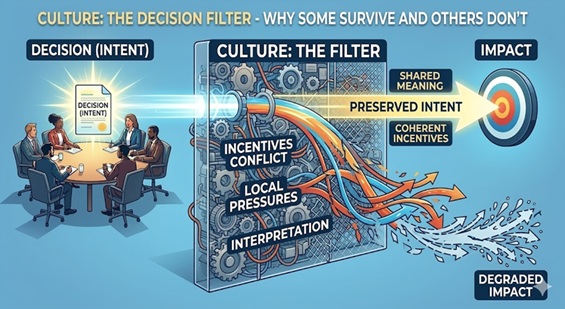 Why Some Decisions Survive and Others Don’t Decisions do not enter neutral systems. They enter environments shaped by: • Incentives • Pressures • Habits • Interpretations What happens next is not execution. It is selection. 1. The System Does Not Execute Decisions Organizations often assume that once a decision is made, the system will execute it. This is rarely the case. Decisions do not move unchanged. They are: • Interpreted • Adapted • Reshaped Not necessarily because people disagree. But because the system filters what it receives. 2. Culture Is Not Background. It Is Mechanism Culture is often described as values, behaviors, or norms. In practice, it operates as a decision filter. It determines: • What Is Accepted • What Is Resisted • What Is Reshaped • What Is Ignored A decision does not pass through culture. It is processed by it. Culture does not just influence decisions. It determines how they are transformed. 3. The Forces That Distort Decisions Decisions rarely fail because they are unclear. They fail because they collide with competing forces. A. Incentives People optimize for what is measured. If the decision conflicts with local incentives, it will be adjusted. Not openly. Gradually. Incentives do not only distort decisions. They define what the system is able to sustain. When redesigned, they become one of the most effective levers to align local behavior with intended direction. B. Local Pressures Teams operate under constraints. Deadlines, targets, and operational realities reshape priorities. The decision is adapted to fit the context. C. Contextual Interpretation Every layer interprets the decision differently. Alignment becomes approximation. Meaning drifts. D. Structural Survival In some systems, adaptation is not optional. It is necessary for survival. Decisions are reshaped to fit what the system can absorb. 4. The Forces That Preserve Decisions Not all decisions degrade. Some survive. Not because they are enforced. But because they are carried. A. Shared Meaning When people understand the intent, not just the instruction, the decision becomes meaningful. Meaning travels better than directives. B. Relational Ownership Decisions that create connection are sustained. Not only owned by one. But supported by many. C. Learning Capacity Systems that allow learning adapt without losing direction. They evolve the decision while preserving its core. D. Coherent Incentives When incentives align with the decision, preservation becomes natural. The system reinforces direction instead of distorting it. 5. Resistance Is Not Always Opposition Resistance is often misunderstood. It is not always disagreement. It is frequently: • Misalignment • Overload • Competing Priorities • Structural Tension What looks like resistance is often the system revealing its constraints. 6. The Real Tension Decisions do not compete with ignorance. They compete with: • Incentives • Embedded Behaviors • Local Realities This is where many decisions fail. Not because they are wrong. But because they are not compatible with the system they enter. This is why many strategic decisions lose strength in execution. For example, a decision to prioritize long-term value often fades when local teams are measured on short-term targets. The decision remains visible, but the system moves in a different direction. 7. From Decision Integrity to Cultural Compatibility Decision integrity ensures that a decision holds its shape. Culture determines whether that shape can be sustained. Without alignment between the two: • Integrity Breaks • Direction Fragments • Execution Drifts 8. Final Insight Culture does not execute decisions. Culture decides what survives. Closing Statement A strong organization is not the one that makes better decisions. It is the one where: Decisions align with incentives, make sense to those who carry them, and can survive the system they enter. Because in the end, decisions do not fail because they are made poorly. They fail because the system reshapes them until they no longer resemble what was originally intended. |
|
"Weaseling out of things is good. It's what separates us from the other animals....except weasels." - Homer Simpson |