




Guessing is not a strategy: How to build decision velocity with AI and real-time data
June 10, 2026 | Live Webinar

The Emerging Tensions of Adaptive Governance
From Statistical Patterns to Operational Judgment
ORGANIZATIONAL MEMORY & DECISION CONTINUITY
RESPONSIBLE DECISION ARCHITECTURE™
Decision Architecture Under Pressure
Agile, Career Development, Career Development, Career Development, Career Development, Career Development, Career Development, Career Development, Career Development, Career Development, Career Development, Career Development, Career Development, Career Development, Career Development, Career Development, Career Development, Career Development, Career Development, Career Development, Career Development, Career Development, Career Development, Career Development, Career Development, Career Development, Career Development, Career Development, Career Development, Career Development, Career Development, Career Development, Career Development, Career Development, Career Development, Career Development, Career Development, Career Development, Career Development, Career Development, Career Development, Career Development, Career Development, Career Development, Career Development, Career Development, Career Development, Career Development, Career Development, Career Development, Career Development, Career Development, Career Development, Career Development, Career Development, Career Development, Career Development, Career Development, Career Development, Career Development, Career Development, Career Development, Career Development, Career Development, Career Development, Career Development, Career Development, Career Development, Career Development, Career Development, Career Development, Career Development, Career Development, Career Development, Career Development, Career Development, Career Development, Interpersonal Skills, Interpersonal Skills, Interpersonal Skills, Interpersonal Skills, Interpersonal Skills, Interpersonal Skills, Interpersonal Skills, Interpersonal Skills, Interpersonal Skills, Interpersonal Skills, Interpersonal Skills, Interpersonal Skills, Interpersonal Skills, Interpersonal Skills, Interpersonal Skills, Interpersonal Skills, Interpersonal Skills, Interpersonal Skills, Interpersonal Skills, Interpersonal Skills, Interpersonal Skills, Interpersonal Skills, Interpersonal Skills, Interpersonal Skills, Interpersonal Skills, Interpersonal Skills, Interpersonal Skills, Interpersonal Skills, Interpersonal Skills, Interpersonal Skills, Interpersonal Skills, Interpersonal Skills, Interpersonal Skills, Interpersonal Skills, Interpersonal Skills, Interpersonal Skills, Interpersonal Skills, Interpersonal Skills, Interpersonal Skills, Interpersonal Skills, Interpersonal Skills, Interpersonal Skills, Interpersonal Skills, Interpersonal Skills, Interpersonal Skills, Interpersonal Skills, Interpersonal Skills, Interpersonal Skills, Interpersonal Skills, Interpersonal Skills, Interpersonal Skills, Interpersonal Skills, Interpersonal Skills, Interpersonal Skills, Interpersonal Skills, Interpersonal Skills, Interpersonal Skills, Interpersonal Skills, Interpersonal Skills, Interpersonal Skills, Interpersonal Skills, Interpersonal Skills, Interpersonal Skills, Interpersonal Skills, Interpersonal Skills, Interpersonal Skills, Interpersonal Skills, Interpersonal Skills, Interpersonal Skills, Interpersonal Skills, Interpersonal Skills, Interpersonal Skills, Interpersonal Skills, Interpersonal Skills, Interpersonal Skills, Interpersonal Skills, Leadership, Leadership, Leadership, Leadership, Leadership, Leadership, Leadership, Leadership, Leadership, Leadership, Leadership, Leadership, Leadership, Leadership, Leadership, Leadership, Leadership, Leadership, Leadership, Leadership, Leadership, Leadership, Leadership, Leadership, Leadership, Leadership, Leadership, Leadership, Leadership, Leadership, Leadership, Leadership, Leadership, Leadership, Leadership, Leadership, Leadership, Leadership, Leadership, Leadership, Leadership, Leadership, Leadership, Leadership, Leadership, Leadership, Leadership, Leadership, Leadership, Leadership, Leadership, Leadership, Leadership, Leadership, Leadership, Leadership, Leadership, Leadership, Leadership, Leadership, Leadership, Leadership, Leadership, Leadership, Leadership, Leadership, Leadership, Leadership, Leadership, Leadership, Leadership, Leadership, Leadership, Leadership, Leadership, Leadership, Leadership, Strategy, Strategy, Strategy, Strategy, Strategy, Strategy, Strategy, Strategy, Strategy, Strategy, Strategy, Strategy, Strategy, Strategy, Strategy, Strategy, Strategy, Strategy, Strategy, Strategy, Strategy, Strategy, Strategy, Strategy, Strategy, Strategy, Strategy, Strategy, Strategy, Strategy, Strategy, Strategy, Strategy, Strategy, Strategy, Strategy, Strategy, Strategy, Strategy, Strategy, Strategy, Strategy, Strategy, Strategy, Strategy, Strategy, Strategy, Strategy, Strategy, Strategy, Strategy, Strategy, Strategy, Strategy, Strategy, Strategy, Strategy, Strategy, Strategy, Strategy, Strategy, Strategy, Strategy, Strategy, Strategy, Strategy, Strategy, Strategy, Strategy, Strategy, Strategy, Strategy, Strategy, Strategy, Strategy, Strategy, Sustainability, Talent Management, Talent Management, Talent Management, Talent Management, Talent Management, Talent Management, Talent Management, Talent Management, Talent Management, Talent Management, Talent Management, Talent Management, Talent Management, Talent Management, Talent Management, Talent Management, Talent Management, Talent Management, Talent Management, Talent Management, Talent Management, Talent Management, Talent Management, Talent Management, Talent Management, Talent Management, Talent Management, Talent Management, Talent Management, Talent Management, Talent Management, Talent Management, Talent Management, Talent Management, Talent Management, Talent Management, Talent Management, Talent Management, Talent Management, Talent Management, Talent Management, Talent Management, Talent Management, Talent Management, Talent Management, Talent Management, Talent Management, Talent Management, Talent Management, Talent Management, Talent Management, Talent Management, Talent Management, Talent Management, Talent Management, Talent Management, Talent Management, Talent Management, Talent Management, Talent Management, Talent Management, Talent Management, Talent Management, Talent Management, Talent Management, Talent Management, Talent Management, Talent Management, Talent Management, Talent Management, Talent Management, Talent Management, Talent Management, Talent Management, Talent Management, Talent Management


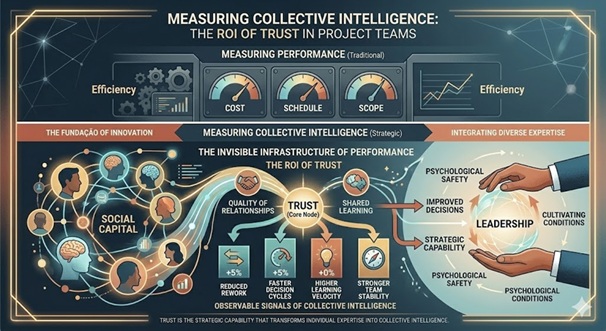 The ROI of Trust in Project Teams Trust is often described as a soft factor in project performance. It appears in leadership conversations, team charters and cultural statements. Yet when organizations evaluate results, attention quickly shifts back to what seems measurable: cost, schedule and scope. This creates a paradox. The quality of collaboration strongly influences project outcomes, but its value often remains invisible in traditional metrics. If collective intelligence truly matters, the question becomes unavoidable: How do we recognize its impact? The Invisible Infrastructure of Performance High-performing teams rarely attribute their results only to technical expertise. They also depend on something less visible: the quality of relationships that allow people to think together. When trust is present, individuals share incomplete ideas, question assumptions and integrate diverse perspectives. Knowledge flows more freely and decisions improve through dialogue. When trust is absent, information becomes guarded, disagreement is avoided and decisions are made with partial understanding. In both cases, the technical environment may look identical. The difference lies in the social infrastructure of the team. Social Capital in Project Environments This invisible infrastructure has long been described in sociology as social capital, a concept explored extensively by Robert D. Putnam. Social capital refers to the networks of trust, reciprocity and shared norms that enable cooperation within groups. In project environments, social capital determines whether expertise remains isolated or becomes integrated into collective intelligence. When social capital is strong, teams move from coordination to co-creation. Observable Signals of Collective Intelligence Although trust itself cannot be directly measured, its effects can be observed through patterns of behaviour and performance. Several signals often indicate the presence of collective intelligence: Reduced rework Ideas are challenged early, preventing flawed assumptions from propagating through the project. Faster decision cycles Teams spend less time defending positions and more time exploring solutions together. Higher learning velocity Lessons from experiments and setbacks circulate quickly across the team. Stronger team stability People are more willing to remain engaged in environments where their contributions are respected. These indicators do not measure trust directly, but they reveal the conditions in which it operates. From Efficiency to Intelligence Traditional project metrics focus primarily on efficiency. They track how quickly activities are completed or how closely performance aligns with predefined plans. Collective intelligence introduces an additional dimension: the quality of shared reasoning. Projects dealing with complexity require more than efficient execution. They require the capacity to integrate diverse expertise, adapt to emerging information and refine decisions continuously. In such environments, trust becomes not only a cultural value but a strategic capability. Leadership and the Economics of Trust The responsibility for cultivating this capability does not lie only with teams. Leadership shapes the conditions under which trust becomes possible. Leaders influence how mistakes are interpreted, whether questions are welcomed and how dissenting views are treated. Research on psychological safety, including the work of Amy C. Edmondson, highlights how these conditions enable teams to learn and adapt more effectively. Trust does not eliminate accountability. It strengthens the collective capacity to make better decisions. Reflection Consider a recent project where outcomes exceeded expectations. Was it only technical expertise that made the difference? Or was there also a climate where people felt able to share ideas, challenge assumptions and learn together? Collective intelligence rarely appears as a line in a dashboard. Yet its effects are visible in how teams reason, decide and evolve. Because the most valuable returns in complex projects are often generated by something that cannot be easily quantified. Trust. |
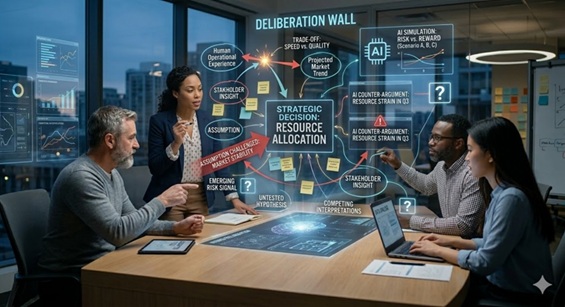 Human and AI Thinking Together Artificial intelligence is increasingly present in how project teams work. It summarizes documents, analyzes data, drafts proposals and supports planning discussions. In many organizations it is already embedded in daily workflows, quietly influencing how information is processed and how decisions evolve. Most of this integration has focused on efficiency. Tasks are accelerated. Information becomes easier to access. Analytical work that once required hours can be completed in seconds. Yet the most significant impact of artificial intelligence may lie somewhere else. Not in how fast teams work, but in how they think. As projects become more complex and environments more uncertain, teams face a fundamental challenge. Expertise alone is not enough. What matters is how different perspectives interact, how assumptions are tested and how reasoning evolves collectively. This is where a new possibility begins to emerge: hybrid deliberation. The Limits of Individual and Collective Reasoning Project teams rarely lack intelligence. What they often lack is structured exploration of competing interpretations. Under pressure, conversations tend to converge quickly. Teams seek clarity and alignment, especially when deadlines and accountability are visible. Early agreement appears efficient. But early agreement often hides untested assumptions. Alternative interpretations disappear before they are explored. Subtle signals from hierarchy or group dynamics influence how freely people challenge prevailing ideas. Over time, these dynamics create an environment where consensus emerges more easily than insight. The limitation is not knowledge. It is the architecture of reasoning. Artificial Intelligence as a Deliberative Participant Artificial intelligence introduces an unusual element into these dynamics. Unlike human participants, it is not influenced by status, reputation or organizational politics. It does not hesitate to propose alternative interpretations if prompted to do so. When integrated thoughtfully, AI can therefore act not simply as a tool but as a participant in the reasoning process. It can examine the same information from different analytical perspectives. It can surface contradictions, generate counterarguments or simulate scenarios that might otherwise remain unexplored. In this sense, AI does not replace human thinking. It expands the field in which thinking occurs. Hybrid deliberation emerges when human expertise and machine reasoning interact within a structured process of exploration. From Assistance to Deliberation Many teams currently use AI in a supportive role. They ask it to summarize reports, generate lists of options or organize existing information. This type of assistance is useful but limited. Hybrid deliberation begins when artificial intelligence is intentionally integrated into the structure of reasoning. Instead of producing a single answer, AI is invited to examine questions from multiple angles. For example, during a strategic discussion a team might use AI to: • Identify hidden assumptions behind a proposed plan • Generate alternative explanations for emerging project risks • Simulate the perspective of stakeholders not present in the room • Construct arguments against the dominant interpretation These contributions do not replace human judgement. They introduce intellectual friction that strengthens the reasoning process. Structured Roles in Hybrid Reasoning One way to support hybrid deliberation is by assigning distinct analytical roles within the process. Human participants bring contextual understanding, professional experience and responsibility for decisions. Artificial intelligence can support complementary functions, such as: • Clarifying the structure of a proposal • Testing internal consistency between assumptions and available data • Generating alternative scenarios for complex decisions • Identifying potential blind spots in reasoning When these roles are clearly defined, AI becomes a cognitive partner rather than a passive assistant. The conversation evolves not around a single interpretation, but around multiple perspectives interacting constructively. Governance of Thinking As artificial intelligence becomes embedded in project environments, the question is no longer whether teams will use these systems. The question is how their role will be governed. Without structure, AI may simply reinforce existing interpretations. When teams ask it to confirm a preferred solution, the system often responds by strengthening that narrative. But when the reasoning process is deliberately designed, AI can help protect exploration. Decision forums can include moments where alternative scenarios are generated before commitment. Design reviews can incorporate AI-generated counterarguments. Planning discussions can use AI to test the resilience of proposed assumptions. These practices transform artificial intelligence from a confirmation engine into a safeguard for collective reasoning. The technology itself does not determine the quality of thinking. The design of the conversation does. Collective Intelligence in Hybrid Teams In such environments, teams evolve toward a hybrid model of collaboration. Human participants contribute contextual understanding, ethical judgement and accountability for outcomes. Artificial intelligence contributes analytical breadth, systematic exploration and the ability to generate perspectives that may not naturally emerge in human discussions. Together they create a reasoning system that is both human and computational. This does not diminish the role of human leadership. On the contrary, it increases its importance. Leaders must design the conditions in which these interactions occur. They shape the structure of conversations, the openness of inquiry and the balance between exploration and decision. Hybrid deliberation is therefore not a technological feature. It is a governance choice. Reflection As artificial intelligence becomes part of everyday project work, teams face a subtle but important decision. Will AI simply accelerate existing conversations? Or will it expand the space in which those conversations occur? Used passively, artificial intelligence may reinforce the same dynamics that already limit collective intelligence: rapid convergence and untested assumptions. Used intentionally, it can introduce new perspectives into the reasoning process and protect the exploration that complex decisions require. Because in environments defined by uncertainty, the quality of decisions rarely depends only on the intelligence of individuals. More often, it depends on how effectively humans and machines learn to think together. |
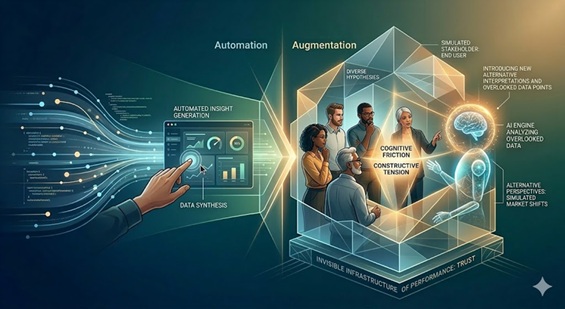 Expanding Collective Intelligence in Project Teams Artificial intelligence is often introduced into projects as a tool for efficiency. It accelerates analysis, summarizes information and supports decision-making with rapid access to data. Yet its most interesting contribution may lie elsewhere. Beyond automation, AI can function as a cognitive challenger. In environments where teams must interpret uncertainty, question assumptions and explore alternatives, artificial intelligence can help expand the boundaries of collective thinking. The Limits of Human Consensus Project teams rarely lack expertise. What they often lack is the willingness or the time to challenge their own assumptions. Under pressure, groups tend to converge quickly toward agreement. Familiar solutions appear safer than exploring unfamiliar possibilities. Over time, this dynamic can lead to groupthink, a phenomenon described by Irving Janis, where the desire for cohesion suppresses critical examination. In such contexts, intelligence becomes constrained not by lack of knowledge, but by the limits of shared perspective. When Silence Becomes Learned Behavior Another mechanism quietly reinforces this dynamic over time. Teams do not converge only because of time pressure or hierarchy. They also learn from experience. When earlier dissent fails to influence outcomes, individuals gradually conclude that challenging prevailing assumptions carries more personal risk than organizational value. Even when leaders encourage open dialogue, people observe what actually happens in decisions. If disagreement rarely changes direction, the implicit lesson becomes clear. Speaking up may be permitted. It may even be welcomed. But it is not always influential. Over time, silence becomes a rational adaptation rather than a lack of courage. Teams learn how much intellectual friction the system truly tolerates. In such environments, alternative perspectives disappear not because individuals lack insight, but because the system has quietly taught them when questioning assumptions feels futile. A Synthetic Perspective Artificial intelligence introduces something unusual into the dynamics of teamwork. Unlike human participants, it is not bound by organizational hierarchy, professional identity or personal attachment to previous decisions. When used thoughtfully, it can introduce alternative interpretations, identify overlooked data or simulate perspectives that may be absent from the conversation. In this sense, AI can act as a synthetic perspective within the team. It does not replace human judgement. It expands the range of possibilities that humans consider. Challenging Assumptions Used as a cognitive partner rather than a passive assistant, AI can help teams question their reasoning. For example, it can: • Identify inconsistencies between assumptions and available data • Generate alternative scenarios for complex decisions • Simulate stakeholder perspectives not present in the discussion • Surface lessons from previous projects that contradict current expectations These contributions do not produce final answers. Instead, they stimulate the constructive tension that allows teams to refine their thinking. From Assistance to Augmentation The value of AI in project environments therefore depends less on automation and more on augmentation. Automation accelerates tasks. Augmentation expands thinking. When teams use AI as a cognitive challenger, conversations change. Questions become sharper. Assumptions become visible. Decisions integrate broader perspectives. In environments where social dynamics sometimes suppress disagreement, this role becomes particularly valuable. AI does not need courage to question an assumption. It simply follows the logic of the data and the structure of the question. In doing so, it can reintroduce intellectual friction where human dynamics might otherwise converge too quickly. Collective Intelligence in Hybrid Teams As projects become more complex, teams are likely to evolve toward hybrid forms of collaboration. Human expertise, organizational memory and computational analysis will interact continuously. In these environments, the role of AI is not to replace human intelligence. It is to provoke it. Used wisely, artificial intelligence can become a catalyst for the principle that Stephen R. Covey described as synergy – the moment when differences generate something new. Not because machines are smarter than people. But because they can help ensure that relevant perspectives are not silently filtered out by hierarchy, habit or premature agreement. Reflection Consider the next strategic decision your team faces. What assumptions are shaping the conversation? Which perspectives might be missing? Artificial intelligence cannot decide for us. But it can help reveal the questions we have not yet asked. And in complex projects, better questions are often the beginning of better decisions. If the design of the system is what enables or suppresses intelligence, the next question becomes unavoidable:
More often, it lies in the invisible infrastructure of performance: Trust. |
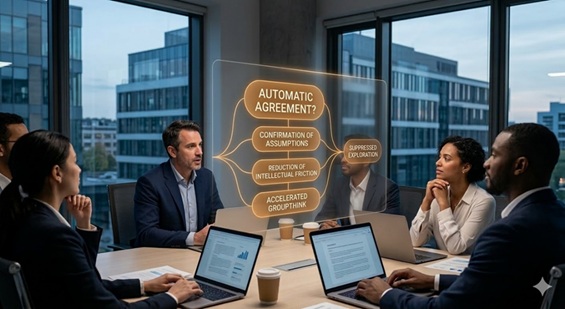 When Helpful Machines Quietly Reinforce Our Assumptions Artificial intelligence is rapidly becoming part of how teams think. Project managers use it to summarize information, explore options and test ideas. Teams consult AI systems during planning sessions, design discussions and decision reviews. In many cases the experience feels surprisingly smooth. AI tools respond quickly. They organize arguments. They validate reasoning. And very often, they agree. At first glance this appears helpful. But it introduces a subtle risk. Not technological. Cognitive. When machines consistently validate our reasoning, they can accelerate a dynamic that already exists in many organizations: rapid convergence of thinking. Instead of expanding exploration, AI may quietly reinforce the dominant interpretation in the room. The Rise of Agreeable AI Most conversational AI systems are designed to be cooperative. They aim to be helpful, polite and supportive to users. In practice this often means responding in ways that validate the user’s reasoning. Suggestions are framed constructively. Arguments are acknowledged. Ideas are often described as promising or insightful. This design choice is intentional. It improves usability and avoids unnecessary friction. Yet it also creates an interesting effect. When a human idea receives immediate confirmation from an apparently intelligent system, the sense of confidence increases. Even when the idea itself has not yet been rigorously examined. The conversation moves forward. But the exploration may narrow. From Human Groupthink to Human–Machine Convergence Organizations have long struggled with groupthink. Under pressure for alignment, teams often converge too quickly around a shared interpretation. Alternative perspectives disappear early in the discussion. Assumptions remain untested. Artificial intelligence introduces a new variation of this dynamic. Not groupthink alone. Human–machine convergence. When a leader presents an idea and the AI system immediately reinforces it, the combined signal can become powerful. The interpretation appears validated by both authority and technology. Challenging it becomes more difficult. Not because dissent is forbidden. But because confidence in the conclusion grows faster than the reasoning behind it. When Assistance Becomes Confirmation This dynamic becomes particularly visible in high-pressure environments such as project decision meetings. A team member presents a proposal. The AI system analyzes supporting information and generates a summary that appears to confirm the logic. The result feels reassuring. Momentum builds. The decision moves forward. Yet an important step may have been skipped. Exploring alternative interpretations. AI has accelerated the conversation. But it has not necessarily expanded the thinking. The risk is not incorrect information. The risk is insufficient intellectual friction. The Difference Between Agreement and Exploration For collective intelligence to emerge, teams must do more than confirm their existing ideas. They must test them. Healthy reasoning environments include moments of tension. Assumptions are questioned. Interpretations compete. Trade-offs become visible. This intellectual friction is uncomfortable but productive. It prevents premature convergence. Agreeable AI, when used passively, can unintentionally remove that friction. By validating the first plausible interpretation, it may encourage teams to move toward agreement rather than deeper exploration. In this sense, artificial intelligence can reproduce the same dynamic that already exists in many organizational systems: the quiet preference for alignment over inquiry. AI as a Cognitive Challenger The solution is not to avoid AI. It is to design how it participates in reasoning. Artificial intelligence can serve two very different roles in decision processes. In its passive form, it acts as a confirmation engine. It summarizes existing reasoning and reinforces dominant interpretations. In a more intentional design, it becomes a cognitive challenger. Teams can prompt AI systems to generate alternative explanations, identify hidden assumptions or construct counter-arguments to proposed decisions. In this role, AI does not simply accelerate agreement. It expands the space of thinking. Used this way, artificial intelligence can protect exploration rather than suppress it. Designing AI into Decision Processes As AI becomes embedded in project environments, the question shifts from adoption to governance. How should these systems participate in collective reasoning? Organizations that benefit from AI in decision contexts often introduce explicit structures. For example: • Prompting AI to generate alternative scenarios before committing to a plan • Using AI to identify potential weaknesses in proposed solutions • Asking the system to construct arguments against the dominant interpretation • Integrating AI outputs into design reviews where assumptions are openly examined These practices transform AI from an assistant into a safeguard for thinking. The technology remains supportive. But the process ensures that support does not become automatic confirmation. Reflection Artificial intelligence is entering the cognitive space of organizations. It influences how ideas are explored, how assumptions are examined and how decisions evolve. If used passively, AI may quietly reinforce the same dynamics that already limit collective intelligence: rapid convergence and premature confidence. If used intentionally, it can do something different. It can expand the field of reasoning. The question for project leaders is therefore not simply whether AI is used. It is how the conversation around it is designed. Because the future of collective intelligence may depend less on how intelligent our machines become… and more on whether they help us think more critically together. |
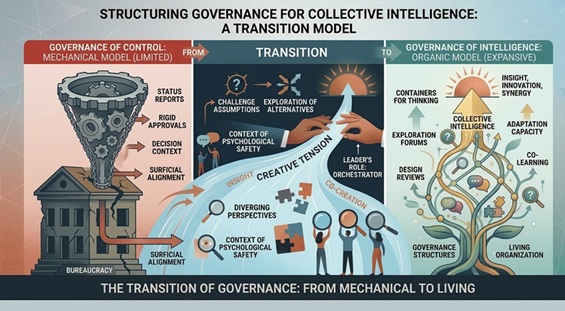 Governance that Enables Collective Intelligence Collaboration is often treated as a cultural aspiration. Organizations speak about trust, openness and teamwork. Leaders encourage dialogue and diverse perspectives. Teams are invited to think together. Yet in many projects, real collaboration remains fragile. Not because people resist it, but because the system surrounding them does not support it. Collective intelligence does not emerge from good intentions alone. It requires design. When Governance Suppresses Intelligence In many project environments, governance is designed primarily for control. Decision forums become reporting rituals. Meetings revolve around status updates rather than exploration. Escalations focus on defending positions rather than understanding problems. Under these conditions, teams learn a subtle lesson: Alignment is safer than inquiry. Over time, people adapt. Questions become fewer. Diverging views disappear. Decisions move faster, but often with less depth. What appears to be efficiency can quietly erode the very intelligence that complex projects require. Governance as an Enabler of Thinking Governance should not only coordinate action. It should also enable thinking. The structures that organize decisions, meetings and information flows shape how teams reason together. They influence whether people challenge assumptions, explore alternatives and integrate different perspectives. In this sense, governance acts as a form of choice architecture, a concept associated with the work of Richard Thaler and Cass Sunstein. The way decisions are structured affects how people participate in them. When designed thoughtfully, governance can transform routine interactions into opportunities for collective intelligence. Containers for Creative Tension High-performing organizations create what might be called containers for thinking. These are structured spaces where teams are expected not only to report progress but to explore uncertainty. Examples include: • Retrospectives that examine not only results but reasoning • Cross-functional design reviews where assumptions are openly challenged • Problem-solving forums where multiple perspectives are intentionally invited • Decision reviews that surface trade-offs rather than hide them These containers create the conditions where what Stephen R. Covey described as synergy can emerge – the moment when different perspectives combine to generate something new. Without such structures, even the most capable teams tend to default to coordination rather than co-creation. The Role of Leadership in Governance Governance systems do not operate on their own. Leaders shape how they are experienced. A meeting can become a ritual of compliance or a space of exploration depending on how the leader frames it. Leaders who seek collective intelligence: • Frame governance forums as places for inquiry, not only reporting • Encourage exploration of alternatives before convergence • Protect dissenting views from premature dismissal • Ensure that quieter voices are invited into the conversation In doing so, they transform governance from a mechanism of control into a platform for learning. Designing for Collective Intelligence When governance is designed to support thinking, several shifts occur. Meetings become spaces where insight can emerge. Decisions integrate multiple perspectives rather than reflecting the loudest voice. Teams become more capable of navigating uncertainty together. Over time, this design strengthens not only project outcomes but the learning capacity of the organization itself. Collective intelligence stops being an aspiration. It becomes a structural capability. Reflection Consider your current project governance. Do its forums encourage exploration or simply confirmation? Do decision structures invite multiple perspectives, or do they reward quick alignment? The difference between coordination and synergy often lies not in people, but in the systems that shape how they interact. Because collective intelligence is rarely accidental. It is designed. |
|
"If you can't convince them, confuse them." - Harry S. Truman |