




Guessing is not a strategy: How to build decision velocity with AI and real-time data
June 10, 2026 | Live Webinar

The Emerging Tensions of Adaptive Governance
From Statistical Patterns to Operational Judgment
ORGANIZATIONAL MEMORY & DECISION CONTINUITY
RESPONSIBLE DECISION ARCHITECTURE™
Decision Architecture Under Pressure
Agile, Career Development, Career Development, Career Development, Career Development, Career Development, Career Development, Career Development, Career Development, Career Development, Career Development, Career Development, Career Development, Career Development, Career Development, Career Development, Career Development, Career Development, Career Development, Career Development, Career Development, Career Development, Career Development, Career Development, Career Development, Career Development, Career Development, Career Development, Career Development, Career Development, Career Development, Career Development, Career Development, Career Development, Career Development, Career Development, Career Development, Career Development, Career Development, Career Development, Career Development, Career Development, Career Development, Career Development, Career Development, Career Development, Career Development, Career Development, Career Development, Career Development, Career Development, Career Development, Career Development, Career Development, Career Development, Career Development, Career Development, Career Development, Career Development, Career Development, Career Development, Career Development, Career Development, Career Development, Career Development, Career Development, Career Development, Career Development, Career Development, Career Development, Career Development, Career Development, Career Development, Career Development, Career Development, Career Development, Career Development, Interpersonal Skills, Interpersonal Skills, Interpersonal Skills, Interpersonal Skills, Interpersonal Skills, Interpersonal Skills, Interpersonal Skills, Interpersonal Skills, Interpersonal Skills, Interpersonal Skills, Interpersonal Skills, Interpersonal Skills, Interpersonal Skills, Interpersonal Skills, Interpersonal Skills, Interpersonal Skills, Interpersonal Skills, Interpersonal Skills, Interpersonal Skills, Interpersonal Skills, Interpersonal Skills, Interpersonal Skills, Interpersonal Skills, Interpersonal Skills, Interpersonal Skills, Interpersonal Skills, Interpersonal Skills, Interpersonal Skills, Interpersonal Skills, Interpersonal Skills, Interpersonal Skills, Interpersonal Skills, Interpersonal Skills, Interpersonal Skills, Interpersonal Skills, Interpersonal Skills, Interpersonal Skills, Interpersonal Skills, Interpersonal Skills, Interpersonal Skills, Interpersonal Skills, Interpersonal Skills, Interpersonal Skills, Interpersonal Skills, Interpersonal Skills, Interpersonal Skills, Interpersonal Skills, Interpersonal Skills, Interpersonal Skills, Interpersonal Skills, Interpersonal Skills, Interpersonal Skills, Interpersonal Skills, Interpersonal Skills, Interpersonal Skills, Interpersonal Skills, Interpersonal Skills, Interpersonal Skills, Interpersonal Skills, Interpersonal Skills, Interpersonal Skills, Interpersonal Skills, Interpersonal Skills, Interpersonal Skills, Interpersonal Skills, Interpersonal Skills, Interpersonal Skills, Interpersonal Skills, Interpersonal Skills, Interpersonal Skills, Interpersonal Skills, Interpersonal Skills, Interpersonal Skills, Interpersonal Skills, Interpersonal Skills, Interpersonal Skills, Leadership, Leadership, Leadership, Leadership, Leadership, Leadership, Leadership, Leadership, Leadership, Leadership, Leadership, Leadership, Leadership, Leadership, Leadership, Leadership, Leadership, Leadership, Leadership, Leadership, Leadership, Leadership, Leadership, Leadership, Leadership, Leadership, Leadership, Leadership, Leadership, Leadership, Leadership, Leadership, Leadership, Leadership, Leadership, Leadership, Leadership, Leadership, Leadership, Leadership, Leadership, Leadership, Leadership, Leadership, Leadership, Leadership, Leadership, Leadership, Leadership, Leadership, Leadership, Leadership, Leadership, Leadership, Leadership, Leadership, Leadership, Leadership, Leadership, Leadership, Leadership, Leadership, Leadership, Leadership, Leadership, Leadership, Leadership, Leadership, Leadership, Leadership, Leadership, Leadership, Leadership, Leadership, Leadership, Leadership, Leadership, Strategy, Strategy, Strategy, Strategy, Strategy, Strategy, Strategy, Strategy, Strategy, Strategy, Strategy, Strategy, Strategy, Strategy, Strategy, Strategy, Strategy, Strategy, Strategy, Strategy, Strategy, Strategy, Strategy, Strategy, Strategy, Strategy, Strategy, Strategy, Strategy, Strategy, Strategy, Strategy, Strategy, Strategy, Strategy, Strategy, Strategy, Strategy, Strategy, Strategy, Strategy, Strategy, Strategy, Strategy, Strategy, Strategy, Strategy, Strategy, Strategy, Strategy, Strategy, Strategy, Strategy, Strategy, Strategy, Strategy, Strategy, Strategy, Strategy, Strategy, Strategy, Strategy, Strategy, Strategy, Strategy, Strategy, Strategy, Strategy, Strategy, Strategy, Strategy, Strategy, Strategy, Strategy, Strategy, Strategy, Sustainability, Talent Management, Talent Management, Talent Management, Talent Management, Talent Management, Talent Management, Talent Management, Talent Management, Talent Management, Talent Management, Talent Management, Talent Management, Talent Management, Talent Management, Talent Management, Talent Management, Talent Management, Talent Management, Talent Management, Talent Management, Talent Management, Talent Management, Talent Management, Talent Management, Talent Management, Talent Management, Talent Management, Talent Management, Talent Management, Talent Management, Talent Management, Talent Management, Talent Management, Talent Management, Talent Management, Talent Management, Talent Management, Talent Management, Talent Management, Talent Management, Talent Management, Talent Management, Talent Management, Talent Management, Talent Management, Talent Management, Talent Management, Talent Management, Talent Management, Talent Management, Talent Management, Talent Management, Talent Management, Talent Management, Talent Management, Talent Management, Talent Management, Talent Management, Talent Management, Talent Management, Talent Management, Talent Management, Talent Management, Talent Management, Talent Management, Talent Management, Talent Management, Talent Management, Talent Management, Talent Management, Talent Management, Talent Management, Talent Management, Talent Management, Talent Management, Talent Management


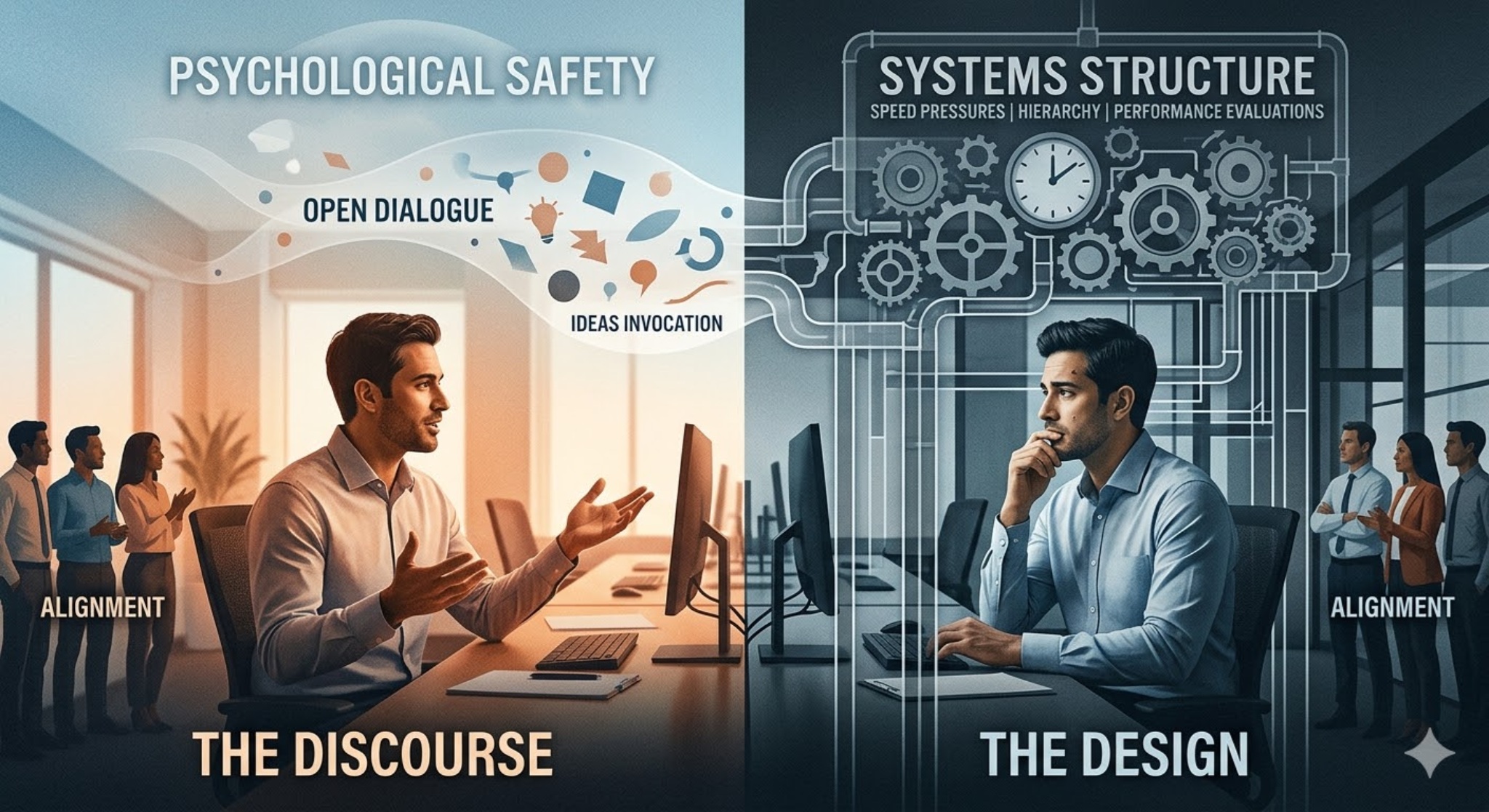 When Alignment Replaces Thinking in Project Environments Most organizations claim to value open dialogue. Leaders speak about psychological safety. Teams are encouraged to share ideas. Diversity of perspectives is described as a driver of innovation. On the surface, the message is clear: Disagreement is welcome. Yet in many project environments, something different happens. Ideas converge quickly. Alternative perspectives disappear early in discussions. Decisions are accepted with little exploration of underlying assumptions. What appears to be alignment may actually be something else. A system that quietly discourages disagreement. The question is therefore not whether people value constructive debate. It is whether the surrounding system truly allows it. The Hidden Signals of Organizational Systems Organizations rarely suppress disagreement intentionally. Instead, they design systems that unintentionally make disagreement risky. Performance evaluations reward reliability and speed. Governance structures prioritize rapid convergence. Escalation paths emphasize clarity rather than exploration. Under these conditions, teams receive subtle signals about what is expected. Alignment begins to be interpreted as professionalism. Questioning assumptions may appear as friction. Raising alternative interpretations can feel like slowing progress. Over time, people adapt. Disagreement becomes less frequent not because teams lack ideas, but because the system quietly teaches them that harmony is safer than inquiry. The Speed Trap Another force reinforcing this dynamic is pressure for speed. Projects operate under tight deadlines, financial constraints and strong expectations for momentum. Leaders often seek clarity and confidence from their teams. In this context, early convergence can appear efficient. Discussions shorten. Meetings produce quick agreements. Decisions move forward with apparent momentum. Yet speed can hide a deeper cost. When teams converge too early, assumptions remain untested. Alternative perspectives are never explored. The collective intelligence of the group remains partially unused. Efficiency improves. Understanding declines. Power and the Cost of Dissent Hierarchy also shapes how freely disagreement appears. In organizations where authority is concentrated, questioning a decision can easily be interpreted as challenging the person behind it. Even when leaders encourage open dialogue, the structural asymmetry of power remains visible. People read the room. They observe which perspectives are welcomed and which are quietly set aside. Over time, a subtle form of self-censorship emerges. Not because individuals lack courage. But because they understand the informal rules of the environment. Silence becomes a rational adaptation. Alignment becomes the safest contribution. Not necessarily the most insightful one. The Difference Between Culture and Design For this reason, constructive disagreement cannot be sustained by culture alone. Organizations often attempt to solve the problem by encouraging new behaviours. Speak up. Challenge assumptions. Share your perspective. These messages matter. But without supportive structures, they remain fragile. Sustained intellectual diversity depends on design. Governance forums must allow time for exploration before convergence. Decision processes must reward insight, not only speed. Leadership must distinguish critique of ideas from judgement of people. When systems support inquiry, disagreement becomes a resource rather than a disruption. Designing Systems That Allow Thinking Organizations that benefit from collective intelligence rarely rely on courage alone. They design structures that make questioning normal. Examples include: • Design reviews where assumptions are examined before commitments are made • Cross-functional problem-solving sessions where multiple perspectives are invited • Retrospectives that analyze reasoning rather than only results • Decision forums that explicitly surface trade-offs instead of hiding them Some organizations also institutionalize dissent through structured techniques such as the pre-mortem, introduced by Gary Klein. In a pre-mortem, teams assume that a project has already failed and work backward to identify what might have caused the failure. This simple shift changes the dynamics of conversation. Instead of requiring individuals to challenge the dominant view, the process itself invites alternative interpretations. Dissent becomes a responsibility of the system rather than a personal risk. AI as a Cognitive Safeguard A new element is beginning to influence how teams reason together. Artificial intelligence is often introduced into organizations as a tool for efficiency. It accelerates analysis, summarizes information and processes large volumes of data. Yet its most interesting role may lie elsewhere. When thoughtfully integrated into decision processes, AI can act as a cognitive safeguard. Unlike human participants, it is not influenced by hierarchy, reputation or social pressure to converge quickly. It can surface contradictory data, highlight inconsistencies in reasoning and introduce alternative interpretations. In this role, artificial intelligence does not replace human judgement. It protects the conditions under which judgement improves. Automation accelerates tasks. Augmentation expands thinking. In environments where speed pressures suppress exploration, this distinction becomes increasingly important. Structural Safety Leaders play a critical role in shaping these dynamics. Their responsibility goes beyond moderating conversations. They shape the conditions under which people think together. When leaders acknowledge uncertainty, invite alternative interpretations and protect dissenting views from premature dismissal, they send a powerful signal. Inquiry is legitimate. Over time, teams begin to experience what might be called structural safety. An environment where questioning assumptions is not only tolerated, but expected. This type of safety does not emerge from encouragement alone. It emerges from systems designed to support it. Reflection Consider your next decision meeting. Will disagreement appear naturally? Or would someone need unusual courage to raise a different perspective? More importantly, does the system surrounding that conversation reward exploration or rapid alignment? Organizations often say they want people to challenge assumptions. But systems ultimately determine whether doing so feels safe. Because collective intelligence rarely depends only on individual courage. More often, it depends on the design of the system in which that courage must appear - and whether the system quietly punishes it. |
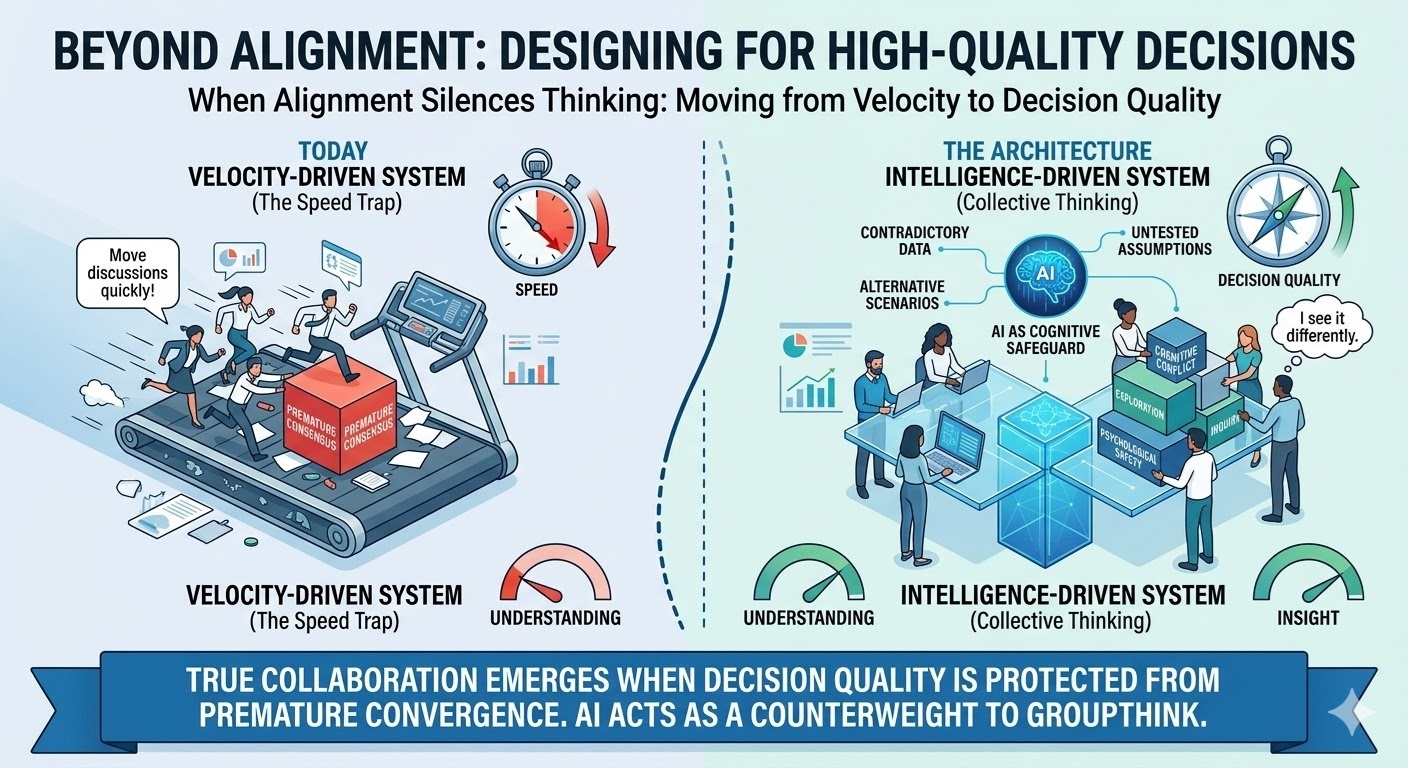 Why Intelligent Teams Sometimes Stop Challenging Ideas Most organizations value collaboration. Teams coordinate tasks, share information and move projects forward together. Meetings are structured, updates are clear and decisions appear aligned. From the outside, everything seems to function smoothly. Yet inside many organizations, an important dynamic often goes unnoticed. Ideas move forward without being sufficiently challenged. Disagreement appears rarely. Assumptions remain unexamined. Early conclusions solidify quickly. What appears to be alignment may simply be the absence of intellectual tension. And without tension, collective thinking rarely reaches its full depth. The Illusion of Productive Agreement In complex projects, agreement often feels like progress. Meetings conclude efficiently. Discussions remain polite. Decisions appear decisive. But agreement reached too early can hide a deeper problem. When perspectives converge before ideas are explored, teams may stop thinking before they fully understand the problem. Coordination continues. Understanding does not. The difference between the two is subtle but significant. Coordination moves work forward. Collective thinking improves the quality of decisions. The Speed–Understanding Trade-off One reason disagreement disappears is pressure for speed. Projects operate under deadlines, financial constraints and expectations for rapid progress. Leaders often interpret quick convergence as efficiency. Under these conditions, teams learn an implicit rule. Move discussions toward agreement quickly. The cost of this dynamic is rarely visible in dashboards. Yet it affects decision quality. When teams prioritize velocity over exploration, assumptions remain untested, alternative perspectives disappear and decisions may rest on incomplete understanding. Efficiency increases. Insight decreases. The Decision Quality–Velocity Paradox Organizations often assume that faster decisions improve performance. In reality, decision velocity and decision quality do not always move in the same direction. When conversations converge too quickly, teams may reach alignment before they reach understanding. The result is a paradox: Decisions move faster, but the reasoning behind them becomes shallower. In complex environments, the real advantage rarely lies in making decisions quickly. It lies in making decisions that integrate diverse perspectives, challenge assumptions and remain robust under uncertainty. In other words, the challenge is not only decision speed. It is decision quality. The Hidden Role of Power Hierarchy also shapes how freely ideas are challenged. In organizations where authority is concentrated, questioning a decision may appear to challenge the person behind it. Even when leaders encourage open dialogue, the structural asymmetry remains visible. People read the room. They observe which perspectives are welcomed and which slow the conversation. Over time, a quiet form of self-censorship emerges. Not because individuals lack ideas. But because they understand the informal rules of the system. Alignment becomes the safest contribution. Not necessarily the most insightful one. Creative Tension and Collective Thinking High-performing teams recognize that disagreement can be constructive. Research on team learning and psychological safety, including the work of Amy C. Edmondson, highlights the importance of distinguishing two very different forms of conflict. Cognitive conflict concerns ideas, assumptions and interpretations. Personal conflict targets individuals rather than the problem. The first expands thinking. The second damages trust. When teams maintain this distinction, disagreement becomes a source of insight rather than disruption. Different perspectives interact. Assumptions become visible. Solutions evolve through dialogue. This is the moment when collaboration moves beyond coordination and becomes collective intelligence. Governance as Thinking Architecture Whether such constructive tension appears often depends less on personality and more on structure. Governance systems shape how teams reason together. In many project environments, decision forums emphasize status reporting and rapid convergence. Under these conditions, conversations tend to close quickly. But governance can be designed differently. Forums that allow exploration before convergence encourage deeper reasoning. Retrospectives, design reviews and cross-functional problem-solving discussions create spaces where multiple perspectives can interact. In this sense, governance becomes a form of thinking architecture. It determines whether teams merely coordinate activity or integrate knowledge. It also determines how organizations balance decision velocity and decision quality. Systems optimized exclusively for speed tend to suppress exploration. Systems designed for inquiry allow teams to examine complexity before committing to action. AI as a Cognitive Safeguard A new factor is beginning to influence this dynamic. Artificial intelligence is often introduced as a tool for efficiency. It summarizes information, analyzes data and accelerates decision processes. Yet its most interesting contribution may lie elsewhere. When integrated thoughtfully into decision forums, AI can function as a cognitive safeguard. Unlike human participants, it is not influenced by hierarchy, reputation or social pressure to converge quickly. It can surface contradictory data, highlight inconsistencies in reasoning and introduce alternative interpretations. In this role, AI does not replace human judgement. It protects the conditions under which judgement improves. Automation accelerates tasks. Augmentation expands thinking. When used wisely, AI can act as a counterweight to premature convergence, helping teams consider information that might otherwise be ignored in the rush toward agreement. Leadership and Structural Safety Leaders play a central role in shaping these conditions. Their responsibility is not simply to maintain harmony. It is to protect the space where ideas can be questioned. Leaders who encourage exploration before convergence, acknowledge uncertainty and distinguish critique of ideas from judgement of people send a powerful signal. Inquiry is legitimate. Over time, teams begin to experience what might be called structural safety – environments where questioning assumptions is not only tolerated but expected. Reflection Think about your last project meeting. Did the discussion explore different perspectives long enough to challenge assumptions? Or did consensus arrive quickly, allowing the conversation to move forward smoothly? Alignment can feel productive. But progress rarely begins there. More often, it begins when someone in the room says: “I see it differently.” And the system around that conversation allows that voice to be heard. Because in complex organizations the real challenge is not choosing between harmony and disagreement. It is designing systems where decision velocity never comes at the expense of decision quality |
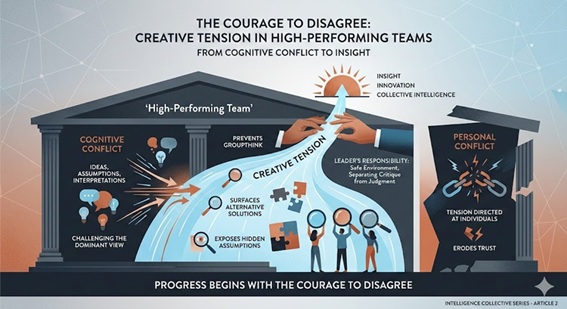 Creative Tension in High-Performing Teams Most teams say they value collaboration. Yet many quietly avoid disagreement. Meetings remain polite. Ideas are accepted quickly. Consensus emerges fast. At first glance, this may look like alignment. In reality, it is often the absence of intellectual tension. And without tension, there is rarely innovation. The Misunderstood Nature of Conflict In many organizations, conflict carries a negative connotation. Leaders fear it may damage relationships or slow progress. Teams learn to soften criticism, avoid uncomfortable questions, or remain silent when they sense disagreement. But not all conflict is the same. High-performing teams distinguish between two very different dynamics: Cognitive conflict – disagreement about ideas, assumptions or interpretations. Personal conflict – tension directed at individuals rather than the problem. The first expands thinking. The second erodes trust. Research on team learning and psychological safety, including the work of Amy C. Edmondson, shows that teams that perform best are not those that avoid disagreement. They are those that know how to engage in it constructively. Why Creative Tension Matters Complex problems rarely have obvious answers. Projects operate in environments of uncertainty, trade-offs and incomplete information. In these contexts, decisions improve when multiple perspectives challenge each other. Creative tension plays a crucial role because it: • Exposes hidden assumptions • Surfaces alternative solutions • Prevents premature consensus • Strengthens collective ownership of decisions Without this tension, teams risk falling into groupthink, a phenomenon described by Irving Janis, where the desire for harmony overrides critical evaluation. When that happens, teams stop thinking together. They simply move forward together. The Leader’s Responsibility Creative tension does not emerge automatically. It requires leadership. A leader who seeks collective intelligence must create an environment where disagreement is safe and purposeful. This means: • Encouraging questions that challenge the dominant view • Separating critique of ideas from judgement of people • Acknowledging uncertainty rather than projecting certainty • Inviting quieter voices into the conversation In such environments, disagreement becomes a signal of engagement rather than a threat. The role of leadership is not to eliminate tension, but to channel it toward insight. From Disagreement to Collective Intelligence When teams learn to navigate cognitive conflict constructively, something powerful happens. Differences stop being obstacles. They become resources. Instead of defending positions, people explore possibilities. Ideas evolve through dialogue. Solutions emerge that no individual could have designed alone. This is the foundation of collective intelligence. It is also the essence of what Stephen R. Covey described as synergy – the moment when differences generate something new rather than division. Reflection Think about your last project meeting. Did the team explore different perspectives? Or did consensus arrive quickly? The quality of a team’s thinking is rarely defined by how smoothly conversations flow. More often, it is defined by how courageously people are willing to question each other’s ideas. Because progress rarely begins with agreement. It begins with the courage to disagree. |
 Turning Collaboration into Collective Intelligence in Project Management “Synergy is not about compromise – it’s about creation.” – Stephen R. Covey The Essence of Habit 6 Covey described synergy as the energy that emerges when the whole becomes greater than the sum of its parts. It is what happens when trust and diversity meet purpose and respect. In project leadership, this means going beyond agreement or coordination. It means creating something new: a third alternative that is neither mine nor yours, but ours. Synergy begins where ego ends. From Coordination to Co-Creation Most project teams stop at coordination, sharing updates, dependencies and timelines. But synergy begins when teams start thinking together, not just working together. A regenerative project leader understands that collaboration is not just a process. It is a practice of collective intelligence. They create the conditions where ideas can collide safely and evolve into something better. Not Consensus – Creative Tension Synergy is often mistaken for forced harmony. In truth, it thrives on constructive difference, where respectful disagreement becomes a source of insight. Not all conflict is the same. The tension that fuels synergy is cognitive: disagreement about ideas, data and possibilities. When disagreement becomes personal, synergy collapses into defensiveness. True synergy therefore demands psychological safety. Without it, diversity turns into silence. It is the leader’s role to hold the space where contrasting views can coexist without fear. Applying Synergy to Project Management When Habit 6 lives within a project team: • Conflicts become creative tensions, not personal battles. • Differences become data, not drama. • Meetings evolve from updates into moments of emergence. • Decisions are made through shared learning, not authority. Practical regenerative practices include: ✓ Facilitating co-creation or design-thinking sessions. ✓ Forming cross-functional micro-teams for complex challenges. ✓ Using AI copilots to reveal hidden links between ideas. ✓ Practicing reflective dialogue, listening to expand rather than to reply. The Regenerative Dimension In the regenerative paradigm, synergy is the ecosystem mindset in motion. Just as nature thrives through relationships, roots and soil, bees and flowers, projects thrive through interdependence and renewal. Synergy transforms a group of experts into a living system of trust and learning. It turns complexity into connection and diversity into design. Reflection and Practice In your next project meeting, invite one voice that rarely speaks. Listen deeply, not for agreement but for the idea behind the idea. That is where synergy begins. Because collaboration is not a technique. It is a state of consciousness. And regenerative leaders do not dominate conversations. They orchestrate coherence. |
 From Cognitive Governance to Practical Discipline If governance is cognitive architecture, it must become visible in practice. Awareness without structure becomes philosophy. Structure without awareness becomes bureaucracy. Operationalizing alignment does not require new layers of control. It requires deliberate validation rituals embedded before commitment. Below are four practical disciplines that translate cognitive governance into operational behavior. 1. Validation Before Authorization Before approving scope, funding or timelines, ask stakeholders to articulate the objective in their own words. Not to repeat the slide. But to explain:
Misalignment is cheaper to detect before commitment than after execution. 2. Assumption Mapping as a Governance Gate Every major decision rests on premises. Instead of documenting only risks, document:
Artificial intelligence can assist here. It can simulate scenarios, stress-test premises, and model what conditions would invalidate key assumptions. But simulation is not judgment. The discernment to accept, reject, or recalibrate a premise remains a human responsibility. Visibility reduces cognitive debt. 3. Structured Dissent Windows Speed compresses reflection. Create protected moments where questioning is expected. Before execution begins:
Alignment is not consensus. It is clarity in the presence of difference. 4. Alignment Pulse Checks Dashboards measure progress. They rarely measure coherence. Introduce periodic alignment reviews where stakeholders answer three questions:
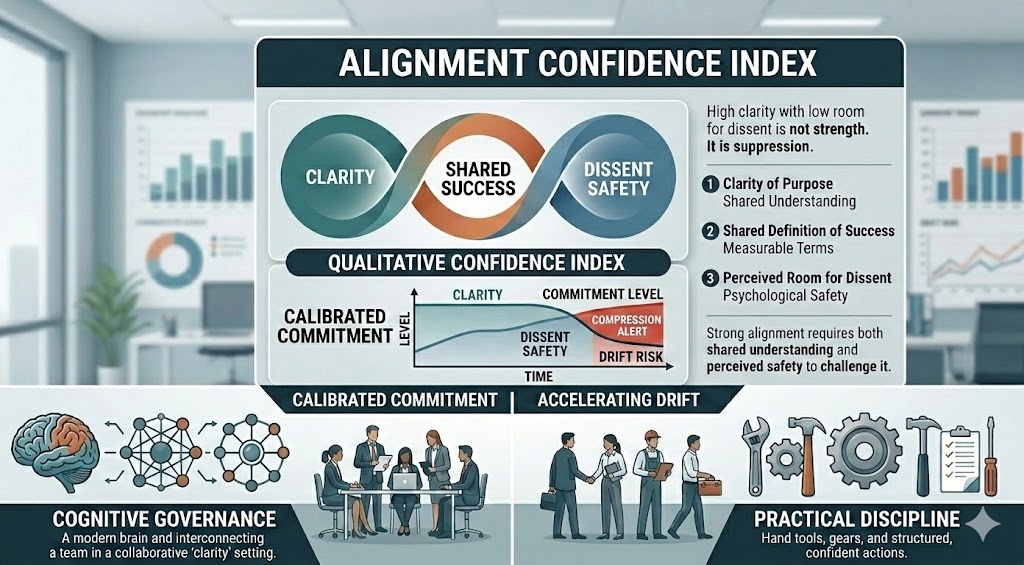
It is a structured qualitative reading of coherence. High clarity with low room for dissent is not strength. It is suppression. Strong alignment requires both shared understanding and perceived safety to challenge it. The Alignment Confidence Index is directional, not absolute. It signals whether coherence is strengthening or eroding over time. A declining dissent signal with stable clarity is not stability. It is compression. The Alignment Confidence Index is not a performance metric. It is a viability metric. When the perceived room for dissent declines, project speed becomes its greatest danger. We are no longer accelerating value. We are accelerating drift without anyone feeling safe enough to pull the brake. Alignment is dynamic. It must be recalibrated, not assumed. From Speed to Discernment Operationalizing alignment is not about slowing projects indefinitely. It is about inserting disciplined pauses that prevent exponential rework. In complex environments, acceleration without validation creates structural drift. In the brain economy, information is abundant. Processing power is scalable. But discernment remains scarce. Discernment is not hesitation. It is calibrated commitment. Closing Reflection Projects do not drift because teams are inactive. They drift because interpretation was never synchronized. Governance becomes real when validation precedes execution. Alignment is not a declaration. It is a discipline. And discipline, when embedded early, protects both speed and trust. |
|
I think somebody should come up with a way to breed a very large shrimp. That way, you could ride him, then, after you camped at night, you could eat him. How about it, science? - Jack Handey |