Generic WBS Example for an IT Project
From the pmStudent Blog
by Josh Nankivel

Ranting and raving about project management and systems engineering.
Recent Posts
The Problem with Project Management
The Problem with Project Management
The Problem with Project Management
LinkedIn Recommendations Are Easy
The Catch-22 of Project Management Certification and Experience
Categories
Agile,
Career Development,
Certification,
Change Management,
Communications Management,
Cost Management,
Documentation,
Earned Value Management,
Education,
Integration and Test,
Kanban,
Leadership,
Lean,
Lessons Learned,
Methodology,
Misc,
Multitasking,
New Project,
Operations,
Planning,
PMP,
Productivity,
Professional Development,
Project Estimation,
Project Leadership,
Quality,
Requirements Management,
Risk Management,
Schedule Management,
Scope Management,
Software,
Systems Thinking,
Tools,
Video,
Work Breakdown Structures (WBS)
Date
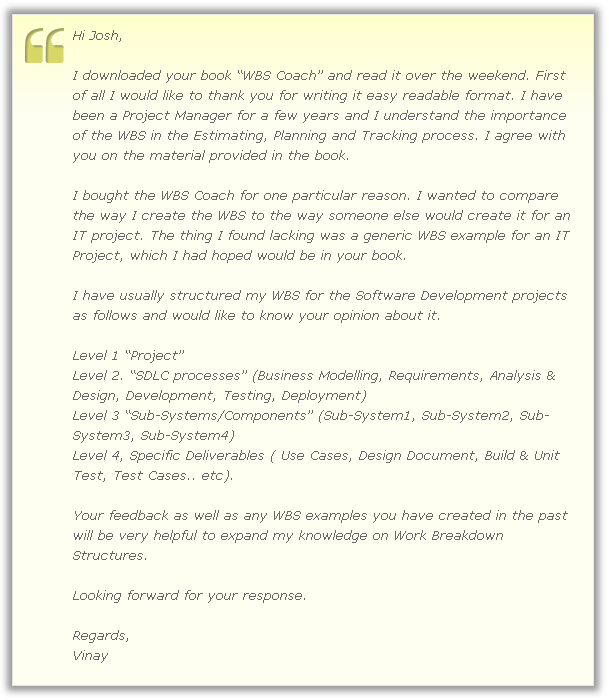
Thanks so much for the email Vinay, and I'm glad you enjoyed the Work Breakdown Structure book.
To answer your question, I've seen many IT projects structured that way and done it that way in the past myself, that's the norm.
However, I think there is a better way.
First, I try to avoid using SDLC/project phases as a way to structure deliverables at a high-level. There are obviously deliverables associated with phases, but in general I think doing this takes the focus away from the product and towards the process. For a scope definition document, I want it to be very much product-focused without regard for the methodology that may be used (and may change during execution).
Second, I use the levels as examples in the book and you'll probably remember my point regarding the levels at which deliverables "live" - trying to assign these levels ahead of time (a level for subsystems, another for components, etc.) is problematic. It tends to introduce artificial groupings of deliverables and levels that don't make sense. The same goes for trying to assign cost control points at an arbitrary level across the entire WBS - sometimes it makes sense to control costs higher or lower depending on the stakeholders, visibility of the element, etc.
That's probably why I went light on full-fledged end-to-end examples - no two projects are alike, and with templates people start making decisions that end up creating artificial complexity and overhead. I've been involved in several large-scale projects where this happened and we ended up with these 'phantom' levels in the WBS and requirements that just create extra work for no value. Lower-level requirements get traced through an intermediate level when they could just get traced directly to the higher level, etc. I'm talking about millions annually down the tubes just due to the structure of a WBS.
Posted on: July 24, 2011 03:02 PM |
Permalink
Comments (2)
Please login or join to subscribe to this item

Ali Alrashoud
PM| National Center of e-learning
Riyadh, Riyadh, Saudi Arabia
" I think doing this takes the focus away from the product and towards the process"
I totally agree with that because it happens several times with me
Thanks for sharing that answer
Josh , I came across a lot of projects having a WBS structure similar to the one that Vinay has specified in his email . However I agree with you that , no two projects are alike and it helps to create a WBS which is unique and product focussed ,for each project and not template based .This way , a lot of unnecessary levels and the respective work could be avoided . For instance ,the WBS that we created while handling projects in the healthcare domain was quite different than the ones we created while handling projects in the Oil & Energy sector.Even in a particular domain(say healthcare) , there could be unique WBS's for each project .Some of these IT projects in healthcare domain could be reverse engineering projects , some could be integration projects ,so on and so forth .
Thanks for sharing this solution on the WBS structure !!!
Please Login/Register to leave a comment.
|
"There is not one wise man in 20 that will praise himself."
- William Shakespeare
|





