When A Team Feels Micromanaged
From the pmStudent Blog
by Josh Nankivel

Ranting and raving about project management and systems engineering.
Recent Posts
The Problem with Project Management
The Problem with Project Management
The Problem with Project Management
LinkedIn Recommendations Are Easy
The Catch-22 of Project Management Certification and Experience
Categories
Agile,
Career Development,
Certification,
Change Management,
Communications Management,
Cost Management,
Documentation,
Earned Value Management,
Education,
Integration and Test,
Kanban,
Leadership,
Lean,
Lessons Learned,
Methodology,
Misc,
Multitasking,
New Project,
Operations,
Planning,
PMP,
Productivity,
Professional Development,
Project Estimation,
Project Leadership,
Quality,
Requirements Management,
Risk Management,
Schedule Management,
Scope Management,
Software,
Systems Thinking,
Tools,
Video,
Work Breakdown Structures (WBS)
Date
Trust and When You've Moved Their Cheese
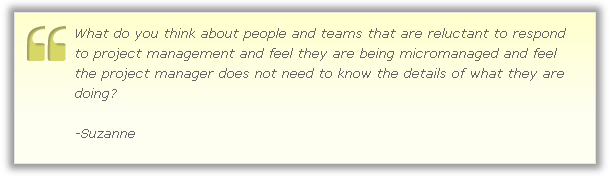
The teams must trust the project manager if they are to work together effectively. If new practices have been introduced recently, it's probably more of an organizational change issue than an issue specific to project management itself. You moved their cheese!
You must establish trust with your teams and stakeholders before pushing them through change. If they are not bought in to you and the change beforehand, you will fail. As I wrote about in "New Project Manager: How to screw up in the first 60 days", flying in, cape waving to 'rescue' your team is not the right approach. It's a good way to screw things up by sending the message that you think the way they have been doing things in the past is stupid.
Tracking At The Right Level
I've also seen this happen when the project manager tries to get too fine-grained in terms of schedule and status updates. My personal opinion is that using details when planning and estimating is good, but trying to have that same low level of detail (especially in a waterfall environment) is going to drive teams nuts.
And frankly, that drives me nuts too.
When you have an agile process like Scrum or Kanban in place, it makes it much easier to go down to these lower levels of detail. This is because you are only worried about being able to visualize the work and make sure everything is getting done....if you try to ask team members to split hours worked across individual tasks, it can become very taxing quickly. Every minute your teams have to spend each day trying to track their time is a minute lost - but more importantly it's frustrating to do!
That level of tracking implies a lack of trust from management, and people start cracking jokes about which charge code to use from the time they leave their desk to the time they get to the meeting.
For example, in our last release one of my teams probably worked a total of 100 or so individual tasks. Most team members had no more than 4 'buckets' to split their time up with.
There is a level of tracking that adds value, and once you go down too deep the value drops off, and the overhead cost increases. Furthermore, the more confusing it is for your teams, the less accurate your time tracking will be.
Posted on: September 02, 2011 12:02 PM |
Permalink
Comments (6)
Please login or join to subscribe to this item

Wai Mun Koo
PMO Director| Intergraph PP&M
Singapore, Singapore
Honestly, no one likes to be micromanaged. Some would like to be guided in details but never about being micromanaged. The lack of trust is one thing, the more damaging part is the perception of being treated like kids.
Why managers like to micromanage? As you have pointed out, lack of trust is the key. Managers who micromanage are firm believers of Theory X. The question they will usually ask is "How can we ensure that others will not abuse your trust in them?" They are also usually lack of confidence. In order to make up with this weakness, they resort into information to cover up the lack of confidence. They believe that having information at their fingertips makes them look good. In order to gather the information they need, they start to micromanage.
Micromanaging can be frustrating and wasteful of resources on tracking something that might not have direct contribution to the team success. It is a bad culture that should be avoided totally.
I am reading It's OK to Manage Your Boss, and the author says that micromanaging is actually rare. We need to distinguish between good managing (where the manager knows what is going on and helps the employee achieve that) and undermanaging (where the manager just gives the headlines for a task and then never follows up) and micromanaging. I had never thought of it like that before but it does make a lot of sense. Some employees will see micromanaging where in reality their previous bosses have been so hands off that they have never been properly managed.

Josh Nankivel
Engineering Project Manager| Apple
Sioux Falls, Sd, United States
I'm not sure about how prevalent micromanaging is, and if there would even be a consistent definition of that term across teams in order to measure it.
It is a dynamic between the individual team members, the manager, and even how the team works as a group. Some people do better with higher or lower levels of autonomy. Recording actual time worked on tasks will likely need to be tracked at the same level consistently for the whole team, but the guidance and follow-up given can and should vary for individual team members, and will also vary for individual tasks as well. Critical path tasks need to be watched more closely, and so do those that could be political hot-potatoes or have dependencies associate with them, internal or external to your team.
Very interesting points Elizabeth, thank you for commenting!

Kenneth Katz
Release Train Engineer/IT Project Manager| UnitedHealth Group
Enfield, Ct, United States
Definition of micromanagement:
You micromanage. I have attention to detail. :)
Seriously, as a project manager I don't supervise my project team members or their work. I do coordinate their work so that the deliverables have acceptable quality and are delivered on schedule and within budget to satisfy project objectives.
I'm the ringmaster at the circus, not one of the performers. The performers don't need or want me to tell them how to use the trapeze and they know better than I do.
In agree with Kenneth, it is often a matter of perspective not a lack of trust.
I have been accused of micromanaging when I asked if the task was on track! Like Kenneth, I don''''t tell people how to do their jobs, but I do need to know if work is tracking as planned and not be told at the deadline that it is going to be 2 weeks late, at that point I have no options to help bring that piece of work back on track.
So to avoid being accused of micromanaging or being too hands off I now explain at the start of the project why I need the information I am asking for so that the team are more proactive in volunteering information.
Wai Mun Koo
PMO Director| Intergraph PP&M
Singapore, Singapore
Elizabeth has brought up a very valid point - perception. Agree, very often, it is a different in perception that causes a false perception of micromanage. This is because there are some activities in the gray area where they are peceived as micromanage to some people while being seen as too hands off by the others. Activities mentioned by Julie probably fall under the gray zone where a good explanation on the objectives of the activities would help in clearing up some doubts. But I have seen activities that track if a person is late by 5 minute to work, or who the person has been talking to within a day and how long each chatter last. In the worst case, the person also being tracked on how many times he/she is visiting the rest room in a single day.
Geez! To me, such trackings are beyong the typical project progress trackings. They are definitely a reflection of lack of trust and honestly, they are quite demoralizing for the team. What interest me more is what could have triggered such emotion and lack of trust in the manager?
Please Login/Register to leave a comment.
|
"I never resist temptation, because I have found that things that are bad for me do not tempt me."
- George Bernard Shaw
|




