


Categories: Kanban
Tweet
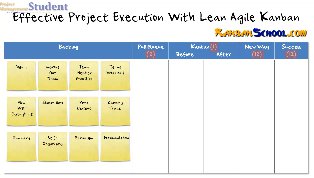 When I teach people about Kanban for the first time one of several key concepts must be fully understood before I proceed into the details of executing with a Kanban-enabled process.
Every Team Has A Value Stream
Whether you know it or not, your team has a value stream. Some teams have several value streams depending on the varied type of work they do.
It is the process by which your team takes input and turns out the product at the end. That process is a value stream.
It's nothing fancy or complicated.
Each Step Adds Value
Well, every step should add value anyway. If it doesn't, why is it a part of your process?
You will also find after using Kanban for awhile that the more time between steps, the lower value you acheive and the more waste is introduced into your system.
This is why cycle time is so important in any system; the longer product in the system lay dormant, the more waste you introduce.
People start forgetting what happened to the product in the last step, and so they have to spend some time reviewing it again before they can try to add more value to it. This process introduces the potential for human error, and in software it means more bugs.
Start Where You Are At
The benefit comes from visualizing your true value stream and facing it. Look it square in the eyes.
You have to fully understand and accept where you are starting from before you can move forward.
This is why visualization with something like Kanban is so astoundingly beneficial. It acts as the mirror you can look at to reflect reality.
Only once you know thyself can you truly improve.
Kaizen (Continuous Improvement)
After you start using Kanban for awhile, you will soon start noticing problems with your value stream. Or rather, opportunities for improvement.
There are no steps I can give you to make this happen. It just will. I never have had to have any retrospectives or set times to consider lessons learned. Every second we use Kanban we are in a retrospective process, evaluating our performance and process in a continuous manner.
You can't help it.
Questions about Kanban? Leave a comment below or check out http://KanbanSchool.com.
Tweet

