


Projects At Work just released a new report called “Distributed Agile Teams”.
The whole report is interesting but I want to focus on a particular question.
21. What is the greatest challenge of working with a distributed agile team?
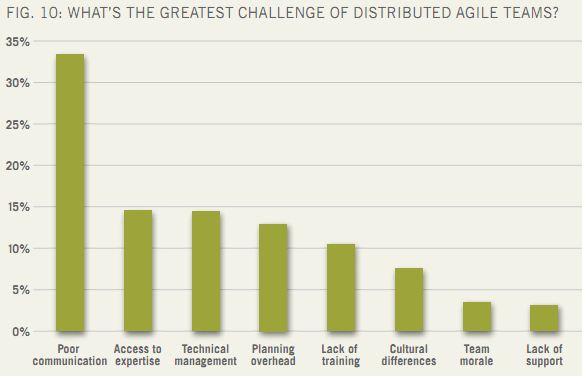
“Poor Communication” was the biggest challenge by far. Go figure!
Now I’ll be the first to admit that co-located teams is an optimal situation if you can get it. There is nothing like face-to-face interaction between team members. At the same time, there are some strategies for dealing with distributed teams that I believe many teams are not taking advantage of.
There are two root causes cited in the study I want to discuss: cultural/language issues and tools issues.
Cross-Cultural Teams
I have experienced first-hand the frustration of assuming communication has been smooth with someone who does not have the same language as you for their first language, only to find out it wasn’t.
This is where I think several options are available to ensure understanding across the entire team. This isn’t really limited to cultural differences within a team, miscommunications and different interpretations happen all the time regardless.
Make It Objective
It’s important to make sure you are using some kind of documentation that makes it clear what is being delivered. Good software requirements work, user stories, use cases, behavior-driven development, etc.
Regardless of the project, I’ve seen requirements that can be interpreted 57 different ways, and those are not good requirements. If you had to have been there when they were written and be told what the intent was, they are not good requirements.
Something I’ve started looking into heavily for my domain is behavior-driven development. It’s sort of like what I’ve known as test-driven development in the past, but much more user-focused. I like it. Aside from being very focused on the end user, it also makes it pretty darn clear what the functionality of the system is supposed to be. There is very little room for interpretation.
Make It Visual
The best way to communicate a concept clearly is through visuals, in my opinion.
This is why I love the kanban board. The whole team can see what’s going on at any given time. There are many online options available for distributed teams.
A picture is worth a thousand words, and it’s true. A diagram can convey a level of understanding that you just can’t get from words alone. Even when speaking to one another about parts and pieces of a system, our hands wave about wildly to illustrate specific points. At some point one of us usually says “Let’s go find a whiteboard, this is going to be much better if we can draw it.”
Well you can do the same with virtual teams too. Screen sharing and whiteboard tools are everywhere, free and paid. For my team members who are offsite, I love to use the desktop screen sharing application while on the phone with them. Either of us can convey understanding and have in-depth discussions this way as if we were in the same room.
Sometimes, the desktop sharing actually makes it seem better than being in the same room. You don’t have to lean over someone else’s shoulder or stare at a projector screen. You have the other person’s desktop right there in front of you.
Independent Validation
Having someone else on the team independently validate the work of other team members after development is finished is critical.
Why?
Not only for quality. No, this really helps teams gel in my experience. They get to know how their team members work better. They share tips and advice. They encourage each other. You know you’ve reached a good spot with independent validation as a part of your teams’ culture when people start actively seeking review from each other. That means they truly value each other’s opinions and communication is going to be enhanced as a result. It needs to be really easy to pick up the phone and just talk!
Tools For Distributed Teams
I think there is a lot of reliance on the wrong kind of tools out there for distributed teams. Task assignments shouldn’t be done through a software tool. In fact with something like kanban or some implementations of agile, it’s not even necessary. Self-organizing teams pull their own work out of the backlog.
Direct communication where possible is best, and so I really don’t believe in many of the tools out there today that get all whiz-bang about task assignments and capturing estimates in the tools, etc.
I’d rather have a simple kanban board, screen sharing software, a phone, and instant messaging. You can do time-boxed Agile just fine with a kanban board.



