Project Management

pmStudent

by
Ranting and raving about project management and systems engineering.

About this Blog

RSS

Recent Posts

The Problem with Project Management

The Problem with Project Management

The Problem with Project Management

LinkedIn Recommendations Are Easy

The Catch-22 of Project Management Certification and Experience

Categories

Agile, Career Development, Certification, Change Management, Communications Management, Cost Management, Documentation, Earned Value Management, Education, Integration and Test, Kanban, Leadership, Lean, Lessons Learned, Methodology, Misc, Multitasking, New Project, Operations, Planning, PMP, Productivity, Professional Development, Project Estimation, Project Leadership, Quality, Requirements Management, Risk Management, Schedule Management, Scope Management, Software, Systems Thinking, Tools, Video, Work Breakdown Structures (WBS)

Date

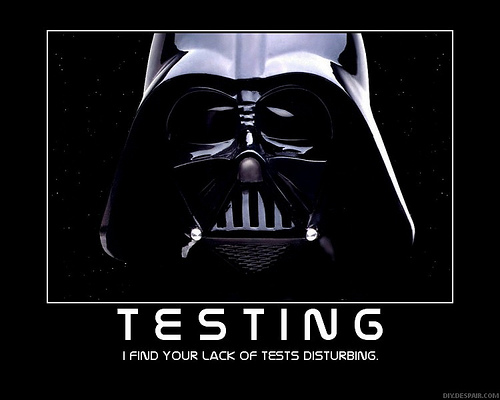
Continuous Integration and Testing is a Must

Categories: Integration and Test

linkedin twitter facebook Request to reuse this  

Learning a lesson the hard way for the second time is a bitter pill to swallow.

It will suffice to say that my believe in continuous I&T has been strongly reinforced.  Partially due to my late arrival on one of my projects, and partially due to circumstances beyond the control of myself or my team, we were only able to do real integrated testing in the last few months.

We're still reeling from the consequences of not having started doing so much earlier.

Benefits of end-to-end testing, early and often:

  1. Find internal interface problems early - In a complex software system, unit testing is necessary but not sufficient.  Those internal components need to be speaking the same language to talk to each other properly, and even if you are coding to the same set of specifications there will be difference in interpretation.  That is why integrated testing is so important.
  2. Find external interface problems early - When your system interfaces with other systems built by other teams, this becomes even more important.  There are more changes for interpretations to be different when teams attend different discussions and assumptions get made.
  3. Team building - I can't stress this one enough.  If your team is made up of people working in silos on their own little components who rarely throw them together and see what breaks, you lose out on so much beneficial communication and collaboration amongst your team.

So, even if you are not doing an agile approach, it's still important to do a build of your system every few weeks or once a month and see what breaks.  After all, the purpose of testing is to try to break what you've built.  Your team may be uncomfortable with this, especially if they are used to being able to polish their own individual pieces before displaying them to the world.

In this case, it pays dividends to be uncomfortable.  Discipline yourself and your teams to be comfortable with little, continuous simulated failures, so that you don't have to deal with a large, catastrophic failure on your project.

Share this with your network
Posted on: January 28, 2011 08:16 AM | Permalink | Comments (0)

10 Attributes I Look For in New Project Managers

Categories: Career Development

linkedin twitter facebook Request to reuse this  

I was recently interviewed and asked the question, "What should hiring managers be looking for in a new project manager?"

by sam_churchill via Flickr

These are the top 10 qualities I look for:


         1. Lifelong learner - You'd better not just be here to punch the clock and try to make it through the day.  I want to see passion.


         2. Clear communicator - Concise and clear communication with the ability to verify you've been understood.


         3. Problem solving abilities - You are going to have a lot of problems, and you'd better be the type of person who will take the bull by the horns and make it your business to resolve them.


         4. Ability to focus - Focus is critical.  If you are all over the place and unable to focus, I probably don't want to hire you as a project manager.  How are you going to focus a team if you can't focus yourself?


         5. Ability to create a plan and execute it - Even if you have little work experience, you probably have something you can show to demonstrate your ability to set goals, formulate a plan to acheive them and follow through.


         6. Empathy - ability to look at a situation from different perspectives.  You have lots of different stakeholders and some of them want your project to die.  Step into their shoes and it will help you be successful.


         7. Self-starter - I want people who thrive when given room to breathe.  I want people who feel stiflied by micro-management and instead want to demonstrate their own ability to go out and produce results.


         8. Listening skills - Being able to pick up on cues in body language and tone is just as important as listening.  I mean really listening to what people have to say.  Too many people are arrogant enough to think what they have to say is the most important.


         9. Ability to lead without relying on role power - So many new managers and project managers fall into the trap of thinking formal authority actually has something to do with leadership.  It really doesn't.  Leadership is about people wanting to follow you because they trust you, not because you told them so.


        10. Domain knowledge - Yes, I want someone with domain knowledge.  Project Management skills are broadly applicable, but you are dead in some domains if you don't have knowledge about that domain.  In fact, most domains.  If your experience is close enough to overlap, great.  But you'd better understand what your teams are doing at a fairly deep level if you want me to hire you.


What do you think of these attributes?  Do you have more to add?

Share this with your network
Posted on: January 20, 2011 09:34 PM | Permalink | Comments (15)

Question for You: Operations and Project Management

Categories: Operations

linkedin twitter facebook Request to reuse this  
"Innovative efforts should never report to line managers charged with responsibility for ongoing operations. ...The new project is an infant and will remain one for the foreseeable future, and infants belong in the nursery. The "adults", that is, the executives in charge of existing businesses or products will have neither the time nor understanding for the infant." - Peter Drucker

I can see the wisdom in this, especially when the new developments are very different than existing operations.

But on the other side of the coin, when projects are very similar to existing operations, or in fact are themselves organizational changes, is this still a good idea? Or would a common source of authority and/or funding for these projects be a positive situation?

This is a question for you. What do you think?

Share this with your network
Posted on: December 31, 2010 04:02 PM | Permalink | Comments (1)

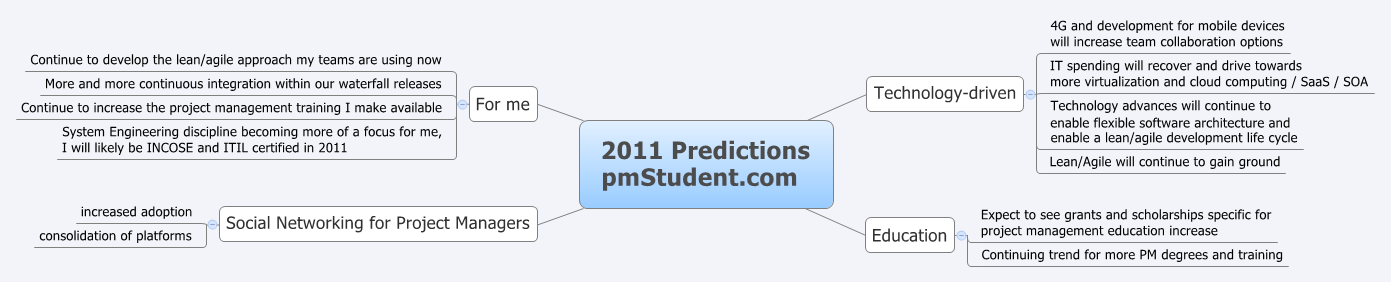
2011 Predictions for Project Management

Categories: Misc

linkedin twitter facebook Request to reuse this  

This happens every year.  We make predictions so we know we can look back and see how wrong we really are.  No one really looks back though, so I'm just going to accept that this is a fun exercise and I'm going to be wrong.

However, you can listen to episode 164 of the Project Management Podcast and hear my project management predictions for 2011 along with a handful from other people.

Lean/Agile

I think we will continue to see momentum in the direction of Lean and Agile.  Technology will enable this in more ways than one, and Lean/Agile projects will enable technology implementations.  It's a virtuous cycle that will continue in 2011 and probably pick up the pace.

Distributed and virtualized systems and technologies in particular will increase in adoption as more and more knowledge workers become distributed.  There will be a struggle between the benefits of co-location and distributed teams, a struggle I am going through now myself.  

Education

I'm a volunteer for the PMI Educational Foundation and have seen increases in both awards and candidates for scholarships and grants for project management education.  I think that will continue in 2011.

Also, the offerings of project management courses and training has grown.  I plan to offer more courses myself through pmStudent e-Learning and other venues, so the choices available will be ever-expanding from me and other providers like here at Gantthead, which is great!

Social Networking

I expect to see increased adoption, and a consolidation of platforms.  I'm spread so thin across so many platforms and groups within those platforms, I think it's time to simplify.  And I think a lot of other project managers involved with social media will feel the same.

For Me Personally

I will continue to develop the lean/agile approach my teams and I have been working on.  Eliminating waste in process has become a bit of an obsession for me, and I will continue to evolve my approach over the course of 2011.  I'm also planning on focusing a bit more on Systems Engineering than I have in the past, and perhaps become INCOSE certified in the process.

What are your predictions for 2011?

Posted on: December 26, 2010 04:52 PM | Permalink | Comments (0)

The 2 Faces of Scope; Are You Managing Them Well?

Categories: Scope Management

linkedin twitter facebook Request to reuse this  

I answer a question from a member of my project management training program about project scope considerations, and highlight a dichotomy between project scope and product scope, their different sources and how they should be thought of as separate but related entities.

Share this with your network
Posted on: December 18, 2010 08:11 PM | Permalink | Comments (0)
ADVERTISEMENTS

"Too many pieces of music finish too long after the end."

- Igor Stravinsky

ADVERTISEMENT

Sponsors