


When A Team Feels Micromanaged


|
|
How To Find Great Information Specific To Your Needs on Gantthead
Categories:
Misc
Categories: Misc
How to use Gantthead.com to find useful information quickly that is pertinent to your needs! | ||||||


When Testing Becomes A Dog And Pony Show
Categories:
Leadership
Categories: Leadership
|
It's a simple question. What is testing for? Some people seem to think that testing is for display purposes only. These people would expect your testing phase to consist of showcasing your product instead of actually testing it. I don't think so I think the best definition of true testing is this: Try to break the product. That's right, the only value in testing your product is to try to poke as many holes in it as you can. If you're testing phase consists of trying to look good in front of your customer, your stakeholders, your sponsors, then you are doing it wrong. Get this. Earlier this week I was actually asked this question. "Next time, could we do integration testing before the official integration testing?" That's right folks. We are talking about testing before we do testing. How sad is that? Now let me make sure I'm clear. We did dry run testing before the official testing. So it's not that we didn't test fully, or have ample preparation before the official testing. No, this is about looking good politically in a testing cycle. This type of showmanship has absolutely no place in effective project management. Period. |
 I'm going to ask you a question.
Kanban With Changing Workflow
Categories:
Kanban
Categories: Kanban
|
This means that we have release cycles that start out with some investigation and detailed planning, move into true development, and then we have an Integration & Test process at the end of each release to go through. A struggle we've had is that our value stream changes each time we transition from one phase of the waterfall cycle to another. Furthermore, when in the Integration & Test phase, there is a specific tool we a required to use to work off what we call Test Descrepancy Reports (TDRs) which are basically bugs we find in testing. At first, we would use a separate kanban board for the I&T phase, which maps the value stream of that process. However, due to the requirement of using a specific tool, it became a wasteful process to try and use both. We had to keep both updated. So in those cases, we dropped the kanban board - everything else was the same, but the visualization and mapping of a value stream went away for that portion of our work. Has anyone else ran into a similar experience, with Kanban or something else, where a tool made a difference in terms of how you could work as a team? |
 My teams and I do Kanban within a waterfall program.
Why Your College Professor Is Wrong
Categories:
Career Development
Categories: Career Development
Felicia, I respectfully disagree with your instructor.
The truth is, you are much less likely to get hired as a project manager with a masters degree and no experience. You will be much better of building your experience base. I’ve written quite a bit on how to gain experience when you are new to this field, and produced in-depth training on the topic as well. For posts I’ve written, and please read the comments too: http://www.google.com/search?sourceid=chrome&ie=UTF-8&q=site%3Apmstudent.com+experience And my my on-demand training: http://learn.pmstudent.com/project-management-career-coaching I hope that answer helps Felicia.
| ||||||||||||
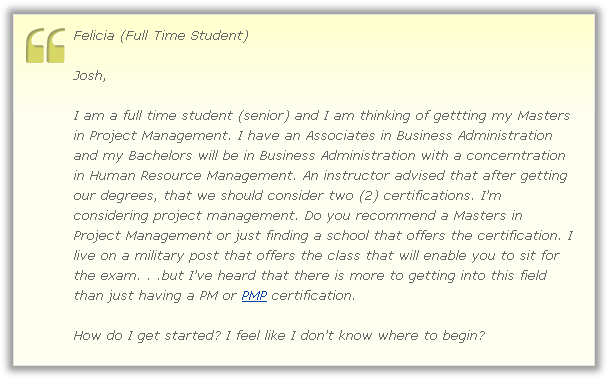
 Even now while you are working on your Bachelor degree, and immediately after, I recommend you focus on gaining experience. After you have a few years of experience, you can make a better decision about what certifications or advanced degrees, if any, to pursue.

