


Advice For New Project Managers
Categories:
Career Development
Categories: Career Development


| I was recently interviewed by Cesar from pmforthemasses.com about getting started in project management. I hope you find my responses helpful! Can you tell us how you got started in Project Management?In early 2004 I had been laid off from my role as an Operations Manager. My wife was pregnant with our first child too, and for the first time I decided to really get strategic about my career. I asked myself "what parts of my previous roles have I really enjoyed doing?" The list was fairly long, but here is an example of the items on it:
During my research into going back to school and what companies were hiring for, I found out about something called project management. It was a discipline, with organizations and standards, etc. As I was learning more about it, I was like "Hey, I do that!" quite a bit. I was shocked and overjoyed!
In very little time, I was managing projects and opening up new opportunities for myself to manage bigger and more complex projects. I had moved from call centers and telecom as an 'accidental project manager' into financial services and eventually aerospace a few years later as a very intentional project manager.
What advice can you give to those planning to start a career in Project Management?
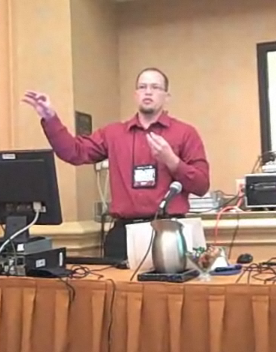 That is a huge question, and I've written hundreds of articles and developed many hours of online training about it. In general though, I would say the following are key points: That is a huge question, and I've written hundreds of articles and developed many hours of online training about it. In general though, I would say the following are key points:
What is the most valuable PM concept/technique one can use in their small business?
Start with a lean, flexible, systems-thinking process using the general flow of
Do you bring any Project Management concepts/techniques to your personal life? How do you implement them?Absolutely. The discipline of project management can be applied to many places in personal life. In fact I once recorded a video titled "Project Management in Everyday Life" in which I give a few examples. What tools or resources can you recommend to the Project Manager wannabe?
I care passionately about helping new and aspiring project managers reach their career goals. My goal is to be the best online resource for them. So I:
|
Remote Teams and Agile
|
"Do you know of any material, studies or other which covers agile project management but with geographically disparate participants. I have a couple of projects where this is difficult - design team in Bay Area, coders in Malaysia, China, India and Pakistan, customers/user reps across dozens of countries and project team in Singapore... timezones are killing me!"
In terms of Agile, I don't know of any training specifically for remote teams. |

Your Project Management Career : Own It!
Categories:
Career Development
Categories: Career Development
| In this video, Josh encourages you to own your project management career. You are your best advocate, and your questions and answers are going to be individual based on your background, goals, and industry.
| |||||


Getting the Stains Out of Your Requirements
|
Here are some tips for your own situations where you must "scrub the stains" out of a set of requirements, as opposed to dealing with change management on one specific requirement. Make it EasyWe use DOORS to manage our requirements. For me, step 1 is to export from DOORS to an excel file. Getting these requirements into a format people are comfortable with is very important. Next, I trim away the fields that don't really matter for what I'm trying to do, and then copy/paste the requirements into a blank Word document. The reason for this will be come clear in a moment. Track Changes, with CommentsI turn on the "tracking changes" option in Microsoft Word, and go to it. Whenever a change is made, a comment accompanies it. I speak to my audience, the customer, so they will easily be able to understand why I am proposing some changes. In this case, I want to add clarity and also specify some functionality that has become known as a user need over time, but wasn't captured in the original requirements. Review With The TeamI always like to review any requirement changes with my teams before proposing them to the customer. This way, I can be sure I'm on the same page as my team members and there aren't any communication gaps about the needed functionality. Many times, the understanding I've gained about new wants and needs comes directly from my team members, who are interacting with the customer and future users of the system. It would be very bad if I had a misunderstanding on a particular requirement and ended up making that part of the baseline, when it's really describing the wrong thing. Meet with CustomerNext I meet with the customer to ensure the changes I'm proposing make sense to them. The comments I did earlier come in really handy, and the better they were, the easier this process is. In my environment, I prefer to do this before having it come up at a Change Control Board (CCB) meeting as a change request. I want the customer to be knowledgeable about the proposed changes and see the value in them before having to make a decision. Change Control BoardThe final step is to "make it official". If you don't have a change control board in your project environment, you should set one up. It doesn't have to be complicated, but it does require that everyone on the project understand that changes don't get made to the project baseline unless they are approved by the CCB. The customer and sponsor should be voting members, and in my environment the customer is the chair of the CCB. That means they have the final word on whether a proposal will be approved or not. If you are in a different contract environment, it may be a CCB internal to your own company/contract you are interacting with.
| |||||
 Having taken over a project, I find myself in the awesome position of needing to revise requirements with my customers that are pretty obviously in need of some spring cleaning.
Conflict Resolution Diagram For Projects
Categories:
Systems Thinking
Categories: Systems Thinking
| If you are a fan of Theory of Constraints (TOC) as I am, you may know of the Evaporating Cloud Diagram. As I have been using Kanban for some time now, I have found myself going back to my TOC roots and unpacking some of the tools I am somewhat familiar with, but haven't used nearly enough in practice until recently. The following figure is an example of this tool put to use. Conflict Resolution Diagram
The GoalThis tool is useful when you have two competing interests that appear to be at odds. Mapping it out like this helps walk through the assumptions being made. Each of the arrows carries at least one assumption, perhaps many assumptions. The 5 sentences below the diagram are the default assumptions being made here. So in the main, this helps everyone understand the underlying assumptions so they can be analyzed with a skeptical eye. Let's Walk it ThroughThe objective here is to have a cost-effective, quality system. We want to maximize quality and minimize costs at the same time. I'm sure this is just a weird example, we've never run into this before, right? One of these assumptions as I walk through them stands out to me. Do we really have to sacrifice functionality and scaleability in order to minimize costs? What about that statement seems like it may not be quite right? In this example, I discovered that "minimize costs" was a requirement, but put this way, it was being assessed in the narrow and short-term way of project cost. The life time cost (and from all sources) were not being properly factored into the ROI equation. Quality was being assessed as a lifetime dimension of the system...but because of accounting practices and separate funding sources, costs were only being assessed in the scope of the project. Looking at it this way (and using this as a tool to help senior management understand) is a great method to apply systems thinking to conflict resolution on your projects. It's helped me personally to help sponsors "see the light" when it comes to justifying the expense of licensing software, procuring specific hardware, etc. It has helped me in many instances. Give it a shot!
| |||||



