
How Does a PMO Really Deliver Value?
Categories:
pmo
Categories: pmo


 It has become common to say that a PMO needs to “deliver value.” The problem is that the phrase, on its own, explains very little. A PMO may have a defined methodology, formalized processes, up-to-date dashboards, implemented tools and a competent team. It may also operate at a high level of maturity. None of this, by itself, demonstrates that it is producing value for the organization. Value delivery depends on a broader combination of factors: why the PMO exists, where it is positioned, which decisions it has authority over or can influence, which services it offers, which capabilities support those services, and which benefits and impacts are actually produced. AIPMO approaches the PMO through a service-oriented architecture and distinguishes this approach from models focused exclusively on processes. The PMO Management Standard also emphasizes the need to adapt services to the organization's needs and evolution. This allows us to ask a more useful question: How does the PMO transform organizational needs into benefits and impact? The starting point is not the service. It is the need.Before discussing service catalogs, tools or structures, it is necessary to understand what contribution the organization expects from the PMO. A PMO established to ensure compliance has a different value logic from a PMO focused on investment prioritization, organizational transformation, executive support or the integration of multiple portfolios. Strategic purpose shapes the rest of the architecture. In PMO-MI®, this logic is also reflected in the assessment of strategic purpose, principles and governance, culture, leadership and management, PMO benefits and value, capabilities, and efficiency and effectiveness. The initial question, therefore, should not be: “Which services should our PMO offer?” Another question needs to come first: “What results does the organization need this PMO to help produce?” Control, Influence and Concern define the scope for producing valueEven when its purpose is clear, the PMO does not operate with the same authority throughout the organization. AIPMO distinguishes three domains: Control, Influence and Concern.
A PMO may have the technical capability to perform a particular service and still lack sufficient mandate or influence for that service to produce the intended effect. It may also continue performing services that no longer address the needs that justified their creation. The PMO's relevance, therefore, depends not only on what it knows how to do. It also depends on where it can act and how its environment is changing. Service Domains organize the capabilities through which the PMO operatesOnce purpose and scope of action are understood, Service Domains come into play. PMO-MI® works with 24 Service Domains, enabling analysis of the PMO in areas such as Governance, Demand, Portfolio, Benefits, Finance, Integration, Capability & Capacity, Knowledge, Innovation and other capabilities related to PMO service management. Imagine a PMO with a strong Portfolio Management capability, but with Benefits Management and Financial Management poorly integrated into decision-making. The organization may select and organize initiatives appropriately, yet still struggle to verify whether the expected benefits are being realized or whether investments remain justified. The same situation may occur in other combinations. Governance may be well structured but have little effect if the information used to make decisions is unreliable. PPM tools may be in place but contribute little if data and decisions are not integrated. Knowledge Management may record lessons learned without turning those lessons into improvement or innovation. The issue is no longer just the level of development of each domain. It also becomes a matter of coherence among them. Having a Service Domain does not mean having sufficient capability to deliver its servicesThere is another layer that is frequently overlooked. Between the service domain and the service actually delivered lie the PMO's capabilities. AIPMO's frameworks include elements such as competencies, information, infrastructure, financial resources, governance, leadership and management, adaptive alignment and continuous improvement as capabilities supporting the PMO Lifecycle and the PMO Services Lifecycle. This distinction matters. An organization may decide that its PMO should offer a sophisticated benefits management service. Without appropriate competencies, available information, infrastructure, governance and the capability to integrate with the areas responsible for results, the service is unlikely to reach its full potential. For this reason, the analysis of value delivery needs to consider at least three different questions:
The PMO Services Lifecycle connects capability to deliveryThe presence of capabilities does not resolve the issue on its own either.Services need to be designed and managed throughout their lifecycle. The model presented by AIPMO includes stages for identifying and assessing the need, design, justification, piloting and implementation, operation and, subsequently, transformation or retirement of the service. This final stage deserves attention. PMO services should not exist indefinitely simply because they have always existed. If the need has disappeared, changed or is now being met in another way, maintaining the service may consume capability without producing a proportional benefit. Managing PMO services therefore involves both creating and improving services and continually questioning the relevance of what is already being delivered. A delivered service is not yet valueThis may be one of the most important distinctions.Producing a report is a deliverable. Making a dashboard available is a deliverable. Holding a governance meeting is a deliverable. Creating a methodology is a deliverable. None of these automatically represents value. There is a chain connecting service delivery to organizational value. A dashboard, for example, may increase the availability of information. That information may improve the quality or speed of a particular decision. The decision may change resource allocation or the composition of the portfolio. That change may produce certain benefits. Only then can its contribution to the organization's objectives be assessed. A more complete architecture can therefore be represented as follows: 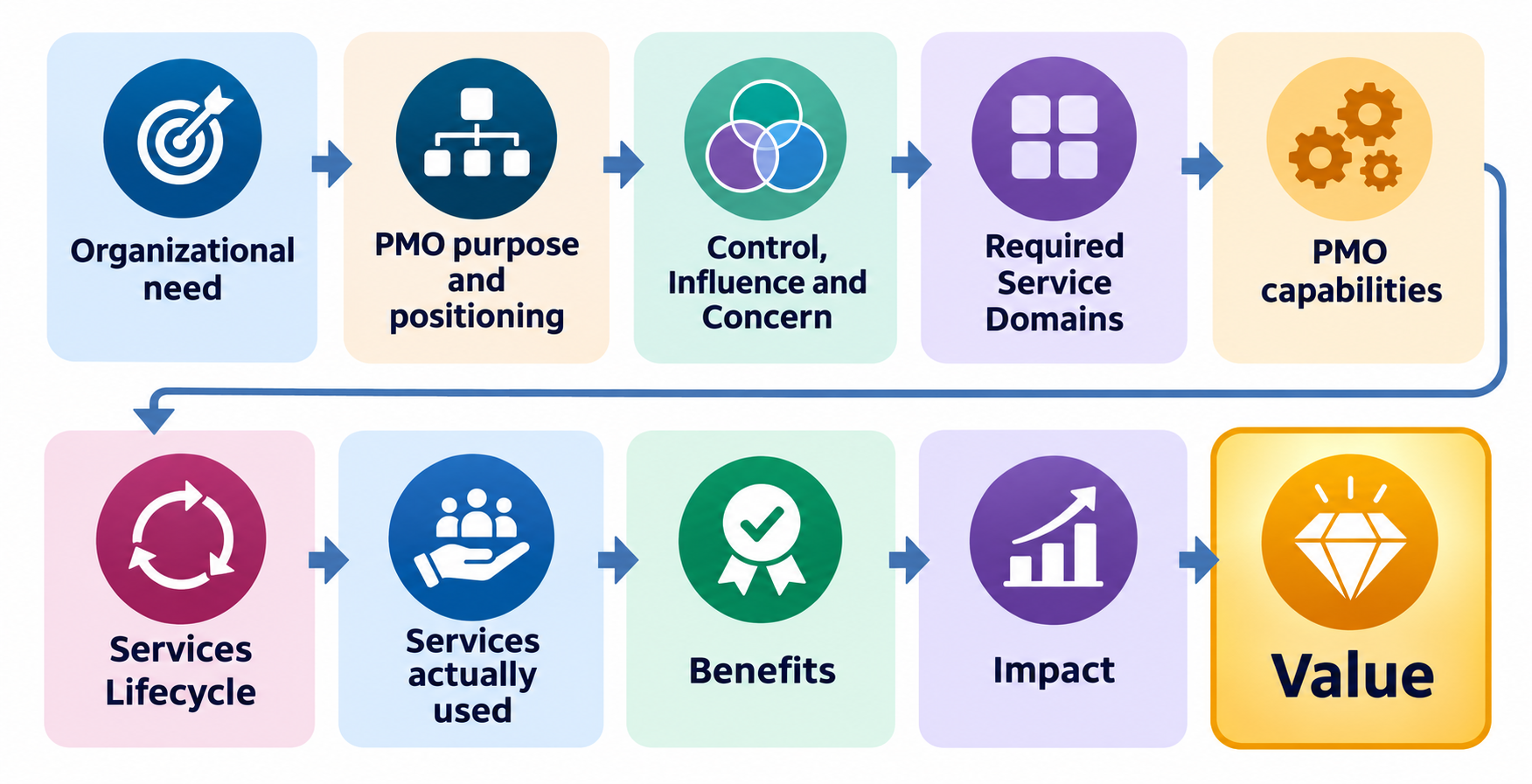 This representation should not be interpreted as a strictly linear process. Changes in the environment alter needs, priorities and the PMO's own scope of action. The results achieved also provide information for reviewing services, capabilities and positioning. The PMO needs to learn and adapt. Maturity and value are not equivalent eitherAnother consequence of this logic is that developing every Service Domain to its maximum level should not be the objective of every PMO.The services needed depend on context, mandate, organizational needs, the topology of PMOs and their Domains of Control and Influence. AIPMO links the three PMO Domains to an understanding of the PMO's maximum potential benefit and uses this logic to assess how far a given office can realize its potential contribution. In environments with multiple PMOs, the material also recognizes that maximizing impact may depend on offices working together. This changes the question about maturity. Instead of asking: “How can we increase the maturity of all our domains?” It may be more relevant to ask: “Which capabilities need to be sufficiently developed for this PMO to produce the results that justify its existence?” Delivering value is a matter of coherenceThe value produced by a PMO is not located in a single process, domain or service. It depends on coherence among what the organization needs, what the PMO was created to do, its scope of authority and influence, its capabilities, its services and the results arising from them. A PMO may be operationally efficient and have little strategic relevance. It may also occupy an apparently strategic position without having sufficient capabilities to fulfill that role. It may offer many services and produce few benefits. It may even generate important benefits without being able to demonstrate its contribution. That is why assessing a PMO's value generation requires looking at the whole. The question remains: Is there evidence that your PMO's current architecture is transforming organizational needs into benefits and impact, and can you identify exactly where this chain works and where it breaks down? Nelson Rosamilha, PhD, IPMO-E, PMP [email protected] |
Posted on: November 05, 2026 07:09 PM
| Permalink |
Comments (0)


