


Mature PMOs Still Fail to Prove Value to the C-Level – Part 1


| There is a pattern that is rarely discussed openly. The more a PMO evolves internally, the less influence it tends to have over the organization’s critical decisions. This is not a competence issue. It is a positioning issue. The PMO becomes more structured, more consistent, and more reliable. But the decision-making center follows a different flow. Executives do not operate based on organization. They operate based on consequence. They respond to movements that change results, reduce material risk, or shift direction. And this type of input rarely comes from the PMO. In practice, what happens is straightforward. The PMO gains more in-depth visibility into projects. But it does not gain greater influence over what gets decided. It sees better. However, it remains outside the moment when decisions are made. This misalignment creates a silent effect. The PMO becomes informative but ceases to be determinative. At that point, executive perception shifts: the PMO is not changing anything that truly matters. The problem is not in reports, rituals, or governance. It lies in the absence of connection between what the PMO produces and the points where the organization defines priorities, risks, and investments. 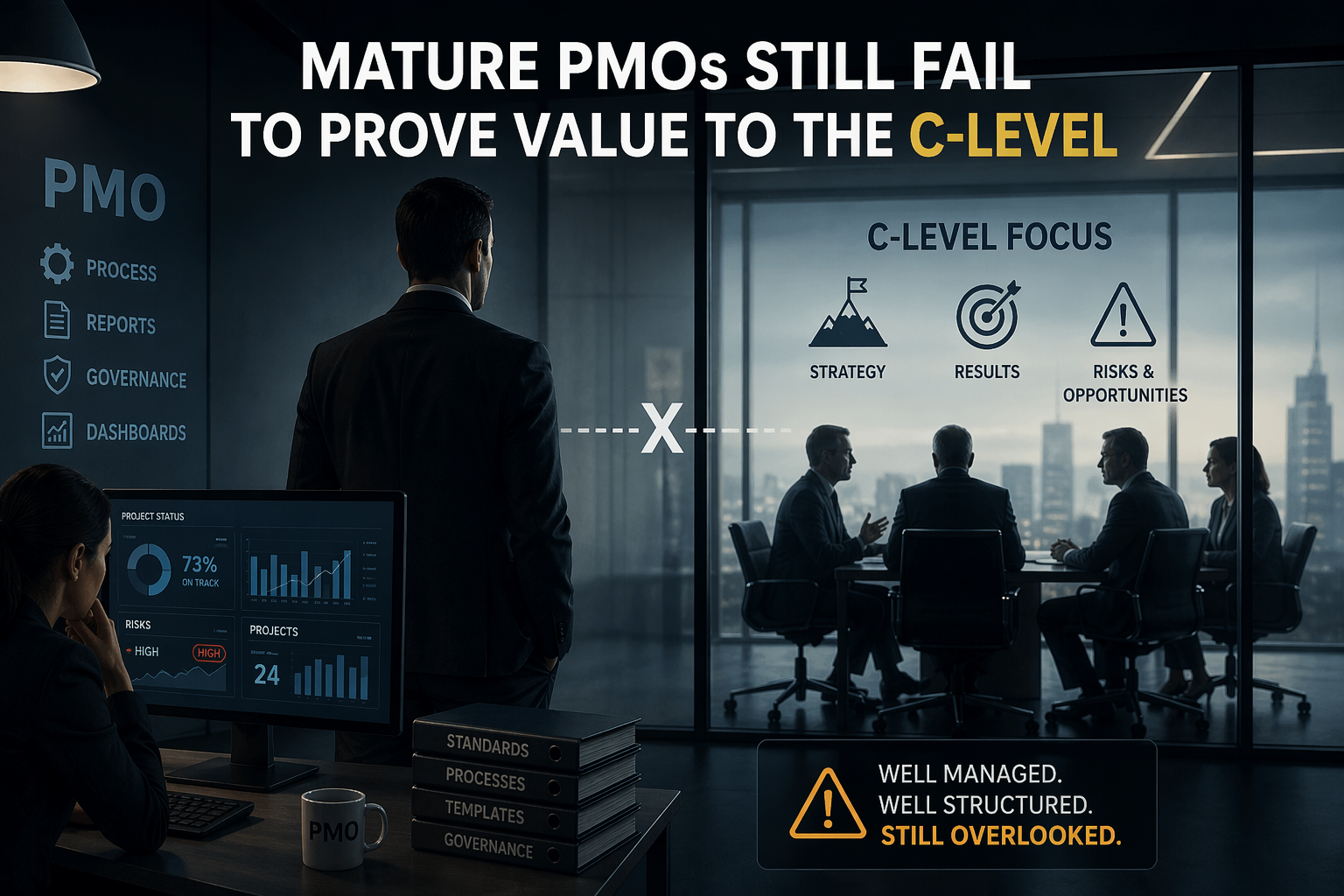 Without that connection:
None of this shows up in internal assessments. Because they measure consistency, not influence. This is the breaking point.
|
Cybersecurity in Project Management: From Risk Awareness to Structured Execution
| |

Your PMO does not have a process problem. It has hotspots you are not seeing.
When something is not working in the PMO, the reaction is usually predictable:
It is a different type of issue. A recurring pattern. We call this a hotspot.  A hotspot is not an isolated error. It is a recurring point of friction that indicates the PMO is not operating where it should. A simple example: A PMO with defined processes tools already implemented rituals in place Even so, strategic decisions continue to happen outside of it. The most common response: “we need to reinforce governance” But the PMO already controls processes well. That is not where the problem is. The problem is that relevant decisions are happening in a different space, where the PMO is not present. In other words, it is not a process failure. It is a positioning failure. Where is the mistake Most PMOs evolve by deepening control. Few are able to expand influence. And it is in this gap that hotspots emerge. The PMO improves what it controls, but decisions remain outside its reach. Result:
 The point that usually goes unnoticed Solving this type of problem is not about reviewing processes. It is also not about changing tools. The real issue is different: clearly understanding where the PMO actually operates and where it should operate, but cannot Without this clarity, any improvement tends to happen in the wrong place. As a result, the PMO may evolve internally, but still struggle to demonstrate real impact. This pattern is not isolated. There is evidence that many organizations are mature in delivery, but still far from achieving effective business outcomes. To reflect If in your context there are:
Or whether you are dealing with hotspots. This type of situation shifts the discussion. It is no longer about method. It becomes about where the PMO is positioned within the organization. And this is where many realize they need to take the next step. |
Why project leadership is becoming an essential capability in complex organizational environments.
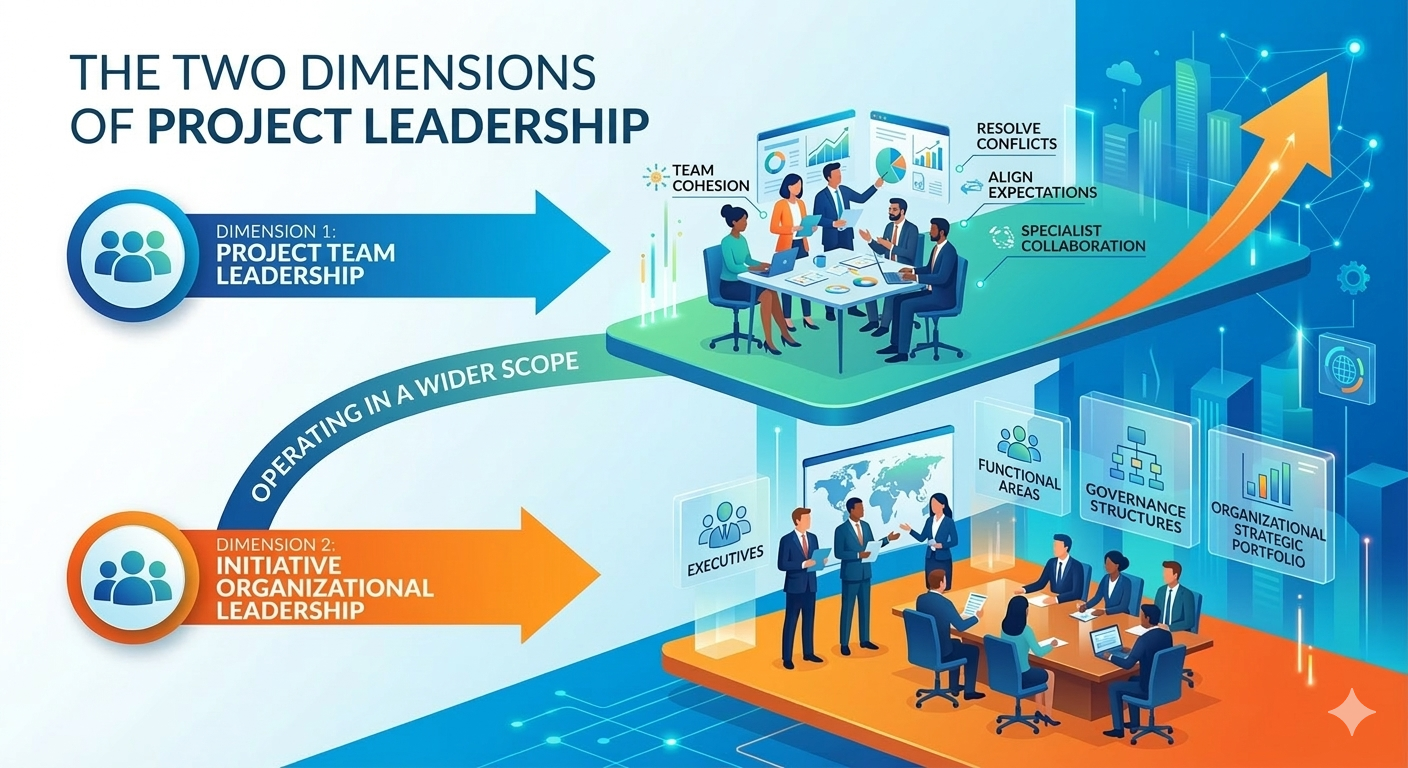
| Leadership in projects has always been considered important in the project management literature. However, the practical meaning of leadership has changed significantly as projects have come to play a more central role in organizational transformation. What was once largely understood as the ability to coordinate teams and deliver scope within time and budget has evolved into something broader: the ability to connect projects to strategy, navigate organizational complexity, and generate real business impact. To understand this evolution, it is useful to examine how three widely used references address the topic: PMI, IPMA, and more recent approaches associated with the concept of Project Leadership. For many years, the dominant literature treated leadership as a competence of the project manager. For the Project Management Institute, leadership appears primarily within the domain related to the project team. The emphasis is on skills such as motivating people, resolving conflicts, building trust, and facilitating collaboration within the project team. This model assumes that the project manager must create an environment in which the team can perform the work effectively. A similar approach can be observed in the IPMA thtat organizes professional competencies into three broad areas: Perspective, People, and Practice. Leadership appears within the People domain and is treated as a behavioral competence involving influence, integrity, communication, and the ability to mobilize people. These models have contributed enormously to the professionalization of the discipline. However, they also reflect a historical moment in which projects were often seen as relatively bounded execution mechanisms within organizations. As projects increasingly became vehicles for innovation, digital transformation, and organizational change, this understanding began to expand. Today many projects are no longer limited to delivering a product or system. They involve profound organizational change. Digital transformation projects, for example, may alter processes, power structures, business models, and even organizational culture. In such contexts, leadership in projects is no longer confined to the project team.
In other words, technically well-managed projects may still fail if they are not properly connected to the strategic priorities of the organization. A simple example helps illustrate this difference. "Imagine a project implementing a new enterprise resource planning (ERP) system in a large industrial organization. A traditional project manager might focus on building a detailed schedule, managing technical risks, coordinating the IT team, and ensuring that the system is delivered on time and within budget. From a project management perspective, this might be considered a success. However, many ERP projects fail not because of technical problems but because of organizational factors. User resistance, conflicts between departments, redefinition of processes, and disputes over information control are common challenges. If these issues are not addressed, the system may be implemented correctly yet still fail to deliver the expected benefits." In this type of situation, the role of leadership becomes much broader. The project leader must act as an organizational integrator. This involves engaging with executives, understanding strategic implications, negotiating changes across departments, and ensuring that the initiative remains aligned with business priorities. This requires competencies that go beyond traditional project management techniques. This point also appears in research analyzing the role of governance structures and PMOs. Studies indicate that these structures influence project success not only through methodologies and tools but primarily through the way they connect projects to strategic decision-making within the organization. In this context, project leadership is exercised within a broader organizational system that includes portfolios, governance mechanisms, and decision structures. This movement helps explain why, in more recent discussions about the evolution of the profession, the term Project Leadership is appearing with increasing frequency. The idea is not to replace the concept of project management but to recognize that the role of the professional has expanded. Project professionals still need to master methods, planning, and control. But they also need to understand organizational dynamics, strategy, and change. The relevant question for the project management community may therefore not be limited to how to improve project management techniques. The question may be deeper. Are we training professionals who are capable only of managing schedules, or leaders capable of guiding initiatives that truly transform organizations?
References
|
Decision Intelligence: The Real Test of AI Maturity in the PMO
| The recent redefinition of project success has shifted the focus from execution to delivered value. Success is no longer defined solely by schedule and budget compliance, but by value creation that justifies the effort and investment involved (Project Management Institute [PMI], 2024). This shift has direct implications for the role of the PMO. At the same time, the profession faces a structural talent deficit. Projections indicate that by 2035, demand for project professionals could reach 65 million, with a potential gap of nearly 30 million (PMI, 2025a). Complexity is growing faster than available human capacity. In this context, decisions become the true organizational asset. However, evidence indicates that only 18% of professionals demonstrate a high level of business acumen, the ability to interpret strategic context, integrate variables, and understand broader organizational impacts (PMI, 2025b). This suggests that many decisions may be made under bounded rationality, even when supported by data. The arrival of artificial intelligence amplifies this tension. Recent studies on GenAI usage indicate that advanced users achieve higher output quality, but also report increased collaboration challenges and risks of misuse (PMI, 2025c). AI does not correct structural weaknesses. It amplifies them. If the PMO’s decision architecture is immature, AI simply accelerates poorly structured decisions. This is where the concept of Decision Intelligence emerges within the AI-PMO context. 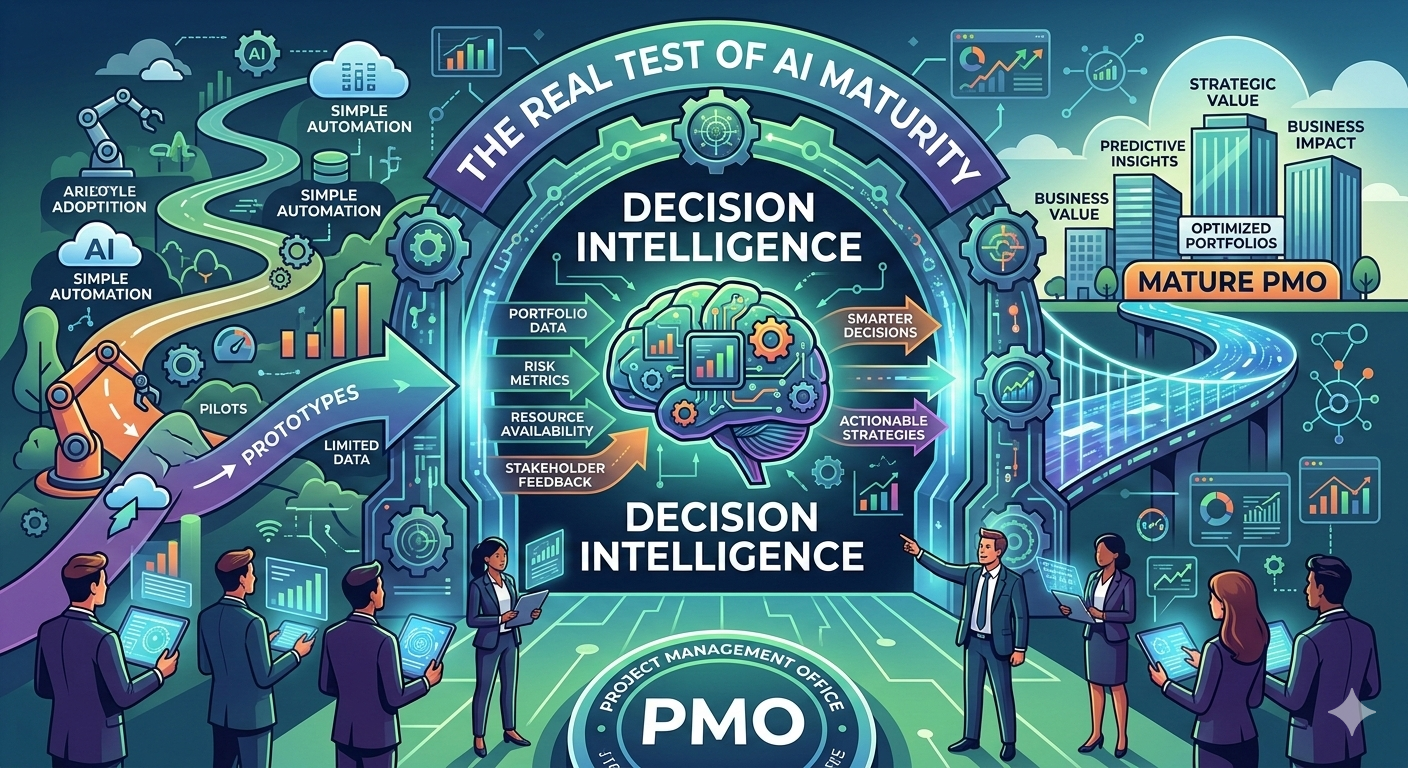 Decision intelligence goes beyond data analysis. It represents the capability to make explicit the criteria, patterns, and biases that structure organizational decisions. The AI-PMO model positions AI as strategic infrastructure and as a cognitive mirror, revealing inconsistencies, recurring patterns, and systemic impacts (AIPMO & Joslin, 2025). Yet this transformation is sustained by clear principles. First, final human accountability. AI-assisted decisions require explicit human validation and justification. Accountability is not transferred to the algorithm. Second, transparency and explainability. If a PMO cannot explain the criteria behind an algorithmic recommendation, maturity does not exist. Governance requires traceability. Third, active governance. AI must operate under structured supervision, with defined roles, continuous monitoring, and risk evaluation. Technology without governance accelerates uncertainty. Fourth, ethics over efficiency. The fastest decision is not necessarily the right one. In the AI-PMO model, operational efficiency never overrides ethical responsibility. Fifth, human AI integration. Maturity does not lie in pure automation, but in combining algorithmic analysis with contextual judgment. AI augments cognition; it does not replace reflection. Sixth, reflexive learning. An intelligent PMO does not merely decide. It learns from its decisions. AI can surface invisible patterns but only if formal review and learning processes exist. These principles fundamentally redefine maturity. AI maturity is not measured by the number of automated dashboards or algorithm-generated reports. It is measured by the PMO’s ability to:
The central question, therefore, is not whether the PMO uses AI. The question is:
The Intelligent PMO is not the one that uses AI as an operational tool. It is the one that governs AI, understands its own decision architecture, and elevates the strategic quality of organizational choices. And perhaps the most important question is not technological. Perhaps it is structural. If AI were removed tomorrow, would your PMO’s decision process remain solid, transparent, and justifiable? Or does it depend on outputs that no one truly questions?
|


