


Do you lack integrity if you change your behaviour?


| Last week on this blog I challenged the idea that perhaps, project managers are too soft. Of course, data being data… well, at least it got people thinking, and that is good. If you’re curious about this topic, feel free to try out the Influence Profile yourself. One of the key notions behind the profile is that if you differ from a stakeholder in terms of style, there is likely to be a distraction in your flow of communication/influence. They will be wondering why you are so different from them, instead of listening to what you are saying. For instance, if they are very sociable (extrovert) and you are not (introvert), they will be worrying that you are so quiet, and you will be wondering when they will shut up. So, we suggest that you should consider adapting your style nearer to the preferred style of your stakeholder, so that you remove the distraction and can both focus on the content of your communication. Thus, you are behaving contrary to the way you would normally behave. Or, you are pretending to be something that you are not. This unsettles many people, especially project managers, because they worry that they lack integrity by changing their behaviour in this way. What do you think? If you pretend to be something that you are not, are you lacking in integrity? |
Are Project Managers too soft?
| Incredible it may be, but the data is beginning to emerge that this could indeed be the case. The usual caveat about generalisations aside, this is what my recent research is starting to reveal. And, you don’t have to be a project manager to learn from these results. Based on a group of 195 project managers I have discovered, somewhat to my surprise, that they are more likely to be high in Tact and Diplomacy and low in Determination, than the general (professional) working population. To be honest, I had expected the opposite. These people all completed my Influence Profile that measures preferred behaviours when working with others. This is not looking at their actual behaviour, but rather the way they would most like to behave (which is reality is the default behaviour they use most of the time). Within this psychometric, four dimensions of behaviour are analysed and
In certain situations, the above is absolutely perfect. In others, it will leave the project manager flailing and struggling to get things done. What is important here is not how project managers prefer to behave, but how they need to behave to deliver their objectives. If the difference between preference and need is too great, it is likely that the project manager will suffer stress and strain because of the stretch from their comfort zone. Consequently, they’ll probably revert to type. With awareness and practice, adapting these behaviours becomes easy, and fun. To turn this towards a practical outcome, it is important to:
The bottom line is that the correct style is the one that maximises the potential to get the outcome you want. If you'd like to take the profile, invite me to connect and let me know you'd like to complete it and I'll give you the link. |
 then ranked (Sociability and Networking, Determination, Emotional Control and Tact and Diplomacy). The result is a short report that describes how the individual is likely to be viewed by their colleagues.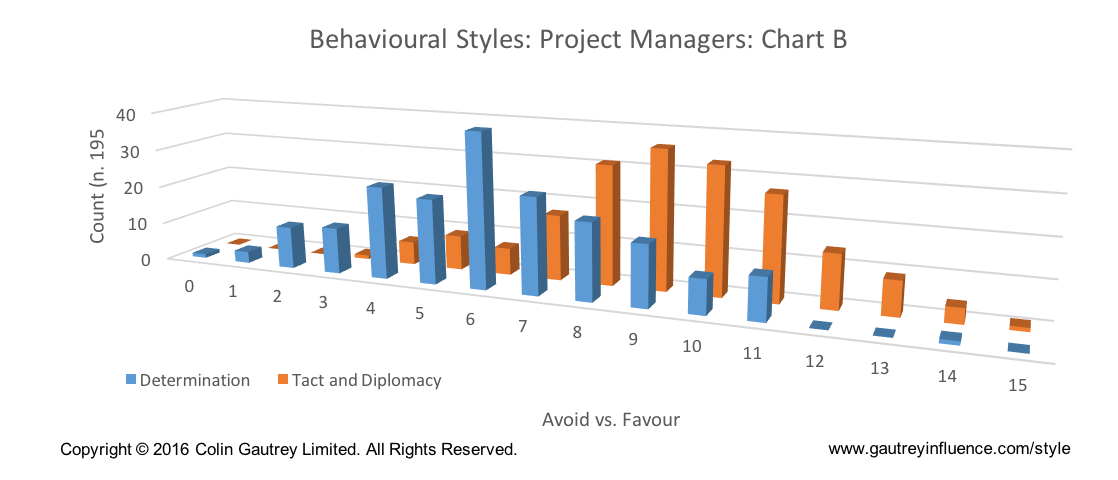
If power is the capacity to influence…
| Projects need power to be delegated to them so that the project manager can influence the successful completion of the project, for the good of the organisation. For example, a group of people with more money than they know what to do with may decide to pool their money (power) and ask some clever person (like a CEO) to do something with it. They, the shareholders (stakeholders), will lay down some conditions, like what type of product or business to form. They will certainly want something in return (profit) at some point in the future. They have delegated their power (money) to the CEO and are trusting the CEO to do a good job for them. The clever CEO then decides on a strategy and plan and realises he/she cannot do it all alone, so hires in various chiefs and gives them all a pot of money (budget) and some objectives (roles). Thus, the CEO has delegated power into a traditional hierarchical structure. Then things can get a little confused (messy). Ambition, ego, rivalry begin to play their part, and roles are rarely mutually exclusive. So, the clever CEO decides to kick off a project that will benefit all stakeholders. To do so, the previously agreed power delegation needs to be revised, and a little power is taken from each stakeholder and given to the project, otherwise, how will it ever deliver benefit to all stakeholders? A question or two, for you:
A final thought: All projects deliver a change to the power structures of the host organisation. |
10 Provocative Thoughts About Power
| As you may know by now, my specialism is helping people to become more successful through the practical use of power and influence. So, I’ve written a lot about the subject of power. Here you will find a selection of thoughts to provoke and tease you to think about your attitudes and experiences of power as a project manager. On the purpose of power:
On the pursuit and use of power:
I could go on, but I will leave it that and enquire, what ideas do these provoke in your mind? For more on the topic of power, check out my OnDemand webinar: Diagnosing Power Dynamics Around Your Project. |
Reciprocal influence: Get both sides capable and confident to attempt to influence
| You may well think that the ultimate position to be in is one where you can influence other people, but they are unable to influence you. That is fantastic in the short term, but very unsafe longer term. For a relationship to really work, both sides need to feel that they can influence the other side. If they feel strongly about something, they should have the chance to negotiate for a change. That is the only way that both sides can win in the long term.
If the other side of your relationship doesn't feel confident to challenge or influence you, they will soon begin to feel oppressed. Oppressed people will look for ways out or seethe until the revolution.
|


