




Guessing is not a strategy: How to build decision velocity with AI and real-time data
June 10, 2026 | Live Webinar

The Emerging Tensions of Adaptive Governance
From Statistical Patterns to Operational Judgment
ORGANIZATIONAL MEMORY & DECISION CONTINUITY
RESPONSIBLE DECISION ARCHITECTURE™
Decision Architecture Under Pressure
Agile, Career Development, Career Development, Career Development, Career Development, Career Development, Career Development, Career Development, Career Development, Career Development, Career Development, Career Development, Career Development, Career Development, Career Development, Career Development, Career Development, Career Development, Career Development, Career Development, Career Development, Career Development, Career Development, Career Development, Career Development, Career Development, Career Development, Career Development, Career Development, Career Development, Career Development, Career Development, Career Development, Career Development, Career Development, Career Development, Career Development, Career Development, Career Development, Career Development, Career Development, Career Development, Career Development, Career Development, Career Development, Career Development, Career Development, Career Development, Career Development, Career Development, Career Development, Career Development, Career Development, Career Development, Career Development, Career Development, Career Development, Career Development, Career Development, Career Development, Career Development, Career Development, Career Development, Career Development, Career Development, Career Development, Career Development, Career Development, Career Development, Career Development, Career Development, Career Development, Career Development, Career Development, Career Development, Career Development, Career Development, Interpersonal Skills, Interpersonal Skills, Interpersonal Skills, Interpersonal Skills, Interpersonal Skills, Interpersonal Skills, Interpersonal Skills, Interpersonal Skills, Interpersonal Skills, Interpersonal Skills, Interpersonal Skills, Interpersonal Skills, Interpersonal Skills, Interpersonal Skills, Interpersonal Skills, Interpersonal Skills, Interpersonal Skills, Interpersonal Skills, Interpersonal Skills, Interpersonal Skills, Interpersonal Skills, Interpersonal Skills, Interpersonal Skills, Interpersonal Skills, Interpersonal Skills, Interpersonal Skills, Interpersonal Skills, Interpersonal Skills, Interpersonal Skills, Interpersonal Skills, Interpersonal Skills, Interpersonal Skills, Interpersonal Skills, Interpersonal Skills, Interpersonal Skills, Interpersonal Skills, Interpersonal Skills, Interpersonal Skills, Interpersonal Skills, Interpersonal Skills, Interpersonal Skills, Interpersonal Skills, Interpersonal Skills, Interpersonal Skills, Interpersonal Skills, Interpersonal Skills, Interpersonal Skills, Interpersonal Skills, Interpersonal Skills, Interpersonal Skills, Interpersonal Skills, Interpersonal Skills, Interpersonal Skills, Interpersonal Skills, Interpersonal Skills, Interpersonal Skills, Interpersonal Skills, Interpersonal Skills, Interpersonal Skills, Interpersonal Skills, Interpersonal Skills, Interpersonal Skills, Interpersonal Skills, Interpersonal Skills, Interpersonal Skills, Interpersonal Skills, Interpersonal Skills, Interpersonal Skills, Interpersonal Skills, Interpersonal Skills, Interpersonal Skills, Interpersonal Skills, Interpersonal Skills, Interpersonal Skills, Interpersonal Skills, Interpersonal Skills, Leadership, Leadership, Leadership, Leadership, Leadership, Leadership, Leadership, Leadership, Leadership, Leadership, Leadership, Leadership, Leadership, Leadership, Leadership, Leadership, Leadership, Leadership, Leadership, Leadership, Leadership, Leadership, Leadership, Leadership, Leadership, Leadership, Leadership, Leadership, Leadership, Leadership, Leadership, Leadership, Leadership, Leadership, Leadership, Leadership, Leadership, Leadership, Leadership, Leadership, Leadership, Leadership, Leadership, Leadership, Leadership, Leadership, Leadership, Leadership, Leadership, Leadership, Leadership, Leadership, Leadership, Leadership, Leadership, Leadership, Leadership, Leadership, Leadership, Leadership, Leadership, Leadership, Leadership, Leadership, Leadership, Leadership, Leadership, Leadership, Leadership, Leadership, Leadership, Leadership, Leadership, Leadership, Leadership, Leadership, Leadership, Strategy, Strategy, Strategy, Strategy, Strategy, Strategy, Strategy, Strategy, Strategy, Strategy, Strategy, Strategy, Strategy, Strategy, Strategy, Strategy, Strategy, Strategy, Strategy, Strategy, Strategy, Strategy, Strategy, Strategy, Strategy, Strategy, Strategy, Strategy, Strategy, Strategy, Strategy, Strategy, Strategy, Strategy, Strategy, Strategy, Strategy, Strategy, Strategy, Strategy, Strategy, Strategy, Strategy, Strategy, Strategy, Strategy, Strategy, Strategy, Strategy, Strategy, Strategy, Strategy, Strategy, Strategy, Strategy, Strategy, Strategy, Strategy, Strategy, Strategy, Strategy, Strategy, Strategy, Strategy, Strategy, Strategy, Strategy, Strategy, Strategy, Strategy, Strategy, Strategy, Strategy, Strategy, Strategy, Strategy, Sustainability, Talent Management, Talent Management, Talent Management, Talent Management, Talent Management, Talent Management, Talent Management, Talent Management, Talent Management, Talent Management, Talent Management, Talent Management, Talent Management, Talent Management, Talent Management, Talent Management, Talent Management, Talent Management, Talent Management, Talent Management, Talent Management, Talent Management, Talent Management, Talent Management, Talent Management, Talent Management, Talent Management, Talent Management, Talent Management, Talent Management, Talent Management, Talent Management, Talent Management, Talent Management, Talent Management, Talent Management, Talent Management, Talent Management, Talent Management, Talent Management, Talent Management, Talent Management, Talent Management, Talent Management, Talent Management, Talent Management, Talent Management, Talent Management, Talent Management, Talent Management, Talent Management, Talent Management, Talent Management, Talent Management, Talent Management, Talent Management, Talent Management, Talent Management, Talent Management, Talent Management, Talent Management, Talent Management, Talent Management, Talent Management, Talent Management, Talent Management, Talent Management, Talent Management, Talent Management, Talent Management, Talent Management, Talent Management, Talent Management, Talent Management, Talent Management, Talent Management


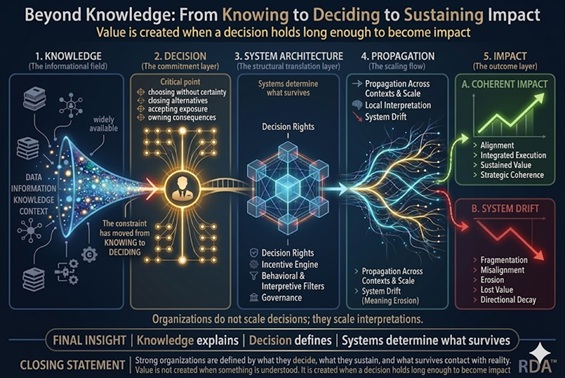 From Knowing to Deciding to Sustaining Impact The End of the Illusion We started with a belief. That knowledge creates advantage. For decades, it did. Data was scarce. Information was slow. Expertise took years to build. Today, none of that is true. Data is everywhere. Information is instant. Knowledge is accessible on demand. What once differentiated organizations is now widely available. And yet, performance does not converge. Because the constraint has moved. 1. The Shift Organizations are no longer limited by what they know. They are limited by what they decide. Knowledge expands possibilities. Decision closes them. That is where difficulty begins. 2. The Break Between knowing and impact, there is a break. Not visible. But structural. Organizations understand more than ever. And move less than they should. Not because they lack intelligence. Because they avoid commitment. 3. The Reality Decision is not the continuation of knowledge. It is a different act. It requires: Choosing without certainty Closing alternatives Accepting exposure Owning consequences This cannot be automated. It cannot be distributed indefinitely. It must be owned. 4. The System Even when decisions are made, they do not hold. They move. Through teams. Through incentives. Through pressure. Through time. And as they move, they change. Not randomly. Systematically. Systems do not execute decisions. They reshape them. 5. The Failure This is where most organizations fail. Not at the moment of decision. After it. When: Intent weakens Ownership diffuses Priorities shift Meaning drifts Execution does not collapse. It fragments. 6. The Difference In this context, advantage is no longer informational. It is decisional. Not the ability to analyze. The ability to: Decide under uncertainty Commit with clarity Sustain direction through the system This is not individual capability. It is system design. 7. The Responsibility Technology will continue to evolve. AI will expand what can be known. But it will not decide. And it will not assume consequences. That boundary remains human. And organizational. Final Insight Knowledge explains. Decision defines. Systems determine what survives. Closing Statement In the end, organizations are not defined by what they know. They are defined by what they decide, what they sustain, and what survives contact with reality. Because value is not created when something is understood. It is created when a decision holds long enough to become impact. |
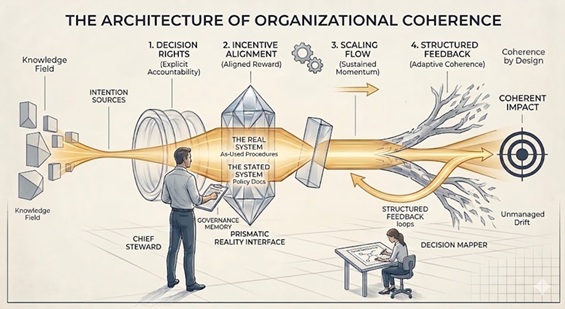 How to Build a Decision-Driven Organization Organizations do not become effective by making more decisions. They become effective when decisions hold, scale, and survive the system. Across this series, one pattern became clear: Decisions fail less because they are wrong, and more because the system cannot sustain them. The implication is practical. Improving decision-making is not enough. What must be designed is the system around the decision. 1. Where to Start Most transformation efforts begin with tools. Better data. Better dashboards. Better processes. But decision failure rarely originates there. It originates in the structure of the system. A useful starting point is diagnostic, not prescriptive. Four questions reveal most systemic weaknesses:
2. The Five Design Levers Building a decision-driven organization requires acting on a small set of structural levers. These levers do not operate independently. They must be designed as a system. A. Decision Rights Who decides must be explicit. Not assumed. Not negotiated in real time. Not diffused across layers. Clarity here reduces delay and prevents avoidance. It also defines where accountability resides. Without clear decision rights, organizations compensate with meetings, escalation, and consensus. All of which increase activity, but reduce commitment. B. Decision Commitment A decision is not complete when it is discussed. It is complete when it is committed. This moment must be visible. It must define:
What appears as alignment is often unresolved optionality. C. Incentive Alignment People do not follow decisions. They follow what is rewarded. If incentives contradict direction, behavior will adapt. Not because people resist. Because they are rational. Aligning incentives means:
It is structural design. D. Decision Flow and Ownership Making a decision is an act. Holding a decision is a responsibility. As decisions move through: Teams, Functions, Timelines, They are exposed to reinterpretation and pressure. Without continuity of ownership: Intent weakens, Priority shifts, Execution diverges. Every critical decision needs:
E. Feedback and Reconfirmation Decisions do not operate in static conditions. They interact with reality. Feedback provides the signal. Reconfirmation provides the discipline. Together, they ensure that:
Without reconfirmation, decisions evolve without being re-decided. 3. The Implementation Path Transformation does not require large programs. It requires precise interventions. A practical sequence is sufficient. Step 1: Map Critical Decisions Identify decisions that:
Focus creates clarity. Step 2: Trace Decision Propagation Follow how those decisions move. Where do they:
Step 3: Identify Structural Misalignments Look for patterns:
Step 4: Redesign the Levers Act on structure:
Step 5: Institutionalize the Cycle Decisions should not depend on individual effort. They should be supported by the system. This means:
4. Common Failure Modes Most initiatives fail in predictable ways. Tool Substitution Replacing structural problems with technology. More dashboards do not create better decisions. Incentive Blindness Ignoring how behavior is actually rewarded. Misalignment persists beneath formal direction. Consensus as Safety Seeking agreement instead of commitment. Decisions are delayed, diluted, or avoided. Distributed Accountability Everyone contributes. No one owns. Execution slows and responsibility dissolves. Avoidance of Commitment Analysis replaces decision. Optionality replaces direction. The system moves without explicit choice. 5. The Practical Test A decision-driven organization is recognizable. Not by how it speaks. By how it behaves.
It is design. 6. Final Insight Organizations do not become decision-driven by improving decision quality alone. They become decision-driven by designing systems where decisions can survive. Closing Statement In the end, leadership is not only about deciding. It is about designing the conditions where decisions hold. Because decisions do not fail in isolation. They fail in systems that were never built to support them. And when the system is designed correctly, decisions no longer depend on effort alone. They become part of how the organization operates. |
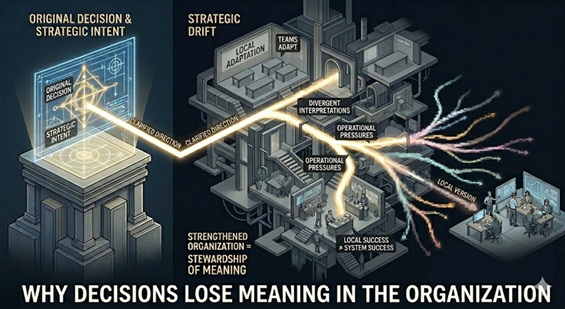 Why Decisions Lose Meaning as They Move Through Organizations Organizations rarely lose strategy through explicit rejection. More often, they lose it gradually. A decision is made. Direction is clarified.Execution begins. And yet, over time, something changes. Teams adapt locally. Priorities shift. Operational pressures intensify. Interpretations diverge. The organization continues moving. But slowly, almost invisibly, the meaning behind the original decision begins to erode. This is where strategic drift truly begins. Not when people stop working. But when people stop feeling responsible for preserving the intent behind what was decided. Decisions Do Not Travel as Instructions Organizations often assume that once a decision is communicated, alignment will follow. But decisions do not travel through systems as static instructions. They travel through interpretation. Each layer: • Translates • Adapts • Prioritizes • Simplifies Tthe decision according to its own context and pressures. This is natural. No complex organization can operate without adaptation. The problem begins when adaptation occurs without continuity of meaning. At that point, execution may continue efficiently while strategic coherence quietly weakens. The Missing Layer: Psychological Ownership Formal accountability is necessary. But it is not sufficient. People protect what they feel connected to. When decisions become abstract directives moving across disconnected functions, stewardship weakens. Teams optimize for: • Local performance • Immediate pressures • Measurable outcomes • Operational survival Not necessarily for preserving strategic intent. This creates a critical distinction: A decision can remain operationally active while psychologically abandoned. And once that happens, the system no longer executes the original decision. It executes the version that local conditions gradually reshape. Strategic Drift Rarely Feels Like Failure One of the most dangerous characteristics of drift is that it rarely appears dramatic. There is no formal rejection. No visible collapse. No explicit decision to abandon direction. Instead: • Small adjustments accumulate • Interpretations shift incrementally • Trade-offs become localized • Incentives reshape priorities Each adaptation appears rational on its own. But collectively, they redefine the meaning of the original decision. Over time, the organization remains busy, productive, and operationally efficient. Yet strategically, it may already be moving somewhere else. Incentives Shape Meaning Organizations often underestimate the interpretive power of incentives. Incentives do not only shape behavior. They shape how decisions are understood. When: • Metrics conflict with intent • Short-term pressures dominate • Local success differs from system success People reinterpret decisions in ways that align with what the system rewards. Not as resistance. As rational adaptation. This is why strategic coherence cannot depend only on communication. It depends on whether the system reinforces the meaning behind the decision consistently across contexts. Stewardship Is the Protection of Meaning Decision stewardship is not micromanagement. It is the continuous protection of coherence as decisions move through reality. A strong steward does not attempt to freeze adaptation. Adaptation is necessary. Instead, stewardship protects: • Intent • Direction • Strategic meaning While allowing operational flexibility. This is a fundamentally different form of responsibility. Traditional accountability asks: Who is responsible if the decision fails? Stewardship asks: Who ensures the decision remains coherent before failure becomes visible? Strong systems therefore create explicit moments of reconfirmation. Not to slow execution. But to verify that adaptation has not silently replaced intent. Critical transitions, handoffs, and scaling points require more than task transfer. They require continuity of meaning. Observability Matters One of the biggest dangers in complex organizations is invisible drift. Most systems measure: • Activity • Delivery • Compliance • Output But few measure whether the original intent still survives across the flow. This creates a structural blind spot. Execution may appear successful while the meaning behind the decision has already changed. Strong organizations reduce this risk by creating simple feedback mechanisms that reconnect execution to intent. Not only: “Was the task completed?” But also: “Is the decision still being interpreted as originally intended?” This is not bureaucracy. It is coherence observability. Shared Context Is a Structural Capability Organizations often treat shared understanding as a cultural aspiration. In reality, it is a structural capability. Without shared context: • Communication expands • Interpretation diverges • Coordination costs increase • Coherence weakens Strong organizations reduce this risk by creating systems where: • Intent remains visible • Trade-offs remain explicit • Adaptations are reconfirmed • Feedback reconnects execution to meaning This is what allows decisions to survive scale without losing identity. The Organization May Continue Moving This is the uncomfortable reality. Organizations can: • Remain active • Execute efficiently • Hit local targets • Maintain operational flow While progressively drifting away from the original strategic direction. Because activity is not coherence. Execution is not continuity of meaning. And movement is not alignment. Final Insight Organizations rarely lose decisions because people openly reject them. They lose them when no one remains psychologically and structurally committed to preserving their meaning across the system. Closing Statement A strong organization is not only the one that makes decisions. It is the one that preserves the meaning of those decisions as they move through complexity, adaptation, and pressure. Because in the end, strategy does not survive through intention alone. It survives when people, structures, incentives, feedback, and stewardship continue protecting what the decision was originally meant to achieve. |
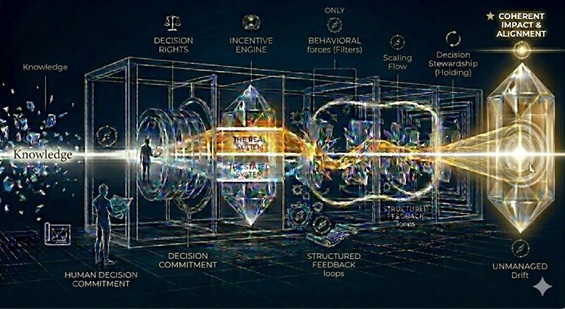 Why Organizations Must Be Designed Around Decisions Organizations were not designed for decision. They were designed for control, coordination, and execution. For a long time, that was enough. When information was scarce, when environments were more stable, when execution was the main challenge, organizations could rely on process. That context no longer exists. 1. The Shift No One Can Ignore We do not operate in a knowledge-constrained world. We operate in a decision-constrained one. Today:
Decisions are delayed, direction is diluted, impact is inconsistent. The constraint has moved. Not from data to knowledge. From knowledge to decision. 2. The Core Misunderstanding Most organizations still operate under a hidden assumption: If we improve analysis, decisions will improve. If we align people, execution will follow. If we design governance, outcomes will stabilize. This is incomplete. Better analysis does not create commitment. Alignment does not guarantee direction. Governance does not ensure that decisions hold. The problem is not at the point of decision. It is what happens after. 3. Decisions Do Not Operate Alone A decision is not an isolated act. It is a signal entering a system. And every system responds in predictable ways. As decisions move, they are:
But because systems:
It is the version the system can carry. 4. The System That Actually Exists Every organization operates with two systems:
Always. No amount of communication can compensate for structural misalignment. No amount of intention can override incentives. No amount of governance can replace ownership. 5. From Events to Architecture If decisions degrade by default, then integrity must be designed. This requires a shift: From seeing decisions as events To designing them as systems A decision system is not a tool. It is an architecture. It defines:
They form a single structure. 6. The Architecture of Decision At its core, a decision-driven organization is built on five interdependent elements: Decision Rights Clarity on who decides and where accountability resides. Incentive and Behavior Engine Alignment between what is decided and what is rewarded. Behavioral Forces Recognition that bias, local optimization, and risk dynamics shape outcomes. Decision Stewardship Continuity of ownership as decisions move through the system. Feedback Loops Connection to reality, enabling learning and reconfirmation. Remove any one of these, and coherence breaks. 7. The New Organizational Principle Organizations do not operate through processes. They operate through decisions sustained over time. Processes can coordinate activity. They cannot guarantee direction. Only decisions, held and reinforced across the system, can do that. 8. Leadership Redefined Leadership is not the ability to know more. It is not the ability to align more. It is not the ability to control more. Leadership is the ability to:
It is a responsibility over time. 9. The Real Risk The greatest risk organizations face is not making wrong decisions. It is allowing decisions to dissolve. When decisions are:
It adapts. Direction is replaced by drift. Responsibility is replaced by ambiguity. And outcomes emerge without being consciously chosen. 10. Final Insight Organizations are not defined by what they plan. They are not defined by what they say. They are not defined by what they know. They are defined by:
In a world where knowledge is abundant, the differentiator is no longer understanding. t is commitment. Decision creates direction. But only a system can ensure that direction holds. Because in the end, value is not created by what is known. It is created by what is decided, carried through, and sustained under real conditions. |
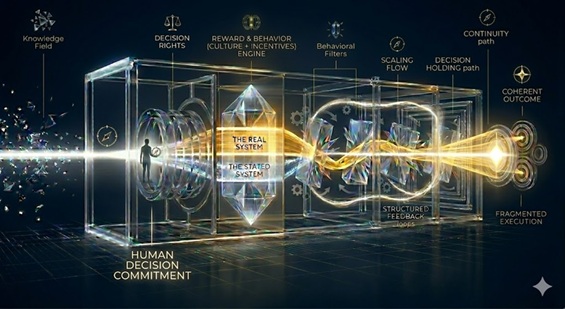 How Decisions, Systems, and Behavior Align Organizations do not fail at a single point. They fail when the system is not coherent. Over time, efforts are made to improve performance:
Yet the result often remains the same:
It is the absence of architecture. 1. The Illusion of Isolated Improvement Most organizations try to fix decision problems locally.
They operate in systems. A strong decision in a weak system will degrade. A well-designed process in a misaligned system will fragment. Improvement at one layer does not compensate for incoherence across layers. 2. From Components to Architecture Across this series, a pattern emerges. Each concept addresses a real failure mode:
Together, they form a system. This is decision architecture. 3. The Layers of Decision Architecture A decision does not move alone. It moves through a set of interdependent layers. A. Knowledge and Its Limits The DIKW model explains how information becomes understanding. But it stops too early. Knowing does not create impact. It prepares for decision. In an environment where knowledge is abundant, its role changes. It is no longer the source of advantage. It is the input to judgment. B. Decision as Commitment Decision is not a continuation of knowledge. It is a reduction of possibilities. It defines direction under uncertainty. This is where:
C. Governance as Decision Architecture Governance is not control. It is the structure that enables decisions to be made clearly and at the right level. It defines:
D. Culture as Filter Decisions do not enter neutral systems. They are processed. Culture determines what is:
E. Incentives as Behavioral Engine Behavior does not follow intention. It follows structure. Incentives define what is rational to do. If incentives contradict decisions, behavior will adapt. Alignment is not achieved through communication. It is designed through incentives. F. Scaling as a Coherence Test A decision is not proven at the moment it is made. It is tested as it spreads. As it moves through the system, it is:
It reveals whether they can remain coherent across variation. G. Ownership as Continuity Making a decision is an act. Holding a decision is a responsibility. Without ownership across the flow:
H. Feedback as Learning Loop Decisions interact with reality. Outcomes generate signals. Without feedback:
It is how the system evolves. 4. The System Dynamic These layers do not operate sequentially. They interact continuously.
5. The Real Failure Mode Organizations rarely fail because of a single weakness. They fail because the system is not aligned. Examples are predictable:
It is the architecture. 6. From Control to Coherence Traditional management emphasizes control. Modern organizations require coherence. Control assumes stability. Coherence accepts variation and preserves direction. The objective is not to eliminate differences. It is to ensure that, despite differences, the system moves in the same direction. 7. Final Insight Organizations do not execute decisions. They execute systems. And systems determine whether decisions survive, adapt with integrity, or disappear. Closing Statement A strong organization is not the one that improves isolated elements. It is the one that designs how those elements work together. Because in the end:
And only when these operate as one system do decisions create real impact. |
|
"I never resist temptation, because I have found that things that are bad for me do not tempt me." - George Bernard Shaw |