Decision Architecture
From the Support to Develop Blog
by Luis Branco

This blog addresses management-related topics and has three areas of focus: 1. Technical skills; 2. Competencies in the field of interpersonal relations and communication (including personal organization and delegation, leadership, teamwork, conflict resolution, conducting meetings, and negotiation); and 3. Strategy (including diagnosis, strategic guidelines, and implementation).4.Technology
Recent Posts
RCPCV™: A Method for Decision-Making and Continuous Improvement
The Same Change Can Succeed and Fail at the Same Time
What Must Exist Even When No Single Role Owns the Whole?
PHASE 4 – THE EMERGENCE
When Structural Drift Becomes Consequential
Categories
Agile,
Career Development,
Career Development,
Career Development,
Career Development,
Career Development,
Career Development,
Career Development,
Career Development,
Career Development,
Career Development,
Career Development,
Career Development,
Career Development,
Career Development,
Career Development,
Career Development,
Career Development,
Career Development,
Career Development,
Career Development,
Career Development,
Career Development,
Career Development,
Career Development,
Career Development,
Career Development,
Career Development,
Career Development,
Career Development,
Career Development,
Career Development,
Career Development,
Career Development,
Career Development,
Career Development,
Career Development,
Career Development,
Career Development,
Career Development,
Career Development,
Career Development,
Career Development,
Career Development,
Career Development,
Career Development,
Career Development,
Career Development,
Career Development,
Career Development,
Career Development,
Career Development,
Career Development,
Career Development,
Career Development,
Career Development,
Career Development,
Career Development,
Career Development,
Career Development,
Career Development,
Career Development,
Career Development,
Career Development,
Career Development,
Career Development,
Career Development,
Career Development,
Career Development,
Career Development,
Career Development,
Career Development,
Career Development,
Career Development,
Career Development,
Career Development,
Career Development,
Career Development,
Career Development,
Career Development,
Career Development,
Career Development,
Career Development,
Career Development,
Career Development,
Career Development,
Career Development,
Career Development,
Career Development,
Career Development,
Career Development,
Career Development,
Career Development,
Career Development,
Career Development,
Career Development,
Career Development,
Career Development,
Career Development,
Career Development,
Career Development,
Career Development,
Career Development,
Career Development,
Career Development,
Career Development,
Career Development,
Career Development,
Career Development,
Career Development,
Career Development,
Career Development,
Career Development,
Career Development,
Career Development,
Career Development,
Career Development,
Career Development,
Career Development,
Career Development,
Career Development,
Career Development,
Career Development,
Education,
Governance,
Governance,
Governance,
Governance,
Governance,
Governance,
Governance,
Governance,
Governance,
Governance,
Governance,
Governance,
Governance,
Governance,
Governance,
Governance,
Governance,
Governance,
Governance,
Governance,
Governance,
In,
Integration Management,
Interpersonal Skills,
Interpersonal Skills,
Interpersonal Skills,
Interpersonal Skills,
Interpersonal Skills,
Interpersonal Skills,
Interpersonal Skills,
Interpersonal Skills,
Interpersonal Skills,
Interpersonal Skills,
Interpersonal Skills,
Interpersonal Skills,
Interpersonal Skills,
Interpersonal Skills,
Interpersonal Skills,
Interpersonal Skills,
Interpersonal Skills,
Interpersonal Skills,
Interpersonal Skills,
Interpersonal Skills,
Interpersonal Skills,
Interpersonal Skills,
Interpersonal Skills,
Interpersonal Skills,
Interpersonal Skills,
Interpersonal Skills,
Interpersonal Skills,
Interpersonal Skills,
Interpersonal Skills,
Interpersonal Skills,
Interpersonal Skills,
Interpersonal Skills,
Interpersonal Skills,
Interpersonal Skills,
Interpersonal Skills,
Interpersonal Skills,
Interpersonal Skills,
Interpersonal Skills,
Interpersonal Skills,
Interpersonal Skills,
Interpersonal Skills,
Interpersonal Skills,
Interpersonal Skills,
Interpersonal Skills,
Interpersonal Skills,
Interpersonal Skills,
Interpersonal Skills,
Interpersonal Skills,
Interpersonal Skills,
Interpersonal Skills,
Interpersonal Skills,
Interpersonal Skills,
Interpersonal Skills,
Interpersonal Skills,
Interpersonal Skills,
Interpersonal Skills,
Interpersonal Skills,
Interpersonal Skills,
Interpersonal Skills,
Interpersonal Skills,
Interpersonal Skills,
Interpersonal Skills,
Interpersonal Skills,
Interpersonal Skills,
Interpersonal Skills,
Interpersonal Skills,
Interpersonal Skills,
Interpersonal Skills,
Interpersonal Skills,
Interpersonal Skills,
Interpersonal Skills,
Interpersonal Skills,
Interpersonal Skills,
Interpersonal Skills,
Interpersonal Skills,
Interpersonal Skills,
Interpersonal Skills,
Interpersonal Skills,
Interpersonal Skills,
Interpersonal Skills,
Interpersonal Skills,
Interpersonal Skills,
Interpersonal Skills,
Interpersonal Skills,
Interpersonal Skills,
Interpersonal Skills,
Interpersonal Skills,
Interpersonal Skills,
Interpersonal Skills,
Interpersonal Skills,
Interpersonal Skills,
Interpersonal Skills,
Interpersonal Skills,
Interpersonal Skills,
Interpersonal Skills,
Interpersonal Skills,
Interpersonal Skills,
Interpersonal Skills,
Interpersonal Skills,
Interpersonal Skills,
Interpersonal Skills,
Interpersonal Skills,
Interpersonal Skills,
Interpersonal Skills,
Interpersonal Skills,
Interpersonal Skills,
Interpersonal Skills,
Interpersonal Skills,
Interpersonal Skills,
Interpersonal Skills,
Interpersonal Skills,
Interpersonal Skills,
Interpersonal Skills,
Interpersonal Skills,
Interpersonal Skills,
Interpersonal Skills,
Interpersonal Skills,
Interpersonal Skills,
Interpersonal Skills,
Interpersonal Skills,
Interpersonal Skills,
Interpersonal Skills,
Knowledge Management,
le,
lea,
Leadership,
Leadership,
Leadership,
Leadership,
Leadership,
Leadership,
Leadership,
Leadership,
Leadership,
Leadership,
Leadership,
Leadership,
Leadership,
Leadership,
Leadership,
Leadership,
Leadership,
Leadership,
Leadership,
Leadership,
Leadership,
Leadership,
Leadership,
Leadership,
Leadership,
Leadership,
Leadership,
Leadership,
Leadership,
Leadership,
Leadership,
Leadership,
Leadership,
Leadership,
Leadership,
Leadership,
Leadership,
Leadership,
Leadership,
Leadership,
Leadership,
Leadership,
Leadership,
Leadership,
Leadership,
Leadership,
Leadership,
Leadership,
Leadership,
Leadership,
Leadership,
Leadership,
Leadership,
Leadership,
Leadership,
Leadership,
Leadership,
Leadership,
Leadership,
Leadership,
Leadership,
Leadership,
Leadership,
Leadership,
Leadership,
Leadership,
Leadership,
Leadership,
Leadership,
Leadership,
Leadership,
Leadership,
Leadership,
Leadership,
Leadership,
Leadership,
Leadership,
Leadership,
Leadership,
Leadership,
Leadership,
Leadership,
Leadership,
Leadership,
Leadership,
Leadership,
Leadership,
Leadership,
Leadership,
Leadership,
Leadership,
Leadership,
Leadership,
Leadership,
Leadership,
Leadership,
Leadership,
Leadership,
Leadership,
Leadership,
Leadership,
Leadership,
Leadership,
Leadership,
Leadership,
Leadership,
Leadership,
Leadership,
Leadership,
Leadership,
Leadership,
Leadership,
Leadership,
Leadership,
Leadership,
Leadership,
Leadership,
Leadership,
Leadership,
Leadership,
Leadership,
Leadership,
Leadership,
or,
Organizational Project Management,
Portfolio Management,
Program,
Program Management,
Strategy,
Strategy,
Strategy,
Strategy,
Strategy,
Strategy,
Strategy,
Strategy,
Strategy,
Strategy,
Strategy,
Strategy,
Strategy,
Strategy,
Strategy,
Strategy,
Strategy,
Strategy,
Strategy,
Strategy,
Strategy,
Strategy,
Strategy,
Strategy,
Strategy,
Strategy,
Strategy,
Strategy,
Strategy,
Strategy,
Strategy,
Strategy,
Strategy,
Strategy,
Strategy,
Strategy,
Strategy,
Strategy,
Strategy,
Strategy,
Strategy,
Strategy,
Strategy,
Strategy,
Strategy,
Strategy,
Strategy,
Strategy,
Strategy,
Strategy,
Strategy,
Strategy,
Strategy,
Strategy,
Strategy,
Strategy,
Strategy,
Strategy,
Strategy,
Strategy,
Strategy,
Strategy,
Strategy,
Strategy,
Strategy,
Strategy,
Strategy,
Strategy,
Strategy,
Strategy,
Strategy,
Strategy,
Strategy,
Strategy,
Strategy,
Strategy,
Strategy,
Strategy,
Strategy,
Strategy,
Strategy,
Strategy,
Strategy,
Strategy,
Strategy,
Strategy,
Strategy,
Strategy,
Strategy,
Strategy,
Strategy,
Strategy,
Strategy,
Strategy,
Strategy,
Strategy,
Strategy,
Strategy,
Strategy,
Strategy,
Strategy,
Strategy,
Strategy,
Strategy,
Strategy,
Strategy,
Strategy,
Strategy,
Strategy,
Strategy,
Strategy,
Strategy,
Strategy,
Strategy,
Strategy,
Strategy,
Strategy,
Strategy,
Strategy,
Strategy,
Strategy,
Strategy,
Strategy,
Sustainability,
Talent Management,
Talent Management,
Talent Management,
Talent Management,
Talent Management,
Talent Management,
Talent Management,
Talent Management,
Talent Management,
Talent Management,
Talent Management,
Talent Management,
Talent Management,
Talent Management,
Talent Management,
Talent Management,
Talent Management,
Talent Management,
Talent Management,
Talent Management,
Talent Management,
Talent Management,
Talent Management,
Talent Management,
Talent Management,
Talent Management,
Talent Management,
Talent Management,
Talent Management,
Talent Management,
Talent Management,
Talent Management,
Talent Management,
Talent Management,
Talent Management,
Talent Management,
Talent Management,
Talent Management,
Talent Management,
Talent Management,
Talent Management,
Talent Management,
Talent Management,
Talent Management,
Talent Management,
Talent Management,
Talent Management,
Talent Management,
Talent Management,
Talent Management,
Talent Management,
Talent Management,
Talent Management,
Talent Management,
Talent Management,
Talent Management,
Talent Management,
Talent Management,
Talent Management,
Talent Management,
Talent Management,
Talent Management,
Talent Management,
Talent Management,
Talent Management,
Talent Management,
Talent Management,
Talent Management,
Talent Management,
Talent Management,
Talent Management,
Talent Management,
Talent Management,
Talent Management,
Talent Management,
Talent Management,
Talent Management,
Talent Management,
Talent Management,
Talent Management,
Talent Management,
Talent Management,
Talent Management,
Talent Management,
Talent Management,
Talent Management,
Talent Management,
Talent Management,
Talent Management,
Talent Management,
Talent Management,
Talent Management,
Talent Management,
Talent Management,
Talent Management,
Talent Management,
Talent Management,
Talent Management,
Talent Management,
Talent Management,
Talent Management,
Talent Management,
Talent Management,
Talent Management,
Talent Management,
Talent Management,
Talent Management,
Talent Management,
Talent Management,
Talent Management,
Talent Management,
Talent Management,
Talent Management,
Talent Management,
Talent Management,
Talent Management,
Talent Management,
Talent Management,
Talent Management,
Talent Management,
Talent Management,
Talent Management,
Talent Management
Date
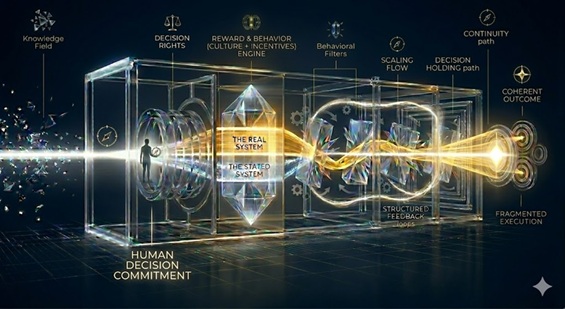 How Decisions, Systems, and Behavior Align
Organizations do not fail at a single point.
They fail when the system is not coherent.
Over time, efforts are made to improve performance:
- Better data.
- Better analysis.
- Stronger governance.
- Cultural initiatives.
- Incentive adjustments.
Each intervention makes sense in isolation.
Yet the result often remains the same:
- Decisions are made.
- But they do not hold.
The issue is not the quality of individual elements.
It is the absence of architecture.
1. The Illusion of Isolated ImprovementMost organizations try to fix decision problems locally.
- They improve decision-making frameworks.
- They invest in culture.
- They redesign incentives.
- They strengthen governance.
But decisions do not operate in parts.
They operate in systems.
A strong decision in a weak system will degrade.
A well-designed process in a misaligned system will fragment.
Improvement at one layer does not compensate for incoherence across layers.
2. From Components to ArchitectureAcross this series, a pattern emerges.
Each concept addresses a real failure mode:
- Knowledge explains the situation.
- Decision commits to a direction.
- Governance defines how decisions are made.
- Culture filters what is sustained.
- Incentives shape behavior.
- Scaling tests coherence.
- Ownership preserves continuity.
- Feedback enables learning.
Individually, each layer is valid.
Together, they form a system.
This is decision architecture.
3. The Layers of Decision ArchitectureA decision does not move alone.
It moves through a set of interdependent layers.
A. Knowledge and Its LimitsThe DIKW model explains how information becomes understanding.
But it stops too early.
Knowing does not create impact.
It prepares for decision.
In an environment where knowledge is abundant, its role changes.
It is no longer the source of advantage.
It is the input to judgment.
B. Decision as CommitmentDecision is not a continuation of knowledge.
It is a reduction of possibilities.
It defines direction under uncertainty.
This is where:
- Alternatives are closed.
- Risk is accepted.
- Responsibility becomes explicit.
Without this step, organizations remain in analysis.
C. Governance as Decision ArchitectureGovernance is not control.
It is the structure that enables decisions to be made clearly and at the right level.
It defines:
- Who decides.
- Under what conditions.
- With what level of challenge.
- When convergence is required.
Without governance, decisions are delayed or diffused.
D. Culture as FilterDecisions do not enter neutral systems.
They are processed.
Culture determines what is:
- Accepted.
- Resisted.
- Reshaped.
- Ignored.
A decision that is not compatible with culture will not survive.
E. Incentives as Behavioral EngineBehavior does not follow intention.
It follows structure.
Incentives define what is rational to do.
If incentives contradict decisions, behavior will adapt.
Alignment is not achieved through communication.
It is designed through incentives.
F. Scaling as a Coherence TestA decision is not proven at the moment it is made.
It is tested as it spreads.
As it moves through the system, it is:
- Interpreted.
- Adapted.
- Reconstructed.
Scaling does not replicate decisions.
It reveals whether they can remain coherent across variation.
G. Ownership as ContinuityMaking a decision is an act.
Holding a decision is a responsibility.
Without ownership across the flow:
- Intent weakens.
- Priority shifts.
- Meaning is lost.
Every critical decision requires someone who ensures it remains coherent as it moves.
H. Feedback as Learning LoopDecisions interact with reality.
Outcomes generate signals.
Without feedback:
- Misalignment remains hidden.
- Errors persist.
- Assumptions go unchallenged.
Learning is not an addition.
It is how the system evolves.
4. The System DynamicThese layers do not operate sequentially.
They interact continuously.
- Knowledge informs decision.
- Decision activates governance.
- Governance shapes how decisions are made.
- Culture filters their propagation.
- Incentives reinforce behavior.
- Scaling exposes variation.
- Ownership preserves intent.
- Feedback updates the system.
When these elements are aligned:
- Decisions hold.
- Behavior is consistent.
- Outcomes are coherent.
When they are not:
- Decisions fragment.
- Execution drifts.
- Responsibility diffuses.
5. The Real Failure ModeOrganizations rarely fail because of a single weakness.
They fail because the system is not aligned.
Examples are predictable:
- Clear decisions with misaligned incentives.
- Strong governance with weak ownership.
- Coherent strategy with incompatible culture.
- Advanced analytics without decision capacity.
In each case, the problem is not the component.
It is the architecture.
6. From Control to CoherenceTraditional management emphasizes control.
Modern organizations require coherence.
Control assumes stability.
Coherence accepts variation and preserves direction.
The objective is not to eliminate differences.
It is to ensure that, despite differences, the system moves in the same direction.
7. Final InsightOrganizations do not execute decisions.
They execute systems.
And systems determine whether decisions survive, adapt with integrity, or disappear.
Closing StatementA strong organization is not the one that improves isolated elements.
It is the one that designs how those elements work together.
Because in the end:
- Knowledge prepares.
- Decision commits.
- Governance enables.
- Culture filters.
- Incentives drive.
- Scaling tests.
- Ownership sustains.
- Feedback evolves.
And only when these operate as one system do decisions create real impact.
Posted on: May 13, 2026 05:42 AM |
Permalink
Comments (1)
Please login or join to subscribe to this item
Please Login/Register to leave a comment.
|
"Common sense is the collection of prejudices acquired by age 18."
- Albert Einstein
|




