
What If the Team Is No Longer the Right Unit of Organizational Design?


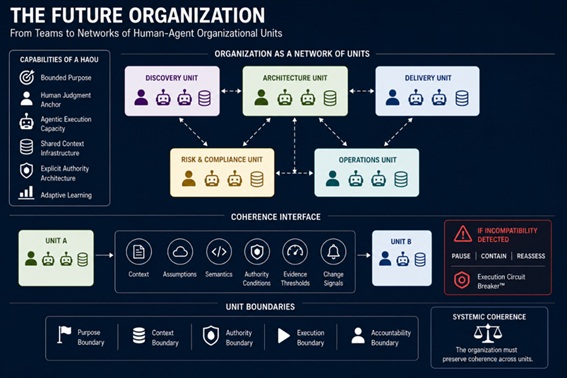 For more than a century, organizations have treated the team as one of the fundamental units of work. People are grouped around a shared objective. Roles distribute responsibility. Skills create specialization. Coordination connects individual contributions. Leadership provides direction. The model has evolved, from functional teams to cross-functional, agile, distributed, and product teams, but the underlying assumption has remained remarkably stable: Work is organized primarily by coordinating people. Artificial intelligence may be challenging that assumption. Not because AI makes teams smaller. But because the system through which work is performed is changing. And if the system is changing, perhaps the organizational unit itself is changing with it. We May Be Using an Old Category for a New Architecture The first wave of workplace AI fitted relatively comfortably inside the traditional concept of team. A human performed the work. AI assisted. The team remained fundamentally human. Its members still held most execution responsibility. Coordination remained largely interpersonal. Authority remained attached to human roles. AI was a tool inside the team. We could describe the model simply: Team + AI tools Agentic AI introduces a different possibility. Imagine a small group of humans working with an orchestrator agent and several specialist agents. One agent analyzes requirements. Another explores architecture options. Another builds. Another tests. Another reviews security. Another prepares deployment. A shared context layer maintains objectives, constraints, assumptions, and dependencies. An orchestration layer decomposes work, distributes tasks, reconciles outputs, and escalates exceptions. Authority rules determine what agents may decide, when evidence is sufficient, when humans must intervene, and when execution must stop. Learning mechanisms reconstruct agentic decisions and challenge the assumptions embedded in automated workflows. We may still call this a team. But perhaps we are using an old organizational category to describe a new organizational architecture. Because this is no longer simply a group of people using better tools. Part of the organization's execution, coordination, and authority architecture has become computational. At what point does a team with AI become something organizationally different? The Traditional Team Was More Than a Group of People To answer that question, it helps to understand why the team became such a powerful unit of organizational design. A team creates a bounded social and operational system. It usually contains a purpose. A set of members. Roles. Skills. Relationships. Coordination mechanisms. Decision patterns. And some form of shared accountability. The team works as a useful organizational unit because many of the elements required to understand how work happens are contained within it. Who performs the work? Look at the team. Who coordinates? Look at the team. Where does expertise reside? Look at the team. Who makes decisions? Look at roles and leadership. Where does learning happen? Largely through the experience of the people doing the work. The concept is not perfect. Matrix organizations, ecosystems, platforms, contractors, and distributed networks have long complicated this picture. But the team has remained a useful unit of analysis because human actors still carried most execution, interpretation, coordination, and judgment. Agentic systems disturb that assumption. When AI Joins the Workflow, the Team Does Not Necessarily Change There is an important distinction between AI-assisted work and AI-native work. If a project manager uses AI to summarize a meeting, the organizational unit has not changed. If a developer uses AI to generate code suggestions, the organizational unit has not necessarily changed. If a marketer uses AI to prepare alternative campaign messages, the organizational unit may still be fundamentally the same. AI improves individual execution. The architecture of work remains largely intact. But consider a different configuration. An orchestrator decomposes an objective into tasks. Several agents execute in parallel. Agents consume outputs produced by other agents. Shared context is updated dynamically. Some decisions occur without human approval. Exceptions are escalated according to predefined thresholds. A circuit breaker can interrupt execution when propagation risk becomes unacceptable. Humans intervene primarily where judgment, consequence, ambiguity, or accountability require them. This is not merely AI assistance. The structure of work itself has changed. Execution is distributed across human and non-human actors. Coordination is partly computational. Context becomes infrastructure. Authority is encoded. Learning must include both human experience and the deconstruction of agentic execution. The difference is not simply that AI has joined the team. The difference is that some of the functions through which the organization works have migrated from human relationships into computational architecture. Perhaps Headcount Is Becoming the Wrong Measure This creates an immediate organizational problem. How large is a team composed of three humans and twelve agents? Is it smaller than a traditional team of eight people? Headcount says yes. Execution capacity may say no. Cognitive demand may say no. Risk may say no. Coordination complexity may say no. A configuration with three humans and twelve highly autonomous, heterogeneous, interdependent agents may be more difficult to govern than a team of fifteen humans performing relatively stable work. The effective size of an AI-native work system cannot therefore be understood through human headcount alone. We also need to consider: Volume of agentic activity How much work is being generated and executed? Heterogeneity How different are the domains, tasks, and forms of reasoning involved? Autonomy How much can agents decide or execute without intervention? Interdependence How extensively do agents consume, modify, or depend on each other's outputs? Reversibility How easily can decisions and actions be undone? Consequence What happens when the system is wrong? This is where Agentic Span of Control becomes more than a supervision problem. It becomes a principle of organizational design. The question is no longer how many people report to one manager. It is how much agentic activity a human-led system can direct, understand, challenge, and remain accountable for without losing decisional coherence. And that raises a deeper question. If headcount no longer adequately describes the size of the work system, is the traditional team still the right unit for describing the system itself? What Would Define a New Organizational Unit? Perhaps the emerging unit of AI-native work should not be defined primarily by the number of humans or agents it contains. Perhaps it should be defined by the organizational capabilities that operate together within a bounded system. Consider six elements. Bounded purpose The system has an explicit outcome, mission, or domain of responsibility. Human judgment anchor Human responsibility remains identifiable where judgment, challenge, and consequential accountability are required. Agentic execution capacity Agents or agentic workflows perform work with defined levels of autonomy. Shared context infrastructure Humans and agents operate with sufficiently aligned objectives, constraints, assumptions, dependencies, and system state. Explicit authority architecture Decision ownership, autonomy boundaries, evidence thresholds, escalation conditions, override authority, and execution interruption are deliberately designed. Adaptive learning The system learns not only from outcomes, but by reconstructing agentic decisions, surfacing assumptions, challenging automated workflows, and adapting both human and agent behavior. Together, these elements describe something more than a team using AI. They describe a bounded system of human judgment and agentic execution designed to operate coherently. For now, I will call this a Human-Agent Organizational Unit. Not as a finished framework. Not as a new label searching for a problem. But as a hypothesis worth testing. A Human-Agent Organizational Unit may be emerging when bounded purpose, human judgment, agentic execution, shared context, explicit authority, and adaptive learning become structurally integrated into one operational system designed to preserve coherence. The critical point is not the presence of agents. It is the structural integration of these capabilities. A person using five AI tools does not automatically constitute a new organizational unit. A team deploying an isolated chatbot does not either. The unit becomes organizationally distinct when work, context, coordination, authority, and learning are redesigned as interdependent properties of a human-agent system. The Boundary May Matter More Than the Org Chart If such a unit exists, its boundaries may also need to be understood differently. Traditional organizations often use reporting lines to indicate organizational boundaries. But a human-agent system may require other boundaries. Purpose boundary Which outcomes belong to the unit? Context boundary What context may the system consume, modify, and preserve? Authority boundary Which decisions may humans and agents make within the unit? Execution boundary Which actions may the system perform autonomously? Accountability boundary For which consequences does identifiable human responsibility remain? These boundaries may not align with the organizational chart. Two human-agent units may share the same manager. They may use the same AI model. They may even use some of the same specialist agents. Yet if their purpose, context, authority, execution, and accountability boundaries differ, they may represent distinct organizational units. This has significant implications. Organizational design can no longer be understood only by asking: Who reports to whom? We may also need to ask: Who and what share context? Where does authority begin and end? Which agentic actions can propagate across boundaries? Where can execution be interrupted? Who remains capable of reconstructing why the system acted? The organizational chart was designed to represent human authority relationships. It was never designed to represent computational execution, shared context, machine autonomy, or agent-to-agent dependencies. Coherent Units Can Still Produce an Incoherent Organization There is another danger. Suppose organizations become very good at designing these human-agent units. Each has a clear purpose. Each has excellent agents. Each maintains shared context. Each has explicit authority. Each learns and adapts. The organization may still fail. Why? Because local coherence does not guarantee systemic coherence. One unit optimizes customer acquisition. Another optimizes risk. Another optimizes operational efficiency. Another optimizes product velocity. Each may act intelligently within its own boundaries. Their combined actions may still produce contradiction, duplication, resource conflict, or strategic drift. AI does not remove this problem. It may accelerate it. Agentic systems also introduce new forms of interdependence. An agent in one unit may generate an output consumed automatically by an agent in another. A context update may alter decisions across several workflows. A local optimization may propagate before any human recognizes its systemic consequence. Authority may be clear within each unit but ambiguous between them. This is where the Execution Capacity-Coherence Capacity Asymmetry becomes critical. Execution capacity can scale rapidly inside individual units. But organizational coherence depends on the capacity to understand and govern relationships across units. If execution scales faster than cross-unit coherence, the Coherence Gap can accelerate. Worse, orchestration layers may present clean summaries that hide unresolved contradictions between units. The organization may experience Hallucinated Coherence. Everything appears aligned. Dashboards are clean. Recommendations are consolidated. Local systems are performing. But incompatible assumptions and competing optimization logics remain underneath. Coherent human-agent units do not automatically produce a coherent organization. Organizational Design May Be Moving from Teams to Systems of Units If this hypothesis is correct, the next organizational design challenge is not simply to build smaller teams with more AI. It is to understand how bounded human-agent systems should be designed and how multiple systems should interact. A product discovery unit may combine human judgment, research agents, customer insight agents, and an orchestration layer. An architecture unit may combine senior architects with design, simulation, security, and dependency agents. A delivery unit may integrate humans with development, testing, documentation, and deployment agents. These units may not need to form a traditional hierarchy. They may operate as a network. But networks of human-agent units require explicit coupling mechanisms. Where one unit depends on another, outputs cannot be transferred without the conditions required to interpret them. Context matters. Assumptions matter. Authority conditions matter. Semantic meaning matters. Changes to any of them matter. The interface between units is therefore not merely a data interface. It is a coherence interface. A Coherence Interface must preserve the interpretability of work as it crosses organizational boundaries. If one unit changes its context, assumptions, semantics, or governing conditions, dependent units must be able to detect that change, determine whether existing dependencies remain compatible, and pause propagation when coherence can no longer be assured. The problem is not simply whether Unit B receives the output produced by Unit A. The problem is whether Unit B still interprets that output under conditions compatible with those under which Unit A produced it. This reveals a deeper possibility. The Coherence Gap may not emerge inside a unit. It may emerge at the boundary between two locally coherent units. Networks therefore create governance questions that traditional organizational structures were not designed to answer. What context must be shared across units? What context must remain bounded? When can one unit trigger execution in another? Whose evidence threshold applies? Which authority prevails when agents reach conflicting conclusions? How are changes in assumptions, semantics, or governing conditions signaled to dependent units? Where does accountability sit when a consequence emerges from a chain of actions across several units? When must an Execution Circuit Breaker stop propagation across the network? And how does the organization ensure that units coevolve rather than optimize themselves into collective incoherence? These are not questions of AI tool adoption. They are questions of organizational architecture. The Team May Not Disappear The concept of team will not suddenly become irrelevant. Humans will continue to collaborate. Relationships will continue to matter. Trust, conflict, identity, psychological safety, and leadership will remain deeply human organizational realities. But the real operational system may increasingly include actors and mechanisms that the traditional concept of team does not adequately represent. Agents execute. Orchestrators coordinate. Shared context aligns. Authority architectures constrain. Coherence interfaces preserve interpretability across boundaries. Circuit breakers contain. Learning loops adapt. Humans judge, challenge, interpret, and remain accountable for consequences that increasingly emerge from distributed systems of action. Perhaps the organizational language has not yet caught up with the organizational reality. The question is therefore not whether AI will make teams smaller. It is whether team remains the right unit of analysis when execution, coordination, context, and authority are increasingly distributed across humans and agents. For now, the Human-Agent Organizational Unit remains a hypothesis. But it begins with a question organizations may need to confront sooner than expected: If span of control is changing because the system being supervised is changing, are we still supervising the same kind of organizational unit? The team may not disappear. But it may no longer be enough to explain how work is organized. |
Posted on: July 05, 2026 09:32 AM
| Permalink |
Comments (0)


