Support to Develop
by Luis Branco

This blog addresses management-related topics and has three areas of focus: 1. Technical skills; 2. Competencies in the field of interpersonal relations and communication (including personal organization and delegation, leadership, teamwork, conflict resolution, conducting meetings, and negotiation); and 3. Strategy (including diagnosis, strategic guidelines, and implementation).4.Technology
Recent Posts
Delegation with Purpose: Building Autonomy and Developing Capability
RCPCV™: A Method for Decision-Making and Continuous Improvement
The Same Change Can Succeed and Fail at the Same Time
What Must Exist Even When No Single Role Owns the Whole?
PHASE 4 – THE EMERGENCE
Categories
Agile,
Career Development,
Career Development,
Career Development,
Career Development,
Career Development,
Career Development,
Career Development,
Career Development,
Career Development,
Career Development,
Career Development,
Career Development,
Career Development,
Career Development,
Career Development,
Career Development,
Career Development,
Career Development,
Career Development,
Career Development,
Career Development,
Career Development,
Career Development,
Career Development,
Career Development,
Career Development,
Career Development,
Career Development,
Career Development,
Career Development,
Career Development,
Career Development,
Career Development,
Career Development,
Career Development,
Career Development,
Career Development,
Career Development,
Career Development,
Career Development,
Career Development,
Career Development,
Career Development,
Career Development,
Career Development,
Career Development,
Career Development,
Career Development,
Career Development,
Career Development,
Career Development,
Career Development,
Career Development,
Career Development,
Career Development,
Career Development,
Career Development,
Career Development,
Career Development,
Career Development,
Career Development,
Career Development,
Career Development,
Career Development,
Career Development,
Career Development,
Career Development,
Career Development,
Career Development,
Career Development,
Career Development,
Career Development,
Career Development,
Career Development,
Career Development,
Career Development,
Career Development,
Career Development,
Career Development,
Career Development,
Career Development,
Career Development,
Career Development,
Career Development,
Career Development,
Career Development,
Career Development,
Career Development,
Career Development,
Career Development,
Career Development,
Career Development,
Career Development,
Career Development,
Career Development,
Career Development,
Career Development,
Career Development,
Career Development,
Career Development,
Career Development,
Career Development,
Career Development,
Career Development,
Career Development,
Career Development,
Career Development,
Career Development,
Career Development,
Career Development,
Career Development,
Career Development,
Career Development,
Career Development,
Career Development,
Career Development,
Career Development,
Career Development,
Career Development,
Career Development,
Career Development,
Career Development,
Education,
Governance,
Governance,
Governance,
Governance,
Governance,
Governance,
Governance,
Governance,
Governance,
Governance,
Governance,
Governance,
Governance,
Governance,
Governance,
Governance,
Governance,
Governance,
Governance,
Governance,
Governance,
Governance,
In,
Integration Management,
Interpersonal Skills,
Interpersonal Skills,
Interpersonal Skills,
Interpersonal Skills,
Interpersonal Skills,
Interpersonal Skills,
Interpersonal Skills,
Interpersonal Skills,
Interpersonal Skills,
Interpersonal Skills,
Interpersonal Skills,
Interpersonal Skills,
Interpersonal Skills,
Interpersonal Skills,
Interpersonal Skills,
Interpersonal Skills,
Interpersonal Skills,
Interpersonal Skills,
Interpersonal Skills,
Interpersonal Skills,
Interpersonal Skills,
Interpersonal Skills,
Interpersonal Skills,
Interpersonal Skills,
Interpersonal Skills,
Interpersonal Skills,
Interpersonal Skills,
Interpersonal Skills,
Interpersonal Skills,
Interpersonal Skills,
Interpersonal Skills,
Interpersonal Skills,
Interpersonal Skills,
Interpersonal Skills,
Interpersonal Skills,
Interpersonal Skills,
Interpersonal Skills,
Interpersonal Skills,
Interpersonal Skills,
Interpersonal Skills,
Interpersonal Skills,
Interpersonal Skills,
Interpersonal Skills,
Interpersonal Skills,
Interpersonal Skills,
Interpersonal Skills,
Interpersonal Skills,
Interpersonal Skills,
Interpersonal Skills,
Interpersonal Skills,
Interpersonal Skills,
Interpersonal Skills,
Interpersonal Skills,
Interpersonal Skills,
Interpersonal Skills,
Interpersonal Skills,
Interpersonal Skills,
Interpersonal Skills,
Interpersonal Skills,
Interpersonal Skills,
Interpersonal Skills,
Interpersonal Skills,
Interpersonal Skills,
Interpersonal Skills,
Interpersonal Skills,
Interpersonal Skills,
Interpersonal Skills,
Interpersonal Skills,
Interpersonal Skills,
Interpersonal Skills,
Interpersonal Skills,
Interpersonal Skills,
Interpersonal Skills,
Interpersonal Skills,
Interpersonal Skills,
Interpersonal Skills,
Interpersonal Skills,
Interpersonal Skills,
Interpersonal Skills,
Interpersonal Skills,
Interpersonal Skills,
Interpersonal Skills,
Interpersonal Skills,
Interpersonal Skills,
Interpersonal Skills,
Interpersonal Skills,
Interpersonal Skills,
Interpersonal Skills,
Interpersonal Skills,
Interpersonal Skills,
Interpersonal Skills,
Interpersonal Skills,
Interpersonal Skills,
Interpersonal Skills,
Interpersonal Skills,
Interpersonal Skills,
Interpersonal Skills,
Interpersonal Skills,
Interpersonal Skills,
Interpersonal Skills,
Interpersonal Skills,
Interpersonal Skills,
Interpersonal Skills,
Interpersonal Skills,
Interpersonal Skills,
Interpersonal Skills,
Interpersonal Skills,
Interpersonal Skills,
Interpersonal Skills,
Interpersonal Skills,
Interpersonal Skills,
Interpersonal Skills,
Interpersonal Skills,
Interpersonal Skills,
Interpersonal Skills,
Interpersonal Skills,
Interpersonal Skills,
Interpersonal Skills,
Interpersonal Skills,
Interpersonal Skills,
Interpersonal Skills,
Interpersonal Skills,
Knowledge Management,
le,
lea,
Leadership,
Leadership,
Leadership,
Leadership,
Leadership,
Leadership,
Leadership,
Leadership,
Leadership,
Leadership,
Leadership,
Leadership,
Leadership,
Leadership,
Leadership,
Leadership,
Leadership,
Leadership,
Leadership,
Leadership,
Leadership,
Leadership,
Leadership,
Leadership,
Leadership,
Leadership,
Leadership,
Leadership,
Leadership,
Leadership,
Leadership,
Leadership,
Leadership,
Leadership,
Leadership,
Leadership,
Leadership,
Leadership,
Leadership,
Leadership,
Leadership,
Leadership,
Leadership,
Leadership,
Leadership,
Leadership,
Leadership,
Leadership,
Leadership,
Leadership,
Leadership,
Leadership,
Leadership,
Leadership,
Leadership,
Leadership,
Leadership,
Leadership,
Leadership,
Leadership,
Leadership,
Leadership,
Leadership,
Leadership,
Leadership,
Leadership,
Leadership,
Leadership,
Leadership,
Leadership,
Leadership,
Leadership,
Leadership,
Leadership,
Leadership,
Leadership,
Leadership,
Leadership,
Leadership,
Leadership,
Leadership,
Leadership,
Leadership,
Leadership,
Leadership,
Leadership,
Leadership,
Leadership,
Leadership,
Leadership,
Leadership,
Leadership,
Leadership,
Leadership,
Leadership,
Leadership,
Leadership,
Leadership,
Leadership,
Leadership,
Leadership,
Leadership,
Leadership,
Leadership,
Leadership,
Leadership,
Leadership,
Leadership,
Leadership,
Leadership,
Leadership,
Leadership,
Leadership,
Leadership,
Leadership,
Leadership,
Leadership,
Leadership,
Leadership,
Leadership,
Leadership,
Leadership,
Leadership,
or,
Organizational Project Management,
Portfolio Management,
Program,
Program Management,
Strategy,
Strategy,
Strategy,
Strategy,
Strategy,
Strategy,
Strategy,
Strategy,
Strategy,
Strategy,
Strategy,
Strategy,
Strategy,
Strategy,
Strategy,
Strategy,
Strategy,
Strategy,
Strategy,
Strategy,
Strategy,
Strategy,
Strategy,
Strategy,
Strategy,
Strategy,
Strategy,
Strategy,
Strategy,
Strategy,
Strategy,
Strategy,
Strategy,
Strategy,
Strategy,
Strategy,
Strategy,
Strategy,
Strategy,
Strategy,
Strategy,
Strategy,
Strategy,
Strategy,
Strategy,
Strategy,
Strategy,
Strategy,
Strategy,
Strategy,
Strategy,
Strategy,
Strategy,
Strategy,
Strategy,
Strategy,
Strategy,
Strategy,
Strategy,
Strategy,
Strategy,
Strategy,
Strategy,
Strategy,
Strategy,
Strategy,
Strategy,
Strategy,
Strategy,
Strategy,
Strategy,
Strategy,
Strategy,
Strategy,
Strategy,
Strategy,
Strategy,
Strategy,
Strategy,
Strategy,
Strategy,
Strategy,
Strategy,
Strategy,
Strategy,
Strategy,
Strategy,
Strategy,
Strategy,
Strategy,
Strategy,
Strategy,
Strategy,
Strategy,
Strategy,
Strategy,
Strategy,
Strategy,
Strategy,
Strategy,
Strategy,
Strategy,
Strategy,
Strategy,
Strategy,
Strategy,
Strategy,
Strategy,
Strategy,
Strategy,
Strategy,
Strategy,
Strategy,
Strategy,
Strategy,
Strategy,
Strategy,
Strategy,
Strategy,
Strategy,
Strategy,
Strategy,
Strategy,
Sustainability,
Talent Management,
Talent Management,
Talent Management,
Talent Management,
Talent Management,
Talent Management,
Talent Management,
Talent Management,
Talent Management,
Talent Management,
Talent Management,
Talent Management,
Talent Management,
Talent Management,
Talent Management,
Talent Management,
Talent Management,
Talent Management,
Talent Management,
Talent Management,
Talent Management,
Talent Management,
Talent Management,
Talent Management,
Talent Management,
Talent Management,
Talent Management,
Talent Management,
Talent Management,
Talent Management,
Talent Management,
Talent Management,
Talent Management,
Talent Management,
Talent Management,
Talent Management,
Talent Management,
Talent Management,
Talent Management,
Talent Management,
Talent Management,
Talent Management,
Talent Management,
Talent Management,
Talent Management,
Talent Management,
Talent Management,
Talent Management,
Talent Management,
Talent Management,
Talent Management,
Talent Management,
Talent Management,
Talent Management,
Talent Management,
Talent Management,
Talent Management,
Talent Management,
Talent Management,
Talent Management,
Talent Management,
Talent Management,
Talent Management,
Talent Management,
Talent Management,
Talent Management,
Talent Management,
Talent Management,
Talent Management,
Talent Management,
Talent Management,
Talent Management,
Talent Management,
Talent Management,
Talent Management,
Talent Management,
Talent Management,
Talent Management,
Talent Management,
Talent Management,
Talent Management,
Talent Management,
Talent Management,
Talent Management,
Talent Management,
Talent Management,
Talent Management,
Talent Management,
Talent Management,
Talent Management,
Talent Management,
Talent Management,
Talent Management,
Talent Management,
Talent Management,
Talent Management,
Talent Management,
Talent Management,
Talent Management,
Talent Management,
Talent Management,
Talent Management,
Talent Management,
Talent Management,
Talent Management,
Talent Management,
Talent Management,
Talent Management,
Talent Management,
Talent Management,
Talent Management,
Talent Management,
Talent Management,
Talent Management,
Talent Management,
Talent Management,
Talent Management,
Talent Management,
Talent Management,
Talent Management,
Talent Management,
Talent Management,
Talent Management
Date
Modern governance increasingly encourages organizations to become more adaptive.
Projects are expected to:
• Reassess continuously,
• Respond dynamically to stakeholders,
• Incorporate feedback rapidly,
• Adapt to changing contexts,
• Evolve alongside shifting perceptions of value and legitimacy.
At first glance, this appears unquestionably positive.
And historically, it emerged for good reasons.
For decades, organizations often operated through rigid governance structures that confused procedural stability with strategic effectiveness.
Projects delivered exactly what had been approved while gradually becoming disconnected from the realities they were originally intended to serve.
Adaptive governance emerged partly as a corrective to that rigidity.
Frameworks such as Agile, modern PMOs, AI-enabled coordination systems, and approaches like M.O.R.E increasingly recognize that legitimacy cannot be treated as static.
Stakeholders evolve.
Markets shift.
Operational conditions change.
Value itself becomes contextual over time.
Under these conditions, governance cannot remain frozen.
Organizations must continuously reassess:
• Whether priorities still make sense,
• Whether value assumptions still hold,
• Whether delivery remains strategically relevant,
• Whether the system is still producing outcomes that remain legitimate for the environment in which it operates.
This is where adaptive legitimacy becomes operationally important.
Because organizations that cannot adapt eventually lose relevance.
But this evolution introduces a tension that modern governance frameworks still struggle to address explicitly:
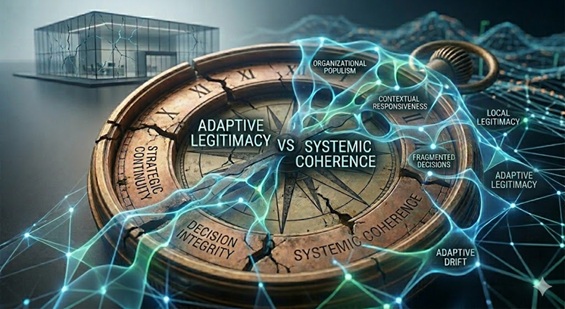
What happens when continuous adaptation begins to erode systemic coherence itself?
This question is becoming increasingly important.
Because adaptive legitimacy and strategic coherence are not automatically aligned.
In fact, under pressure, they can begin pulling organizations in opposite directions.
Local stakeholders may demand immediate responsiveness.
Teams may optimize for contextual legitimacy.
Business units may continuously reinterpret priorities.
Governance bodies may adjust direction reactively to preserve alignment and approval.
Individually, each adaptation may appear reasonable.
Collectively, however, the system may slowly lose strategic continuity.
This is the beginning of adaptive drift.
Adaptive drift rarely appears dramatically.
Organizations do not usually collapse because a single decision was obviously catastrophic.
More often, they drift gradually:
• Priorities shift incrementally,
• Trade-Offs become localized,
• Exceptions accumulate,
• Decision criteria evolve inconsistently,
• Short-Term legitimacy progressively overrides long-term coherence.
At some point, the organization may still appear adaptive, responsive, and operationally active while no longer moving coherently toward a stable strategic direction.
This is one of the central governance tensions emerging inside adaptive organizations.
Because adaptation itself is not inherently virtuous.
Poorly governed adaptation can fragment systems faster than rigid governance ever did.
This becomes particularly difficult in environments shaped by:
• AI-enabled coordination,
• Distributed decision-making,
• Continuous feedback loops,
• Real-Time analytics,
• Increasing pressure for responsiveness.
The faster organizations can sense and react, the harder it becomes to preserve shared interpretive stability across the system.
And this creates an uncomfortable paradox:
The same mechanisms designed to increase organizational adaptability may simultaneously increase the probability of strategic fragmentation.
This tension becomes especially visible when legitimacy itself becomes increasingly localized.
Different stakeholders often operate under different definitions of:
• Success,
• Value,
• Urgency,
• Acceptable risk,
• Even organizational purpose.
Under these conditions, governance faces a difficult question:
Should organizations continuously optimize for local legitimacy?
Or should governance sometimes preserve strategic continuity even when immediate stakeholder pressure pushes in different directions?
This is where adaptive governance begins approaching a politically uncomfortable territory.
Because excessive optimization for local legitimacy can gradually evolve into a form of organizational populism:
A system that continuously adapts to immediate contextual pressures while progressively weakening long-term strategic coherence.
The system remains responsive.
But responsiveness alone does not guarantee viability.
This is not a purely procedural problem.
It is fundamentally a judgment problem.
Because no framework can fully determine:
• When adaptation remains healthy,
• When reassessment becomes destabilizing,
• When responsiveness becomes reactive drift,
• When local legitimacy begins undermining long-term coherence.
And this is where many modern governance conversations remain incomplete.
Adaptive governance is often discussed as if flexibility itself automatically produces better organizational outcomes.
But systems thinking suggests something more complex.
Highly adaptive systems without stabilizing coherence mechanisms can become behaviorally unstable over time.
The issue is not adaptation itself.
The issue is whether the system preserves enough coherence to prevent fragmentation under continuous reinterpretation.
This distinction matters enormously for PMOs, governance bodies, and leadership teams.
Because the future challenge may no longer be simply enabling adaptation.
The deeper challenge may be governing the boundaries of adaptation itself.
Not every local optimization strengthens the whole system.
Not every legitimate stakeholder request should redefine strategic direction.
Not every reassessment improves organizational coherence.
And not every adaptive response preserves long-term viability.
This is why modern governance increasingly requires something beyond procedural compliance or continuous flexibility.
It requires the capacity to sustain simultaneously:
• Strategic continuity,
• Decision integrity,
• Contextual interpretation,
• Stakeholder legitimacy,
• Systemic coherence.
That is extraordinarily difficult under conditions of continuous adaptation.
Especially inside AI-native organizations where:
• Feedback accelerates,
• Options multiply,
• Visibility expands,
• Pressure for responsiveness becomes continuous.
Because acceleration amplifies both adaptation and fragmentation at the same time.
And this may ultimately become one of the defining governance challenges of the AI-native era:
How do organizations remain adaptive enough to preserve legitimacy without becoming so fluid that they dissolve strategic coherence itself?
In the next article, I will explore another tension emerging from this transformation:
If command-and-control structures are supposedly disappearing, why are modern organizations becoming increasingly observable, measurable, behaviorally coordinated, and algorithmically managed?
Has command-and-control actually disappeared?
Or has it simply become less visible? |
Posted on: June 08, 2026 03:16 AM
|
Permalink |
Comments (0)
|
"Try not to have a good time...this is supposed to be educational."
- Charles Schultz
|




