I absolutely love this TED talk by Simon Sinek and had to share it with you. I want to draw out some of these ideas and apply them to project leadership and project management.
And by the way, he gave the 'I have a dream' speech, not the 'I have a plan' speech. ~Sinek
A great example of this principle in action for projects are implementations of particular methodologies driven by calls for efficiency or because all of the hip kids are doing it. Countless organizational change iniatives fall prey to this same failure of trying to sell what and how, not why.
How many of us have had process change around us because someone thought it would be a good idea, but we have no idea why the change is happening or why we should care?
"...we follow those who lead not because we have to, but because we want to." ~Sinek
If you adopt agile or kanban or whatever whiz-bang method of working, are your teams and organization following because they have to, or because they want to? Have you sold them first on the why?
I think this is an area I can improve on, as I'm sure almost all of us can. I have implemented agile methods of working with teams without any more justification then "trust me, I think this will really help us work better." I was luck in that my teams have usually had some knowledge of agile and were positive on the general approach. So I was relying on their own internal reasons for why in those cases.
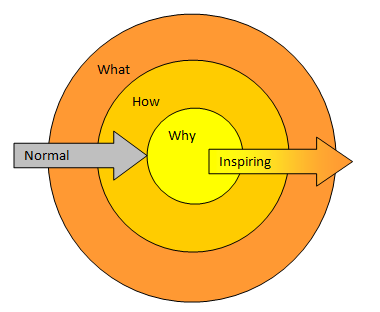
Below is my own representation of Sinek's "Golden Circle". The normal method of selling stakeholders and project teams on a project vision is to start with the what, figure out the how, and probably barely touch on the why. For many project team members, the best answer they have to "why?" is "because it's my job."
On the other hand, the inspiring arrow shows a project leader who sells their stakeholders and teams on the core "why?" question first, by answering it in a compelling way. From then on, the details of what, how, when, etc. get worked out in light of the primary answer to "why?" - The Goal.
Please check out his TED talk below. I think you'll enjoy it.
People don't buy what you do. They buy why you do it. ~Sinek
Wai Mun KooPMO Director| Intergraph PP&MSingapore, Singapore
Couldn't agree more. As a matter of fact, those that started off with 'What' probably don't even know 'Why' in the first place.
Josh NankivelEngineering Project Manager| AppleSioux Falls, Sd, United States
Absolutely! Or at least, the perceived or assumed 'Why' doesn't match reality. And in projects, that means you end up producing something that doesn't really solve the core problem.
"Those who starts with why that have the ability to inspire those around them or find others who inspires them" - great way to end such facilitation as to why its much more beneficial to start with the Why, then the How and lastly the What. Many tnx!
Wai Mun KooPMO Director| Intergraph PP&MSingapore, Singapore
Josh, you are right that sometimes, the 'Why' is lost along the way and things starts to deviate wildly. It is important for us to constantly check back to see if the original purpose is still intact and if we are delivering it in an efficient and ethical way.
Leam HallPM Apprentice| Smartronix/DoDPulaski, Va, United States
Josh, very good! I don't see the TED talk though...
Leam
cristian rosuGlobal Business Manager| MAHLE GmbHRegensburg, Germany
Not starting with Why seems to be one of the most frequent reason for project failure. If you go to nowhere then any road takes you there. I have seen many organisational changes being wrongly started with what in Kotter’s 8 steps change model should be step number 5. Skipping the former steps ‘makes things much easier’ because nobody knows what the intention was. Visionary leadership is very powerful as attracts volunteers and volunteers are considered as having the bravest heart of all.
Elizabeth HarrinDirector| RebelsGuideToPM.comLondon, England, United Kingdom
Leam, you can get all the TED talks through iTunes or through smartphone apps, if that helps.
Josh NankivelEngineering Project Manager| AppleSioux Falls, Sd, United States
@cristian - It seems we do jump to the "What" very often...customers like to start with what they need...features, functionality...it's up to us to ask "Why" when it's not there. I like to say "Help me understand what you will use this for." - sometimes the context is everything, and you can figure out a way to meet their needs better with less effort and/or in a more effective manner.