


Categories: Carole Osterweil, Change Management, communications management, Leadership, stakeholder management, Teams
Welcome to the second in this series of blogs exploring what the project world can learn from neuroscience.
I set out my stall in the first blog - projects don’t behave the way textbooks say they should. Neither do people.
How often have you seen a team member becoming defensive or a client getting wound up and quite aggressive over something relatively minor? Or perhaps you’ve sat in a meeting when you suspect that several others, like you, are convinced that the discussion is adding no value, or even worse it’s downright unhelpful – yet nobody does anything about it.
Have you noticed how few people talk openly about finding project delivery, with its complexity and uncertainty, stressful and anxiety-provoking? Yet plenty do so in private!
Neuroscience tells us stress and anxiety impact our ability to think clearly
Neuroscience tells us that stress and anxiety impact our ability to think clearly, increasing the chance that we’ll misread the situation and behave in ways which raise the stakes and add complexity.
This blog sets out five Brain Basics and explains the SCARF model which will help you spot what’s going on beneath the surface in these highly charged moments.
Read on and you'll see why I recommend that everyone involved in project delivery acquires a basic understanding of how the human brain works and uses this knowledge to inform their actions.
5 BRAIN BASICS

Source: Visible Dynamics
Take a moment to reflect on charged moments you’ve been party to.
Use the five Brain Basics to consider what might have been going on beneath the surface. How does thinking in terms of ‘avoidance’ and ‘approach’ emotions and behaviours help you make sense of the situation?
Social threats cause avoidance behaviours, so we need to understand what they are and where they come from. That’s where SCARF comes in!
What is the SCARF Model?
There are five factors that the brain is always monitoring and they have a huge impact on how we behave.
David Rock developed the SCARF model to explain these factors[i] We are acutely sensitised to look out for them. SCARF stands for:
- Status – the perception of being considered better or worse than others
- Certainty – the predictability of future events
- Autonomy – the level of control we feel able to exert over our lives
- Relatedness – the sense of having shared goals and being part of the ‘in crowd’
- Fairness – the sense that we are being respected and treated fairly in comparison to others
When people sense a change in any one of the SCARF factors, it can activate an avoidance response - The bigger the change the stronger the response.
An example of SCARF in action

Source: Project Delivery, Uncertainty and Neuroscience - A Leader's Guide to Walking in Fog .[ii]
Responding to Social Threat
We see and respond to social threat in the most mundane situations. These threats do not have to be explicit, intentional or real. We only have to perceive that our status has been reduced or that we are being treated unfairly and we will respond with avoidance behaviours.
The converse is also true. When we believe we are being treated fairly and that we have a degree of control over the future it’s easier be highly productive. We want the feelings of excitement and trust that come with engagement.
USING SCARF TO HELP MANAGE CHANGE ON PROJECTS
Understanding how the brain works adds new perspectives to many good leadership practices. Take the adage ‘When dealing with change communicate, communicate, communicate!’
SCARF guides us to five areas that need to inform all our actions in organisational and project settings.
For example, by highlighting our desire for certainty, SCARF tells us that the prospect of change – whether a tweak to the IT system or wholesale digital transformation is likely to activate a threat response. We need to include this knowledge in our project planning, and make sure that we prioritise activities to reduce the degree of uncertainty and counter the threat response.
This means speaking to people about the vision for the future, and sharing plans for achieving objectives; it means explicitly discussing what you do know about the future and being willing to admit what you have yet to work out; and it means offering timescales or admitting ‘we can’t tell you now but we will tell you by …’
This table gives further examples for using SCARF in organisational and project settings.
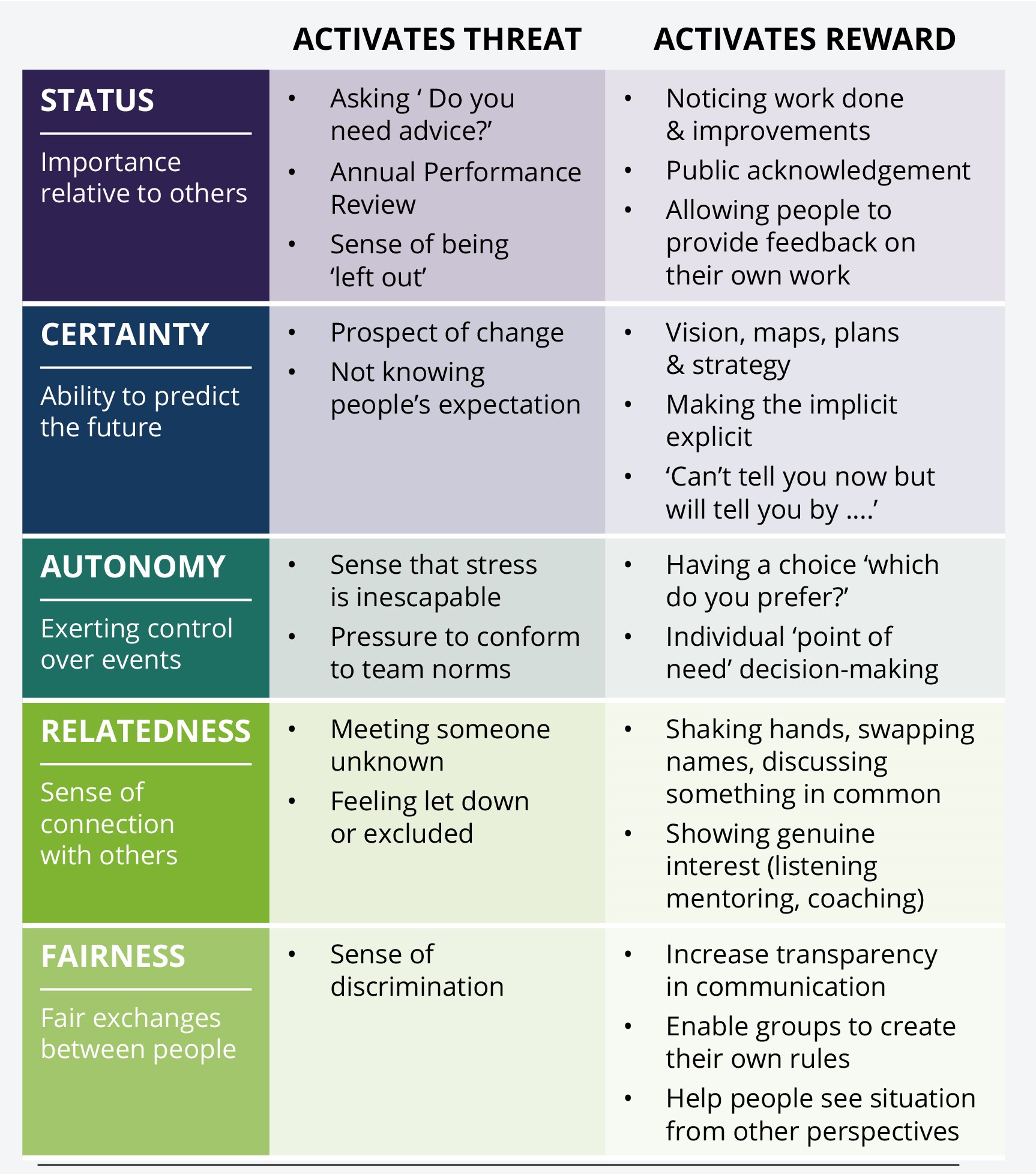
Using SCARF on Projects
Source: Project Delivery, Uncertainty and Neuroscience - A Leader's Guide to Walking in Fog
We’ve seen from Brain Basics and the discussion of SCARF and that every interaction with another person triggers a change in the intensity and quality of our emotions. Most of us are unaware of the ebbs and flows of our emotions. Yet it’s these changes, driven by our innate need to survive, that determine how we behave.
KEY TAKEAWAYS
On projects we rarely work in isolation. There are as many sources of social interaction and emotional triggers as people in the proverbial room (which includes those we connect with digitally via email, video and social media). This means we must:
- Remember SCARF.
- Learn to spot when avoidance emotions and behaviours are triggered (in you and others!)
- Develop the skills to contain them and to evoke an approach response instead
It will stop you adding to the volatility uncertainty, complexity and ambiguity of VUCA environments. It will bring down stress levels, reduce distractions and allow you to focus on what really matters - achieving your project goals.
BLOGS IN THIS SERIES
- What Can the Project World Learn from Neuroscience?
- PM Point of View Episode 69: Neuroscience in Project Management Carole Osterweil in conversation with Kendall Lott ( starts 40 mins in)
- Change Requests and the Project Stress Cycle
- Corona Reducing Personal Uncertainty
- Corona Reducing Team Uncertainty
[i] Rock, D (2009) Managing with the Brain in Mind Strategy +Business, Autumn 2009, Issue 56 Retrieved from: https://www.strategy-business.com/article/09306?gko=5df7f
[ii] Osterweil, C (2019) Project Delivery, Uncertainty and Neuroscience – a Leader’s Guide to Walking in Fog, London: Visible Dynamics


 Community Champion






