
Viewing Posts by Tony Saldanha
Is it Time to Re-brand and Re-charter the IT Function?


| Is it Time to Re-brand and Re-charter the IT Function? Very few functions have evolved as much in the past 3-4 decades as the IT function. It’s been in the vanguard of driving efficiency and transforming legacy operations, and has been rewarded in being moved out of the backrooms of the company and into the boardrooms. However, with great power comes great responsibilities. We need to ask if we in the IT function are doing enough to transform our own legacy behaviors. I would contend that not all organizations are. Which is why it might be time to re-brand and re-charter the IT function. I call this new re-branded organization the “digital resources function”. Why Re-charter the IT Function? With digital transformation becoming the #1 priority for most company boards, expectations from the IT functions have increased. At its heart is the change from “managing” technology to “leading” the digital transformation of the enterprise. The change isn’t just administrative though, there are technologies, platforms and people skills that will need to be redone. I have identified six vectors of change –
In contrast, the current technologies in most enterprises were originally built for enterprise efficiency and scale. They are large, complex, took a long time to implement, and take even longer to modify. Think large enterprise resource planning (e.g. SAP) implementations. These monolithic systems worked extremely well in the past because the goal at the time was scale. The new digital revolution has changed that goal.
Why Re-brand the IT Function?
[i] Scorsone, G. (2018). 5 hot and high-paying tech skills for 2018. [online] CIO. Available at: https://www.cio.com/article/3269251/it-skills-training/5-hot-and-high-paying-tech-skills-for-2018.html [Accessed 19 Dec. 2018]. [ii] Caminiti, S. (2018). 4 gig economy trends that are radically transforming the US job market. [online] CNBC. Available at: https://www.cnbc.com/2018/10/29/4-gig-economy-trends-that-are-radically-transforming-the-us-job-market.html [Accessed 19 Dec. 2018]. |
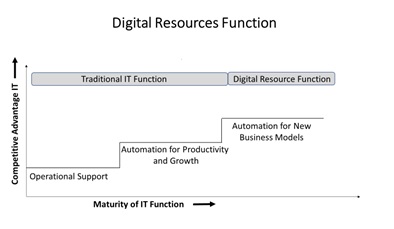 As we’ve learned from the experience with constantly upgrading our smartphones, technology gets old fast. That’s true of IT functions in the enterprise as well. IT technologies, IT scope of operations and IT skills all have incredibly short life cycles. That’s been historically true and is not a surprise. What’s new is that the piston-engine version of IT has reached an inflection point. It needs a consciously different engine. We’re no longer talking evolution; we’re talking about a dramatically different redesign. The new IT function is not just about new technology platforms, a new charter of work, or newer skills; it is about leading all the other functions and business units in the company to new technology-enabled business models. The digital enterprise needs digital to be done by every function, but powered by IT. Which is why I believe that the new IT function needs a totally new charter and a new name – The Digital Resources Function.
Next Level Transformation Management: How to avoid hitting the target but missing the point
|
Next Level Transformation Management: How to avoid hitting the target but missing the point If there’s one execution-related principle that has been drilled into us by management theory, it’s that ‘you get what you measure’. We’re exhorted to just get going when it comes to metrics – i.e. ‘Measurement is like laundry. It piles up the longer you wait to do it’. That’s all fine, but every seasoned project manager knows that there are limits to which business sponsors can fully and precisely envision what success looks like ahead of time. Don’t get me wrong, they may have a general idea of which direction success lies. But often, it’s difficult to see what’s possible unless you iterate. Which is why Steve Jobs said, ' People don't know what they want until you show it to them. That's why I never rely on market research’. The issue of unclear end-state articulation becomes more difficult as you move up from managing projects to managing portfolios to managing digital transformations. When it comes to imagining an end-state of large-scale digital transformation of an enterprises business model itself, you then get into the realm of fuzzy meanings per United States Justice Potter Stewart who famously said of the definition of obscenity that ‘I could never succeed in intelligibly [defining it], but I know it when I see it’.
The “north pole” of metrics in digital transformation That leaves most transformation leaders thinking ‘Great! If managing a complex digital transformation portfolio wasn’t hard enough, I now need to work with the handicap of the goal posts being moved as we execute…’. Well, it’s not that bad. There is clearly confusion on what the term ‘digital transformation’ implies, but there are some “north pole” business outcomes that will never change. Navigating by those “north pole” metrics are likely to keep the program safe on track. For enterprises, the eventual “Wall Street” grade business metrics of sustained “Total Shareholder Return”, which puts together all financial metrics of cost, revenue, cash, controls, and sustained performance factors like brand equity and organizational strength are usually a great guiding star. Once we factor that in, the question becomes how to define usable and relevant metrics that can be cascaded down the organization. And, often this is where the issue lies.
The dilemma of measuring success in digital transformation The root of the ambiguity in definitions is driven by the confusion on what digital transformation is. Most executives tend to relate it to technology i.e. using technology for more effective or efficient operations. That’s only the first stage of digital transformation. True digital transformation is the rewiring of entire business models, work processes and people skills, so that enterprises which are successful in the third industrial revolution are made ready to be successful in the fourth. Or said another way, it is to rewire people, processes and business models to understand the needs of the customer and meet it exponentially better, as in say, the successful transition from printed classified ads to Craigslist. To better appreciate how digital transformation leaders can seize this historic opportunity, we need to understand the context of the fourth industrial revolution, the stages of digital transformation, and how a full-fledged digital transformation is all about meeting customer needs exponentially better.
The context of industrial revolutions is foundational. The World Economic Forum has declared that we’re in the midst of the Fourth Industrial Revolution where digital technology is transforming and fusing together the physical, biological, chemical, and information worlds. It’s affecting every area valued by society—from convenience (e.g., online shopping) and improved health (e.g., biotech) to personal security (e.g., digital homes), food security (e.g., agrotech), and so on. Only one thing is guaranteed: it will bring about dramatic change, just as the previous three industrial revolutions did. The first three were caused by different technologies i.e. steam, electricity and the internet respectively, whereas the fourth is caused by digital. However, all four have one thing in common. Individuals and societies will be affected significantly, and companies will either transform or die. And the process of transforming from being a viable entity in the third to the fourth industrial revolution is digital transformation.
The stages of digital transformation
Stage 1 is the Foundation. This is where enterprises are actively automating internal processes, such as marketing, selling, manufacturing, or finance. This is more automation (also called digitalization) than transformation, but it provides the digitalized foundation necessary for future transformation. The next stage is called Siloed, where you might see individual functions or businesses start to use disruptive technologies to create new business models. So, for instance, this is what using digital channels for selling is. Additionally, this is what the transition to using digital media, and more precise targeting of customers using data is. Stage 3 is Partially Synchronized transformation. The enterprise leader, owner, or CEO has recognized the disruptive power of digital technologies and defined a digital future state. At Stage 3, the organization has started rowing in the same direction. Stage 4, or Fully Synchronized, marks the point where an enterprise-wide digital platform or new business model has fully taken root. However, it is a one-time transformation. It is still just one technology (or business model) change away from being disrupted. Stage 5, or Living DNA, is the step where the transformation becomes perpetual. You maintain ongoing industry trend leadership because you are disciplined in constantly innovating and setting industry trends. You’re not just a market leader; you’re a disciplined innovator.
The context of the five-stage model helps define the gap between the eventual “north pole” success of sustainable digital transformation and what incremental stages of transformation is being targeted by your current program. Articulate that correctly, and you mitigate the risk of hitting the target but missing the point.
|
 What is digital transformation?
 Although full-fledged digital transformation is about fully rewiring the business models, processes and organization capability, there’s no getting away from the fact that still mass confusion on the definition. Most executives mix it up with the run-of-the-mill digital technology project. The best way to frame the definition is to put it in the context of the five-stage digital transformation model.
The future is digital, but not in the way we think
|
The future is digital, but not in the way we think The question I get asked most often in conferences around capability building is, “What skills should I focus on, to be successful in a digital future”. I’ve always suspected that’s a loaded question. After all, if you ask a Global IT executive that question, you’re not expecting a response of “circus trapeze artist”, but most likely some variation of “computer science”. However, as an aside, are you really sure you want to ask any type of expert a question about the future? You see, when experts are wrong, they can be horribly off the mark. When experts go horribly wrong Consider these opinions from very reputable people about the future. “Television won’t be able to hold on to any market it captures after the first six months. People will soon get tired of staring at a plywood box every night.” — Darryl Zanuck, executive at 20th Century Fox, 1946 “The horse is here to stay but the automobile is only a novelty – a fad.” — President of the Michigan Savings Bank advising Henry Ford’s lawyer, Horace Rackham, not to invest in the Ford Motor Company, 1903 “The Americans have need of the telephone, but we do not. We have plenty of messenger boys.” — Sir William Preece, Chief Engineer, British Post Office, 1876 "I think there is a world market for maybe five computers." Thomas Watson, president of IBM, 1943 "There is no reason anyone would want a computer in their home." Ken Olsen, founder of Digital Equipment Corporation, 1977 Oops! You might charitably call these “a swing and a miss”. More bluntly, you might wonder what these guys were smoking when they said this. After all, these were all experts in their field. So, should we be asking any type of expert about the future? The future is digital. Seriously, everyone knows that the future is digital. But, what the best visionaries and change leaders know is that this statement cannot be taken literally. The risk with being literal is that you go down rabbit holes of technology in an attempt to find digital versions of products (digital ice cream?), services (digital dry cleaning?) or work processes (digital financial analysis?). To be fair, some of these are important ingredients for the digital world and they are future-oriented. However, they are all means to a digital end. What most successful change leaders do, is to understand the context of the world around them, and then deliberately go about creating the future by marrying their own capabilities with future trends. Where’s the future headed? So, what key context should we examine regarding the digital future? Here’s a few examples I’d like to share to make a point about a digital future. This is what technology will bring to future life as we know it. - Driverless cars, which were just a dream a few years ago, have gotten to the stage where children being born today may never need to apply for a driver’s license. - Between 40-50% of jobs in the manufacturing, transportation and retail sectors could be done by hardware or software robots in the next 15 years. - Even robots in manufacturing will be disrupted in the next 10 years, as 3D printing takes over. If you can print your PC or smartphone at home, you eliminate robots in the factory. - Certain news agencies already generate 90% of their short, pro-forma real-time news updates on sports and financial markets using software robots. Artificial Intelligence (AI), with some human journalist help will generate 90% of all news in 15 years. - Voice recognition is already 3 times faster and more accurate than typing. In the future, Natural Language Processing bots will understand and execute most of the day-to-day tasks at home and at work. - Deep Learning can already read your lips with more than 90% accuracy, while the average lip reader usually delivers 50% accuracy. - In 20 to 30 years, the cost of producing energy at home will be a fraction of the cost of buying it off the grid. - More importantly, it’s the consequences of cheap electricity that are more exciting. Cheap electricity means cheap drinking water, as energy allows you to process all kinds of water including sea water. - In the next 5 years, there will be apps that can tell by your facial expression if you’re lying. Imagine what that could do to the judicial system!
Wait! Don’t all these examples simply illustrate the criticality of building technical capabilities? No. Not necessarily. Let me share one final statistic to explain why. - Over the next decade, modern manufacturing in the US will create 3.5 million new jobs. But, up to 2 million high-tech manufacturing jobs may go unfilled for lack of higher-skilled factory workers. You read that right. In this case the gap will not be in IT programmer availability but in factory workers who know just enough digital technology to operate high-tech machines. Follow your passion, but in a high-tech way The future world will need lawyers, and bankers, and CEOs, and businesspeople, and teachers, and nurses, and sanitation workers, and cooks, and accountants, and priests, and factory and farm workers, and yes, politicians. Recent studies on the workforce of the future have demonstrated that beyond a technical digital skills shortage, the bigger skills gap will be related to right brained work. The future of the ice cream business isn’t necessarily a dystopian one where bits and bytes replace a snow cone, but in reimagining how we might better meet the need of ice cream consumers using digital technology. Design thinking, imagination, visual and intuitive product and service design, change management, bringing your organization along – these are all on the critical path to a digital future. Obviously, this doesn’t take away from the need for a minimum level of digital literacy. We will all need a certain minimum amount of high-tech WITHIN OUR RESPECTIVE FIELD. That technical knowledge doesn’t have to be a one-size-fits-all skill like AI programming. It must be relevant to your field. So, if your field of passion is say, teaching, then keep building capabilities in that area. But ensure that you study enough digital teaching skills so that you can be the most relevant leader within the teaching field.
|


Leadership Lessons on Project Management: What Project Sponsors Can Learn from Swiss Cheese
| Leadership Lessons on Project Management: What Project Sponsors Can Learn from Swiss Cheese
Professional techniques for project management have made a huge impact on the success rates of projects in the past three decades, but there’s no denying that we still have a long road ahead of us. Statistical information from G2.com gives us a peek into this challenge. Most organizations have a 70 percent project failure rate, only 28 percent of companies use project performance techniques, on average one in six projects has a budget over-run greater than 200 percent, and only 2.5 percent of companies complete 100 percent of their projects successfully. That’s probably not a surprise to you, since I’m preaching to the choir here. The question is what else we can do to improve project management reliability. I believe we can learn much more from a technique called the Swiss Cheese Model of Accident Causation which has been used to dramatic effect in several industries including aviation, to improve reliability.
Accident Prevention and Swiss Cheese The improvement in aviation reliability from the early days of World War 1 where pilots flew “on a wing and a prayer”, to 99.999999% reliability today has been an inspiration to several industries, including medical safety and computer security. Flight safety in the early days of aviation was not a given. The airplanes which were made of fabric, glue and wood for the most part made flying more a game of skill than process. Takeoff and landing crashes were common. The intervening decades have seen an improvement in both design and methodology. The Swiss Cheese Model was one of the risk minimization techniques employed.
James Reason, who created the Swiss Cheese Model (SCM), believed that accidents can happen for four reasons i.e. organizational influences, unsafe supervision, preconditions for unsafe acts, and the unsafe acts themselves.
Organization-centric vs. Individual-centric Causes of Project Failure Let’s try and get this back to project management. There’s something intriguing about the number 70, which indicates the percentage of failures in project management. That number shows up in other industries too. In an interesting analysis by the Colorado Firecamp, called the Human Factors Analysis and Classification System, it is pointed out about 70 percent of aviation accidents can be partly attributed to human error (Shappell & Wiegmann, 1996). However, we know the attribution of a large percentage of failure to pilots alone is misleading. Their analysis rightly argues that to off-handedly attribute accidents solely to aircrew error is like telling patients they are simply “sick” without examining the underlying causes or further defining the illness. In other words, we need to look at not just the final visible cause (individual-centric), but also to the previous layers of issues (organizational-centric). It’s well known that aviation accidents are the end result of a number of causes, only the last of which are the unsafe acts of the aircrew (Reason, 1990; Shappell & Wiegmann, 1997a; Heinrich, Peterson, & Roos, 1980; Bird, 1974). That’s true in project management failures as well. Attributing most of the failures to the project manager and the project team ignores the three other preceding layers in the swiss cheese model i.e. organizational influences, unsafe supervision, and the preconditions for unsafe acts. That’s where project sponsors need to play an important role.
The Sponsor’s Role in Addressing Organizational Influences, Unsafe Supervision, and Preconditions for Unsafe Acts Unsafe acts in Project Management are generally based on the foundation laid by Organizational Influences, Unsafe Supervision, and Preconditions for Unsafe Acts. So, for example, choosing a weak software solution in a given project is an unsafe act. However, when we step back a layer it’s possible that the poor choice was based on lax procedures in either technology standards, or in matching-and-mapping process design to software solutions (precondition for the unsafe act). Step back another layer and we may find that the project board did not ask the right questions while overseeing the project (unsafe supervision). Go back yet another layer, and we might find that the siloes between the IT architecture group, the software procurement function and the project management group sub-optimized the software choice while trying to optimize individual department results (organizational influences). Who needs to help the project team across these layers? I believe project sponsors play a key role here. To be clear, it is impossible for any given project sponsor to systemically fix all issues across all four layers. A good sponsor, however, is educated enough in these practices to work alongside the project team and guide them in avoiding these traps when they cannot be systemically addressed. In closing As Vice-President at Procter & Gamble’s famed Global Business Services and IT, I considered the ideal project sponsor to be a person who had four qualities. They had to own the organization that needed the project, they needed to have enough time to devote to the team, they had to have enough knowledge of the project’s subject matter to add value, and they had to be effective in breaking organizational barriers for the project team. This worked extremely well for us. Unsurprisingly, these are also the qualities that help project sponsors address all four layers of the Swiss Cheese model.
|
 The Swiss Cheese model of accident causation states that human systems are similar to slices of swiss cheese that are placed vertically in front of each other. The holes in the cheese represent defects or weaknesses in each system and tend to be of different sizes and positions. If a line can pass through the stack of cheese holes then that represents failure of the system as a whole, leading to an accident. The goal in designing the system is to reduce the probability of an accident by improvements on both “holes” and “number of slices”.
How to Tailor Your Project Management Approach For Successful Digital Transformation
| Digital Transformation is a 1.7 trillion dollar industry as of 2019, which has obvious demand implications for project managers. At the same time an estimated 70% of all digital transformations fail based on a Mckinsey report on retail. What can project managers do to stand out from the crowd on successful digital transformation? Based on my own experience of having led multi-billion dollar organization transformations over a three decade career at Procter & Gamble, combined with industry research, project managers need to tailor project management approaches to complement mainstream methodologies with “transformation” related disciplines when managing true digital transformation efforts.
What’s Missing in Current Digital Transformation Approaches? To understand why current project management approaches need to be complemented, we need to dig into why 70% of all digital transformations fail. The answer comes down to two issues – a lack of clarity on the definition of digital transformation and the use of incomplete methodologies to execute it.
Figure 1: Five-Stage Digital Transformation Model
How to tailor your approach for leading digital transformation programs In 2015 Procter & Gamble’s Global Business Services (GBS) unit set out to digitally disrupt itself. The 5,000-strong GBS organization provided more than 160 business services worth multi-billion dollars of operations including IT, finance, facilities, purchasing, employee services, and more. Despite GBS’s already best-in-class capabilities, we wanted to transform it into what we called Next Gen Services (NGS), capable of delivering long-term operational superiority. To avoid the trap of the 70% failure rate of digital transformations, we started by examining what had driven successful transformation in the past.
To increase change demand, we brought in leaders from disruptive companies to talk to our operational leaders about looming digital disruption. In addition, operational leaders made consideration of disruptive innovation goals part of routine annual strategy reviews.
But such attitudes to middle managers unfairly penalize them for doing what their reward systems dictate—running stable operations and being wary of destabilizing effects. So we identified the middle management leaders affected by each project, involved them in the initial “fun” of designing the disruption, and jointly designed the risky roll-out of disruptive projects that could destabilize ongoing operations.
If sufficient time, internal capability, and a relatively straightforward path forward are available, then transformation can usually be handled via organic change. After the 2008 economic crisis for instance, Fidelity Investments increased its investments in digital capabilities while competitors were slashing budgets, giving the company room to move forward with a deliberate organic transformation. That consistent focus on digital transformation strategy has pushed them ahead of competition in areas like blockchain, artificial intelligence, and crypto currency. If existing capabilities, time, and internal resistance to change are all a challenge, then your best bet may be inorganic change—look for an acquisition or partnership with an external entity, as Walmart did in acquiring Jet.com. Inorganic change comes with its own risk, since a majority of acquisition-related changes fail. However, by giving the acquired entity a strong mandate and change-management support, this approach can jump-start new capabilities quickly. If there is little time and the prevailing organization culture is partly resistant to change, then organic change won’t work. In such cases, edge organizations, given full freedom to operate differently from the rest of the business, are the preferred approach. At GBS, we felt that time was at a premium. We knew that our real standard of comparison wasn’t just other large companies any more, but digitally native startups with far more cost-efficient and agile internal business operations. Resting on our laurels—our superiority to peer companies—would be risky. So to drive disruptive change faster than an organic approach could, we set up NGS as an edge organization. To facilitate agility, NGS would be allowed “amnesty” on purchasing standards, IT architectures, and even some HR practices in the early stages of idea development. As a successful project manager of complex digital transformations, your methodology needs to complement best in class thinking on project and portfolio management with the latest approaches on scaled organization change leadership. Most executions of digital transformations fail due to organizational reasons, not work-process or technology design. That issue becomes much more material when leading transformations to overcome existential threats caused by digital disruption. |




