


Who are the stakeholders in your research project and why is it important to engage with them? How can you keep your project team and people outside interested in your project? How important is communication with your key stakeholders and how can you make sure your communication is effective?
Stakeholder management is key to scientific research. Every project has stakeholders who can influence the project in a positive or negative way. The ability to manage stakeholders in an appropriate manner can mean the difference between success and failure. Stakeholder engagement is important to increase support and minimise resistance from key stakeholders.
Identify your stakeholders
Stakeholders are people, groups or organisations that could affect, be affected or perceive to be affected by any decision, activity or outcome of the project.
It is important that all stakeholders are identified regardless of how major or minor they are. This is because they will be categorized after they are identified. If stakeholders are omitted there is a likelihood that they may become evident at some point during the project’s lifecycle and introduce delays or other obstacles to the project’s success.
Stakeholder analysis is the process by which you identify your project’s stakeholders:
- Will the person or their organization be directly or indirectly affected by this project?
- Does the person or their organization hold a position from which they can influence the project?
- Does the person have an impact on the project’s resources (material, personnel, funding)?
- Does the person or their organization have any special skills or capabilities the project will require?
- Does the person potentially benefit from the project or are they in a position to resist this change?
Any individual who meets one or more of the above criteria can be identified as a stakeholder. Stakeholders from the same organization can be grouped in order to simplify stakeholder management.
Once you have identified your stakeholders you can analyse the list (your Stakeholder Register) and categorized or grouped them assigning a level of impact they may have based on their power, influence, and involvement in the project. You should also add any description which might be helpful to plan your stakeholder engagement. How could the project stakeholders identified in the previous section be impacted by the project? Do any of the stakeholders link/relate with each other? You can also visualise your project’s stakeholders on a power/interest grid and prioritise them based on the grid.
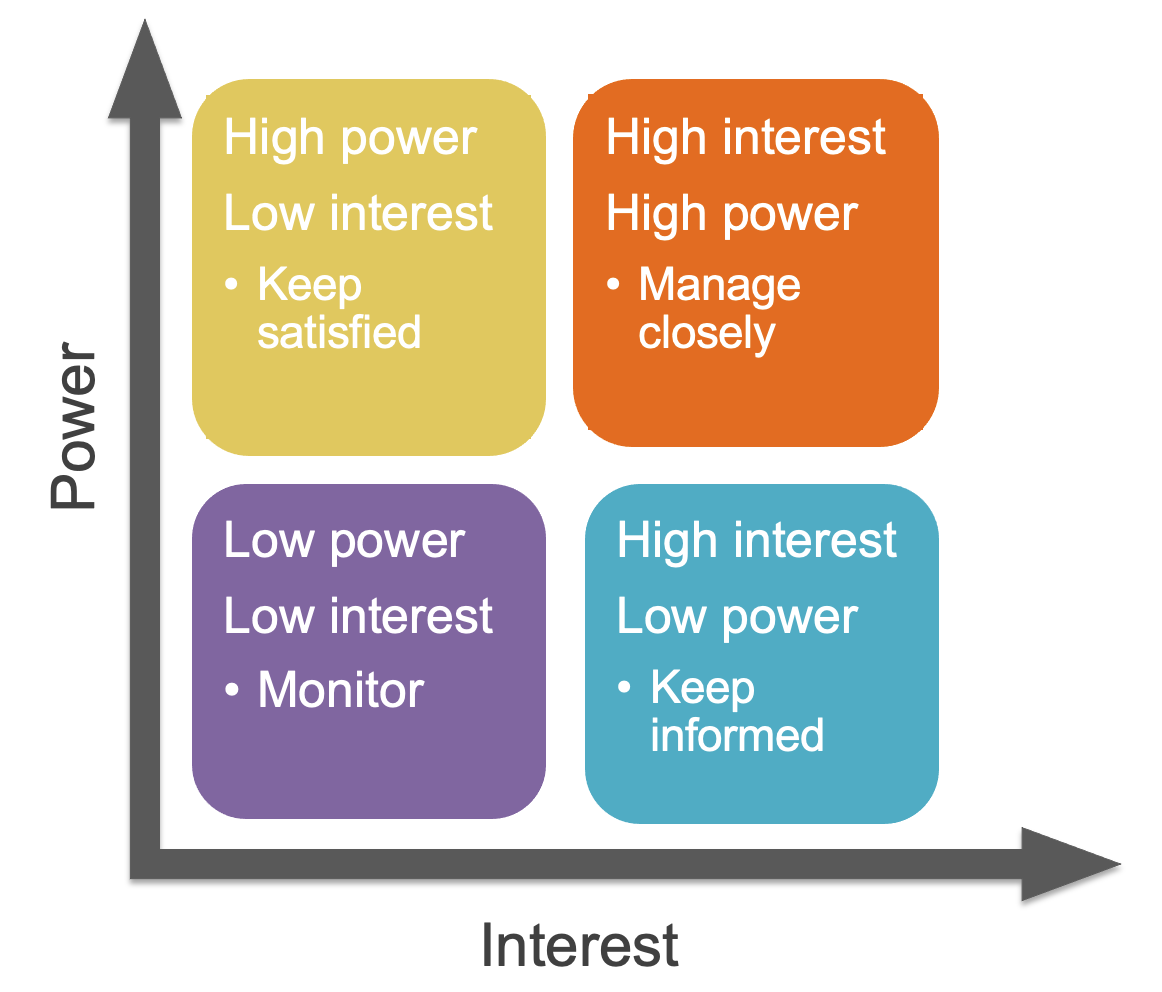
A stakeholder analysis is very beneficial because:
- It helps understand who are your stakeholders and their role in the project
- It allows identifying the focus of each stakeholder or group
- It helps develop stakeholder an engagement strategy
Plan your stakeholder engagement
Once you have identified and analysed your stakeholders in the stakeholder register, you can develop a Stakeholder Engagement Plan. In the plan you should describe how stakeholders will be approached and by whom in the project team, as well as how often the project team will communicate with them.
First you need to carry out a stakeholder engagement assessment: what is the current level of engagement of each stakeholder? What is the desired engagement level? You will prioritise your stakeholder engagement based on the power/interest grid and your stakeholders’ engagement levels:
- Unaware: Unaware of the project and potential impacts
- Resistant: Aware of the project and potential impacts and resistant to change
- Neutral: Aware of the project yet neither supportive nor resistant
- Supportive: Aware of the project and potential impacts and supportive to change
- Leading: Aware of the project and potential impact and actively engaged in ensuring the project is a success
Once you have prioritised your stakeholders you need to decide how to engage with them, that is, how you will communicate with them throughout the project. What information about the project will be communicated to which stakeholders? How will the communication be delivered and when? Who will be in charge of the communication? How often will feedback be requested from the stakeholders? How will the feedback be implemented in the project?
Receiving feedback from your stakeholder is crucial in research projects because engaging with your stakeholders by listening to their feedback and incorporating their needs in your research means co-production of knowledge, important to achieve results.
Communication is key to stakeholder management
Communication is crucial for stakeholder engagement because it is the most powerful tool:
- To ensure that stakeholders clearly understand project goals, objectives, benefits and risks
- To build trust
- To resolve conflicts
- To overcome resistance
- To achieve the desired level of engagement
You should communicate and work with your stakeholders often throughout the project to meet their expectations and needs, address issues as they occur and foster appropriate engagement strategies. The timing of your communication with your stakeholders is also important. Engagement at appropriate stages helps to obtain or confirm their commitment to the success of the project.
Keep an agile mindset
Research projects are a way to explore the unknown and in most cases, you do not know what to expect as a result. Keeping an agile mindset helps address changes that might occur along the way and overcome challenges. This is important also when engaging with your stakeholders so here are some points to keep in mind to embrace change:
- Revise stakeholder engagement strategy often as requirements might change throughout the project
- Keep stakeholder register up to date as new stakeholders might appear and key stakeholders might change
- Deliver often project increments (knowledge/research outputs) as a way to engage with your stakeholders and request feedback
- Favour collaborations to find solutions to research problems
References
- Agile Practice Guide (2017).
- PMBOK® Guide – Sixth Edition (2017).
- Project Management Docs: https://www.projectmanagementdocs.com/


 Community Champion




